
How Electric Submetering Works, Step by Step
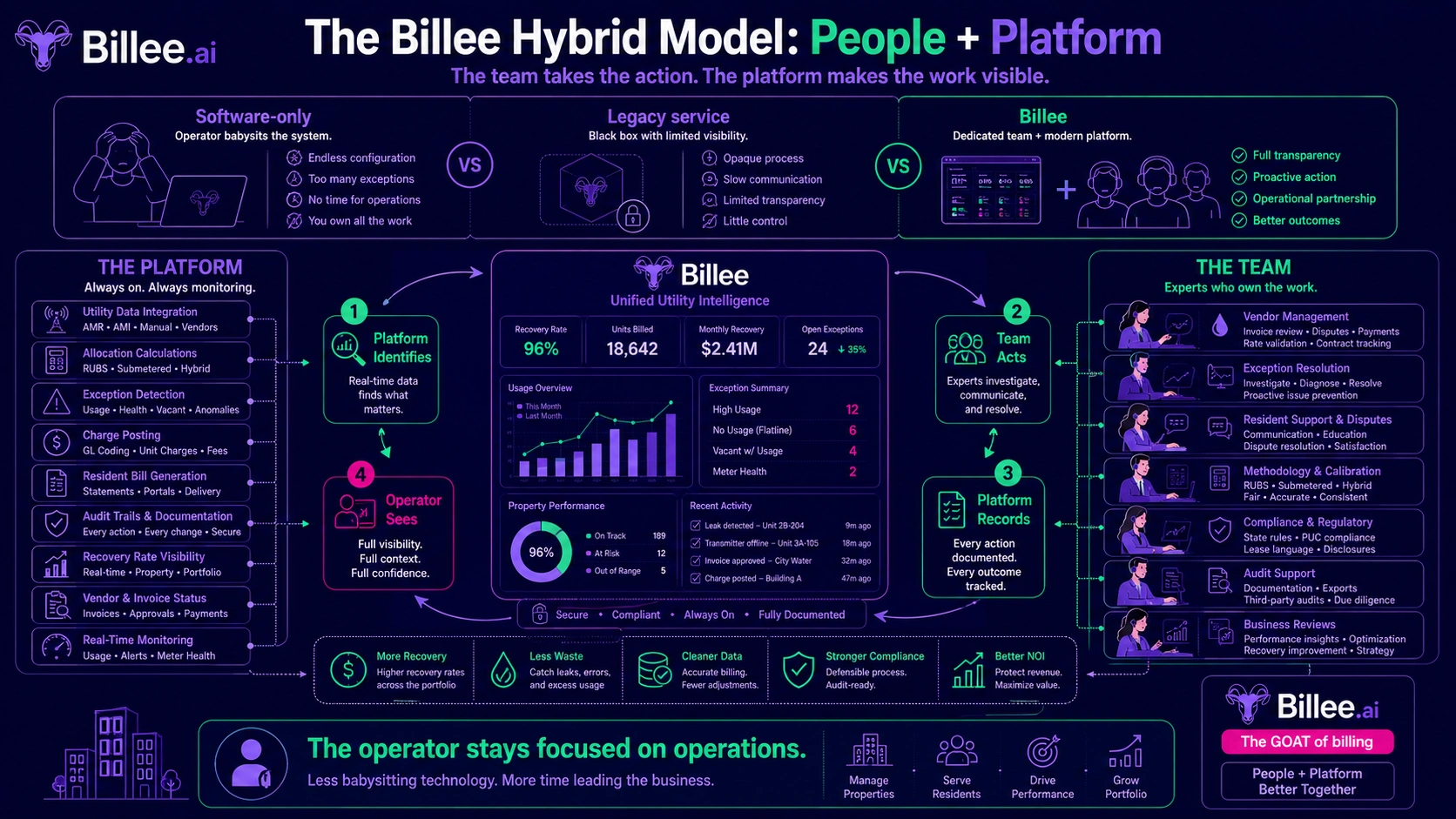
Electric submetering installs a current transformer (CT) meter at each unit's breaker panel so residents are billed for what they actually use instead of splitting one master electric bill. The process runs through six steps: confirming the property qualifies, an electrical feasibility assessment, permitting and licensed-electrician installation, commissioning and calibration, integrating the data into a billing platform, and activating billing with resident disclosure. Most rollouts move from decision to first submeter-based bill in one to three months. Billee coordinates the hardware and billing side of that process for operators who want a dedicated team running it.
Quick answer
Electric submetering only applies to properties with a master electric meter, where the utility currently bills the owner for the whole building. A CT meter clamps around the wiring at each unit's breaker and, combined with a voltage reading, calculates the kilowatt-hours that unit consumes, built to the ±0.5% accuracy class specified in ANSI C12.1, the standard covering revenue-grade electric meters.
Getting from "we should do this" to a resident's first submeter-based bill involves an electrician, a permit office, a commissioning period, and a billing platform that can ingest the new data, in that order. Skipping or rushing any one of those steps is where most electric submetering rollouts run into trouble.
Key takeaways
- Electric submetering only applies when a property has a master electric meter; if residents already have individual utility accounts, there is nothing to submeter.
- CT meters clamp around existing wiring at each unit's breaker panel and are built to the ±0.5% accuracy class in ANSI C12.1, the standard for revenue-grade electric meters.
- Retrofit installation typically runs $250 to $500 per unit, and most installations do not require cutting power to the unit.
- Most jurisdictions require a licensed electrician and an electrical permit before installation can start, and permitting is usually what determines how long the whole rollout takes.
- Commissioning, checking submeter reads against the master meter before billing starts, is the step most likely to get skipped, and skipping it is what causes billing disputes later.
- Billee's Hardware & Maintenance Support coordinates installation and calibration, and its account team handles billing activation once meters are live.
Why this matters for multifamily operators
A property on a master electric meter absorbs 100% of the building's electricity cost with no mechanism to bill residents for what they individually use. Every kilowatt-hour a resident runs, from a space heater left on all winter to appliances nobody unplugs between leases, comes straight out of the operating budget instead of the resident's account.
The financial case for submetering generally is well documented: a Guidehouse study of 1,500 submetered units found a 40% reduction in electricity consumption in the first year, once residents could see and were billed for their own usage. Billee's own portfolio benchmark for submetered properties is 80 to 95% effective recovery of billable utility costs (Billee's standard portfolio benchmark), though the actual number for any property depends on occupancy, rate structure, and how quickly billing goes live after meters are commissioned.
Electric submetering is also increasingly a compliance question, not just a financial one. A growing number of states require specific disclosure and billing-methodology documentation before an operator can bill residents on submetered electric usage, covered in full in Utility Management Compliance for Multifamily Properties.
How electric submetering works, step by step
Step 1: Confirm the property actually needs electric submetering
Electric submetering only makes sense on a property with a master electric meter, where the operator currently splits one bulk bill across residents through a ratio formula or a flat fee. If residents already have individual utility accounts with the electric company, there is nothing to submeter, since the utility already bills each apartment directly. Confirming which situation applies is a short call to the utility, and it is worth making before any budgeting conversation starts.
Master-metered electric buildings are most common in older properties, high-rises built before individual panel wiring was standard, and properties where the operator has historically paid one bulk bill. For the fuller technology comparison across water, electric, and gas submetering, see Best Submetering Systems for Apartment Buildings in 2026.
Step 2: Assess electrical feasibility
Properties with a dedicated breaker panel per unit are the simplest case: a CT meter installs directly at each unit's panel with minimal engineering work. Properties built around shared distribution panels, common in older mid-rise and high-rise buildings, need more work, since an electrician has to assess how circuits are grouped before pricing out the installation.
A proper feasibility assessment also checks panel capacity and condition, whether wiring is easily accessible or buried behind finished walls, and whether any code-driven upgrades, like an outdated panel that needs replacing, stand between the property and installation. Skipping this step is the most common reason an electric submetering project runs over its original budget.
Step 3: Get permitted and installed
Electric submeter installation involves working at or near a live electrical panel, so in most jurisdictions it requires a licensed electrician and an electrical permit before work can start. Permit review timelines vary widely by city and county, and this step is the one most likely to get underestimated in a project schedule.
On installation day, the CT meter clamps around the existing wiring at each unit's breaker, and combined with a voltage measurement, it calculates the kilowatt-hours that unit consumes. These meters are built to the ±0.5% accuracy class specified in ANSI C12.1, and installation for a single unit is quick, typically one visit that does not require cutting power. Retrofit installation typically runs $250 to $500 per unit, depending on building age, panel configuration, and how accessible the wiring is.
Step 4: Commission and calibrate before anyone gets billed
Commissioning is the step most likely to get skipped, and skipping it is what causes billing disputes months later. Before a submeter goes live for billing, its readings need to be checked against the master meter and, where possible, against a known load, to catch wiring errors early. A CT clamped backward or connected to the wrong circuit still reports a number; it is just the wrong number, and nothing about that error is visible from the reading itself.
The fix is a short commissioning period: track the new submeter readings in parallel with whatever billing method the property currently uses, for at least one full cycle, before the new charges take effect. If a submeter's readings do not track sensibly against the master meter or against comparable units, that is a wiring or configuration problem to fix before a resident ever sees a bill based on it.
Step 5: Get the data into a billing platform
Once meters are commissioned, their readings need a path from the hardware to a resident's bill. That path runs through either AMR (automated meter reading) or AMI (advanced metering infrastructure) technology, covered in full in AMI vs. AMR Meters: Which Is Right for Multifamily Properties. AMR requires a periodic drive-by or walk-by read; AMI reports usage automatically throughout the day, which gives a billing platform more data to work with.
Meter monitoring and proactive alerts also starts to matter once electric submeters are reporting data. The same continuous-monitoring pattern already used for water submeters on a property flags a spike, a drop, or a flatline before it becomes a resident dispute or a maintenance emergency, covered in full in What Is Meter Monitoring & Proactive Alerts?
Step 6: Activate billing and disclose to residents
Most states require some form of lease disclosure before a resident can be billed on submetered electric usage, and the specific requirements, notice periods, and permitted billing methods vary by state, as covered in the compliance article linked above. Once disclosure requirements are met, the first billing cycle runs on the new submeter data, with the commissioning-period comparison on hand as a reference if a resident disputes an early charge.
How long the whole rollout takes
Per Billee's Hardware & Maintenance Support and account teams, who coordinate electric submetering rollouts across multiple properties, the table below reflects a typical timeline. Actual timing depends most on local permitting speed and whether a property has individual or shared distribution panels.
| Step | What happens | Typical duration |
|---|---|---|
| Feasibility assessment | Confirm master meter status and panel configuration | About one to two weeks |
| Permitting | Electrical permit application and approval | Usually the longest step; varies by jurisdiction |
| Installation | CT meter installation per unit | A single visit per unit |
| Commissioning | Parallel-run readings against the master meter | One full billing cycle |
| Activation | Resident disclosure and first submeter-based bill | Next scheduled billing cycle |
Start to finish, most rollouts move from decision to first submeter-based bill in one to three months.
Common mistakes
- Pricing the project off a per-unit average that assumes individual panels. Shared distribution panels cost more to retrofit, and finding that out during installation instead of during feasibility assessment blows the budget.
- Treating the electrical permit as a formality. Permit review timelines vary by jurisdiction and are the single biggest source of schedule slip.
- Skipping commissioning to get to the first bill faster. An uncommissioned meter with a wiring error still produces a number, and residents dispute the bill built on it.
- Activating billing before confirming state and lease disclosure requirements. Billing on submetered usage without the required disclosure creates dispute and compliance exposure that is expensive to unwind after the fact.
- Choosing meter hardware on price alone. A meter that cannot feed data directly into a billing platform creates a manual-export workflow that erodes the savings the project was supposed to capture.
When to handle this in-house vs. bring in a partner
A single property with individual breaker panels and an in-house facilities team that already manages electrician relationships can often run this process directly, treating it like any other capital project: get a feasibility assessment, pull the permit, and coordinate installation.
The calculus changes across a multi-property portfolio, especially one with a mix of panel configurations, several jurisdictions with different permitting rules, and a billing platform that needs a consistent data feed regardless of which meter hardware is on site. At that point, the work shifts from a single capital project to an ongoing vendor management and data integration problem, which is the case where a dedicated partner earns its cost.
How Billee can help
Billee's Hardware & Maintenance Support handles procurement, installation coordination, and ongoing calibration and lifecycle management for a rollout like this, so the property team is not chasing electricians and permit offices alone across a portfolio. Once meters are live, meter monitoring and proactive alerts covers the data side, and Billee's dedicated account team handles billing activation and resident communication when questions come up.
FAQ
How much does electric submetering cost per unit?
Retrofit installation typically runs $250 to $500 per unit, depending on building age, panel configuration, and how accessible the wiring is.
Do I need a licensed electrician to install electric submeters?
In most jurisdictions, yes. Electric submeter installation involves working at or near a live panel, so it typically requires a licensed electrician and an electrical permit before work can start.
How long does an electric submetering rollout take?
Installation itself is quick, usually a single visit per unit. The full process, from feasibility assessment through commissioning and activation, usually takes one to three months across a portfolio, with permitting as the biggest variable.
Will installing electric submeters cut power to residents?
Most retrofit CT meter installations do not require a power interruption, since the meter clamps around existing wiring rather than requiring a rewire. An electrician can confirm this during the feasibility assessment for a specific property.
What's the difference between AMR and AMI for electric submeters?
AMR requires a periodic drive-by or walk-by read to collect data, while AMI reports usage automatically throughout the day. Both work with electric CT meters; AMI simply produces more frequent data for monitoring and dispute resolution.
Do I have to switch billing platforms to add electric submetering?
Not necessarily. The requirement is that meter data can feed into whatever billing platform the property already uses. If the current platform cannot ingest submeter data directly, that is a data integration gap worth solving before installation, not after.
Does Billee handle electric submetering billing?
Yes. Billee integrates submeter data into resident billing, monitors readings for anomalies through meter monitoring and proactive alerts, and its account team manages activation and resident communication.
Related reading
- How Submetering Works in Multifamily Properties: the broader economics and recovery-rate case across all utility types.
- What Is Multifamily Utility Management?: how electric submetering fits into the full utility management function.
If coordinating an electric submetering rollout across a portfolio is on your list, Billee's Hardware & Maintenance Support and account team coordinate that process from installation through billing activation. Talk to the team if you want to see how.
Sources
- National Electrical Manufacturers Association, "ANSI C12.1-2014: American National Standard for Electric Meters," accessed 2026.
- Synergy Utility Billing, "When Electric Submeter Systems Make Sense for Multifamily," accessed 2026.
- Guidehouse, "Electricity Submetering Study: 1,500-Unit Analysis," accessed 2026.
Insights and Industry Trends