
Submetering ROI for Multifamily: What to Expect Before You Invest
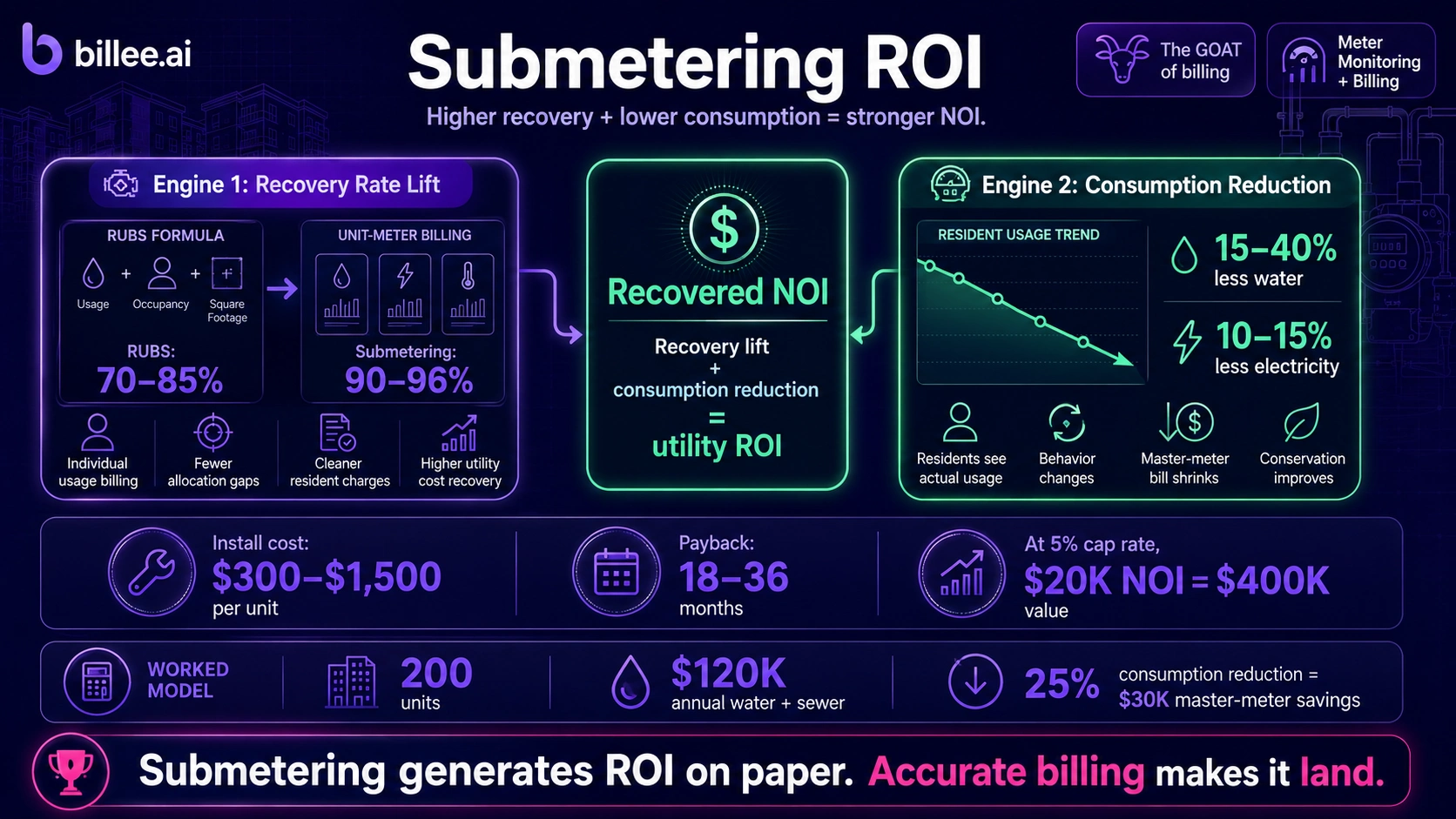
Submetering generates ROI through two separate mechanisms: a recovery rate lift, as individual metering typically pushes recovery to 90–96% versus the 70–85% typical of RUBS; and a consumption reduction, as residents billed for actual usage consume 15–40% less water and 10–15% less electricity on average. Hardware installation runs $300–$1,500 per unit depending on utility type and building age. Most portfolios reach payback in 18–36 months. Billee manages the billing and meter monitoring side for submetered portfolios, so the ROI you model actually lands.
Key Takeaways
Submetered properties typically achieve 90–96% utility cost recovery; RUBS-billed properties typically recover 70–85% (per HUD submetering research and industry benchmarks).
The EPA WaterSense program documents 15–40% water consumption reduction in multifamily properties that switch from master-metered to individual billing.
Installation costs typically run $300–$1,500 per unit for water submetering and $250–$500 per unit for electric submetering, depending on building configuration and whether the project is retrofit or new construction.
Most multifamily portfolios reach submetering payback in 18–36 months. Speed depends on current recovery rate gap, utility spend per unit, and resident behavior change.
On a 200-unit property with $120,000 per year in water and sewer costs, a 25% consumption reduction models to approximately $30,000 in annual master-meter savings before accounting for the recovery rate lift on the remaining bill.
Installing submeters converts utility expenses from owner-absorbed to resident-paid, which directly improves NOI and increases property valuation at exit.
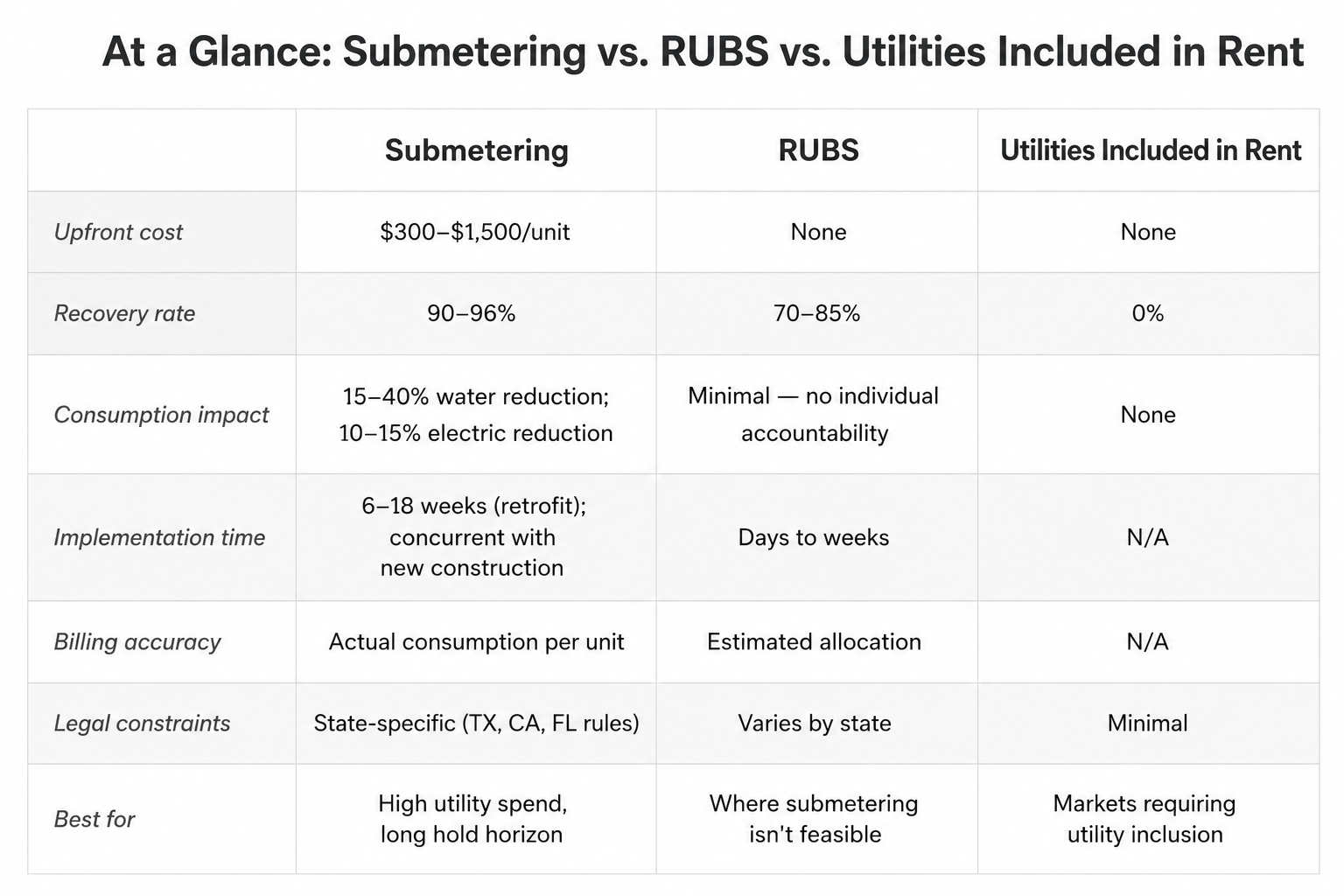
At a Glance: Submetering vs. RUBS vs. Utilities Included in Rent
How Submetering Generates Returns
Submetering ROI in multifamily runs on two engines simultaneously. The first is a recovery rate lift: individual billing closes the gap between what the property pays the utility company and what it recovers from residents. The second is a consumption reduction: residents billed for actual usage conserve meaningfully, which shrinks the master meter bill itself.
Recovery rate lift. Properties running RUBS typically recover 70–85% of recoverable utility costs. Submetered properties routinely settle at 90–96% once billing stabilizes. On a property with $150,000 per year in utility spend, closing that gap from 78% to 93% recovery adds approximately $22,500 per year in recovered costs.
Consumption reduction. Individual billing changes resident behavior in a documented, consistent way. The EPA WaterSense program documents 15–40% water consumption reduction in multifamily properties where residents are billed individually, with one EPA-cited study finding savings averaging approximately 21.8 gallons per day per unit after conversion. For electricity, a Guidehouse study of 1,500 individually billed units found an average decrease of 139 kWh per unit per month in the first year after conversion, representing a 40% reduction.
The two mechanisms compound. Less total utility spend means a lower base on which to apply the recovery rate. A property that reduces water consumption by 20% and then recovers 93% of the remaining bill captures gains on both sides of the equation.
Submetering improves multifamily utility ROI through two separate channels: a recovery rate lift and a consumption reduction. Each works independently of the other.
Submetering ROI by the Numbers
Installation costs per unit:
Water submetering (retrofit): $300–$1,500 per unit, depending on building configuration, plumbing complexity, and meter technology
Electric submetering (retrofit): $250–$500 per unit
Modern wireless system covering one utility type with transponders and professional installation: $400–$600 per unit on average
New construction: lower end of each range; installing meters during construction reduces labor significantly
Recovery rates
Submetered properties: 90–96%. RUBS-billed properties: 70–85%. The gap typically widens on older buildings with high resident turnover, where RUBS allocation errors accumulate over time.
Payback timeline
Most multifamily portfolios reach payback in 18–36 months. Properties with high per-unit utility spend and a wide current recovery gap typically reach payback toward the shorter end of that range.
Worked model
A 200-unit apartment community pays $120,000 per year in water and sewer. On RUBS at 78% recovery, it absorbs $26,400 per year. After submetering: residents conserve 20%, reducing the master meter bill to $96,000. Recovery settles at 92%, leaving the property absorbing approximately $7,700 per year. Net annual improvement: approximately $18,700. At $450 per unit install ($90,000 total), payback arrives in just under 5 years.
This is an illustrative model, not a performance guarantee. Results depend on property-specific variables including utility rate, building configuration, resident mix, and billing management quality.
NOI and valuation impact
At a 5% cap rate, $20,000 per year in additional recovered utility costs represents $400,000 in additional property value at exit. The National Apartment Association has cited a case study in which combined electricity and water submetering generated $456,000 in annual NOI improvement and a $5.5 million valuation increase on a single 450-unit building.
When Submetering Pencils Out
Submetering ROI is strongest when:
The property has high utility spend per unit. Properties paying $80 or more per unit per month in master-meter utility costs, especially in water-intensive markets or older buildings with high base consumption, see faster payback.
The current recovery gap is large. A property recovering 65% of a $200,000 annual utility budget has significantly more room to benefit than one already at 85% via well-run RUBS.
The hold horizon is 5 years or longer. Payback at 18–36 months is favorable, but the value compounds over time. Short-hold strategies may not recover the capital.
The property is new construction or has accessible metering infrastructure. Retrofit labor is the biggest cost driver. Installing meters concurrently during construction adds relatively little to construction cost.
The utility type has a strong conservation response. Water and electricity both show documented demand reduction when residents pay individually. In markets with high municipal water rates, water submetering is typically the first and fastest ROI.
Submetering ROI is strongest on properties with high per-unit utility spend, a current recovery gap of 15 percentage points or more versus achievable benchmarks, and an owner hold horizon of at least 5 years.
When RUBS Is the Better Answer
Submetering does not always win the ROI comparison.
Properties under 50–75 units face harder capital recovery math at small scale. The annual recovery lift from submetering may not justify a five- or six-figure hardware investment when distributed across fewer units.
Buildings with shared risers or complex plumbing push install costs toward the high end of the range. At $1,200–$1,500 per unit, payback may stretch beyond the typical hold period for many operators.
State regulations add compliance overhead. Texas PUC Chapter 24, California Civil Code §1954.201–204, and Florida's Public Service Commission each set specific rules on submetering disclosure, billing accuracy, and dispute resolution. If RUBS is legal and defensible in your jurisdiction, the regulatory simplicity is a genuine advantage.
Properties approaching sale may not have time for payback. Submetering can improve exit valuation, but only if the deal still makes sense with the capital expenditure included in the underwrite.
Getting the ROI That's Already There
Installing hardware is the capital decision. What happens every month after that determines whether the ROI you modeled actually lands.
Many properties invest in hardware and then leave recovery on the table. Meters malfunction. Billing cycles miss units during turnover. Common Area Deduction (CAD) errors quietly drag recovery rates below benchmark. A broken meter that goes undetected for 60 days means 60 days of recovery loss, plus distorted billing that requires retroactive correction.
Billee’s Meter Monitoring and Proactive Alerts product monitors submetered properties continuously. When something looks wrong, such as an unexpected spike, a sudden drop, or a flatline indicating broken hardware, the Billee team takes action, not just notifies. The Billing and Recovery Engine handles accurate monthly billing for submetered units: consumption pulled directly from meter reads, charges reconciled against the master meter, and results pushed to the property management system. Recovery rate is reported at the property level every billing cycle.
Submetering generates ROI on paper. Accurate billing and active meter monitoring determine whether that ROI is actually captured.
Questions to Ask Before Installing Submeters
What is your current annual utility spend per unit, and what percentage are you currently recovering? Your annual absorption figure is the ceiling on your submetering benefit before consumption reduction is factored in. Divide install cost by annual recovery lift to get a rough payback estimate.
What is the age and configuration of your building’s plumbing and electrical infrastructure? Shared risers, older copper systems, and multi-story buildings with complex entry points all push install costs higher. Get a retrofit assessment before committing to a budget.
Which utility types have the highest spend? Start with the highest-spend utility for the fastest payback. Water comes first in markets with high municipal water rates. Electric follows on properties with individual HVAC.
What are the submetering regulations in your state? Texas, California, and Florida each have specific rules on billing disclosure, accuracy standards, and dispute resolution. Know the framework before you install.
How long do you plan to hold? If your hold horizon is shorter than payback, model the exit valuation impact to determine whether the investment still pencils.
Frequently Asked Questions
What is the typical ROI on multifamily submetering?
Submetering ROI comes from two sources: a recovery rate lift from roughly 75–80% on RUBS to 90–96% with individual metering, and a consumption reduction of 15–40% for water and 10–15% for electricity as residents conserve when billed for actual use. Most portfolios reach payback in 18–36 months on a $300–$1,500 per unit install.
How much does submetering cost per unit?
Water submeter installation typically runs $300–$1,500 per unit in retrofit settings, with new construction at the lower end. Electric submeter installation typically runs $250–$500 per unit. A modern wireless system covering one utility type with transponders and professional installation averages $400–$600 per unit.
What recovery rate should a submetered property expect?
Well-managed submetered properties typically recover 90–96% of utility costs once billing stabilizes, compared to 70–85% for RUBS-billed properties. Recovery below 88–90% on a submetered property usually signals a meter health issue, a billing gap, or an incorrectly configured Common Area Deduction (CAD).
Does submetering reduce utility consumption?
The EPA WaterSense program documents 15–40% water reduction in multifamily properties with individual billing. A Guidehouse study of 1,500 units found a 40% electricity reduction in the first year after conversion to individual billing.
Is submetering better than RUBS for multifamily?
Submetering delivers higher recovery rates and consumption reductions that RUBS cannot match, but requires capital investment that RUBS does not. Submetering is the better choice for properties with high per-unit utility spend, a long hold period, and a meaningful current recovery gap. The two methods are not mutually exclusive: many operators run submetering on feasible properties and RUBS on the rest.
What happens if a submeter malfunctions?
A malfunctioning submeter distorts billing and, if undetected, erodes recovery rates for months. Real-time monitoring that watches for consumption spikes, unexpected drops, and flatlines is the standard way to catch meter issues before they affect billing. Billee’s Meter Monitoring product surfaces these anomalies before they distort a billing cycle, and the team dispatches for repair rather than waiting for the monthly invoice to flag the problem.
Does submetering increase property value?
Submetering increases NOI by converting owner-absorbed utility expenses into resident-paid costs. At a 5% cap rate, every $10,000 per year in NOI improvement represents $200,000 in additional property value at exit. The National Apartment Association has cited a case study where electricity and water submetering together contributed $5.5 million in valuation increase on a single building.
Billee handles submetered utility billing and meter monitoring for multifamily portfolios that have already made the hardware investment. The platform tracks meter health in real time, the team handles exceptions, and recovery rate is reported at the property level every cycle. See how it works.
Sources
United States Environmental Protection Agency, “WaterSense at Work: Multifamily Submetering,” accessed 2026.
National Apartment Association, “Improving Returns and ESG Metrics Through Multifamily Submetering,” accessed 2026.
U.S. Department of Housing and Urban Development, “Study of Submetering in HUD-Funded Housing,” accessed 2026.
Texas Public Utility Commission, “Substantive Rules Chapter 24,” updated 2024.
Fannie Mae Multifamily, “Benefiting from Efficiency Measures,” accessed 2026.
Insights and Industry Trends