
Maryland RUBS and Submetering Rules: Four Regimes and the New Water Law
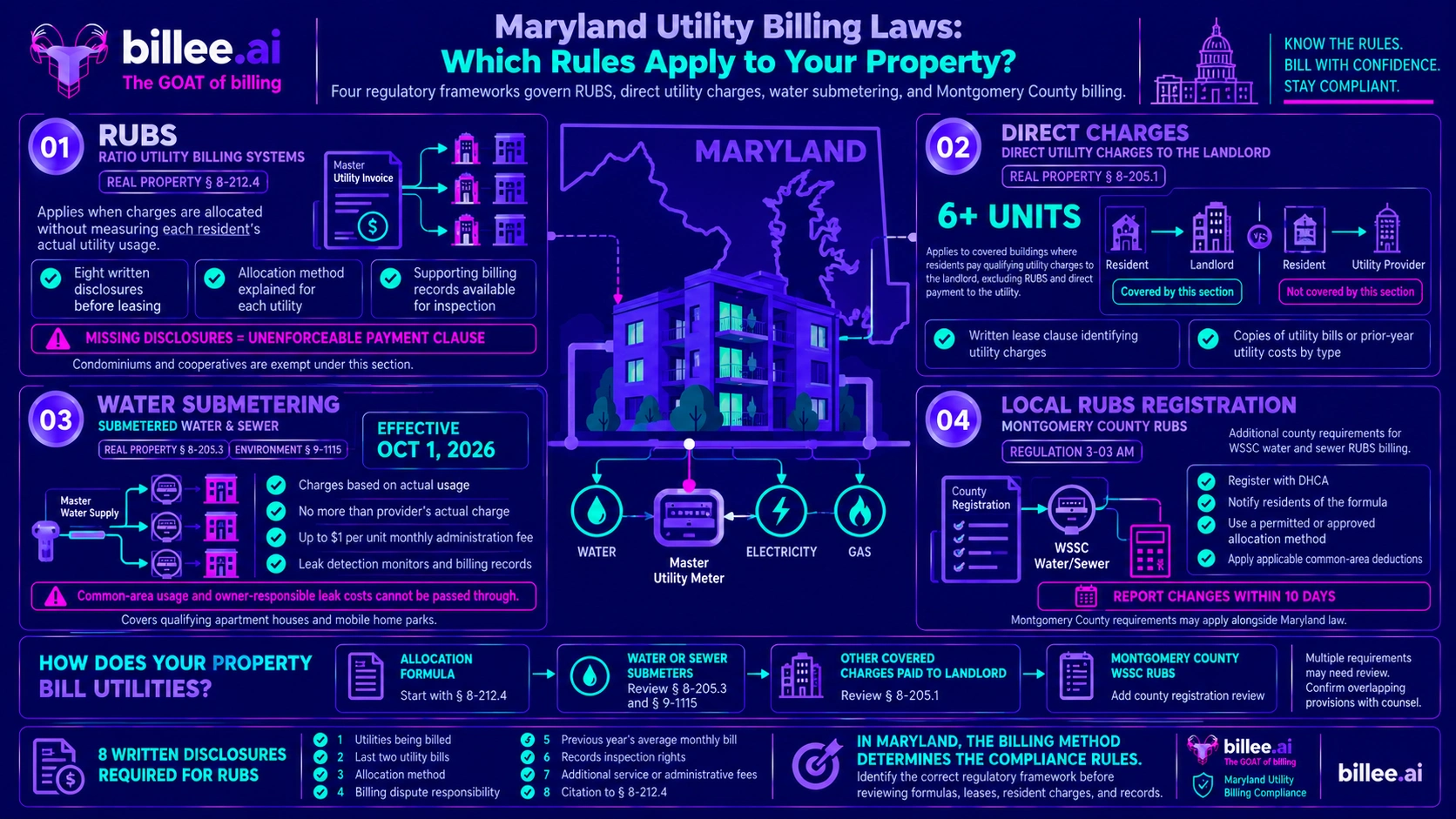
Maryland regulates utility billing under four separate rules: RUBS disclosures in Real Property § 8-212.4, direct charges in § 8-205.1, a new submetered-water law that took effect Oct. 1, 2026, and Montgomery County's RUBS registration. Which one applies depends on how you bill. Billee Technologies, Inc. helps operators check formulas, leases and records against all four.
Chapter 261 of the 2026 Maryland Laws, which began as Senate Bill 130, did not amend the RUBS statute. It built a parallel regime for submetered water and sewer, with its own charge limits, records duties and complaint routes. This guide sorts out which rule governs which billing method, what the new text requires and what it leaves open.
Key takeaways
- Maryland has four regimes: § 8-212.4 (RUBS), § 8-205.1 (utility charges paid to the owner in buildings with six or more units), § 8-205.3 with Environment § 9-1115 (submetered water and sewer) and Montgomery County's RUBS registration.
- Under § 8-212.4, a lease clause requiring ratio-billed charges is unenforceable if the landlord does not give prospective residents eight written items, including the last two utility bills and the allocation method for each utility.
- The new water law, effective Oct. 1, 2026, caps charges at the water provider's actual charge, requires allocation by actual use and allows up to $1 per unit per month for administration.
- Leaks, poor maintenance, common area usage and non-residential space cannot be passed on.
- A submeter left unrepaired or unreplaced for two consecutive billing cycles stops billing for that occupant until it is fixed.
- A landlord that does not meet § 9-1115 may not require a resident to pay a third party for water or sewer service.
- Montgomery County asks landlords who use RUBS for WSSC water and sewer to register with the Department of Housing and Community Affairs.
- The new text sets no record-retention period, no penalty beyond complaints and a private action, and no transition rule for existing leases or submeters.
Maryland utility billing rules at a glance
| Rule | Covers | Core requirement | Status |
|---|---|---|---|
| Real Property § 8-212.4 | RUBS, meaning any allocation that does not measure each resident's actual use | Eight written items to prospective residents; records inspection on request | Current Code text; condos and co-ops exempt |
| Real Property § 8-205.1 | Buildings with six or more units where residents pay utilities to the landlord | Written lease clause; copy of each bill or prior-year totals by utility | Current Code text; RUBS and direct-to-utility payment excluded |
| Real Property § 8-205.3 and Environment § 9-1115 | Submetered water and sewer in apartment houses and mobile home parks | Charge limits, exclusions, bill timing, records, leak monitors | Effective Oct. 1, 2026 |
| Montgomery County Regulation 3-03 AM | RUBS billing of WSSC water and sewer | Registration, resident notice, approved formula, default deductions | County survey form, current copy |
Which Maryland rule applies to your billing method?
The billing method decides the rule. A formula that does not measure each resident's actual use is RUBS. A meter in each unit is a submeter. A bill the resident pays straight to the utility sits outside these billing rules.
| If you bill this way | Start with |
|---|---|
| An allocation formula | § 8-212.4; in Montgomery County, also DHCA registration for WSSC water and sewer |
| Individual submeters for water or sewer | § 8-205.3 and Environment § 9-1115 |
| Other utility charges paid to the owner, in a building with six or more units | § 8-205.1 |
| The resident pays the utility directly | None of the above |
The guide leaves out submetered electricity and gas. The text also does not say how § 8-205.1 and § 8-205.3 fit together for one building. The new section is written around residents paying a third party for submetered water or sewer, so owners who bill that water themselves should ask counsel how the two sections interact. Billee's guide to master-metered versus submetered buildings explains the technical difference.
RUBS in Maryland: the § 8-212.4 disclosure list
Real Property § 8-212.4 treats a ratio utility billing system as any method of allocating charges that does not measure each resident's actual usage. A landlord using one must give every prospective resident these items in writing:
- Notice that the landlord will bill residents for allocated utility services, and which utilities are involved.
- Copies of the last two utility bills issued to the landlord.
- The method used to allocate each utility's cost to the resident.
- A statement that billing disputes are between the resident and the landlord.
- The average monthly bill for all dwelling units in the previous calendar year, by utility.
- The resident's right to inspect the records supporting the utility bill on written request.
- Any additional service charges or administrative fees for the system.
- A citation to the section.
The consequence is practical. If the landlord does not provide the information, a lease provision requiring the resident to pay ratio-billed charges is unenforceable. The landlord must also let a resident inspect the supporting records on written request. Condominiums and cooperatives are exempt.
The statute sets no deduction percentage. It uses the term common elements for the usage a master meter measures alongside dwelling units, and it does not treat that usage as a separate disclosure item. Billee's guide to how RUBS allocates utility costs walks through the common formulas, and its lease addendum guide covers what to put in writing.
Direct charges: § 8-205.1
Section 8-205.1 applies to landlords of buildings with six or more residential dwelling units who require residents to pay water, sewer, gas or electric charges to the landlord. It excludes landlords whose residents pay the utility directly. It also excludes utilities allocated through a RUBS system as § 8-212.4 defines it.
Two duties follow. The lease must be in writing and must tell the resident that utility charges are payable to the landlord. The landlord must also either give the resident a copy of each utility bill or, before the initial lease and each later term, give written notice of the prior year's utility costs billed to the landlord, broken out by utility type.
The section sets no markup limit and states no penalty or resident remedy. Other Maryland consumer law may still apply, and counsel can say how.
The new water law: what you may charge
Chapter 261 added Real Property § 8-205.3 and Environment Article § 9-1115. It covers water and sewer service in apartment houses, defined as buildings with more than two dwelling units, and in mobile home parks. Owners, operators and managers may install individual unit submeters where the units are not individually metered by the utility.
The cap. Charges may not exceed what the water service provider actually charges the owner, operator or manager. They must be allocated among units in proportion to actual usage.
The fee. An additional service charge of up to $1 per unit per month is allowed to cover administration and billing. The text does not say whether that amount can change.
What cannot be passed on. Three categories are excluded: costs from poor maintenance or leaks that the owner or contractor is responsible for, common area usage, and usage in any part of a building not used as a residential unit.
When a submeter fails. If a submeter does not give adequate or accurate billing data, the owner may bill the average cost of the occupant's most recent three months of actual usage. If those records are unavailable, the average of three months of estimated usage applies. If a submeter goes unrepaired or unreplaced for two consecutive billing cycles, the owner may not bill that occupant until it is repaired or replaced.
Leak monitors and accuracy. Each submeter must include a leak detection monitor, and occupants must be allowed to inspect it periodically. A state department is directed to adopt rules on submeter accuracy, testing and recordkeeping that are at least as strict as those for water meters installed by providers. Billee's guide to state rules on submeter accuracy puts the Maryland approach in context.
Compliance as a condition. A landlord that does not meet § 9-1115 may not require a resident to pay a third party for water or sewer service, and that bar applies despite other law. Meeting the section is a condition of billing at all.
The new water law: what you must provide and keep
Lease and pre-lease notice. The written lease must say the resident is responsible for paying the third party for water or sewer. Before the initial lease begins, the landlord must give the prospective resident written notice of the total water and sewer costs billed to that unit's occupants in the preceding two years. If nothing was billed to that unit, the notice covers a comparably sized unit.
The bill. The landlord must give the resident a copy of the water or sewer bill no later than 20 days before the payment due date. The text does not say whether that means the provider's bill or the owner's bill to the resident, or what else a bill must show.
Records. The law defines adequate records as copies of everything the provider charged the owner in the preceding two years, total monthly utility cost for all units for the current and previous calendar years, total monthly revenue collected from occupants for the same periods, an explanation of the allocation formula and any other information needed to verify a bill.
The owner must keep those records, obtain more if a resident needs them to verify a bill, and allow inspection during reasonable business hours.
Disputes. A complaint can go to the local landlord-tenant commission if one exists, then the local consumer protection agency, then the Attorney General's Consumer Protection Division. The text also allows a private cause of action. Unpaid water bills under the section may not be treated as unpaid rent in an eviction.
Montgomery County: RUBS registration and default deductions
Montgomery County adds its own layer. Its Department of Housing and Community Affairs publishes a Ratio Utility Billing System Survey that implements Landlord-Tenant Regulation 3-03 AM. Any landlord intending to use RUBS must register with the department and notify all residents of the formula.
The form covers WSSC water and sewer service only. Charges must not include other WSSC fees billed to the landlord, such as deposits, disconnect or reconnect fees, or late payments.
The owner certifies the information under penalty of perjury, attaches a copy of a water and sewer bill showing how residents would be billed, and reports any change to the department within 10 days. The form describes three methods:
- Formula 1: the WSSC bill, less common-area usage, divided by total occupants and multiplied by the occupants in the resident's unit.
- Formula 2: the same pool, with a weighted factor of 1 for one occupant, 1.6 for two and 2.2 for three, plus 0.4 for each occupant beyond three.
- Formula 3: an alternate method the department must approve in advance. The landlord carries the burden of proving it is fair and accurate, and the department has 30 days to decide.
Where common areas are metered or submetered, the form deducts actual usage. Where they are not, it deducts seasonal common-area usage using these defaults:
| Unmetered common area | Default deduction |
|---|---|
| Installed irrigation system | 15% |
| Laundry rooms | 10% |
| Swimming pool, and each other water amenity | 10% |
The form states no filing fee, initial registration deadline or renewal cycle. It also gives no way to document a different percentage. The only alternative it offers is metering or submetering for actual usage.
What Maryland leaves open
The text raises questions that counsel should settle. Nothing here is legal advice.
Record retention. The law defines adequate records but sets no separate retention period.
Existing leases and buildings. The law took effect Oct. 1, 2026. The text read has no transition rule, grandfathering or treatment of leases and submeter systems already in place.
The department. The text does not name the state department that writes the accuracy rules. The bill's fiscal note appears to point to the Maryland Department of the Environment. Check whether those rules have been adopted.
Penalties. Beyond complaints and a private action, the text states no fine or damages amount.
Undefined terms. The law does not define landlord or tenant, and it does not say how the leak detection monitor must work.
Local law. The text contains no general preemption clause. County rules such as Montgomery's may apply alongside it, so check each county where you operate.
How to get ready
- Sort each Maryland property by regime. Mark it RUBS, direct charge or submetered water, and note any Montgomery County properties. Billee's state-by-state RUBS guide shows how other states divide the same ground.
- Test the RUBS disclosure packet. Confirm that every prospective resident gets all eight items, by utility, in writing.
- Test every water charge line. Compare it with the provider's bill, keep any administrative charge at $1 or less per unit per month, and strip out leaks, common areas and non-residential space.
- Track failed submeters. Build a list of units with a failed or inaccurate meter and date each repair, so the two-cycle limit never surprises you.
- Build the records file. Collect two years of provider charges, monthly totals, revenue collected and a plain-language explanation of the formula.
- Check the bill calendar. Work backward from each payment due date to confirm residents get the copy at least 20 days earlier.
- Ask your billing vendor in writing. Get its plan for the fee cap, the failed-meter method and the records file.
- Put the open points to counsel. Use the list above and set a review date.
How Billee Technologies helps
Billee Technologies pairs a platform with a named, dedicated account team. Your people review and approve. Billee's team does the work. For a state with four overlapping regimes, that means a formula checked against the rule, submeters watched and a monthly record you can hand to an inspector or a resident.
Check the method and the lease
Billee's Regulatory & Compliance service covers billing methodology audits, access to legal support and ongoing monitoring for rule changes. Access to legal support is not legal advice. Billee's guide to its regulatory and compliance support explains the scope.
A Billee audit reviews four required document categories for the same billing period: the current billing provider's reports, master meter invoices, lease agreements, and the property's W-9 and legal entity name. It surfaces methodology gaps, allocation drift, reconciliation problems and lease language gaps.
For Maryland, that shows which regime a property sits in and what its lease says today. Billee's guide to preparing a billing methodology audit lists what reviewers ask for. Billee's 45-day standard implementation includes a methodology audit of formulas, submeter configuration and allocation logic.
Keep submeters honest
Under the new law, a failed meter has a clock on it. Billee's Meter Monitoring raises alerts when a reading spikes, drops or flatlines, and the team acts on them. Catching a flatlined submeter early gives you room to repair it before the two-cycle limit bites. Read more in Billee's guide to meter monitoring and proactive alerts.
Monitoring works on portfolios that already have submetering infrastructure. How Billee records a failed meter and the averaging method used meanwhile is a question for Billee in writing.
Run a monthly cycle that leaves a record
Each month Billee assembles utility data and produces a preliminary bill. Your billing administrator reviews it in the Billee portal next to Biller Highlights, the team's notes on exceptions, and can download a Detail Resident Report or an Itemized Report. Billee replies to comments within 1–2 business days, and an administrator can request a new report, which takes 1–2 business days.
After approval, Billee locks the report, charges post to the property management system's resident ledger on the set date and e-bills go out. The activity log records every billing action, who performed it and when. Whether those dates leave room for Maryland's 20-day copy rule is a scheduling question to settle with your account team.
Handle disputes and move-outs
Disputes are where records get tested. Billee's guide to handling resident utility bill disputes covers the usual patterns. Final bills are managed on the portal's Move-Outs page, and the dashboard's Move-Out Overview shows status counts for Past Due, Upcoming, Needs Review and Issue.
What to ask Billee for in writing
- How Billee applies the $1 per unit per month limit, and where any Billee or property-level fee appears on Maryland resident bills.
- How bills and supporting documents are timed and delivered to meet the 20-day copy rule.
- How a failed submeter is flagged, how the three-month average is calculated and how the two-cycle limit is tracked.
- How the two-year records file is assembled and where residents or inspectors can see it.
- Whether the audit checks leases and pre-lease notices against § 8-212.4, § 8-205.1 and § 8-205.3.
- How Montgomery County registration and the default deductions are reflected in formulas.
- How Maryland rule changes reach your account team.
Who Billee is not for
- Portfolios under about 300 units, where Billee's full-service model is usually more than the job needs.
- Anyone looking for a legal opinion on how Maryland's statutes apply to a formula or lease. Billee gives access to legal support, not legal advice, so involve counsel.
- Operators who want to run billing themselves with software alone. Billee's portal exists for review and approval, not self-service operation.
FAQ
Is RUBS legal in Maryland?
Maryland's RUBS statute, § 8-212.4, regulates RUBS through disclosure duties and does not ban it in the text read. A lease clause requiring ratio-billed charges is unenforceable if the landlord skips the required written items. Local rules, such as Montgomery County's registration, may add duties.
What must a Maryland landlord disclose before using RUBS?
Eight written items: that residents will be billed and for which utilities, the last two utility bills, the allocation method for each utility, that billing disputes are between resident and landlord, last year's average monthly bill by utility, the right to inspect records, any added service or administrative fees and a citation to § 8-212.4.
When did Maryland's new water submetering law take effect?
Oct. 1, 2026. Chapter 261 added Real Property § 8-205.3 and Environment § 9-1115. The text read contains no transition rule for existing leases or submeter systems, so ask counsel how it applies to buildings already billing.
Can a Maryland landlord charge an administrative fee on submetered water?
Yes, up to $1 per unit per month to cover administration and billing. Total charges cannot exceed what the water provider actually charges the owner, and they must follow each unit's actual usage.
Can common area water be billed through submeters in Maryland?
No. The new law bars passing on common area usage, leak and poor-maintenance costs, and usage in any part of a building not used as a residential unit.
What happens when a Maryland submeter fails?
The owner may bill the average of the occupant's last three months of actual usage, or three months of estimated usage if those records are unavailable. If the meter stays unrepaired or unreplaced for two consecutive billing cycles, the owner may not bill that occupant until it is fixed.
Does Montgomery County require RUBS registration?
According to the county's survey form, yes. A landlord intending to use RUBS must register with the Department of Housing and Community Affairs and notify all residents of the formula. The form covers WSSC water and sewer service only.
What records does Maryland's water law require?
Two years of provider charges, monthly utility cost and revenue totals for the current and previous calendar years, an explanation of the allocation formula and any other information needed to verify a bill. Residents may inspect them during reasonable business hours.
Billee handles utility billing, vacant cost recovery and vendor management for multifamily operators who want a dedicated team behind the software. If you operate in Maryland, talk to the team about your portfolio.
Sources
- Maryland General Assembly, "Chapter 261 (Senate Bill 130), 2026 Regular Session," accessed October 2026.
- Maryland General Assembly, "Real Property Article, Section 8-212.4," accessed October 2026.
- Maryland General Assembly, "Real Property Article, Section 8-205.1," accessed October 2026.
- Montgomery County Department of Housing and Community Affairs, "Multi-Family Apartment Complex Ratio Utility Billing System Survey," accessed October 2026.
- Maryland Department of Legislative Services, "Fiscal and Policy Note, Senate Bill 130 (2026 Regular Session)," accessed October 2026.
Insights and Industry Trends