

Master-Metered vs Submetered Multifamily: Which Billing Model Recovers More?
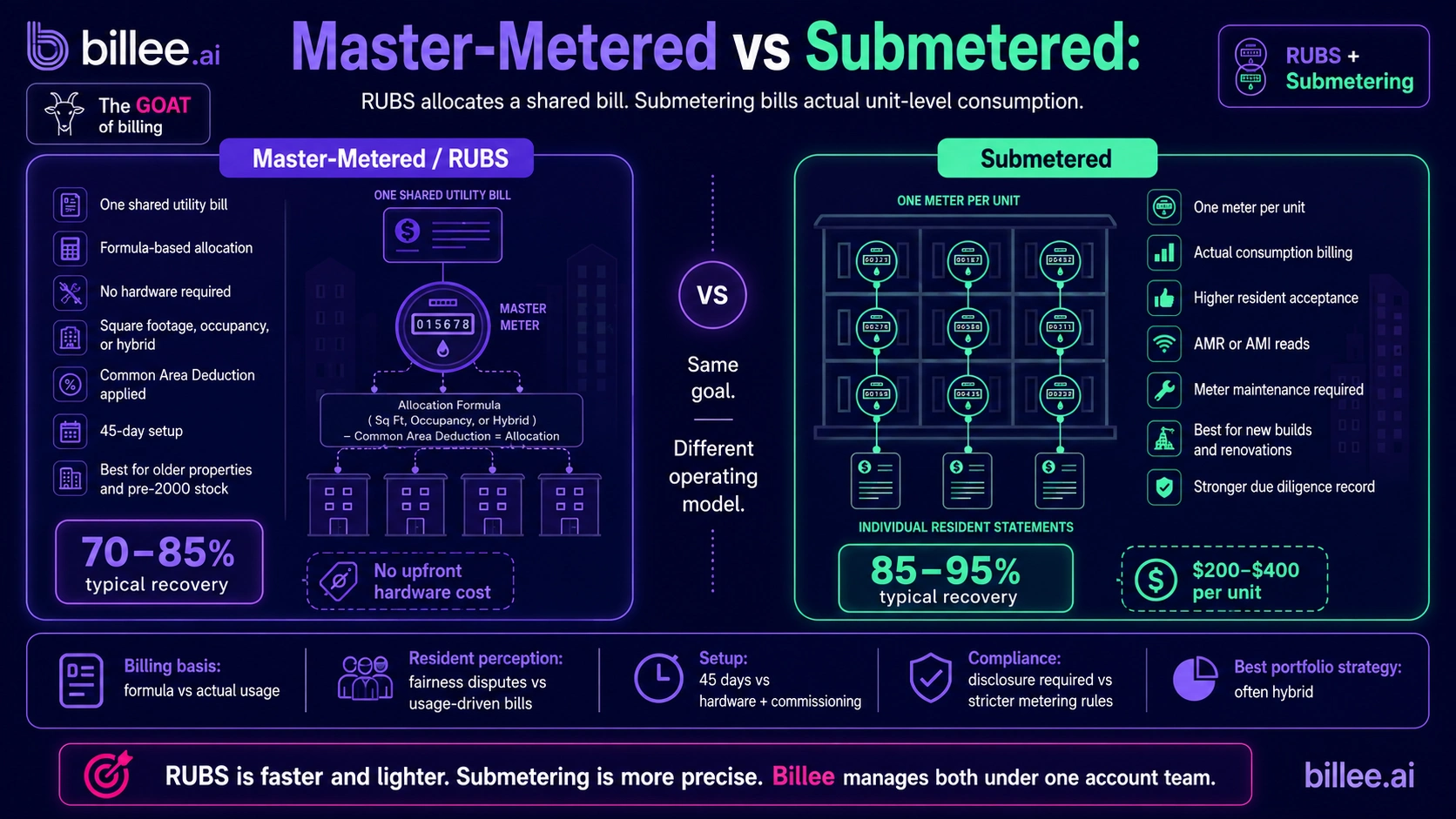
Master-metered properties allocate a shared utility bill to residents using RUBS. Submetered properties bill residents for their actual unit-level consumption. Submetering typically produces recovery rates of 85–95% versus 70–85% for RUBS (per Billee's customer benchmark). The right model depends on property type, capital budget, and state regulations. Billee manages both.
Key Takeaways
- Master-metered buildings use RUBS to allocate one shared utility bill across occupied units. No hardware is required.
- Submetered buildings install a meter per unit and bill residents for actual consumption.
- Submetering typically recovers 85–95% of utility costs. RUBS typically recovers 70–85% (Billee's customer dashboard benchmark).
- RUBS requires no capital investment. Submetering hardware and installation typically run $200–$400 per unit.
- Texas, California, and Colorado have the most detailed regulatory frameworks covering both billing models.
- Billee manages RUBS billing, submetered billing, and hybrid portfolios under a single account team.
At a Glance: RUBS vs. Submetering
| Dimension | Master-Metered (RUBS) | Submetered |
|---|---|---|
| Billing basis | Formula-based allocation | Actual unit consumption |
| Hardware required | No | Yes (one meter per unit) |
| Typical recovery rate | 70–85% | 85–95% |
| Upfront cost | Low | ~$200–$400 per unit |
| Setup timeline | 45 days | Weeks to months (hardware + commissioning) |
| Resident perception | Can generate fairness disputes | Higher acceptance; usage drives the bill |
| State regulation | Disclosure required in most states | More prescriptive; varies by state |
| Best for | Any age property; especially pre-2000 stock | New builds, renovations, high-NOI-priority assets |
What Is a Master-Metered Property?
A master-metered property has one utility meter for the entire building. The utility company reads that meter and bills the property owner directly for total consumption. The owner then recovers a portion of that cost from residents using RUBS — Ratio Utility Billing System.
RUBS allocates the shared bill across occupied units using a documented formula. Common formulas are based on square footage, number of occupants, bedroom count, or a combination. Before allocating, operators subtract common-area consumption using a Common Area Deduction (CAD). Whatever remains is divided among residents per the formula.
Most states permit RUBS billing with disclosure requirements. Residents must be informed of the allocation method in writing, typically through a lease addendum, before billing begins.
What Is Submetering in Multifamily?
Submetering installs an individual utility meter in each unit. Residents receive a bill based on their actual water, electricity, or gas consumption, not a formula-based share of the building total.
Submeters are installed downstream of the master meter. Two types are common in multifamily: AMR (Automatic Meter Reading) systems collect reads on a fixed schedule; AMI (Advanced Metering Infrastructure) systems transmit reads in near-real time. AMI costs more upfront but eliminates the billing-period timing gaps that AMR can produce.
Submeters require ongoing maintenance. Meters drift, fail, and eventually need replacement. That maintenance responsibility falls to the property owner, not the utility company.
Recovery Rate: RUBS vs. Submetering
Submetering recovers more than RUBS in most well-run programs. Billee's benchmark for submetered portfolios is 85–95% effective recovery. RUBS-billed portfolios typically run 70–85%. But neither number is guaranteed. Each model has specific failure modes that push recovery below benchmark, and understanding them matters more than the headline comparison.
What the Benchmark Numbers Mean
Billee tracks recovery rate on every customer portfolio through the customer dashboard. Three reference points define what the numbers mean in practice:
- 85–95% recovery is healthy for submetered programs. The gap below 100% comes from meter read timing, move-in/move-out lag, and hardware failures on specific units.
- 70–85% recovery is healthy for RUBS programs. The gap reflects vacant unit absorption, CAD deduction exclusions, and allocation formula design.
- Below 80% on either model is a signal that something is wrong. Per Billee's methodology, a recovery rate below 80% triggers a billing review regardless of which model a property runs.
The benchmark gap between models represents real NOI. On a 200-unit community spending $1,500 per unit per year on utilities, a 10-point recovery improvement is $300,000 in recovered revenue annually.
Why RUBS Recovery Slips Below Benchmark
RUBS recovery erodes when the allocation formula does not keep pace with the property. Four failure modes drive most of the gap.
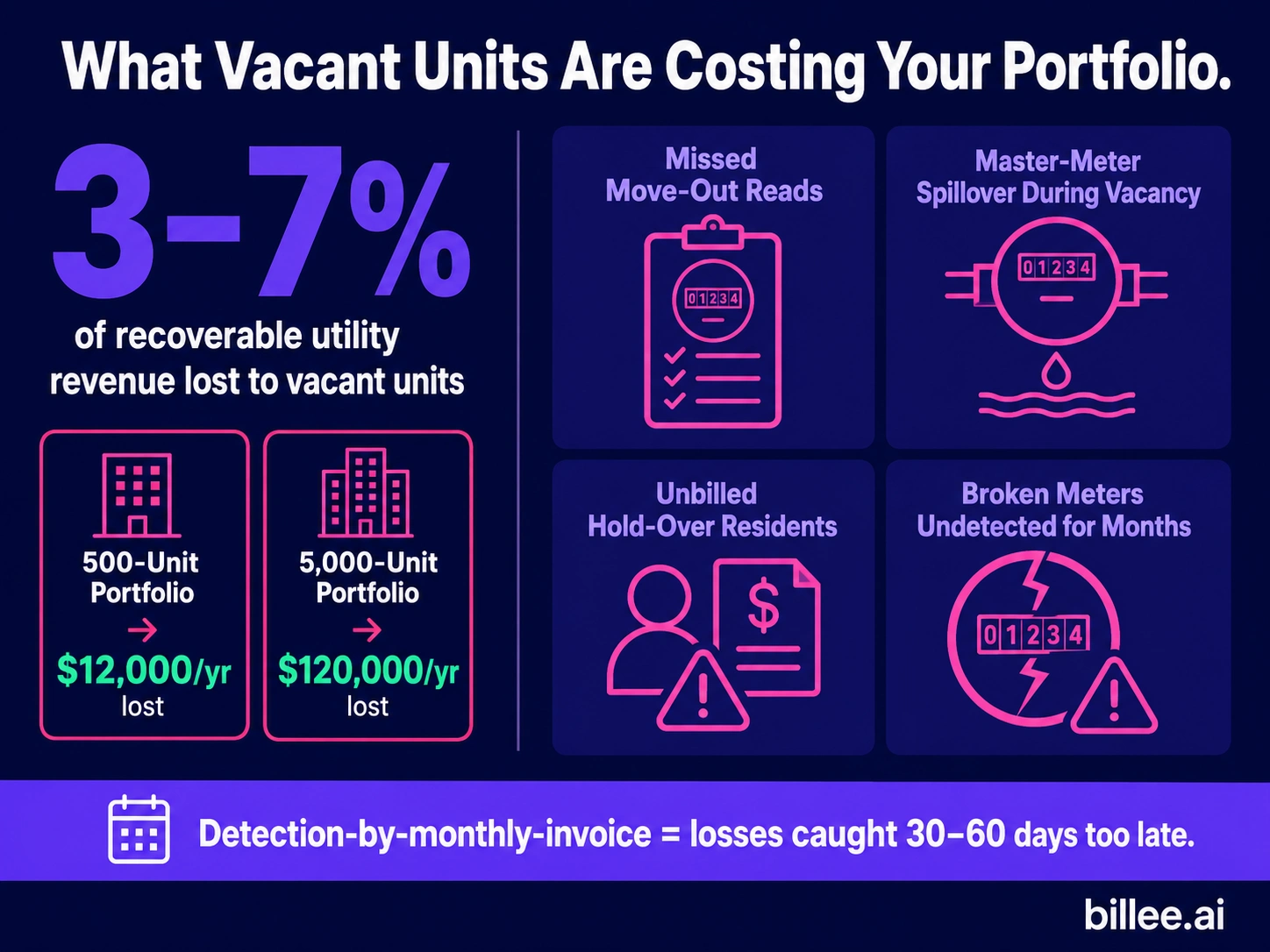
Vacant units. RUBS allocates costs across occupied units only. High vacancy means fewer residents sharing the bill. The property absorbs the difference unless a Vacant Cost Recovery (VCR) program is running alongside the RUBS billing.
Stale CAD deductions. The Common Area Deduction removes common-area consumption from the allocation pool before billing residents. A CAD configured at onboarding and never updated drifts from actual common-area usage. Misconfigured CADs either under-bill residents or create overage disputes — both reduce effective recovery.
Outdated allocation formulas. A RUBS formula built around square footage works cleanly until the unit mix changes. Renovations, combined units, and reclassified space all shift the formula's accuracy without triggering an automatic correction.
Lease language gaps. RUBS billing requires specific addendum language in most states. If the addendum does not match the billing methodology, recovery is legally at risk regardless of how well the formula runs. Billee's implementation audit flags this before the first billing cycle goes out.
Why Submetered Recovery Slips Below Benchmark
Submetering is not self-maintaining. Hardware problems and data gaps push submetered recovery below the 85–95% benchmark faster than most operators expect.
Meter failures and skipped reads. A submeter that stops reporting — or reports incorrectly after a hardware fault — creates an unbillable unit. Depending on how the program handles failed reads, that unit may go unbilled across multiple cycles before the issue surfaces.
Move-in commissioning gaps. A resident who moves in before the submeter is confirmed active and correctly assigned in the billing system loses the first billing cycle entirely. This is a process failure, not a hardware one, and it is entirely preventable.
AMR read timing. AMR systems collect reads on a fixed schedule. When the read date does not align with the billing period, billed consumption does not match the actual period. AMI systems eliminate this at higher upfront cost.
No master-meter reconciliation. Unit-level reads should sum close to the master meter total. When they do not, it is a sign of hardware drift or data processing errors. Programs without regular reconciliation let those errors compound silently across billing cycles.
What Closes the Gap
The difference between a program running at benchmark and one running 10–15 points below it is almost never the billing model. It is the operating discipline behind the model.
For RUBS programs: accurate CAD deductions, current allocation formulas, correct lease addendum language, and a VCR program covering vacant units.
For submetered programs: active meter health monitoring, move-in commissioning checklists, regular master-meter reconciliation, and a failed-read escalation process.
Billee's monthly billing cycle includes Biller Highlights — exception notes from the billing team flagged in every preliminary report before charges are posted. That mechanism catches configuration and hardware issues before they compound across billing cycles.
When RUBS Is the Right Model
RUBS is the right starting point for most operators. It requires no capital investment, can go live in 45 days, and works on any property regardless of age or construction type.
Three scenarios point clearly to RUBS. The first is older buildings where installing submeters would require significant construction work. The second is properties with a stable, homogeneous unit mix where square footage allocation runs cleanly. The third is budget-constrained portfolios where the hardware investment payback stretches beyond two or three years.
A well-configured RUBS program on a stabilized 200-unit community with high occupancy and accurate CAD deductions can deliver 80%+ recovery with no hardware cost and a 45-day implementation timeline (Billee's standard). That is the right baseline before evaluating whether submetering is worth the capital.
When to Switch to Submetering
Submetering earns its cost when the recovery rate improvement justifies the installation. Two timing windows make that math work best.
New construction is the cheapest point to submeter. Hardware and installation are integrated into the construction budget. Per-unit cost is lower, and commissioning runs alongside other building systems work rather than disrupting occupied units.
Gut renovation is the second window. When a property is emptied for major work, submeter installation can proceed without resident coordination and with walls already open for runs.
Outside those windows, the ROI calculation depends on utility cost and current recovery rate. A property spending $1,500 per unit annually running RUBS at 75% recovery has roughly $187 per unit per year in addressable gap. At $300 per unit for hardware, the payback on a 10-point recovery improvement is under two years.
Pre-sale due diligence is a fourth trigger. Institutional buyers increasingly expect metered consumption data. Submetering documentation is more defensible in due diligence than RUBS reporting because recovery ties directly to meter reads, not to a formula.
State Rules: What Operators Need to Know
No U.S. state universally requires submetering for existing multifamily. Several have detailed rules governing how both RUBS and submetered billing must be disclosed, administered, and disputed.
Texas sets the most prescriptive framework under PUC Chapter 24. It governs billing methods, disclosure requirements, markup limits, and resident dispute rights for both RUBS and submetered communities. Texas operators should treat PUC Chapter 24 as the floor for compliance, not a ceiling.
California's Civil Code §1954.201–204 governs water submetering specifically. It includes stronger resident protections than most states — billing frequency requirements, dispute resolution timelines, and accuracy standards for metering equipment.
Colorado passed HB 26-1013 in 2026, adding RUBS-specific requirements around Common Area Deductions and billing transparency. For a full breakdown of what Colorado operators need to do before the next billing cycle, see Colorado RUBS Rules 2026: What Multifamily Operators Need to Know.
For all other states: RUBS is generally permitted with lease disclosure. Submetering rules vary and should be confirmed before implementation.
How Billee Manages Both Models
Billee manages RUBS billing and submetered billing for multifamily operators across a single account team. Operators do not need a different platform when they switch billing models or run a hybrid portfolio.
The 45-day implementation timeline applies to both models. For RUBS, onboarding includes formula configuration, CAD deduction setup, and a lease addendum language audit. For submetered properties, Billee integrates with submeter data feeds, reconciles unit reads against the master meter, and generates per-unit bills through the same monthly prelim workflow.
Hybrid portfolios — some buildings on RUBS, others submetered — are managed under one account. Operators phasing in submetering at new or renovated buildings do not change their billing provider or their reporting structure.
The monthly billing cycle is the same regardless of model: Billee generates a preliminary report, the operator reviews it through the Billee portal, Biller Highlights flag exceptions, and charges push to the PMS (Yardi, RealPage, or Entrata) once approved.
Frequently Asked Questions
What is the difference between a master-metered and submetered apartment community?
A master-metered community has one utility meter for the entire building. Utility costs are allocated to residents using RUBS — a documented formula based on square footage, occupancy, or bedroom count. A submetered community installs individual meters in each unit so residents are billed for their actual consumption rather than a calculated share.
What recovery rate can I expect from RUBS vs. submetering?
RUBS-billed portfolios typically recover 70–85% of utility costs. Submetered portfolios typically recover 85–95%. Both ranges assume a correctly configured program with active monitoring. Billee tracks these benchmarks on every customer portfolio through the customer dashboard, and flags any portfolio running below 80% for a methodology review.
Why is my submetered recovery rate lower than expected?
The most common causes are meter failures generating skipped reads, move-in commissioning gaps that leave new units unbilled for the first cycle, and the absence of master-meter reconciliation. Running a reconciliation of unit-level reads against the master meter total will usually surface the problem within one billing cycle.
When should I switch from RUBS to submetering?
New construction and gut renovations are the two windows where submetering installation is most cost-effective. Outside those windows, submetering makes financial sense when the per-unit hardware cost pays back within two to three years through recovery rate improvement, and when the property is preparing for institutional sale or refinancing.
How much does submetering cost per unit?
Hardware and installation typically run $200–$400 per unit for water or gas submetering. Electricity submetering varies more depending on local code and panel configuration. Costs are lowest when installed during construction or major renovation because walls are already open and coordination with occupied units is not required.
Which states regulate RUBS or submetering in multifamily?
Texas (PUC Chapter 24), California (Civil Code §1954.201–204), and Colorado (HB 26-1013) have the most detailed regulatory frameworks. Most other states permit both RUBS and submetering with lease disclosure requirements. Specific rules should be confirmed with a billing compliance advisor before implementation.
Does Billee support both RUBS billing and submetering?
Billee supports both billing models and manages hybrid portfolios where some properties run RUBS and others are submetered. The 45-day implementation timeline and the monthly prelim-based billing cycle apply to both models. Operators switching billing models or phasing in submetering at new buildings do not need to change their billing provider.
Billee handles RUBS billing, submetering, and hybrid portfolios for multifamily operators who want the recovery without the overhead. See how it works for portfolios like yours.
Sources
- Billee Technologies, "Customer Dashboard Benchmark: Recovery Rate," accessed July 2026.
- Texas Public Utility Commission, "Substantive Rules Chapter 24," updated 2024.
- California Legislative Information, "Civil Code §1954.201–204," 2024.
- Colorado General Assembly, "HB 26-1013," 2026.
Insights and Industry Trends


Explore more insights