
State Rules on Submeter Accuracy: What Operators Need to Know
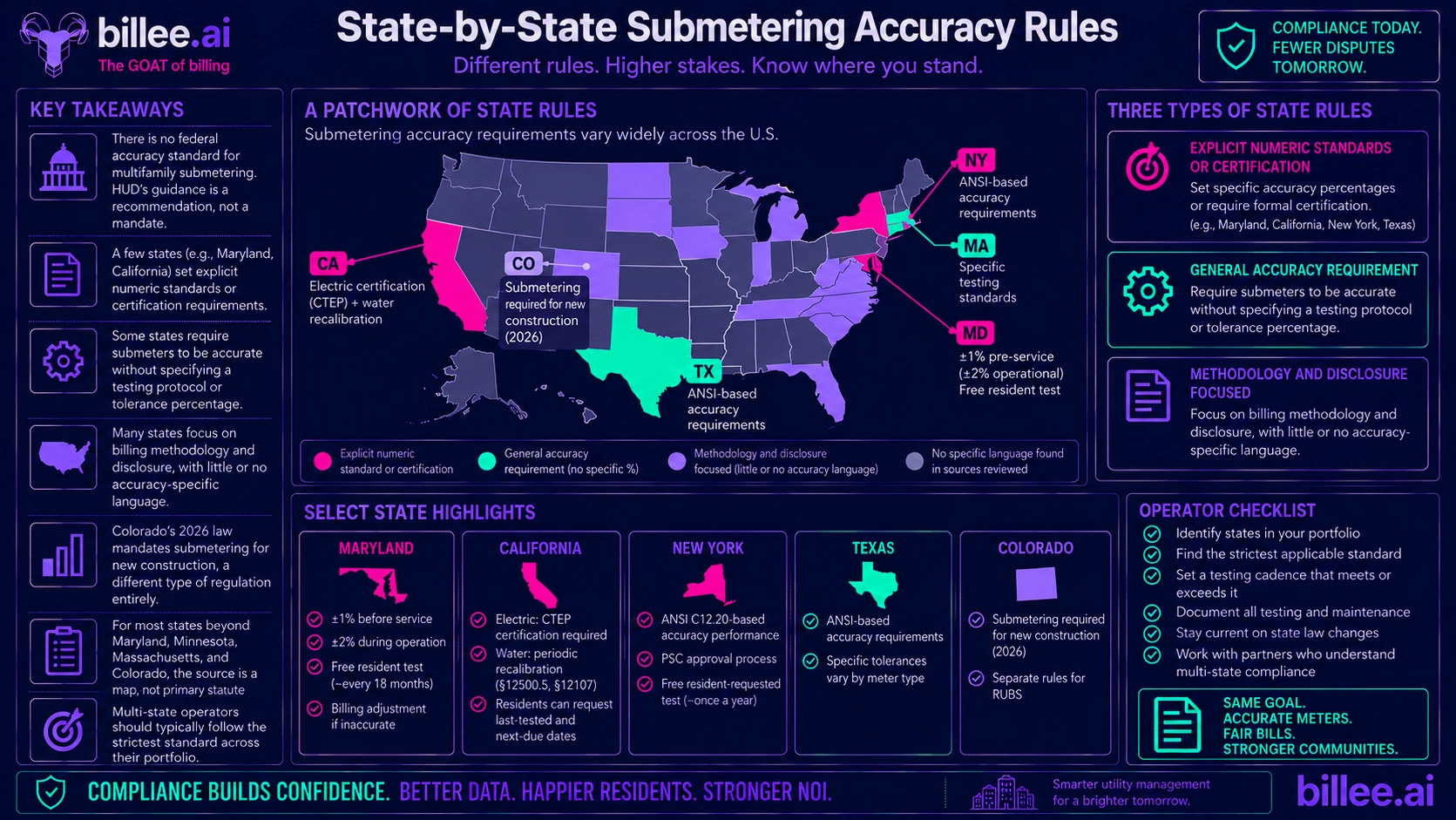
There is no federal accuracy standard for multifamily submetering. HUD's own submetering study recommends tolerances, but recommendations are not law. What actually governs a property's accuracy obligations is a genuine state-by-state patchwork, ranging from numeric tolerances and certification programs in some states down to general disclosure rules with no technical accuracy language at all in others.
A portfolio spread across several states does not get to pick the easiest rule. Its real compliance floor is set by its strictest state.
Key Takeaways
- No federal law sets a submeter accuracy tolerance for multifamily properties. HUD's guidance is a recommendation, not a mandate.
- A handful of states, led by Maryland and California, set explicit numeric accuracy standards or require formal certification before a submeter can be used for resident billing.
- A second group of states impose a general duty that submeters be accurate without specifying a testing protocol or tolerance percentage, leaving the technical detail to the operator.
- A larger group of states focus almost entirely on billing methodology and disclosure, with little or no accuracy-specific language in the statutes and guidance reviewed for this article.
- Colorado's 2026 law shows a different kind of regulation entirely: a mandate on whether submetering must exist at all for new construction, layered on top of separate rules governing ratio utility billing.
- For most of this article's state detail beyond Maryland, Minnesota, Massachusetts, and Colorado, the source is a compiled third-party compliance map rather than primary statute text this research could independently verify. That distinction is called out plainly wherever it applies.
- The practical answer for a multi-state operator is usually to set one testing cadence at the strictest standard in the portfolio, rather than tracking dozens of separate thresholds.
Why There's No National Standard
HUD's guidance is a recommendation, not a mandate
Billee's guide on what submeter calibration means covers HUD's Study of Submetering in HUD-Funded Housing in more depth, but the relevant point here is simple. HUD recommends electric meters hit roughly ±1% accuracy and water meters follow AWWA's technology-specific ranges. Those are recommendations aimed at HUD-funded housing, not a binding national rule that applies to every multifamily property regardless of funding source.
ANSI and AWWA are voluntary until a state adopts them
ANSI C12.20 for electric meters and the AWWA C700 series for water meters are industry standards, written by standards bodies rather than legislatures. They only carry legal force in a given state once that state's law or administrative code references them directly, which several states do and several do not.
States With Explicit, Numeric Accuracy Requirements
Maryland
Maryland's COMAR 20.25.01.04, already covered in Billee's guides on calibration basics and testing cadence, requires electric submeters to test within ±1% before entering service and treats results within 2% as acceptable during ongoing operational testing. Residents have a right to a free meter test, commonly cited at roughly every 18 months, and an inaccurate meter found outside tolerance requires a billing adjustment.
California, electric
California runs its accuracy requirement through a certification program rather than a bare percentage. The California Type Evaluation Program, administered by the Department of Food and Agriculture's Division of Measurement Standards, requires electric submetering systems to be independently tested as a complete system, meter and current transformer together, before that system can legally be used for resident billing under Title 24, Part 6 measurement and verification rules. A meter that has not received CTEP type approval cannot legally be used to bill a resident in California, regardless of how accurate it might actually be.
California, water
Separately from CTEP, Billee's guide on testing cadence covers a finding from this research: California's Business and Professions Code §12500.5 and §12107 impose a periodic reinspection and recalibration requirement on water submeters, and give residents the right to request a meter's last-tested and next-due dates in writing. California is one of the few states regulating both an electric certification standard and a separate water recalibration duty at the same time.
New York and Texas
A compiled multi-state compliance resource describes New York as requiring ANSI C12.20-based accuracy performance for submeters used in residential billing, tied to a Public Service Commission approval process, with a free resident-requested test available roughly once a year. The same resource describes Texas as requiring compliance with the Public Utility Commission's Chapter 25 submetering rules and the National Electrical Code, citing a 2% accuracy figure and a recordkeeping requirement covering the current month plus the prior twelve months. Attempts to pull the underlying Texas administrative rule text directly were blocked by a site restriction during this research, and New York's primary regulatory text was not independently reviewed either. Both entries here should be treated as reported by a third-party compliance map rather than independently verified against primary law.
States With a General Accuracy Duty but No Specified Tolerance
Minnesota
Minnesota Statute 504B.216 states plainly that "all submeters, regardless of when the submeter was installed, must accurately measure utility service." That is a real legal duty, independently confirmed in this research directly from the statute. What the law does not do is specify a testing protocol, a tolerance percentage, or a calibration interval. Water submeters installed after January 1, 2025 must additionally conform to whatever standard the local municipal water utility uses for its own meters, which effectively borrows a local standard rather than setting a state one.
Massachusetts
Massachusetts regulates water submetering through General Law Chapter 186, Section 22 and 105 CMR 410.235(B)(4), independently confirmed in this research. The framework places installation, maintenance, and repair responsibility squarely on the property owner, requires a licensed plumber for installation, and requires local Board of Health approval before a landlord can legally bill for submetered water at all. No numeric accuracy tolerance appears in the provisions reviewed. The regulatory structure is real and detailed; it just expresses itself as procedural requirements rather than a percentage.
Virginia and D.C.
The same compiled compliance resource used for New York and Texas describes Virginia as requiring ANSI-standard accuracy performance with a free resident test available every 24 months, and describes the District of Columbia as requiring periodic accuracy testing with a 2% tolerance triggering a required billing adjustment and a free test available every 24 months. Neither entry was independently verified against primary code text in this research, and should be read with that caveat.
States With Billing-Methodology Rules but Minimal Technical Accuracy Language
A cluster with disclosure-first regulation
The same compiled source describes a larger group of states, including Arizona, Connecticut, Florida, Georgia, Indiana, New Jersey, North Carolina, Oklahoma, and Oregon, as regulating submetering primarily through billing transparency, fee disclosure, and National Electrical Code compliance, with little to no numeric accuracy language identified. This is the least independently verified tier in this article, and operators in these states should treat it as a starting point for their own legal review rather than a final answer.
No numeric standard does not mean no liability
A state with no submetering-specific accuracy statute still has general consumer protection law, landlord-tenant law, and common-law fraud and negligence claims available to a resident who believes they were billed for consumption they did not use. The absence of a specific percentage in the statute books is not the same as the absence of legal exposure.
States Regulating Whether Submetering Happens at All
Colorado's HB26-1013
Colorado's HB26-1013, effective March 26, 2026, is primarily a law about ratio utility billing systems, not meter accuracy. It caps the markup a landlord can add on actual utility costs at 2% or $10, whichever is less, requires that aggregate resident charges never exceed the property's actual utility bill, excludes common-area costs from resident allocations, and requires the allocation method to be clearly disclosed in the lease. Layered into the same bill is a separate provision: residential properties where a building permit is applied for on or after July 1, 2027 must be metered directly by the utility provider or by a submeter, rather than relying on ratio billing alone. That is a mandate on whether metering infrastructure exists, a different category of regulation than an accuracy tolerance, and it is worth multifamily operators tracking both halves of the law separately.
What This Patchwork Means for Multi-State Operators
The compliance floor is the strictest state, not the average
A portfolio operating in Maryland, Texas, and a disclosure-focused state does not get to apply Texas's or the disclosure state's lighter requirements company-wide. Maryland's numeric tolerance and testing-interval obligations apply in Maryland regardless of what other states in the portfolio require, and any resident dispute in Maryland will be measured against Maryland's actual legal standard.
One national cadence is usually simpler than fifty
Rather than tracking a different testing interval for every state, many multi-state operators set a single portfolio-wide testing cadence pegged to the strictest applicable jurisdiction, covered in more detail in Billee's guide on how often submeters should be calibrated. It costs more in the states with lighter requirements, but it removes the operational risk of tracking which property falls under which rule.
Documentation matters even where the law is thin
A dated testing record protects an operator regardless of whether the underlying state statute demands one, since a resident dispute or a due-diligence review during a sale can raise questions a thin statute never anticipated. Billee's Regulatory & Compliance product is built around keeping that documentation available regardless of which state's rule actually applies.
Comparison Table
| State | Standard Type | Specific Requirement Cited | Resident Test Right | Sourcing Confidence |
|---|---|---|---|---|
| Maryland | Numeric tolerance | ±1% before service, 2% operational tolerance | Every 18 months (free) | Primary source (COMAR) |
| California, electric | Certification program | CTEP type approval required before billing use | N/A, tied to certification | Primary/near-primary source |
| California, water | Periodic recalibration duty | Reinspection and recalibration required, interval not specified in source | Right to request last/next test dates | Primary source (statute) |
| New York | Numeric standard cited | ANSI C12.20-based accuracy | Roughly annual, complaint-triggered | Compiled third-party source |
| Texas | Numeric standard cited | 2% figure, 12-month recordkeeping | Not specified in source | Compiled third-party source |
| Minnesota | General duty | Must "accurately measure," no protocol specified | Not specified in statute reviewed | Primary source (statute) |
| Massachusetts | Procedural framework | Licensed-plumber install, Board of Health approval | Not specified in source | Primary source (regulation) |
| Virginia | Numeric standard cited | ANSI-standard accuracy | Every 24 months (free) | Compiled third-party source |
| District of Columbia | Numeric standard cited | 2% tolerance triggers adjustment | Every 24 months (free) | Compiled third-party source |
| Colorado | Metering mandate | Direct metering or submetering required for new construction permitted after July 1, 2027 | N/A | Primary source (bill text) |
| AZ, CT, FL, GA, IN, NJ, NC, OK, OR | Disclosure-focused | No numeric tolerance identified in sources reviewed | Varies, not confirmed | Compiled third-party source, least verified |
Best Practices
Treat state law as a floor, not a ceiling
Even in a state with no numeric accuracy standard, adopting the testing discipline of a stricter state protects an operator from disputes that a thin statute was never written to resolve.
Re-map exposure whenever the portfolio expands
A new acquisition in a new state changes the compliance floor for the whole portfolio if that state's requirements are stricter than what the existing testing cadence assumes. This is worth checking at acquisition, not discovered later during a dispute.
Watch for legislative movement
Colorado's HB26-1013 became law in March 2026, adding a new-construction metering mandate that did not exist before. This is an actively moving area of law, not a settled one, and a compliance map built once and never revisited will eventually go stale.
What to Look for in a Partner
- Multi-state regulatory awareness that tracks the actual differences between states, not a single generic compliance claim
- A documented testing cadence that can be pegged to the strictest state in a portfolio
- Audit-ready, dated records maintained regardless of whether the property's own state technically requires them
How Billee Supports This
Billee's Regulatory & Compliance product is built to hold the documentation trail this article describes, regardless of which state's accuracy standard actually applies to a given property. For the operational side of setting a testing cadence and deciding who performs it, see Billee's guides on testing cadence and in-house versus outsourced meter maintenance.
FAQ
Is there a federal accuracy standard for multifamily submeters? No. HUD's submetering study recommends accuracy tolerances for HUD-funded housing, but that is guidance, not a binding national law covering all multifamily properties.
Which states have the strictest submeter accuracy requirements? Based on the research behind this article, Maryland and California stand out, with Maryland's numeric tolerance and testing-interval rules and California's CTEP certification requirement and separate water recalibration duty.
What happens in a state with no specific submeter accuracy law? General consumer protection and landlord-tenant law can still apply to a resident dispute over inaccurate billing, even without a specific numeric statute. Absence of a percentage in the code is not the same as absence of legal risk.
How should a multi-state operator set a testing cadence? Most operators set one portfolio-wide cadence pegged to the strictest state they operate in, rather than tracking a separate interval for every jurisdiction, since the operational simplicity usually outweighs the extra cost in lighter-regulation states.
Does Colorado require submetering for all multifamily properties now? No. Colorado's HB26-1013 requires direct metering or submetering only for new construction where the building permit is applied for on or after July 1, 2027. Existing properties can continue using ratio utility billing if they meet the law's disclosure and markup-cap requirements.
How reliable is the state-by-state detail in this article? It varies by state and is labeled accordingly. Maryland, Minnesota, Massachusetts, and Colorado were confirmed against primary statute, regulation, or bill text. Several other states rely on a single compiled third-party compliance resource that could not be independently verified against primary law in this research, and that distinction is called out in the comparison table.
State submetering law is a genuine patchwork, and getting it wrong in even one state can mean a resident dispute or a compliance gap that shows up at the worst possible time. Talk to Billee about keeping documentation audit-ready across every state in your portfolio, not just the ones with the clearest rules.
Sources
- HUD User, "Study of Submetering in HUD-Funded Housing"
- Cornell Law School, Legal Information Institute, "Md. Code Regs. 20.25.01.04: Electric Submetering"
- California Apartment Association, "California Water Submeter Requirements for Multi-Family Properties"
- DENT Instruments, "CTEP: California Revenue-Grade Metering"
- Minnesota Office of the Revisor of Statutes, "Minnesota Statute 504B.216"
- Mass.gov, "Massachusetts law about submetering water for tenants"
- Colorado General Assembly, "HB26-1013: Ratio Utility Billing Systems"
- Holland & Knight, "Existing Colorado Multifamily Housing Developments Can Continue Using RUBS Under New Law"
- DENT Instruments, "US Submetering Compliance Map"
- Wikipedia, "ANSI C12.20"
Insights and Industry Trends