
What Is Vacant Cost Recovery (VCR)?
Vacant Cost Recovery (VCR) is the practice of monitoring and recovering the utility costs that leak from vacant multifamily units: HVAC left running for freeze protection, missed move-out meter reads, and leaks nobody catches because no resident is there to notice. Billee's VCR engine checks occupancy data against meter usage continuously and routes every exception to a named account team member who takes action, not just a dashboard alert. Most portfolios see first measurable recovery within one billing cycle, 30 to 45 days.
Key takeaways
- Vacant units generate real utility costs even though nobody is paying rent on them: freeze protection, mold prevention, showings, and make-ready work all keep meters running.
- National rental vacancy runs around 7.3% (U.S. Census Bureau, Q1 2026); professionally managed communities, the properties closest to Billee's own customer base, run tighter at roughly 4.8% (CBRE) for the same quarter.
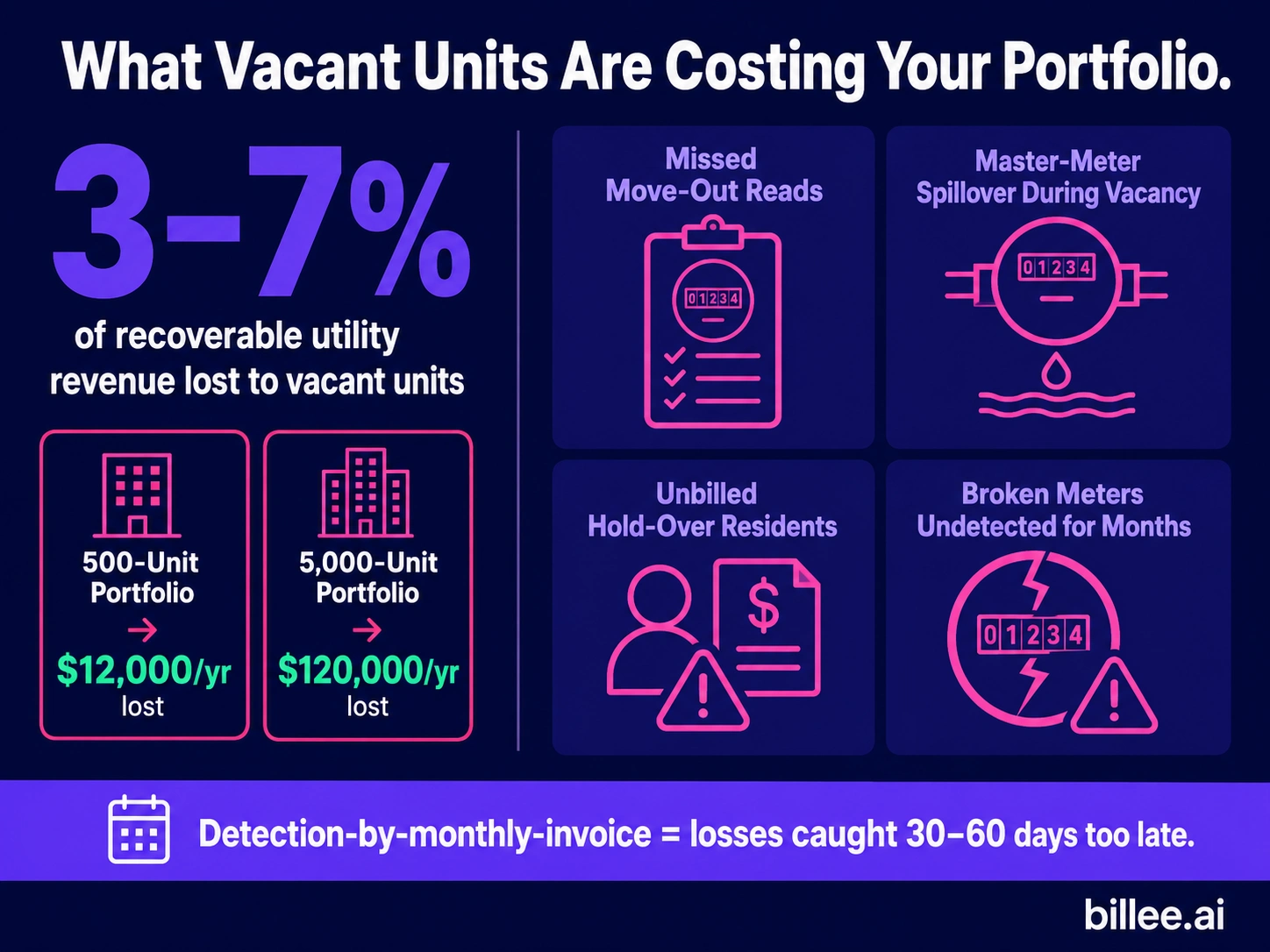
- No independent, external study currently puts a fixed percentage on vacant-unit utility leakage; Billee's own portfolio data shows vacant units typically leak 3 to 7 percent of recoverable utility revenue.
- Multifamily operating margins are thin: NAA research shows 93 cents of every rental dollar goes to mortgage, operating costs, and property taxes combined, leaving roughly 7 cents for payroll, reserves, and profit.
- Billee's own benchmark treats an 80 to 95 percent recovery rate as strong performance and anything below 80 percent as a signal to investigate.
- Billee's VCR engine routes every exception to a named account team member who takes the action, not a dashboard alert nobody checks.
The problem this solves
Vacant units generate real utility costs even with nobody home. Flagship Realty Group advises owners to keep thermostats around 55°F in winter and 85°F in summer specifically to prevent burst pipes, since skipping that step can mean $10,000 or more in damage. Showings need lights and climate control on, make-ready work needs active power and water, and the final move-in inspection needs everything tested and working before a new resident gets a key.
A stuck toilet flapper or a slow HVAC condensate leak can run for weeks in a unit nobody is checking. A resident who leaves without a clean final read can go unbilled for the same reason: nobody was watching the meter.
National rental vacancy runs around 7.3%, per the U.S. Census Bureau's Q1 2026 report. Professionally managed apartment communities, the properties closest to Billee's own customer base, run tighter, at 4.8% according to CBRE for the same quarter. Every one of those vacant units is a unit where utility costs can run unchecked.
Multifamily margins do not leave room to shrug off a percentage point of leakage. NAA research on federally mortgaged properties puts 93 cents of every rental dollar toward the mortgage, operating costs, and property taxes: 46 cents to the mortgage, 27 cents to maintenance, insurance, and utilities, and 11 cents to property taxes, leaving roughly 7 cents for payroll, capital reserves, and profit. On a margin that thin, uncaptured utility revenue is not a rounding error.
No independent industry study currently puts a fixed percentage on vacant-unit utility leakage. Billee's own portfolio data shows vacant units typically leak 3 to 7 percent of recoverable utility revenue across a portfolio, and that gap moves real dollars out of net operating income, a dynamic explored in Billee's analysis of how VCR protects NOI.
How Vacant Cost Recovery works
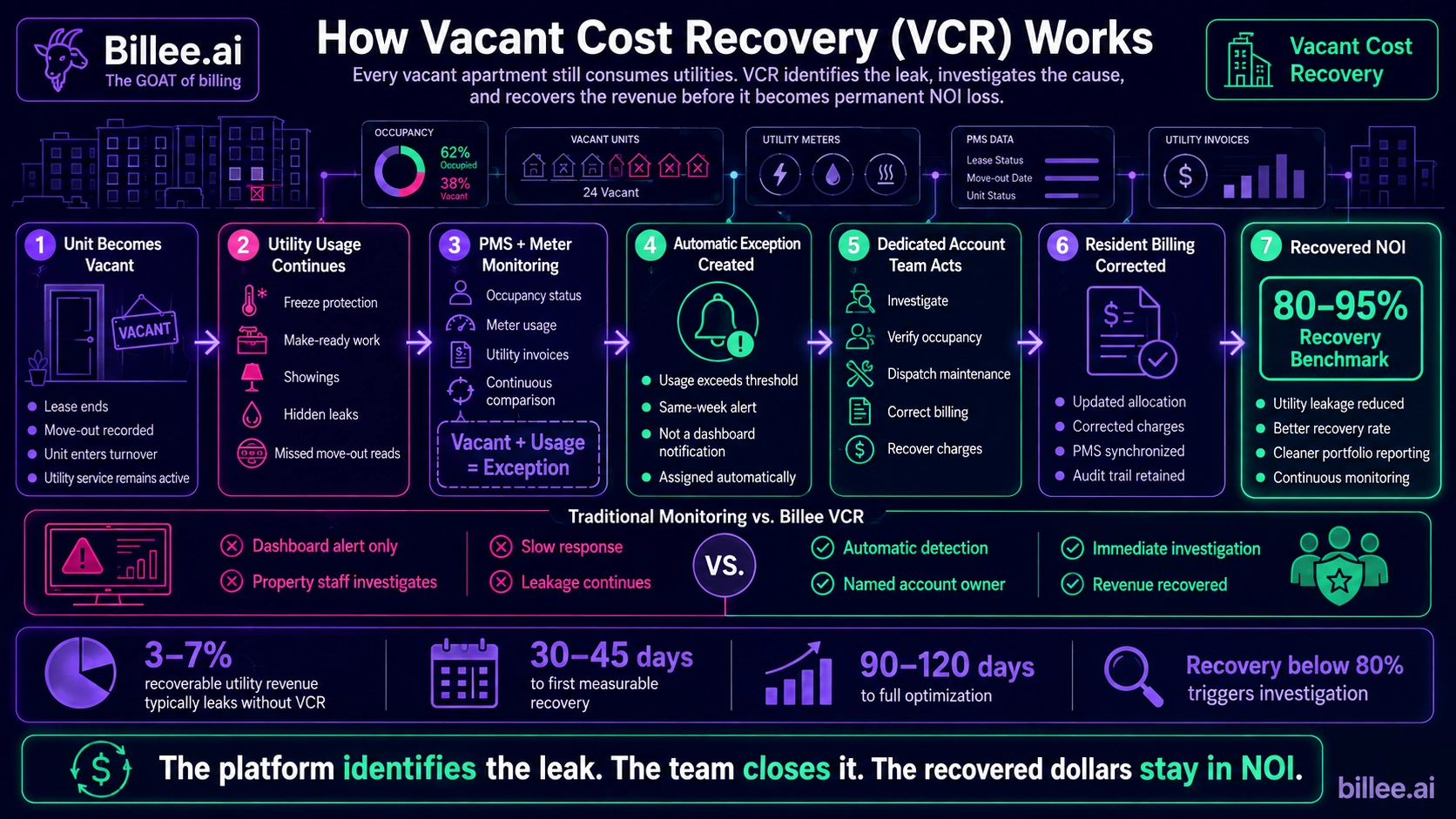
Billee's VCR engine watches every unit in the portfolio the same way, occupied or not. The engine continuously checks occupancy data pulled from the property's PMS against actual meter usage, so a unit marked vacant never quietly falls out of view.
When a vacant unit shows usage above a configurable threshold, more than 50 kWh in a billing cycle or any water usage at all, an exception generates within the same week. The exception routes directly to a named Billee account team member, not a dashboard someone has to remember to check. The account manager investigates, dispatches a vendor if needed, corrects the billing, and recovers the charges.
Most VCR tools surface the problem. Billee solves it. The distinction matters: software that flags an anomaly still leaves someone on the property team to chase it down, while Billee puts a person on the exception the same week it appears, a process detailed in Billee's guide to recovering utility costs from vacant units.
What's included
VCR includes continuous monitoring of occupancy, usage, and billing across every unit in the portfolio, not just the ones flagged as high-risk. The goal is prevention as much as recovery: catching a unit quietly draining NOI before it shows up as a bad number next month. None of this adds disruption for residents or extra work for the on-site team, since Billee's account team resolves the exceptions in the background. Move-in and move-out handling is built into the same workflow, so the unit gets watched at exactly the moments when billing errors are most likely to happen.
Outcomes you can expect
Most portfolios see first measurable recovery within 30 to 45 days of turning on VCR, one full billing cycle (Billee's standard timeline). Full program optimization, meaning threshold calibration by unit type and climate zone, typically takes 90 to 120 days before the engine is tuned to a specific portfolio's patterns, also a Billee benchmark.
Billee tracks recovery rate as the core performance metric on the customer dashboard. An 80 to 95 percent recovery rate is Billee's benchmark for strong performance, and anything below 80 percent is treated as a signal to investigate, whether the cause is vacancy, hardware and maintenance issues, or an allocation and CAD-deduction problem. The result compounds: VCR keeps closing the gap between what residents actually use and what actually gets billed, cycle after cycle.
How it integrates with your PMS
VCR pulls occupancy data directly from your property management system, working natively with Yardi, RealPage, and Entrata. No separate system is required for the property team to check, since the same PMS data your team already works in feeds the engine.
VCR also works with both submetered and RUBS-billed portfolios, so recovery is not gated behind a specific billing methodology. The same PMS connection also powers Billee's broader Billing & Recovery Engine, which automates resident utility billing, allocation, and AP posting, so vacant-unit recovery and everyday billing accuracy run through one relationship instead of two.
Who this is for
VCR fits any multifamily operator with measurable vacancy and recoverable utility costs, which in practice covers most portfolios. Three groups see the most value: high-turnover portfolios such as student housing, Class C, or build-to-rent, where vacancy is frequent and leakage compounds faster; operators heading into a refinancing or asset sale who need defensible, documented recovery numbers; and portfolios spread across multiple utility jurisdictions, where manual tracking gets complicated fast.
FAQ
What is Vacant Cost Recovery (VCR)?
Vacant Cost Recovery is the practice of monitoring and recovering utility costs that leak from vacant multifamily units, from HVAC left running to missed move-out meter reads. Billee's VCR engine automates that monitoring and routes exceptions to a dedicated account team member for action.
How does Billee's VCR engine detect a problem in a vacant unit?
The engine continuously checks occupancy data from the property's PMS against actual meter usage. When a unit flagged vacant shows usage above a configurable threshold, an exception generates within the same week.
How quickly can I expect to see recovered costs after starting VCR?
Most portfolios see first measurable recovery within 30 to 45 days, one full billing cycle. Full program optimization, including threshold calibration by unit type and climate zone, typically takes 90 to 120 days.
Does VCR work with RUBS-billed properties or only submetered ones?
VCR works with both submetered and RUBS-billed portfolios. Recovery is not gated behind a specific billing methodology.
What causes a vacant unit to rack up utility charges in the first place?
Common causes include HVAC left running for freeze or mold prevention, lights and climate control kept on for showings, and make-ready or maintenance work in progress. Leaks also go undetected more often in vacant units simply because no resident is there to notice them.
Is an 80 to 95 percent recovery rate realistic, or is that a marketing number?
Billee's 80 to 95 percent figure is its own portfolio benchmark, tracked and surfaced directly on the customer dashboard, not an external marketing claim. Recovery below 80 percent is treated as a signal to investigate, not a footnote.
Does VCR require new hardware or meters?
VCR is built to run on data Billee already has: occupancy from your PMS and meter usage from the billing cycle Billee already processes, whether that is master-meter or submeter data. In most portfolios that means no new hardware, though the exact answer depends on how granular your existing metering setup is, so it is worth confirming with your account team during setup.
Billee runs Vacant Cost Recovery across the whole portfolio, from detection through recovery. The engine flags exceptions, the team takes action, and the recovered revenue lands in NOI. See how it works.
Sources
- Flagship Realty Group, "Why Rental Property Owners Should Keep Utilities On Before Tenant Move-In," accessed 2026.
- U.S. Census Bureau, "Quarterly Residential Vacancies and Homeownership, Q1 2026," April 2026.
- CBRE, "Multifamily Vacancy Rate Falls Amid Rebounding Demand, Q1 2026 US Multifamily Figures," April 2026.
- National Apartment Association, "Research Finds 93 Cents of Every Rent Dollar Keep Apartments Running," September 2023.
Insights and Industry Trends