
PUC Disclosure Requirements for Multifamily Utility Billing: What Must Appear on Every Statement
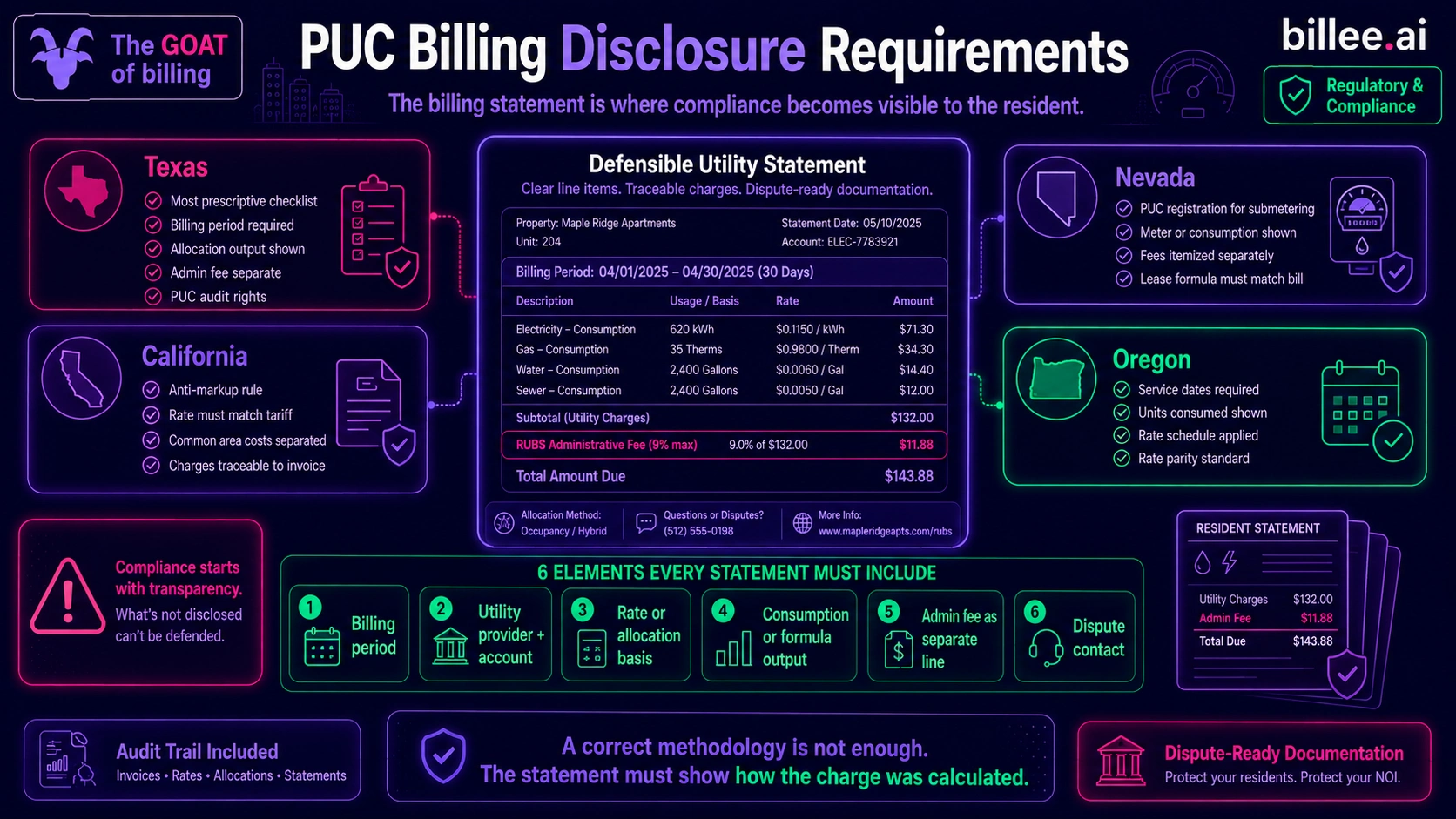
State Public Utility Commissions set the floor for what must appear on utility billing statements issued to multifamily residents. Texas, California, Nevada, and Oregon have codified specific line-item requirements covering billing period, rate or allocation basis, consumption figures, and administrative fee disclosure. In states with no PUC-specific billing rule, operators still face consumer protection exposure when statements omit or obscure the basis for the charge. The universal minimum (billing period, utility provider and account reference, rate or allocation formula applied, consumption or formula output, administrative fee as a separate line item, and a dispute contact) is what makes any billing statement defensible in any state. Billee's billing platform generates statements that meet PUC requirements in regulated states and applies the universal disclosure floor in all others.
Key Takeaways
PUC billing disclosure requirements for multifamily apply to the billing statement itself: what line items must appear, how charges must be labeled, and how fees must be separated from utility costs. Meeting the disclosure floor is distinct from having a correct allocation methodology.
Texas Chapter 291 is the most prescriptive: the billing statement must separately itemize the base utility cost, the resident's allocated share, and the administrative fee. The Texas PUC can audit compliance, and residents have a statutory right to request billing documentation.
California's CPUC requires that charges to residents in master-metered buildings be traceable to the utility invoice. Common area costs must be separated from resident-allocated costs in the statement; a blended charge that combines both is a CPUC violation. California also prohibits landlords from charging a per-unit rate that exceeds what the utility company charged them.
In states with no PUC billing rule, the lease addendum and the billing statement together form the compliance framework. A statement that does not match what the lease addendum described is contractually defective and creates a consumer protection claim regardless of state.
Submetered properties face stricter disclosure requirements than RUBS properties in most states: the billing statement must show the meter reading, consumption units, rate applied, and resulting charge, the same elements that appear on a utility company's own bill.
The single most common disclosure gap is the administrative fee: operators frequently bundle it into the utility charge rather than itemizing it, which is a statutory violation in Texas, unenforceable in Nevada, and a consumer protection exposure in every other state.
What PUC Disclosure Requirements Are and Why They Apply to Multifamily
Public Utility Commissions regulate utility service within their states, historically focusing on the relationship between utility companies and their customers. As submetering and ratio utility billing expanded in the multifamily industry, PUC authority extended to cover landlords who re-bill utility costs to residents.
The distinction matters: when a utility company bills a property owner, the PUC regulates that bill. When the property owner then bills residents, they are acting as a billing intermediary. Several states have determined that this intermediary role carries its own disclosure obligations, separate from and in addition to what the utility company must disclose on its own invoice.
The billing statement is where compliance becomes visible to the resident. An allocation methodology that is correctly configured in the back office is still a compliance failure if the statement does not show the resident how the charge was calculated.
The practical consequence for multifamily operators is that having the right RUBS formula or a calibrated submeter is necessary but not sufficient. The billing statement itself must carry the information that makes the charge verifiable. States with PUC rules specify exactly which information is required; states without PUC rules still expect it under general consumer protection standards.
States With Specific PUC Billing Disclosure Rules
A minority of states have enacted billing statement requirements at the PUC level. In these states, omitting a required line item is a statutory violation, not merely a disclosure best-practice failure.
Texas: The Most Prescriptive Billing Statement Checklist
Texas Utilities Code Chapter 291 specifies required billing statement elements for both submetered and RUBS properties. For a submetered property, the statement must show: the billing period (start and end dates), the meter reading at the beginning and end of the period, the units consumed, the rate applied, the calculated utility charge, and the administrative fee as a separate line item.
For a RUBS property, the statement must show: the total utility cost for the billing period, the resident's allocation percentage or formula output, the dollar amount allocated to the resident, and the administrative fee as a separate line. Bundling the administrative fee into the utility allocation without separate disclosure violates the statute. The Texas PUC has enforcement authority and operators must retain billing records sufficient to respond to PUC audit requests.
Texas also gives residents a formal avenue for billing disputes: residents can file a complaint with the Texas PUC if they believe their billing statement does not meet Chapter 291 requirements. Operators who receive a PUC complaint must produce billing documentation that demonstrates compliance with the statement format rules. Operators without complete records are in a structurally weak position in that process.
California: CPUC Rules and the Anti-Markup Requirement
California's CPUC regulates submetered residential properties under Rules 11 and 12, which specify the content of billing statements issued to residents. The statement must show: the meter reading at the start and end of the billing period, the units consumed (kWh, gallons, or therms), the rate schedule applied, and the calculated charge. The rate schedule must match the tariff under which the landlord is billed by the utility company.
California imposes an anti-markup rule that does not exist in most other states: the per-unit rate charged to the resident may not exceed the rate the landlord paid the utility company. A landlord who pays $0.14 per kWh under a commercial tariff cannot bill residents at $0.16 per kWh, even if the difference is framed as an administrative fee embedded in the rate. The fee must be disclosed separately and the base rate must match the utility tariff.
For master-metered RUBS properties, the CPUC requires that common area utility costs be excluded from the resident allocation unless they are disclosed as a separate line item. A billing statement that shows a single allocation amount without distinguishing resident-caused consumption from building-wide usage is a CPUC violation. California Civil Code Section 1940.9 adds the pre-lease disclosure obligation on top of the billing statement requirements, so a RUBS property in California must meet requirements at two points: before the lease is signed and on every billing statement thereafter.
Nevada: NV PUC Registration and Billing Standards
Multifamily operators who submeter in Nevada must register with the Nevada Public Utilities Commission before issuing submetered billing statements to residents. Registered submeterers must issue statements that show: the billing period, the meter reading or consumption units, the rate applied, and the resulting charge. Administrative fees must be disclosed as a separate line item.
Nevada's registration requirement means the PUC maintains a record of submetered properties and can audit billing practices. Unregistered submetering carries a separate penalty exposure beyond any billing statement deficiency. For RUBS properties, Nevada Administrative Code Chapter 392 requires the allocation method to be stated in the lease addendum, and the billing statement must reflect that method; a statement that uses a different formula than the lease discloses is defective under both the PUC framework and standard contract law.
Nevada does not impose an anti-markup rule for submetered properties, unlike California, but it does require that fees be itemized. An administrative fee that is embedded in a per-unit rate rather than shown as a separate charge is unenforceable in a Nevada billing dispute.
Oregon: Oregon PUC and the Landlord-Tenant Billing Standard
Oregon's PUC rules for submetered residential properties require that billing statements show: the service dates (billing period), the units consumed, and the rate schedule applied. Oregon also applies a rate-parity standard similar to California's: the per-unit rate on the resident's statement may not exceed the rate the landlord was charged by the utility company. This parity requirement is codified in Oregon PUC rules for submetered properties and is distinct from the general landlord-tenant disclosure requirements in ORS Chapter 90.
Oregon does not have a RUBS-specific PUC rule. For RUBS properties in Oregon, the governing framework is ORS Chapter 90, which requires that any utility cost charged to a resident be described in the rental agreement and that the billing methodology be disclosed. The combination of the rental agreement disclosure requirement and Oregon's strong consumer protection statute (ORS Chapter 646) creates meaningful exposure for Oregon operators whose statements do not clearly show the basis for the charge, even without a state RUBS statute.
The Universal Disclosure Floor: Six Elements Every Statement Must Include
Regardless of whether the state has enacted PUC billing rules, these six elements make a utility billing statement legally defensible.
The billing period. The statement must show the start and end dates of the period being billed. A statement that shows only a month name ("May utilities") without specific dates creates ambiguity about what consumption period the charge covers, which is the most common technical defect in billing disputes.
The utility provider and account reference. The statement should identify the utility vendor and the account or meter number associated with the charge. For RUBS properties, this is the master account from which the allocation derives. For submetered properties, it is the submeter identifier. This makes the charge traceable to the underlying utility invoice.
The rate or allocation basis. For submetered properties, the rate per unit applied ($/kWh, $/gallon, $/therm). For RUBS properties, the allocation formula and the variables used (number of occupants, unit square footage, or hybrid). The resident must be able to see how the dollar amount on the statement was produced.
The consumption or formula output. For submetered properties, the units consumed during the billing period. For RUBS properties, the resident's allocation percentage or the formula output that produced their share. This is the number that, combined with the rate or formula basis, explains the total charge.
The administrative fee as a separate line item. The fee must appear distinctly from the utility charge. It may be shown as a flat dollar amount or a percentage of the utility charge, but it must be visible as a separate entry. A statement that shows a single total with no fee breakdown is defective in Texas, unenforceable in Nevada, and a consumer protection exposure in every other state.
A dispute contact. The statement should include the name, phone number, or email address the resident can use to ask questions or challenge a billing statement. In Texas, this is a statutory requirement; in other states, the absence of a dispute contact makes the billing process appear designed to prevent challenges rather than resolve them.
Submetered vs RUBS: How Disclosure Requirements Differ
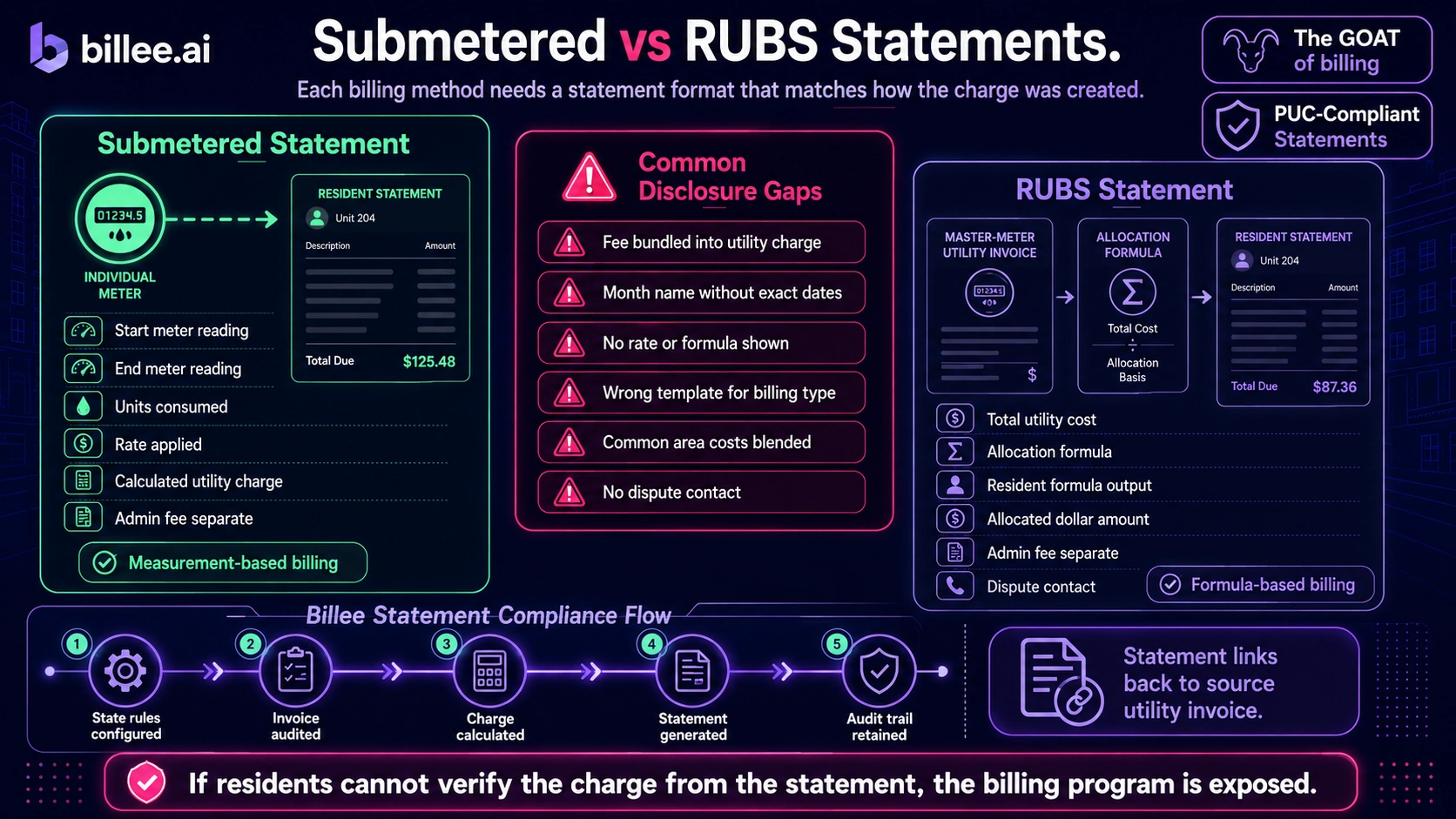
Submetered billing statements must mirror the structure of a utility company's own bill because the charge is based on individual consumption measured at a meter. The statement needs: a meter reading, a consumption figure in units, a rate applied to those units, and a resulting charge. States with PUC rules for submetering are essentially requiring that landlords issue bills that look like utility bills.
RUBS billing statements operate differently because there is no individual meter reading. The charge is based on a formula applied to a shared cost. The disclosure obligation is about making the formula visible: showing the resident the total cost being allocated, the formula used, and the calculation that produced their specific share.
The common mistake is applying a submetered statement template to a RUBS program, or a RUBS template to a submetered program. A submetered resident who receives a statement showing an "allocation percentage" instead of a meter reading cannot verify their bill. A RUBS resident who receives a statement showing kWh consumed when there is no individual meter has been given false information.
For operators running both billing types across a portfolio, each property's billing format must match its actual billing methodology. A management company that uses a single statement template for all properties creates a disclosure mismatch at every property where the template does not match the billing type.
Common Disclosure Gaps That Create Compliance Risk
Three gaps appear consistently in billing disputes and regulatory complaints.
The administrative fee is the most common gap. Operators who set up billing programs frequently bury the fee inside the utility allocation rather than showing it as a separate line item. This is a statutory violation in Texas, unenforceable in Nevada, and a basis for consumer protection claims in states with private rights of action. It also prevents the resident from knowing how much of what they are paying is for utility cost versus management overhead.
The billing period is the second most common gap. Statements that show a month name without specific dates leave open the question of whether the billing period aligns with the utility company's billing cycle or with some other interval the operator has defined. In submetered properties, a mismatch between the utility company's billing period and the operator's billing period means the consumption figure on the resident's statement may not match any verifiable underlying invoice.
Rate or formula transparency is the third gap. Residents who receive a dollar amount without being shown the rate or formula that produced it cannot verify the charge without requesting additional documentation. In states with active tenant advocacy, residents who cannot verify their bills from the statement itself are more likely to file formal complaints. The invoice audit process that catches billing errors before payment also generates the documentation that makes billing statements verifiable; operators who run a structured audit have the underlying data to support every line on the statement.
How Billee Generates PUC-Compliant Billing Statements
Billee's billing platform configures statement formats at enrollment to match the requirements of each state's regulatory framework. Texas properties receive statements that meet Chapter 291's itemization requirements; California properties receive CPUC-compliant statements with the anti-markup check and common area cost separation built into the billing calculation. Nevada properties follow the NV PUC registration and statement format requirements.
For properties in states with no PUC-specific billing rule, Billee applies the universal disclosure floor: billing period with specific dates, utility provider and account reference, rate or allocation basis, consumption or formula output, administrative fee as a separate line, and dispute contact. This format is defensible in any consumer protection proceeding regardless of state.
Billee's utility vendor management platform retains the underlying utility invoices that support each billing statement. When a resident or a PUC inquiry requests documentation, the audit trail runs from the billing statement back to the original invoice. Operators who use Billee for AP automation have both the compliant statement format and the underlying documentation to support it at every billing cycle.
Implementation takes 45 days. Vendor onboarding, state-specific billing configuration, and PMS integration are handled by the Billee team.
Billee configures utility billing statements to meet PUC requirements in every state where a portfolio operates, with the documentation to support every line item. See how it works for your portfolio.
FAQ: PUC Disclosure Requirements for Multifamily Utility Billing
What are PUC disclosure requirements for multifamily utility billing?
PUC (Public Utility Commission) disclosure requirements specify what information must appear on utility billing statements issued to multifamily residents. In states with specific PUC rules, including Texas, California, Nevada, and Oregon, the requirements cover billing period, consumption or allocation figures, the rate or formula applied, and administrative fees shown as separate line items. In states without PUC-specific rules, general consumer protection law applies, and statements that omit the basis for the charge create exposure under those statutes.
What must appear on a utility billing statement for apartment residents?
Every defensible utility billing statement must include six elements: the billing period with specific start and end dates; the utility provider and account reference; the rate applied (for submetered) or allocation formula (for RUBS); the consumption in units (for submetered) or the formula output showing the resident's share (for RUBS); the administrative fee as a separate line item; and a dispute contact the resident can reach with questions. These six elements apply regardless of state PUC rules.
What is the Texas PUC billing statement requirement for RUBS or submetered properties?
Texas Utilities Code Chapter 291 requires RUBS billing statements to show the total utility cost for the period, the resident's allocation percentage or formula output, the resulting dollar amount, and the administrative fee as a separate line not bundled into the utility charge. For submetered properties, the statement must show meter readings, units consumed, rate applied, and the calculated charge, plus the administrative fee separately. The Texas PUC has enforcement authority and operators must retain documentation sufficient to respond to audit requests.
Can a landlord charge more per unit than the utility company charges them?
In California and Oregon, no. Both states have rate-parity rules: the per-unit rate charged to residents may not exceed the rate the landlord paid the utility company under its tariff. An operator in California who pays $0.14 per kWh cannot bill residents at $0.16 per kWh, even if the difference is characterized as a fee. Administrative fees must be disclosed separately and the base utility rate must match the tariff. Most other states do not have an explicit anti-markup rule, but undisclosed markups embedded in the per-unit rate are challengeable under consumer protection law in any state.
What happens if a utility billing statement does not meet PUC disclosure requirements?
In states with specific PUC rules, including Texas, California, and Nevada, a noncompliant statement gives residents the right to file a formal complaint with the PUC. The operator must respond with documentation demonstrating compliance; failure to produce that documentation exposes the operator to PUC enforcement action. In all states, a billing statement that does not disclose the basis for the charge is defective under consumer protection law, and residents can challenge the charge in small claims court or through a state attorney general complaint. The practical consequence is that disclosure gaps are not low-probability risks; they are predictable outcomes whenever a billing dispute arises.
Sources
Texas Legislature, "Utilities Code, Chapter 291: Submetering and Non-Submetered Master Metered Utility Service," accessed July 2026.
California Public Utilities Commission, "General Order 103-A: Rules Governing Submetering of Electrical Service," accessed July 2026.
California Legislative Information, "Civil Code Section 1940.9," accessed July 2026.
Nevada Legislature, "Nevada Administrative Code, Chapter 392: Landlord and Tenant," accessed July 2026.
Zego, "The Top 3 Utility Accounts Payable Mistakes Multifamily Companies Make," 2025. (Cites ENGIE Impact audit finding: at least 17% of utility invoices contain a billing error.)
Insights and Industry Trends