
North Carolina RUBS and Utility Billing Rules: What the NCUC Requires of Landlords
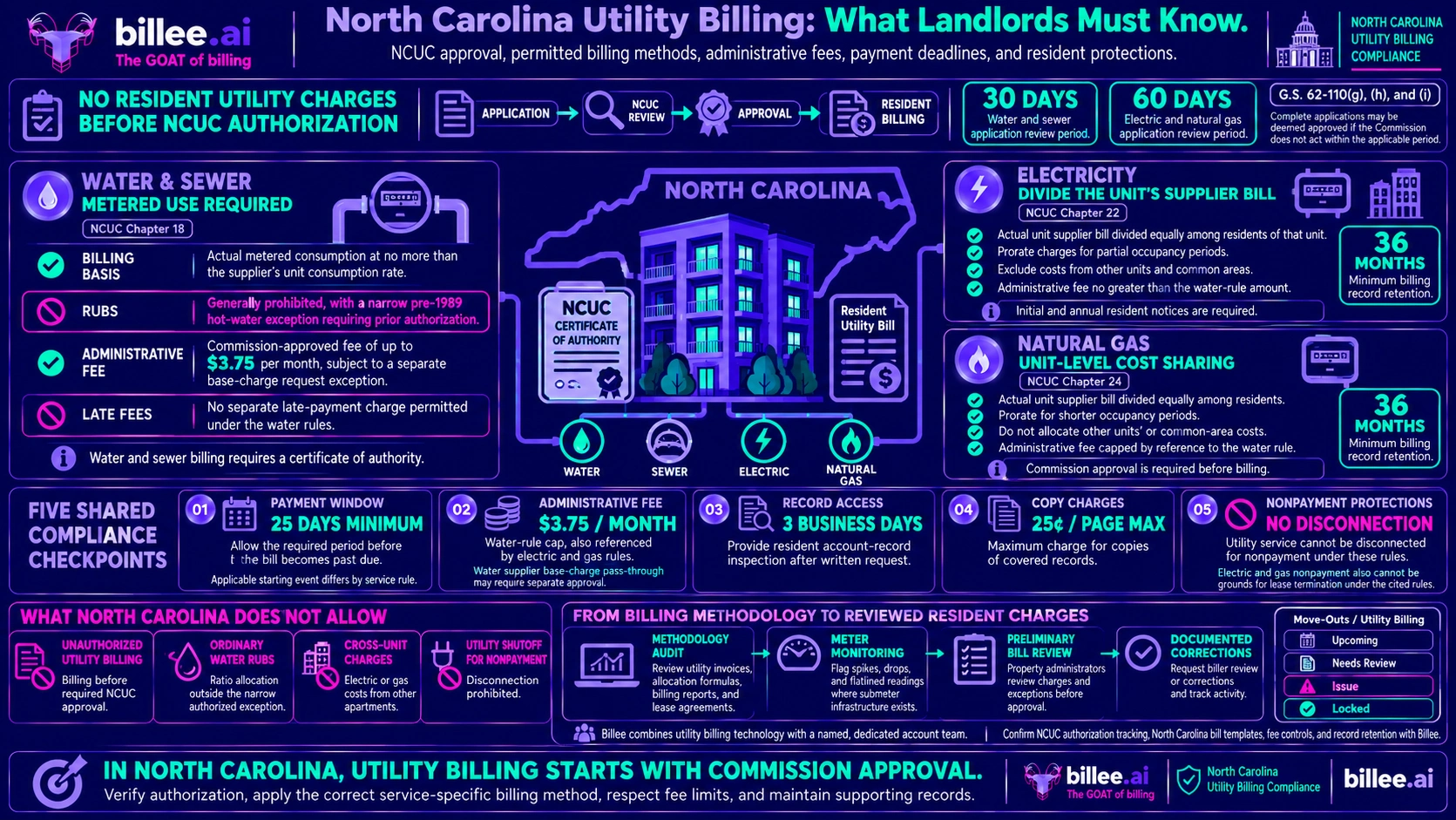
North Carolina regulates a landlord that bills residents for water, sewer, electric or gas. The landlord needs Utilities Commission approval before charging, and water charges must follow metered use. The Commission caps the administrative fee at $3.75 a month and bars RUBS except for a narrow method in contiguous units built before 1989. Billee Technologies, Inc. audits billing methodology against rules like these.
North Carolina treats landlord utility billing as a regulated activity, not a lease detail. The rules reach approval, the billing basis, the fee line, the bill layout, the records file and disconnection, and water, electric and gas each have their own rule chapter. This guide sets out what the statute and the Commission require, where the rules go quiet and how to get ready. It is not legal advice.
Key takeaways
- G.S. 62-110 and the North Carolina Utilities Commission (NCUC) rules let a landlord charge residents for water, sewer, electric or natural gas only with Commission approval.
- Water and sewer charges must be based on metered use at the supplier's rate. RUBS is not allowed, apart from a narrow hot-water method for contiguous units built before 1989 with the Commission's prior authorization.
- The water administrative fee may not exceed $3.75, and the electric and gas rules cap their fee at the same water amount. No late charge is allowed on water bills.
- Electric and gas bills divide the unit's supplier bill equally among the residents of the unit, prorated for partial periods, with no cost from other units or common areas.
- A provider may not disconnect service for nonpayment. For electric and gas, a provider also may not terminate a lease for nonpayment of that service.
- Bills must allow at least 25 days to pay. Electric and gas records must be kept at least 36 months, and residents can review their records within three business days of a written request.
North Carolina utility billing rules at a glance
| Item | Water and sewer | Electric | Natural gas |
|---|---|---|---|
| Rules | G.S. 62-110(g); NCUC Chapter 18 | G.S. 62-110(h); NCUC Chapter 22 | G.S. 62-110(i); NCUC Chapter 24 |
| Billing basis | Metered use at the supplier's rate; narrow pre-1989 hot-water exception | Unit's supplier bill divided equally among its residents | Same as electric |
| Approval | Certificate of authority before charging; 30-day review, then deemed approved | Commission approval; 60-day review, then deemed approved | Same as electric |
| Administrative fee | Not to exceed $3.75 a month | No greater than the water amount | No greater than the water amount |
| Late charge | None | Capped by Commission rule; NCUC form says 1% a month | Same as electric |
| Returned check | Up to the G.S. 25-3-506 maximum | Same; NCUC form says $25 | Same; NCUC form says $25 |
| Records | Kept at an onsite or North Carolina office; R18-5 states no retention period | At least 36 months | At least 36 months |
| Nonpayment | No disconnection | No disconnection; no lease termination | No disconnection; no lease termination |
Who regulates a landlord's utility billing
The North Carolina Utilities Commission (NCUC) regulates landlords that bill residents for utility service. G.S. 62-110 lets the Commission set procedures for a lessor to charge lessees for water and sewer in subsection (g), electric in (h) and natural gas in (i). The statute and rules call the landlord the lessor and the resident the lessee.
Session Law 2017-172 added natural gas in 2017. Billee's state-by-state RUBS guide shows how North Carolina compares with other states.
Approval comes before the first charge. Under Rule R18-3, a provider of water or sewer service may not charge until the Commission grants a certificate of authority, and the rule describes the provider as a public utility under the Public Utilities Act. The Commission approves or disapproves a complete application within 30 days. If it does not act, the application is deemed approved.
Electric and gas run on a 60-day clock. Under G.S. 62-110(h) and (i), the Commission must approve the application before billing starts, and a complete application is deemed approved if no order issues within 60 days. Form GR-1, the gas application, asks for a Secretary of State certification for business entities, a warranty deed, a vicinity map, the supplier's rate schedule, a billing statement template and the lease forms.
Regulation has a cost, but not a bond. The water rule requires no bond, and landlords using these provisions are not required to file annual reports under G.S. 62-36.
The NCUC forms list a filing fee under G.S. 62-300 by annual revenue class: $250 for revenues of $1,000,000 or more, $100 for $200,000 to $1,000,000 and $25 below $200,000, as shown on Form GR-1 and on Form WRN-1. Providers also file regulatory fee reports and pay the fee under Rule R15-1.
Water and sewer: metered billing, and where RUBS stops
Charges follow metered use. Under G.S. 62-110(g)(1), water and sewer charges rest on metered consumption, and the rate cannot exceed the supplier's unit consumption rate. Rule R18-6 states that RUBS and hot water capture, cold water allocation are not allowed, subject to one exception in the statute and Rule R18-8. Billee's guide to how RUBS allocates utility costs explains the formulas this rule shuts out.
The exception is narrow. G.S. 62-110(g)(1a) applies to contiguous dwelling units built before 1989 where measuring total use is "impractical or not economical." There the landlord may allocate cost by individually submetered hot water use, and Rule R18-8 requires the Commission's prior authorization. The conditions are strict:
- No RUBS or other allocation unless it relies on submetered hot water.
- No billing of common-area water, main leaks or excess caused by a plumbing malfunction.
- Metering equipment must comply with American Water Works Association (AWWA) standards.
- Records must be kept at least 12 months, open to resident inspection on advance written notice.
- Bills must show the amount, the method, the period dates, a past-due date at least 25 days after mailing and a phone number and address.
Common-area use comes out first. Rule R18-8 sets four ways to take common-area water out of the pool before allocating. The first is a default 20% reduction in the water purchased. The second uses actual metered common-area use, reported quarterly. The third subtracts 15% for irrigation and 5% for each pool or laundry room, and the fourth mixes methods. The bill must state which one the landlord uses.
The 15-unit figure is a definition. Rule R18-2 defines a lessor as an owner of 15 or more dwelling units available for lease, and an apartment complex as one or more buildings under common ownership with 15 or more apartments. Read that as a definition, not a safe harbor, and ask counsel before relying on it. Billee's guide to states that ban or restrict RUBS sets this against other states.
Fees, bills and disputes for water and sewer
The fee line is short. Rule R18-6 allows a Commission-approved administrative fee "not to exceed $3.75" on top of the cost of purchased water and sewer service. A provider without a separate resident base charge may ask to pass the supplier's base charge into the administrative fee, which can push the monthly total above $3.75. That takes a separate request.
| Item | Water and sewer rule |
|---|---|
| Administrative fee | Not to exceed $3.75; higher total only through the base-charge request |
| Late charge | None beyond the R18-6 rate |
| Connection or disconnection charge | None |
| Returned check | Up to the G.S. 25-3-506 maximum |
| Disconnection | Not allowed for nonpayment |
| Billing frequency | At least monthly |
| Due date | At least 25 days after the billing date |
| Rate changes | On 14 days' notice |
| Record review | Within three business days of a written request; copies at no more than 25¢ a page |
Rule R18-7 adds three more duties. Bills may not include excess from a plumbing malfunction that is unknown or reported. Residents get notices at lease signing, and the notices are posted in the office. Bills carry a toll-free number.
For a dispute, the rule sends the resident to the provider first and then to the NCUC Public Staff. Records sit at the onsite office or a North Carolina office, open to the Commission and the Public Staff. Rule R18-5 states no retention period for ordinary water records.
Electric and gas: an equal split per unit
One supplier bill, divided equally. Under G.S. 62-110(h) and (i), a landlord with individually metered units in its own name can apply to bill electric or gas. It divides the actual amount of the unit's supplier bill equally among the residents of that unit and prorates for anyone who leased for fewer days. Rules R22-5 and R24-5 bar charging the cost of any other unit or common area.
The fee line matches water. The administrative fee cannot exceed the water amount in Rule R18-6, which NCUC's Form ER-1 for electric and Form GR-1 put at $3.75 a month. Both forms put the late payment charge at no more than 1% a month on the balance in arrears, and the returned check charge at no more than $25. The rules cap these by reference to Rule R12-9(d) and G.S. 25-3-506.
Bills carry set content. Under the statute, a bill shows the supplier's name, the usage dates, a past-due date at least 25 days after mailing, a local or toll-free number and address, any approved fees, and the resident's right to question the bill and complain to the Commission. If a lease runs by the bedroom, the bill also shows the unit-wide bill and the resident's share.
Records, payments and nonpayment. Providers keep records for at least 36 months. Residents can examine their account records within three business days of a written request, with copies at no more than 25¢ a page. Payments apply to rent first and then to the utility charge unless the resident directs otherwise. Providers may not disconnect, or ask the supplier to disconnect, and may not terminate a lease for nonpayment of electric or gas service.
Electric adds two duties. Rule R22-7 requires an initial and annual notice to residents about the billing arrangement. It also requires written notice to the Commission and affected residents within 24 hours if the provider expects to miss a supplier payment or receives a disconnection notice.
What the North Carolina rules do not say
- Billing vendors. The rules speak of the provider. The text read for this guide says nothing about whether a billing company needs its own authority, so ask counsel and the NCUC.
- Ordinary water record retention. Rule R18-5 states no period. The statute sets 12 months only for the pre-1989 hot-water exception.
- Small owners. The water rules define a lessor at 15 or more units. The electric and gas rules set no unit count.
- Gas notice duties. The 24-hour notice in Rule R22-7 is an electric rule. The gas chapter text read for this guide showed no matching provision, so confirm before assuming either way.
- Currency. The statute and rule chapters were read in November 2026. Check the official sites before changing a template.
How to get ready
- List every North Carolina property that bills water, sewer, electric or gas. Note the service, the billing basis and the year built.
- Confirm NCUC approval for each service. Find the certificate or approval, its date and any conditions.
- Check the water billing basis. Charges must follow metered use. A ratio formula needs the pre-1989 exception and prior authorization, or it should go.
- Review the fee line. Hold the administrative fee to $3.75 unless a base-charge request is approved. Remove any late charge, and any connection or disconnection charge, from water bills.
- Compare the bill to the rule. Check the due date, the toll-free number, the method statement and, for electric and gas, the supplier name, usage dates and complaint-right statement.
- Build the records file. Keep at least 36 months for electric and gas, and set a process for three-business-day review requests and 25¢ copies.
- Write the nonpayment procedure. No disconnection, no lease termination for electric or gas, and payments applied to rent first.
- Ask your billing company in writing. Ask who holds the approvals and files the fee reports.
How Billee Technologies helps
Billee Technologies pairs a platform with a named, dedicated account team. Your people review and approve. Billee's team does the work. For North Carolina, the job is showing that each bill matches the approval on file: the billing basis, the fee line, the layout and the records behind it.
Check the formula, the fees and the lease
Billee's Regulatory & Compliance service covers billing methodology audits, access to legal support and ongoing monitoring for rule changes. Access to legal support is not legal advice. Billee's guide to its regulatory and compliance support explains the scope.
A Billee audit reviews four required document categories for the same billing period: the current billing provider's reports, master meter invoices, lease agreements, and the property's W-9 and legal entity name. It surfaces methodology gaps, allocation drift, reconciliation problems and lease-language gaps. In North Carolina, allocation drift is where a leftover ratio formula would show up.
Billee's guide to preparing a billing methodology audit lists what reviewers ask for. Billee's 45-day standard implementation includes a methodology audit of formulas, submeter configuration and allocation logic. Whether the audit checks each property's NCUC approval and its conditions against billing practice is a question for Billee in writing.
Catch meter errors early
North Carolina ties water charges to metered use, so meter data carries the weight. Billee's Meter Monitoring raises alerts when a reading spikes, drops or flatlines, and the team acts on them. Read more in Billee's guide to meter monitoring and proactive alerts. Monitoring works on portfolios that already have submetering infrastructure.
Run each cycle with a paper trail
Each month Billee assembles utility data and produces a preliminary bill. Your billing administrator reviews it in the Billee portal next to Biller Highlights, the team's notes on exceptions, and can download a Detail Resident Report or an Itemized Report. Billee replies to comments within 1–2 business days, and an administrator can request a new report, which takes 1–2 business days.
After approval, Billee locks the report and charges post to the property management system's resident ledger on the set date. Residents receive e-bills. The activity log records every billing action, who performed it and when. Whether those reports and the log meet the 36-month retention rule for electric and gas, and the three-business-day review rule, is a question for Billee in writing.
Fix a bill after it goes out
If a bill has data problems, such as a missing meter read, it shows an Issue status, and an administrator can request a biller review, which takes 1–2 business days. After a bill is sent, an administrator can request a correction, also 1–2 business days, and the revised bill locks automatically when complete. Billee's guide to handling resident utility bill disputes covers the resident side. North Carolina sends a water dispute to the provider first, so the correction path matters.
What to ask Billee for in writing
- How Billee tracks each property's NCUC approval and its conditions, and who holds the application, the fee reports under Rule R15-1 and any change notices.
- Whether Billee bills carry the items the rules list, including the toll-free number, a due date at least 25 days out, the method statement, and the supplier name, usage dates and complaint-right statement for electric and gas.
- How the administrative fee is applied and shown, and whether it is held to the $3.75 cap.
- How a billing basis other than metered use, such as a ratio formula inherited from a prior vendor, is found and handled at North Carolina properties.
- Whether Billee supports the pre-1989 hot-water exception, including common-area handling.
- How a resident's records request is answered within three business days, and how long billing records are kept.
- How an electric supplier-payment problem is escalated so the 24-hour notice can be met.
- How North Carolina rule changes reach your account team.
Who Billee is not for
- Portfolios under about 300 units, where Billee's full-service model is usually more than the job needs.
- Anyone looking for a legal opinion on how North Carolina's rules apply to a formula, lease or bill. Billee gives access to legal support, not legal advice, so involve counsel.
- Operators who want to run billing themselves with software alone. Billee's portal exists for review and approval, not self-service operation.
FAQ
Does North Carolina allow RUBS for apartment water bills?
Generally no. Rule R18-6 states that RUBS and hot water capture, cold water allocation are not allowed, and water charges must follow metered use. The one exception is G.S. 62-110(g)(1a): contiguous dwelling units built before 1989, allocated by individually submetered hot water use, with the Commission's prior authorization.
Do North Carolina landlords need NCUC approval to bill residents for utilities?
Yes, for water, sewer, electric and natural gas. A water or sewer provider needs a certificate of authority before charging. Electric and gas providers need the Commission's approval of their application, which is deemed approved if the Commission does not act within 60 days.
What is the maximum administrative fee a North Carolina landlord can charge?
For water and sewer, Rule R18-6 says the Commission-approved fee may not exceed $3.75. A separate request to pass the supplier's base charge through can produce a higher monthly total. The electric and gas rules cap their fee at the same water amount.
Can a North Carolina landlord bill residents for common-area water?
No. The pre-1989 hot-water exception bars billing common-area water, and the electric and gas rules bar the cost of any other unit or common area. Water charges otherwise rest on metered consumption.
Can a North Carolina landlord disconnect utilities for nonpayment?
No. The water, electric and gas rules bar a provider from disconnecting service for nonpayment. The electric and gas rules also bar terminating a lease for nonpayment of that service.
Can North Carolina landlords bill residents for natural gas?
Yes, with Commission approval. Session Law 2017-172 added natural gas to G.S. 62-110, and the application is Form GR-1. The unit's supplier bill is divided equally among the residents of the unit.
How long must North Carolina landlords keep utility billing records?
At least 36 months for electric and gas. The statute sets at least 12 months for the pre-1989 water exception, and Rule R18-5 states no general period for water. Residents can examine their account records within three business days of a written request.
Do North Carolina's utility billing rules apply to small landlords?
The Commission's water rules define a lessor as an owner of 15 or more dwelling units available for lease. The electric and gas rules set no unit count. Owners with fewer units should ask counsel before assuming an exemption.
Billee handles utility billing, vacant cost recovery and vendor management for multifamily operators who want a dedicated team behind the software. If you bill water, electric or gas in North Carolina, talk to the team about your portfolio.
Sources
- North Carolina General Assembly, "N.C. Gen. Stat. § 62-110 (certificate of public convenience and necessity; lessor billing, subsections (g) to (j))," accessed November 2026.
- North Carolina General Assembly, "Session Law 2017-172 (House Bill 799)," accessed November 2026.
- North Carolina Utilities Commission, "Chapter 18, Water and Sewer Service by Lessors (Rules R18-1 to R18-8)," accessed November 2026.
- North Carolina Utilities Commission, "Form GR-1, Application for Certificate of Authority to Resell Natural Gas Service to Lessees," accessed November 2026.
- North Carolina Utilities Commission, "Form WRN-1, Application for Water Service by a Single-Family Rental Lessor," accessed November 2026.
- North Carolina Utilities Commission, "Chapter 22, Electric Service by Lessors," accessed November 2026.
- North Carolina Utilities Commission, "Chapter 24, Natural Gas Service by Lessors," accessed November 2026.
- North Carolina Utilities Commission, "Form ER-1, Application to Resell Electric Service to Lessees," accessed November 2026.
Insights and Industry Trends