

New York Submetering Rules: What Multifamily Operators Need to Know
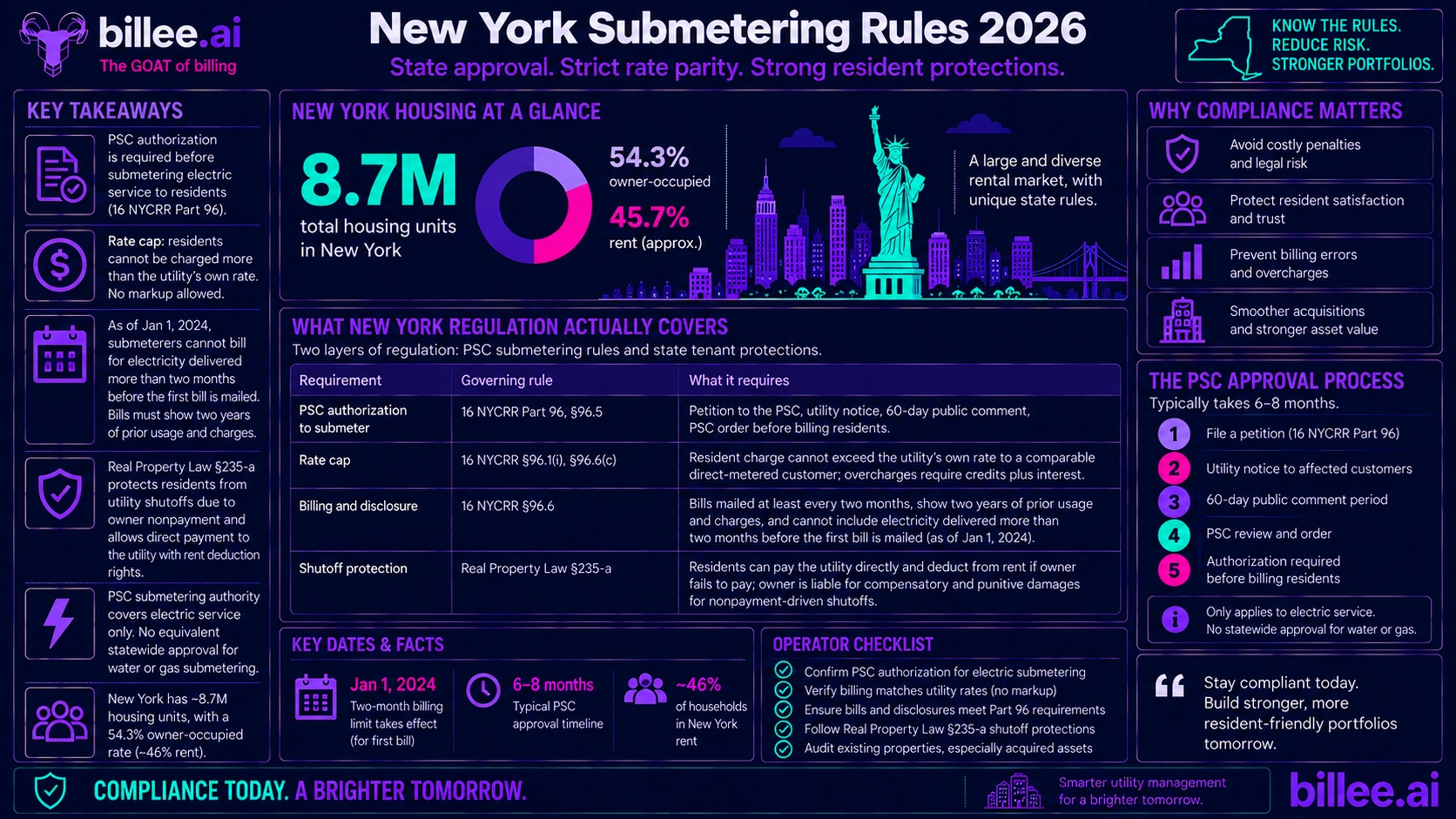
New York is one of the few states that regulates submetering through an actual state agency approval process rather than landlord-tenant law. An owner who wants to submeter electric service to residents must petition the Public Service Commission under 16 NYCRR Part 96 and get authorization before billing a single resident, a process that typically takes six to eight months. Separately, New York Real Property Law protects residents in any master-metered building, electric or otherwise, from losing gas, electric, steam, or water service when an owner stops paying the bill. Billee's Regulatory & Compliance service tracks New York portfolios against both layers, since missing either one carries real exposure.
Quick answer
New York regulates residential electric submetering through the Public Service Commission (PSC) under 16 NYCRR Part 96, which requires an owner to file a petition and receive PSC authorization before submetering any building, plus a rate cap that limits residents to no more than what the local utility would charge a comparable direct-metered customer. Separately, New York Real Property Law Section 235-a protects residents in master-metered buildings from utility shutoffs caused by an owner's nonpayment, regardless of fuel type, and lets residents pay the utility directly and deduct it from rent. New York does not regulate water or gas submetering through the same PSC approval process; that authority is specific to electric service.
Two things determine compliance: whether the building has PSC authorization to submeter electric service at all, and whether the billing, disclosure, and record-keeping practices match what Part 96 requires once that authorization is in place.
Key takeaways
- New York requires PSC authorization before an owner can submeter electric service to residents, under 16 NYCRR Part 96. The petition process typically takes six to eight months and includes a 60-day public comment period.
- The submetering rate cap is strict parity with the utility's own rate: a submeterer cannot charge a resident more than the local distribution utility would charge a similarly situated, direct-metered residential customer. No percentage markup is authorized on top of that.
- As of January 1, 2024, submeterers cannot bill residents for electricity delivered more than two months before the first bill is mailed, down from a prior six-month allowance, and invoices must show two years of prior usage and charges.
- New York Real Property Law Section 235-a lets residents in a master-metered building pay the utility directly and deduct it from rent if the owner stops paying, and it exposes the owner to compensatory and punitive damages for a nonpayment-driven shutoff.
- PSC submetering authority under Part 96 covers electric service specifically. New York has no equivalent statewide approval regime for water or gas submetering.
- New York has roughly 8.7 million housing units, with a 54.3% owner-occupied rate, meaning close to 46% of households rent, one of the highest renter shares of any state with a dedicated state guide on this site.
Why this matters for multifamily operators
New York's approach puts real teeth behind the submetering approval step itself. Submetering without PSC authorization isn't a paperwork gap the way a missing lease disclosure might be elsewhere; it's billing residents for a service the state hasn't cleared the building to sell. An owner who inherits a submetered building through acquisition and has never confirmed the underlying PSC authorization is carrying exposure that predates their ownership.
The rate cap adds a second layer that's easy to miss. Billee's guide to how RUBS rules vary by state covers states that cap a markup percentage or an administrative fee. New York doesn't work that way: the cap is exact parity with the utility's own rate, so any service fee or administrative charge added on top of the commodity rate needs a separate legal basis, not just a documented calculation. A portfolio importing a markup model from a state that allows one risks building it directly into New York billing software.
What New York regulation actually covers
| Requirement | Governing rule | What it requires |
|---|---|---|
| PSC authorization to submeter | 16 NYCRR Part 96, §96.5 | Petition to the PSC, utility notice, 60-day public comment, PSC order before billing residents |
| Rate cap | 16 NYCRR §96.1(i), §96.6(c) | Resident charge cannot exceed the utility's own rate to a comparable direct-metered customer; overcharges require credits plus interest |
| Billing and disclosure | 16 NYCRR §96.6 | Bills mailed within 30 days of the utility bill; two years of usage history on invoices; six-year record retention; no time-of-use rates without resident agreement |
| Back-billing limit | 16 NYCRR §96.6 (amended 2024) | Cannot bill for electricity delivered more than two months before the first bill is mailed |
| Shutoff protection (all fuel types) | Real Property Law § 235-a | Residents may pay the utility directly and deduct from rent; owner liable for compensatory and punitive damages for a nonpayment shutoff |
Getting PSC authorization before submetering
An owner who wants to submeter electric service has to file a petition with the Secretary of the Commission, including a Submeterer Identification Form, and show proof that the local electric utility was notified of the intent to submeter. The case is noticed in the State Register for a mandatory 60-day public comment period before the PSC acts. The full process typically runs six to eight months, so it has to be planned well ahead of a conversion, not treated as paperwork that can be finished after residents are already being billed. Only PSC-approved metering equipment qualifies, and every submetered unit needs equipment capable of individual service termination, with a narrow exception for systems already in place before January 1, 2016. Billee's guide to how electric submetering works, step by step covers the installation side of meeting that equipment standard.
Staying inside the rate cap
Once authorized, a submeterer cannot charge a resident more than the local distribution utility would charge a comparable direct-metered residential customer for delivery and commodity that billing period. There is no separate percentage markup written into the rule. If a resident is overcharged, the PSC can direct the submeterer to issue credits plus interest. Bills must go out within 30 days of the submeterer receiving its own bill from the utility or energy services company, include two years of the resident's usage and charge history in both graph and written form, and cannot apply time-of-use rates unless the resident agreed to them. Since January 1, 2024, submeterers also cannot bill residents for electricity delivered more than two months before the first bill is mailed, down from a six-month allowance under the prior rule, and residential billing records have to be kept for six years.
Resident protections that apply regardless of authorization status
Real Property Law Section 235-a sits outside the PSC's submetering framework entirely and applies to any multiple dwelling, submetered or master-metered, for gas, electric, steam, or water. If an owner stops paying the underlying utility bill and service is at risk, residents can pay the utility directly under the applicable Public Service Law provisions and deduct that payment from future rent. If service is actually discontinued because the owner failed to pay, the owner becomes liable for compensatory and punitive damages. Submeterers separately have to provide residents the consumer protections in the Home Energy Fair Practices Act before pursuing collection or termination for nonpayment, and lease or offering-plan disclosures have to reference those protections. Billee's guide to utility billing transparency and resident rights covers how that disclosure obligation compares across other regulated states.
What New York does not regulate the same way
PSC authorization and the Part 96 rate cap apply to electric submetering specifically. New York has no equivalent statewide approval regime for water or gas submetering; those arrangements are governed by ordinary lease terms and the general protections in Real Property Law rather than a PSC petition process. Operators used to treating "submetering" as one regulatory category should not assume New York's electric-specific approval requirement extends to a building's water submeters.
Common mistakes
- Submetering electric service, or converting a building to submetering, before PSC authorization is final, rather than treating the six-to-eight-month process as a prerequisite to billing.
- Building a percentage markup or flat administrative fee into New York billing when the rate cap allows parity with the utility's rate only.
- Applying a submetered building's six-month back-billing assumption after the January 2024 change dropped the limit to two months.
- Assuming water submeters carry the same PSC approval requirement as electric submeters in the same building.
- Treating Real Property Law Section 235-a protections as specific to submetered buildings, when they apply to any master-metered building regardless of submetering status.
When to handle this in-house vs. bring in a partner
A single New York property with existing, confirmed PSC authorization and a property manager who tracks the rate cap and back-billing window closely can often stay compliant on its own. The authorization step itself is the harder lift: preparing a petition, coordinating utility notice, and carrying a building through a 60-day comment period is not a routine property-management task.
Across a multi-state portfolio, New York's requirements don't map onto a template built for states with a flat markup allowance or no approval process at all. Billee's complete guide to utility management compliance covers what that burden looks like across a full portfolio, not just New York.
How Billee can help
Billee's Regulatory & Compliance service confirms PSC authorization status for New York submetered buildings, audits billing against the rate cap and the two-month back-billing limit, and keeps a documented trail ready for a PSC inquiry, refinancing, or disposition. The audit checks the specific things a resident complaint or a PSC review would test: is the authorization current, does the billing match the utility's own rate for the period, and is the required usage history actually on the invoice.
Billee's account team also separates the submetering-specific requirements from the broader Real Property Law shutoff protections, since a portfolio can be fully authorized to submeter and still carry exposure under Section 235-a if a master-metered building elsewhere in the portfolio falls behind on its utility account.
FAQ
Do I need approval before submetering an apartment building in New York?
Yes. An owner must petition the Public Service Commission under 16 NYCRR Part 96 and receive authorization before submetering electric service to residents. The process typically takes six to eight months.
Is there a cap on how much I can charge residents for submetered electricity in New York?
Yes. A submeterer cannot charge more than the local utility would charge a comparable direct-metered residential customer. There's no separate percentage markup allowed on top of that rate.
How far back can I bill a resident for submetered electricity?
Since January 1, 2024, submeterers cannot bill for electricity delivered more than two months before the first bill is mailed, down from the previous six-month allowance.
Does New York regulate water submetering the same way as electric?
No. The PSC's authorization and rate-cap requirements under Part 96 apply to electric submetering specifically. New York has no equivalent statewide approval process for water submetering.
What happens if a landlord stops paying utilities in a master-metered New York building?
Under Real Property Law Section 235-a, residents can pay the utility directly and deduct it from rent, and the owner becomes liable for compensatory and punitive damages if service is actually shut off for nonpayment. This applies to gas, electric, steam, or water.
What is HEFPA and does it apply to submetered buildings?
The Home Energy Fair Practices Act sets consumer protections around utility termination and collection. Submeterers must provide residents these protections before pursuing collection or termination for nonpayment, and disclose them in the lease or offering plan.
Can a resident designate someone else to receive their submetered utility bill notices?
Yes. As of June 19, 2024, submeterers must let residents designate a third party to receive notices about amounts due, past-due amounts, and service termination, not just termination notices as under the prior rule. Billee's compliance audits confirm this designee process is in place for New York accounts.
Related reading
- Where Is RUBS Banned or Restricted? A 2026 State-by-State Reference: how New York's approval-based model compares to states that restrict billing methods outright.
- Illinois RUBS Rules 2026: What Multifamily Operators Need to Know: a state that regulates the same territory through landlord-tenant law instead of a utility-agency approval process.
- What Is Meter Monitoring & Proactive Alerts?: how ongoing meter monitoring supports the record-keeping New York's rules require.
Billee's Regulatory & Compliance service confirms PSC submetering authorization, audits New York billing against the rate cap and back-billing limits, and keeps the documentation ready before a resident complaint turns into a PSC inquiry. Talk to the team.
Sources
- New York State Department of Public Service, "16 NYCRR Part 96, Residential Electric Submetering Regulations," accessed September 2026.
- New York State Department of Public Service, "Electric Submetering Information," accessed September 2026.
- Cornell Law School Legal Information Institute, "16 NYCRR § 96.6, Electric submetering service conditions," accessed September 2026.
- Justia, "New York Real Property Law § 235-A, Tenant Right to Offset Payments and Entitlement to Damages in Certain Cases," accessed September 2026.
- Harris Beach Murtha via JD Supra, "New York Increases Submetering Compliance Requirements," accessed September 2026.
- U.S. Census Bureau, "QuickFacts: New York," accessed September 2026.
Insights and Industry Trends


Explore more insights