

Washington RUBS Rules 2026: What Multifamily Operators Need to Know
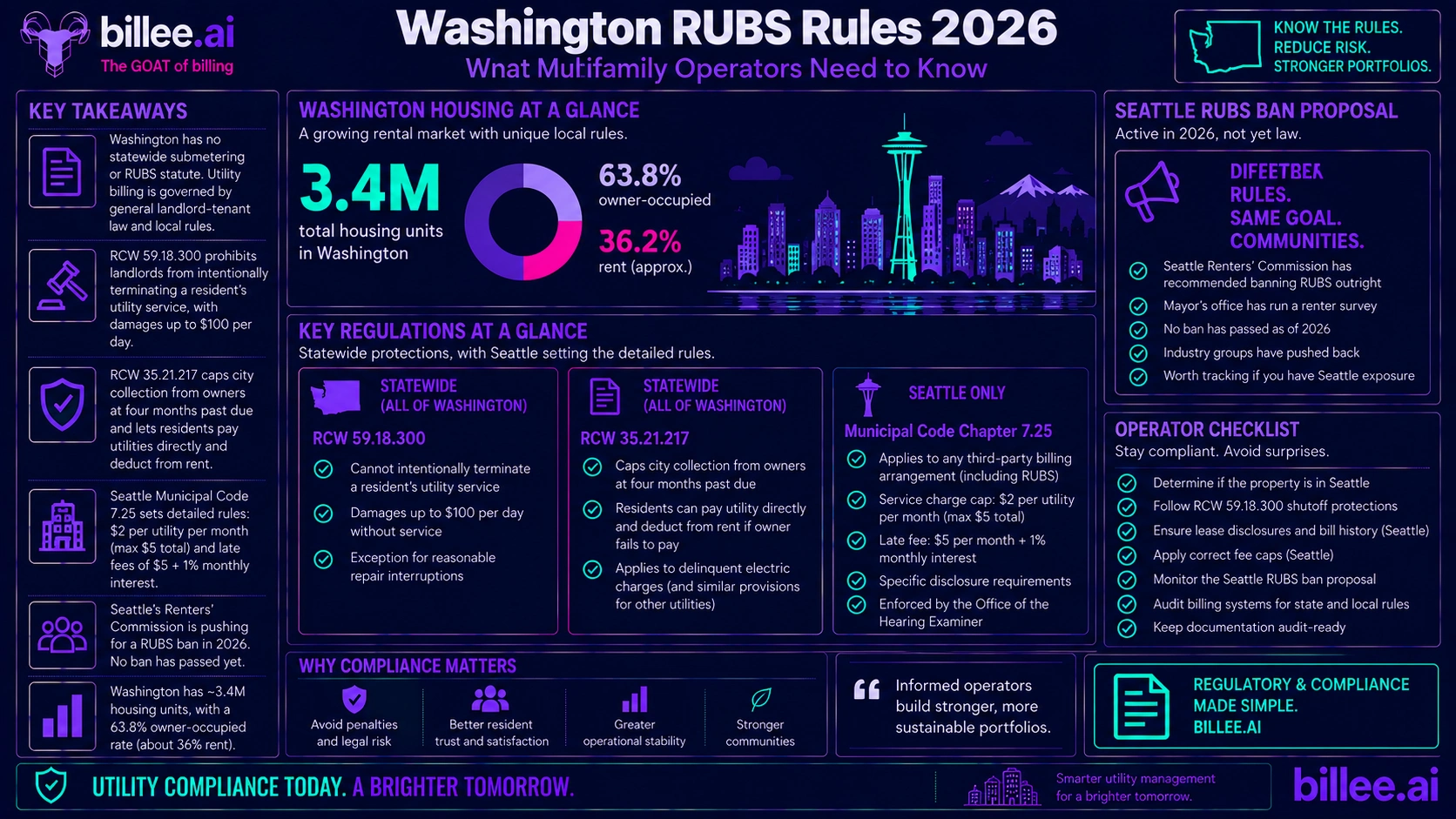
Washington regulates multifamily utility billing across two layers that operators often conflate. State law prohibits landlords from intentionally cutting off a resident's utilities and caps what a city can collect from an owner for a resident's delinquent account, while Seattle runs the state's only detailed third-party billing ordinance, with specific disclosure rules and dollar caps on service and late fees. Seattle is also in the middle of an active push to ban RUBS outright, a proposal that hasn't passed as of this writing but is worth tracking closely. Billee's Regulatory & Compliance service tracks Washington portfolios against both the state layer and Seattle's municipal code, and watches the ban proposal for any Billee client with Seattle exposure.
Quick answer
Washington has no dedicated statewide submetering or RUBS statute. Instead, state law (RCW 59.18.300) prohibits landlords from intentionally terminating a resident's utility service, backed by statutory damages of up to $100 per day, and a separate statute (RCW 35.21.217) caps what a city can collect from a property owner for a resident's delinquent utility account and gives residents the right to pay a utility directly and deduct it from rent if the owner falls behind. Seattle is the exception: its Municipal Code Chapter 7.25 imposes detailed disclosure requirements and specific fee caps on any landlord who bills residents through a third-party utility billing arrangement, including RUBS. As of 2026, Seattle's Renters' Commission is pushing the City Council to replace that disclosure-based framework with an outright RUBS ban, but no ban has passed.
Two things determine compliance: whether the property is in Seattle, where the detailed municipal ordinance applies, and whether the standard statewide shutoff and delinquency protections are being followed everywhere else.
Key takeaways
- Washington has no statewide submetering or RUBS statute. Utility billing is governed by general landlord-tenant shutoff protections and municipal-level rules, not a dedicated state framework.
- RCW 59.18.300 makes it unlawful for a landlord to intentionally terminate a resident's utility service, with an exception for reasonable repair interruptions, and sets statutory damages of up to $100 per day the resident lacks service.
- RCW 35.21.217 caps city collection from a property owner for a resident's delinquent electric charges at four months past due, and lets a resident who pays a utility directly deduct that payment from rent if the owner fails to pay.
- Seattle Municipal Code Chapter 7.25 is Washington's only detailed billing ordinance: it caps the service charge at $2 per utility per month (maximum $5 per month across all utilities combined) and late fees at $5 per month plus 1% monthly interest.
- As of 2026, the Seattle Renters' Commission has formally asked the City Council to ban RUBS outright rather than continue regulating it through disclosure, and the mayor's office has run a renter survey on the question. No ban has passed.
- Washington has roughly 3.4 million housing units, with a 63.8% owner-occupied rate, meaning about 36% of households rent.
Why this matters for multifamily operators
Washington's light statewide touch means most of the compliance risk concentrates wherever a portfolio has Seattle exposure. Outside Seattle, the state's shutoff and delinquency protections apply, but there's no dedicated billing-format, disclosure, or fee-cap statute the way Texas or California has for submetering. Inside Seattle, Municipal Code Chapter 7.25 is specific and enforceable through the Office of the Hearing Examiner, with concrete dollar caps that are easy to violate without noticing if a billing system was configured against a different state's rules.
The bigger near-term risk is the Seattle ban proposal itself. Billee's guide to how RUBS rules vary by state tracks states that restrict or ban RUBS outright, and Seattle's Renters' Commission is explicitly asking the City Council to join that list rather than keep RUBS legal under stricter disclosure. Nothing has passed, and industry groups have pushed back, but a Seattle-heavy portfolio should treat this as an active item to monitor, not settled law.
What Washington regulation actually covers
| Requirement | Governing rule | What it requires |
|---|---|---|
| Utility shutoff prohibition | RCW 59.18.300 | Landlord cannot intentionally terminate a resident's utility service; statutory damages up to $100/day for violations |
| City delinquency and lien rules | RCW 35.21.217, RCW 35.21.290 | City collection from owner capped at 4 months past due if notice requirements are met; city liens attach to the property |
| Resident rent-deduction right | RCW 35.21.217 | Resident who pays a delinquent utility directly may deduct that payment from rent |
| Seattle third-party billing disclosure | Seattle Municipal Code Ch. 7.25 | Written disclosure of billing basis, meter readings, allocation methodology, and the three most recent utility bills |
| Seattle fee caps | Seattle Municipal Code Ch. 7.25 | Service charge capped at $2/utility/month ($5/month max combined); late fee capped at $5/month plus 1% monthly interest |
| Seattle RUBS ban proposal | Pending, not yet law (2026) | Renters' Commission has asked the City Council to prohibit RUBS outright; status pending |
The statewide shutoff prohibition and its cost
RCW 59.18.300 makes it unlawful for a landlord to intentionally cause termination of a resident's water, heat, electric, or gas service, with the only exception being a reasonable interruption to make necessary repairs. A violation exposes the landlord to actual damages, statutory damages of up to $100 for each day the resident lacked service, and the prevailing party's attorney's fees and costs. This is a statewide rule that applies whether or not a property submeters or uses RUBS.
City delinquency notice, collection limits, and the resident's rent-deduction right
RCW 35.21.217 governs how cities handle delinquent utility accounts in rental property. If an owner has requested written notice and correctly identified the property as residential rental, the city must notify the owner of a resident's delinquency at the same time it notifies the resident, and even then can collect no more than four months of past-due electric charges from the owner. In a building where utilities serve multiple units through one account, the city must make a good-faith effort to give written notice at the service address at least seven days before disconnection. If an owner fails to pay a utility bill, a resident who pays it directly can deduct those reasonable charges from rent owed, and the statute bars retaliation for exercising that right. Cities can also lien the property itself for unpaid water, sewer, and electric charges under RCW 35.21.290 and RCW 35.67.200, separate from anything owed by the resident. Billee's guide to utility billing transparency and resident rights covers how these disclosure obligations compare across other regulated states.
Seattle's detailed billing ordinance
Seattle Municipal Code Chapter 7.25, in effect since February 2004, is the only detailed, RUBS-specific billing framework in Washington. A landlord using a third-party billing arrangement, including RUBS, must disclose the billing entity's contact information, the basis for each charge as a line item, meter readings if the building is submetered, due dates and late fee terms, and dispute contact information, plus post the allocation methodology and the building's three most recent utility bills. Total charges to residents cannot exceed what the utility company charges the building. On top of the actual utility cost, a landlord can add a service charge of no more than $2 per utility per month, capped at $5 per month combined. Late fees cap at $5 per month plus 1% monthly interest after 30 days, and a dishonored check fee cannot exceed $31. Residents who dispute a charge have 30 days to notify the billing agent, the agent has 30 days to respond, and an unresolved dispute can go to Seattle's Office of the Hearing Examiner or to court within 120 days.
The push to ban RUBS in Seattle
As of 2026, the Seattle Renters' Commission has formally urged the City Council to replace Chapter 7.25's disclosure-based approach with an outright prohibition on RUBS, arguing that utility charges not tied to individual submetering should be folded into rent instead of billed separately. The mayor's office has run a renter survey to inform the decision, and the Washington Multi-Family Housing Association has pushed back, warning that a ban could shift costs in ways residents won't like and complicate new development, while signaling openness to stronger disclosure rules short of a ban. No ordinance number has been introduced as of this writing, and no ban has passed. Operators with Seattle-heavy portfolios should treat this as an open item rather than a settled question.
Common mistakes
- Assuming Washington has a dedicated statewide submetering statute like Texas or New York, when the state's protections are general landlord-tenant provisions rather than a utility-specific framework.
- Applying Seattle's Chapter 7.25 fee caps and disclosure rules to properties outside Seattle, or skipping them entirely for Seattle properties because no equivalent exists elsewhere in the state.
- Setting a Seattle service charge above the $2-per-utility, $5-combined monthly cap, especially on a billing system configured against a state with a percentage-based markup allowance instead.
- Treating an interrupted utility service as a maintenance issue without documenting that it falls under the "necessary repairs" exception to RCW 59.18.300, leaving no defense if a resident disputes it.
- Missing the four-month cap on what a city can collect from the owner for a resident's delinquent electric account, and assuming the city's collection rights are unlimited.
- Not tracking the Seattle RUBS ban proposal, and getting caught flat-footed if the City Council moves on it later in 2026.
When to handle this in-house vs. bring in a partner
A single Washington property outside Seattle with a property manager who understands the shutoff prohibition and the city's delinquency notice process can typically stay compliant without much overhead. A Seattle property adds real complexity: the fee caps, disclosure list, and dispute-response timeline in Chapter 7.25 require billing configuration that's specific to that one city.
Across a multi-state portfolio, Washington's split between a light statewide layer and a strict Seattle-specific ordinance is easy to miss if billing rules are applied uniformly. Billee's complete guide to utility management compliance covers what that burden looks like across a full portfolio, not just Washington.
How Billee can help
Billee's Regulatory & Compliance service configures Washington billing against the right layer for each property, applying Seattle's Chapter 7.25 fee caps and disclosure requirements only where they apply and the general statewide shutoff and delinquency protections everywhere else. The audit checks what a resident dispute or a Hearing Examiner complaint would test: does the Seattle service charge stay under $2 per utility, is the allocation methodology posted, and is the dispute-response timeline being met.
Billee's team also tracks the Seattle RUBS ban proposal on behalf of clients with Seattle exposure, so a portfolio isn't caught reconfiguring billing after the fact if the City Council acts.
FAQ
Does Washington have a submetering law like Texas or California?
No. Washington has no dedicated statewide submetering or RUBS statute. Utility billing is governed by general landlord-tenant shutoff protections and, in Seattle, a detailed municipal ordinance.
Can a landlord shut off a resident's utilities in Washington for nonpayment?
No. RCW 59.18.300 makes it unlawful for a landlord to intentionally terminate a resident's utility service, except for a reasonable interruption to make necessary repairs. Violations carry statutory damages of up to $100 per day.
Is RUBS legal in Seattle?
Yes, as of 2026, but it's tightly regulated under Seattle Municipal Code Chapter 7.25, which caps the service charge at $2 per utility per month ($5 combined) and requires detailed disclosure. The Seattle Renters' Commission has asked the City Council to ban it outright, but no ban has passed.
What happens if a Washington city disconnects utilities in a multi-unit building?
The city must make a good-faith effort to give written notice at the service address at least seven days before disconnection when the building has multiple units on one account, under RCW 35.21.217.
How much can a Seattle landlord charge as a service fee for third-party utility billing?
No more than $2 per utility per month, capped at $5 per month combined across all utilities billed, under Seattle Municipal Code Chapter 7.25.
What can a resident do if a landlord stops paying the building's utility bill in Washington?
Under RCW 35.21.217, a resident who pays the utility directly can deduct those reasonable charges from rent owed, and the landlord cannot retaliate for that action.
Is Seattle about to ban RUBS?
Not yet. As of 2026, the Seattle Renters' Commission has formally asked the City Council to ban RUBS, and the mayor's office has surveyed renters on the question, but no ordinance has passed. Billee tracks this proposal for clients with Seattle properties.
Related reading
- Illinois RUBS Rules 2026: What Multifamily Operators Need to Know: a state that regulates the same territory through landlord-tenant law rather than a municipal ordinance.
- New York Submetering Rules 2026: What Multifamily Operators Need to Know: a state agency approval model, a different structure than Washington's city-level approach.
- How RUBS Allocates Utility Costs in Multifamily Properties: the general math behind allocation formulas, independent of any single state or city's rules.
Billee's Regulatory & Compliance service configures Washington billing to the right layer for each property, tracks Seattle's fee caps and disclosure rules, and watches the city's RUBS ban proposal on behalf of clients. Talk to the team.
Sources
- Washington State Legislature, "RCW 59.18.300, Termination of tenant's utility services," accessed September 2026.
- Washington State Legislature, "RCW 35.21.217, Utility services to rental property," accessed September 2026.
- City of Seattle, Office of the Hearing Examiner, "Residential Third-Party Billing Questions and Answers," accessed September 2026.
- Hoodline, "Seattle Renters Revolt Over Soaring Utility Bills, Target Predatory RUBS," April 2026.
- U.S. Census Bureau, "QuickFacts: Washington," accessed September 2026.
Insights and Industry Trends


Explore more insights