

Illinois RUBS Rules: What Multifamily Operators Need to Know
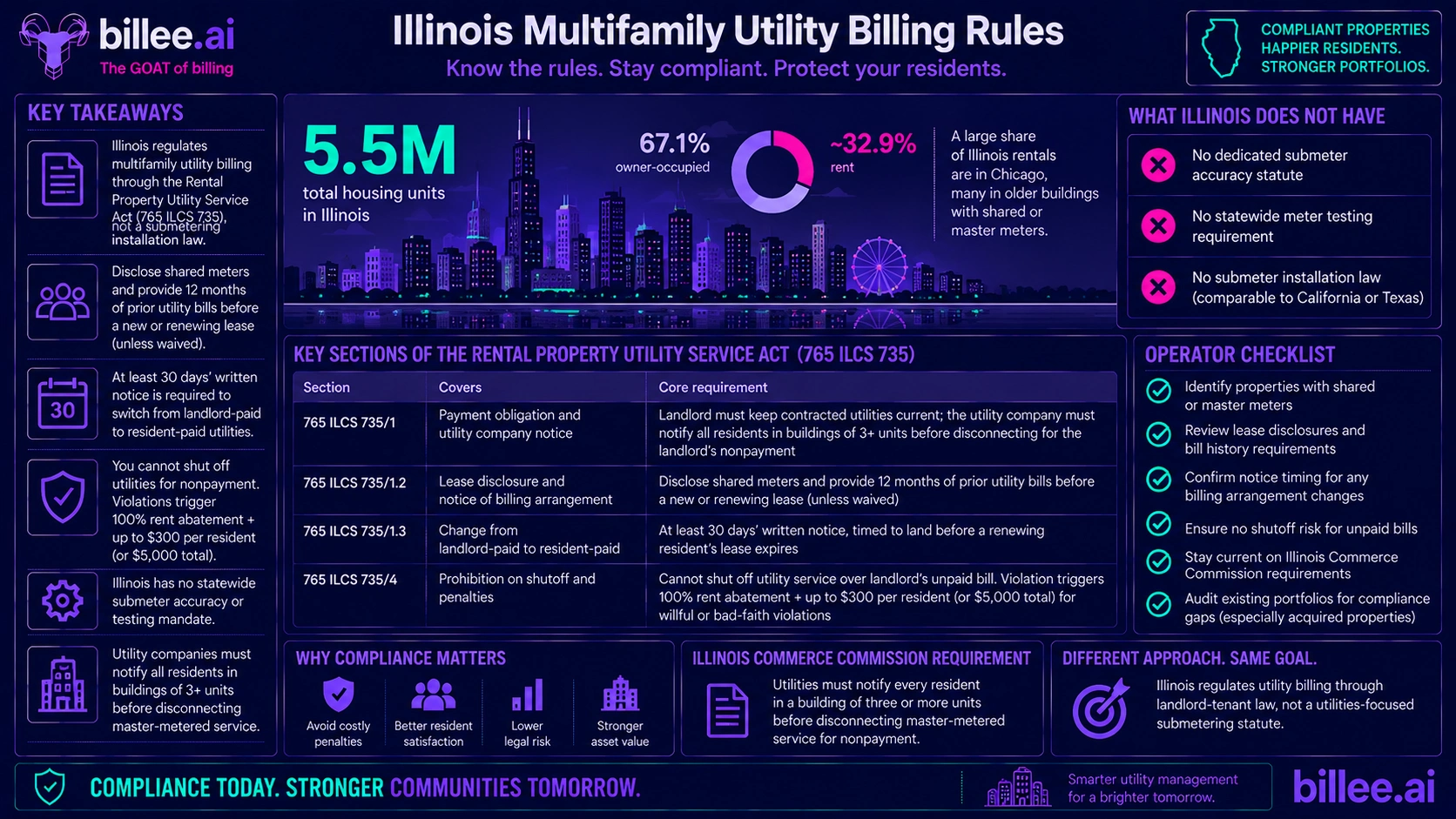
Illinois does not regulate submetering through a dedicated installation or accuracy statute the way Texas or California do. Instead, the state controls how multifamily operators bill residents for utilities through the Rental Property Utility Service Act (765 ILCS 735), a law that applies whenever a resident's bill runs through a meter shared with another unit or a common area, and that attaches automatic financial penalties to a handful of specific violations. Billee's Regulatory & Compliance service tracks Illinois portfolios against every disclosure, notice, and shutoff-protection requirement in the Act so operators find out about a gap from an audit, not a resident complaint.
Quick answer
Illinois regulates multifamily utility billing primarily through the Rental Property Utility Service Act (765 ILCS 735), not through a submetering-specific statute. The Act applies when a landlord bills residents for utility service running through a master meter or any meter with a shared load, and it sets requirements for lease disclosure, notice before changing billing arrangements, a shutoff prohibition backed by automatic rent abatement, and a ban on recovering utility costs through rent increases. Illinois has not enacted a statewide submeter accuracy or testing standard comparable to Texas's PUC Chapter 24 or California's water-submetering statute.
Two things determine whether a property is compliant: whether any unit is billed off a meter with a shared load, and whether the lease paperwork and notice timing match what the Act requires.
Key takeaways
- The Rental Property Utility Service Act (765 ILCS 735) governs utility billing to Illinois residents and applies to both master-metered and individually metered buildings, though its strongest protections target shared-meter arrangements.
- Before a new or renewing lease, landlords must disclose in writing which parts of the building share a meter and provide 12 months of prior utility bills, unless the resident waives the bill history in writing.
- Converting a building from landlord-paid to resident-paid utilities requires at least 30 days' written notice, timed to land before a renewing resident's lease expires.
- Landlords cannot shut off utility service over their own unpaid master-metered bill. A violation triggers 100% rent abatement for every affected month, plus up to $300 per resident (or $5,000 split among affected residents, whichever is less) for willful or bad-faith violations.
- Illinois has no dedicated submeter accuracy, testing, or installation statute. Operators arriving from Texas or California should not assume an equivalent meter-testing mandate exists here.
- The Illinois Commerce Commission requires utility companies, not just landlords, to notify every resident in a building of three or more units before disconnecting master-metered service.
Why this matters for multifamily operators
Illinois has roughly 5.5 million total housing units, and Census data puts the state's owner-occupied rate at 67.1%, which means close to a third of Illinois households rent. Chicago carries a large share of that rental stock, much of it in buildings converted decades ago from owner-occupied two-flats and three-flats into multifamily rentals, exactly the kind of building most likely to still run on a shared or master meter rather than individual submeters.
The Act does not require registering with a state agency before billing residents, unlike Texas's PUC Chapter 24. But its notice and disclosure requirements are specific, and the shutoff-prohibition penalties are not discretionary once a violation is established. A portfolio that inherited informal utility arrangements through an acquisition, or that has never audited its lease disclosures against the current statute, is carrying exposure that stays invisible until a resident escalates it.
Illinois also regulates differently than most operators expect. Billee's guide to how RUBS rules vary by state covers the broader pattern: some states regulate submetering hardware directly, some regulate the billing relationship, and Illinois does nearly all of its regulating through landlord-tenant law rather than a utilities-focused statute.
What Illinois regulation actually covers
| Section | Covers | Core requirement |
|---|---|---|
| 765 ILCS 735/1 | Payment obligation and utility company notice | Landlord must keep contracted utilities current; the utility company must notify all residents in buildings of 3+ units before disconnecting for the landlord's nonpayment |
| 765 ILCS 735/1.2 | Lease disclosure and notice of billing changes | Written disclosure of shared-meter areas and 12 months of bills before signing; 30 days' notice before converting billing arrangements |
| 765 ILCS 735/1.4 | Shutoff prohibition | Landlord cannot interrupt master-metered service except for emergencies or noticed repairs |
| 765 ILCS 735/2.1 | Resident remedies | 100% rent abatement per affected month, plus added damages for willful violations |
| 765 ILCS 735/4 | Rent-increase ban | Landlord cannot raise rent to recover utility costs lawfully deducted under the Act |
| 83 Ill. Adm. Code 280.150 | Utility company obligations | Utility must notify residents of pending disconnection and their right to petition for a receiver |
Disclosure before a resident signs a lease
Before a new or renewing lease, the Act requires the landlord to give the resident a written statement identifying which parts of the building share the meter that determines their bill, plus copies of the building's utility bills for the prior 12 months, unless the resident waives the bill history in writing. Landlords cannot require residents to collect payment from neighbors for shared usage, and any rent reduction offered in exchange for a resident assuming a utility obligation has to be in writing. This sits alongside the broader lease-disclosure discipline in Billee's guide to RUBS lease addendum requirements, which applies whether or not Illinois's shared-meter trigger is in play.
Notice before changing how residents are billed
A property moving from landlord-paid to resident-paid utilities, or otherwise changing the billing arrangement, must give affected residents at least 30 days' written notice, timed to land no less than 30 days before a renewing resident's lease expires. Changing the arrangement mid-lease requires a signed written amendment instead. Any lease clause that conflicts with this notice requirement is void, regardless of what the resident signed.
The shutoff prohibition and what it costs to violate
Landlords cannot interrupt utility service to residents in an occupied building by failing to pay a master-metered bill they've assumed responsibility for, by agreement or by implication, or by tampering with the equipment or lines. The only exceptions are genuine emergencies, such as a gas leak or fire, and planned repairs, which require seven days' written notice to affected residents.
Violating the shutoff prohibition triggers 100% rent abatement for each month, or partial month, that service was out, plus any consequential damages the resident can show. If the violation shows deliberate indifference, recklessness, or bad faith, a court can add damages of up to $300 per affected resident, or $5,000 split across all affected residents, whichever amount is smaller.
The rent-increase ban
Landlords cannot raise rent to recover utility costs that were lawfully deducted from what a resident owed under the Act. This closes an obvious workaround: an operator can't absorb a rent-abatement penalty in one month and quietly rebuild it into the next renewal's rent.
What Illinois does not require
Illinois has not enacted a submetering-specific statute governing meter accuracy, installation standards, or testing intervals, the way Texas's PUC Chapter 24 sets a 24-month calibration window or California's water-submetering statute sets installation and billing-format rules. An operator moving into Illinois from a state with a dedicated submetering rule should not assume an equivalent meter-testing mandate exists here.
The absence of a testing statute doesn't mean meter accuracy stops mattering. A meter that's drifted out of calibration is still a billing-accuracy and resident-trust problem without a law requiring the test, which is why Billee treats submeter calibration as standard practice everywhere, not just where it's mandated.
Common mistakes
- Assuming the Act's disclosure and notice requirements disappear once each unit has its own reading, when a meter with any shared load can still trigger them.
- Converting a billing arrangement without the required 30 days' written notice, especially during a management transition when utility responsibility is being renegotiated informally.
- Treating a nonpayment shutoff as a private billing dispute rather than a statutory violation with an automatic remedy attached.
- Importing a Texas- or California-style submeter testing cadence into an Illinois checklist and treating it as a state mandate rather than a best practice.
- Raising rent at renewal to quietly recover a utility cost already deducted under the Act, which Section 4 prohibits outright.
When to handle this in-house vs. bring in a partner
A single Illinois property with a stable resident base and a property manager who tracks renewals closely can often stay compliant with a checklist: confirm the lease addendum matches the Act's disclosure list, calendar the 30-day notice window before any billing change, and document every planned shutoff with the required seven-day notice.
The burden compounds across a multi-state portfolio. Illinois's requirements don't transfer cleanly to a template built for Texas or California, and standardized paperwork across states can miss the Illinois-specific triggers entirely. Billee's complete guide to utility management compliance covers what that burden looks like across a full portfolio, not just Illinois.
How Billee can help
Billee's Regulatory & Compliance service audits Illinois lease disclosures, notice documentation, and billing-arrangement history against the Rental Property Utility Service Act, and keeps a documented trail ready for refinancing, disposition, or an Illinois Commerce Commission inquiry. The audit checks what a resident complaint or an ICC filing would test: does the lease disclose the shared-meter areas the Act requires, is a signed 30-day notice on file for the current billing arrangement, and does the shutoff and repair-notice history hold up.
Billee's account team also treats meter accuracy as an operating discipline rather than a compliance checkbox, which matters in a state where no statute requires it.
FAQ
Does Illinois require submetering registration like Texas?
No. Illinois has no statute requiring landlords to register with a state agency before submetering or allocating utility costs to residents. Texas's PUC Chapter 24 registration requirement does not have an Illinois equivalent.
Is RUBS legal in Illinois?
Yes. Illinois does not ban ratio utility billing or ratio-based allocation. What the state regulates instead is the billing relationship itself, primarily through the Rental Property Utility Service Act's disclosure, notice, and shutoff-protection requirements.
What is the Rental Property Utility Service Act?
The Rental Property Utility Service Act (765 ILCS 735) is the Illinois statute that governs how landlords bill residents for utility service, with particular focus on master-metered and shared-meter arrangements. It covers lease disclosure, notice before changing billing methods, a shutoff prohibition, resident remedies, and a rent-increase ban.
Can a landlord bill residents for master-metered utilities in Illinois?
Yes, but only after providing the written disclosures the Act requires before the lease is signed, including which parts of the building share the meter and the prior 12 months of utility bills unless waived in writing.
How much notice is required to switch from landlord-paid to resident-paid utilities?
At least 30 days' written notice, timed to land before a renewing resident's lease expires. Changing the arrangement mid-lease instead requires a signed written amendment.
What happens if a landlord shuts off utilities for nonpayment in Illinois?
The resident is entitled to 100% rent abatement for each affected month, plus consequential damages, and courts can add up to $300 per resident (or $5,000 split among affected residents) for willful or bad-faith conduct.
Does Illinois require submeters to be tested or calibrated on a schedule?
No. Illinois has no statewide submeter accuracy or testing statute, so the testing cadence required in Texas or California does not carry over.
Are there additional utility billing rules specific to Chicago?
Chicago's Residential Landlord and Tenant Ordinance covers the broader landlord-resident relationship, including utility shutoff protections, but the Rental Property Utility Service Act is the primary statewide source of Illinois-specific utility billing requirements for multifamily operators. Billee's Regulatory & Compliance team tracks both layers for Chicago-area portfolios.
Related reading
- Where Is RUBS Banned or Restricted? A 2026 State-by-State Reference: how Illinois's approach compares to states that restrict RUBS outright.
- California Submetering and RUBS Law Explained: a state that regulates the same territory through four separate legal threads instead of one act.
- How RUBS Allocates Utility Costs in Multifamily Properties: the general math behind allocation formulas, independent of any single state's rules.
Billee's Regulatory & Compliance service audits Illinois portfolios against the Rental Property Utility Service Act's disclosure, notice, and shutoff-protection requirements, and keeps the documentation ready before a resident complaint turns into an ICC filing. Talk to the team.
Sources
- Illinois General Assembly, "765 ILCS 735, Rental Property Utility Service Act," accessed September 2026.
- Illinois General Assembly, "765 ILCS 735/1.2, Certain tenant-paid utility payment arrangements prohibited; Notice of change in payment arrangement," accessed September 2026.
- Illinois General Assembly, "765 ILCS 735/1.4, Prohibition on termination of utility service by landlord," accessed September 2026.
- Illinois General Assembly, "765 ILCS 735/2.1, Tenant damages," accessed September 2026.
- Illinois General Assembly, "765 ILCS 735/4, Rent increase prohibition," accessed September 2026.
- Illinois Administrative Code, "83 Ill. Adm. Code 280.150," Illinois Commerce Commission, accessed September 2026.
- U.S. Census Bureau, "QuickFacts: Illinois," accessed September 2026.
Insights and Industry Trends


Explore more insights