
What Is Submeter Calibration and Why It Matters for Billing Accuracy
Submeter calibration is the process of checking a meter's reading against a known-accurate reference and correcting it when the two disagree. Every resident utility bill in a submetered property traces back to that check, whether or not anyone has performed it recently. This article covers what calibration actually means, how accuracy standards differ by meter type, why meters drift, and what is genuinely at stake, financially and legally, when that drift goes unmanaged.
Key Takeaways
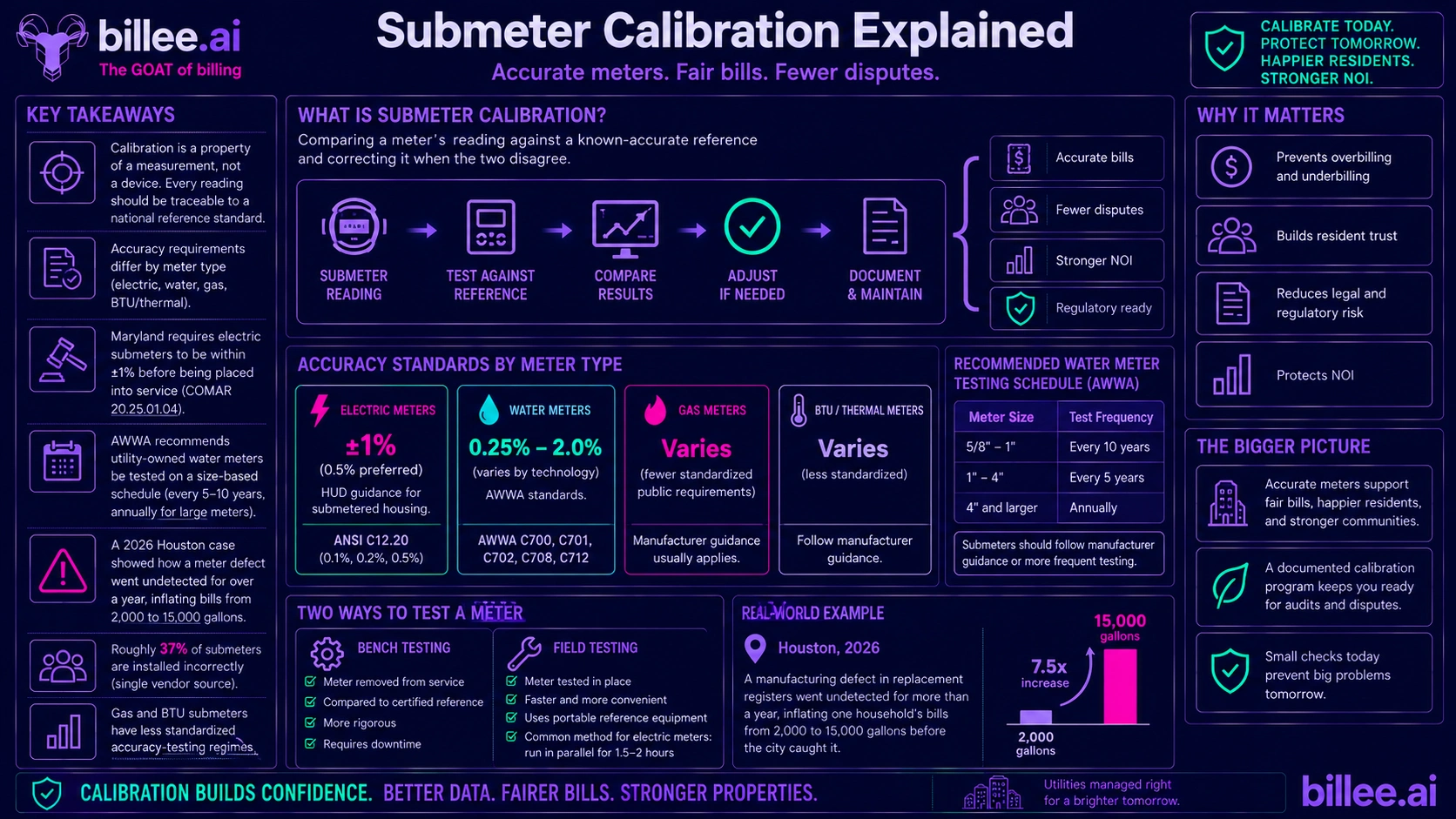
- Calibration is a property of a measurement, not a device. A meter is only as trustworthy as the documented chain connecting its reading back to a national reference standard, a concept metrologists call traceability.
- Accuracy requirements differ by meter type. HUD's own submetering guidance recommends electric submeters hit plus or minus 1% accuracy, with 0.5% preferable, while water meters follow AWWA standards ranging from 0.25% to 2.0% depending on the specific meter technology.
- Maryland writes meter accuracy directly into regulation. COMAR 20.25.01.04 requires electric submeters to be tested and adjusted to within plus or minus 1% before being placed into service, referencing the ANSI Code for Electricity Metering.
- AWWA recommends utility-owned water meters be tested on a size-based schedule: every 10 years for 5/8-inch to 1-inch meters, every 5 years for 1-inch to 4-inch meters, and annually for meters 4 inches and larger. Submeters should follow manufacturer guidance or more frequent testing.
- A 2026 Houston municipal water case shows what happens when meter hardware fails silently. A manufacturing defect in replacement registers went undetected for more than a year, inflating one household's bills from a typical 2,000 gallons a month to as high as 15,000 gallons before the city caught it.
- One industry source states that roughly 37% of submeters are installed incorrectly. That figure comes from a single vendor blog, not an independent study, and is presented here with that caveat rather than as an established industry fact.
- Gas and BTU or thermal submeters have far less standardized, publicly documented accuracy-testing regimes than water and electric meters. That gap is itself worth naming rather than glossing over with false precision.
What Calibration Actually Means
Traceability, not just accuracy
A calibration is only meaningful if it connects, through a documented and unbroken chain of comparisons, back to a national or international reference standard. Metrologists call this traceability, and it is a property of a measurement, not of the device that produced it. A meter itself is never "NIST-traceable." A specific reading taken under specific, documented testing conditions can be traceable if the chain behind it holds up.
That distinction matters for a multifamily operator because it reframes what a calibration record needs to contain. A sticker on a meter saying it was tested once is not a calibration program. A documented chain showing what was tested, when, against what certified reference, and with what result is what actually protects an operator in a billing dispute or a regulatory inquiry.
How a meter actually gets tested
Meters are tested one of two ways. Bench testing removes the meter from service and compares it against a certified reference standard in a controlled setting, which is the more rigorous approach but requires downtime. Field testing checks the meter in place, which is faster but depends on the portability and precision of the field reference equipment.
For electric submeters specifically, a common field method connects a certified power analyzer to the same circuit as the meter being tested, lets both run in parallel for roughly 1.5 to 2 hours, and compares the readings. A meter reading within 5% of the reference analyzer is generally treated as passing, though that 5% figure is an industry practitioner benchmark rather than a codified regulatory standard.
The Accuracy Standard Depends on the Meter Type
Electric meters
ANSI C12.20 defines three accuracy classes for electric meters: 0.1%, 0.2%, and 0.5%, referring to the maximum permissible deviation from true consumption at full load. Lower numbers mean tighter tolerances. HUD's own guidance for submetered HUD-funded housing recommends that meters and current transformers achieve at least plus or minus 1% accuracy across their rated range, with plus or minus 0.5% preferable, and specifies that meters used to bill residents should generally be revenue grade, typically plus or minus 0.5%.
Water meters
Water meters fall under the AWWA C700 series of standards, and the specific standard depends on the meter technology. C700 covers metal-alloy displacement meters, C701 covers turbine-type meters, C702 covers compound meters that combine turbine and bypass components for high and low flow, and C708 and C712 cover multijet and singlejet meters respectively. Each standard defines an accuracy curve across minimum, intermediate, and maximum flow rather than a single tolerance number, and HUD's guidance notes that typical water meter accuracy ranges from 0.25% to 2.0% depending on which of these technologies is in use.
Gas meters
Diaphragm-type meters are the dominant technology for residential and multifamily gas submetering. The American Gas Association publishes standards for gas measurement, but the most detailed and widely cited AGA standards (AGA 3, 7, 8, and 9) govern orifice, turbine, and ultrasonic metering used in commercial custody-transfer applications, not the diaphragm meters found in apartment buildings. Publicly available detail on residential diaphragm meter accuracy tolerances is genuinely thinner than what exists for water and electric metering, and that gap is worth stating plainly rather than filling with unsupported specificity.
BTU and thermal meters
BTU meters, used to measure shared condenser water or central-plant energy for billing purposes, work by measuring flow rate and temperature differential rather than a single physical quantity. Building industry guidance is consistent that installation quality is the dominant accuracy risk for these meters, and that calibration requirements are typically set by the manufacturer rather than governed by a single widely adopted accuracy standard the way water and electric metering are.
Why Meters Drift Out of Calibration
Water meters lose accuracy over time primarily through mechanical wear and mineral or sediment buildup, which slows the moving parts that register flow and causes the meter to under-register usage as it ages. Installation errors compound this: EPA's WaterSense guidance specifically calls out insufficient straight-pipe clearance upstream and downstream of a meter as a source of inaccurate readings from day one.
Electric meters fail differently. Common issues include voltage loss, phasing errors, battery depletion in meters with battery-backed components, and display failures that make an otherwise-functioning meter unreadable. Manufacturing defects are a less common but real failure mode across meter types, illustrated by a 2026 Houston case where a bad batch of replacement registers shipped from the manufacturer went undetected for more than a year after installation, inflating bills for more than 600 households before the city discovered the pattern.
Simple aging affects every meter type. No meter holds its factory accuracy indefinitely, which is why testing cadence, not just installation quality, has to be part of any credible calibration program.
What's at Stake When Calibration Slips
The financial exposure compounds across a portfolio
A single meter reading 2% off true consumption sounds trivial. Across a 500-unit property, that same 2% inaccuracy can translate into thousands of dollars in misallocated or lost revenue annually. Undetected hardware drift is one of the causes Billee's own recovery-rate benchmark points to when a portfolio's recovery rate falls below the 80-95% range that indicates healthy performance.
The regulatory exposure is real, but narrower than most operators assume
Maryland is the clearest example of a state writing meter accuracy directly into binding regulation rather than leaving it to best practice. COMAR 20.25.01.04 requires electric submeters to be tested and adjusted to within plus or minus 1% before being placed into service, and defines a submeter as operating acceptably if it measures within 2% of actual usage during operational testing. That is meaningfully different from how most other states approach submetering law.
California's and Texas's submetering rules, covered in Billee's existing guides to those states, focus on billing methodology and resident disclosure rather than hardware accuracy specifically. An operator who has read those guides and assumes the same is true everywhere would be missing Maryland's distinct hardware-level requirement.
A cautionary example, correctly framed
In 2026, Houston Public Works discovered that a batch of faulty water meter registers, installed across the city starting in September 2024, had been recording usage inconsistently with actual consumption. One resident's bills rose from a typical 2,000 gallons a month to readings of 7,000, then 11,000, then 15,000 gallons before the problem was identified in January 2026 and the meters replaced that March. The city is now issuing refunds calculated against pre-installation usage history.
This is a municipal water utility case, not a multifamily submetering example, and it should be read that way. What it illustrates, applicable to any metering program, is how long a hardware defect can run undetected and how difficult the eventual reconciliation becomes.
Accuracy Standards by Meter Type at a Glance
| Meter Type | Governing Standard(s) | Typical Accuracy Tolerance | Testing Note |
|---|---|---|---|
| Electric | ANSI C12.20 (0.1%, 0.2%, 0.5% classes); HUD submetering guidance | ±1% acceptable, ±0.5% preferable for billing meters | Maryland requires ±1% pre-service testing by regulation (COMAR 20.25.01.04) |
| Water | AWWA C700 series (C700, C701, C702, C708, C712, and others by technology) | 0.25%-2.0% depending on meter technology | AWWA recommends testing utility-owned meters every 10 years (5/8"-1"), 5 years (1"-4"), or annually (4"+) |
| Gas | AGA standards (primarily commercial custody-transfer focused); diaphragm meters dominant in residential use | Not well-documented publicly for residential diaphragm meters | Manufacturer guidance is the primary reference point |
| BTU / Thermal | No single widely adopted standard; manufacturer-set requirements | Installation-dependent; not standardized industry-wide | Calibration cadence typically set by manufacturer, not codified regulation |
Best Practices for Operators
Distinguish pre-service testing from ongoing drift monitoring
A meter that passed inspection at installation says nothing about its accuracy five years later. Treat initial testing and periodic re-testing as two separate obligations, not one event that satisfies both.
Build a testing cadence around meter type and size
AWWA's size-based intervals for utility-owned water meters are a reasonable starting framework even for submeters, adjusted to manufacturer guidance for the specific hardware in use. A single fixed calendar applied to every meter type and size in a portfolio will over-test some meters and under-test others.
Treat consumption anomalies as calibration signals, not just usage signals
An unexplained spike, a sudden drop, or a flatline reading is often the first sign of a meter that needs physical testing, not just a resident behavior change worth investigating. Connecting real-time monitoring alerts to a decision about physical calibration closes the gap between noticing a problem and fixing it.
Document every test as part of a defensible record
What was tested, when, against what reference standard, and with what result. That record is what protects an operator in a billing dispute, a regulatory inquiry, or a refinancing due diligence review, and it is exactly the kind of documentation gap that surfaces during acquisition-time diligence on an unfamiliar property.
What to Look for in a Metering Hardware Partner
- Experience across meter types (water, electric, gas, and BTU/thermal), not just one commodity
- A documented testing cadence tailored to meter type and size, rather than a single fixed calendar applied portfolio-wide
- The ability to connect real-time consumption monitoring alerts directly to physical dispatch and testing decisions
- Transparent handling of hardware defects when they are found, rather than waiting for resident complaints to surface a problem
- Capital planning support for meter replacement cycles, not just reactive repair after a meter fails
How Billee Supports Metering Hardware Programs
Billee's Hardware & Maintenance Services product handles procurement, installation coordination, and ongoing calibration scheduling for metering infrastructure, built around the size- and type-specific cadence this article describes rather than a one-size-fits-all calendar. It pairs directly with Billee's Meter Monitoring & Proactive Alerts, which flags consumption anomalies in real time so a physical test gets scheduled before a resident ever sees an inaccurate bill.
Both connect back to the recovery-rate benchmark Billee's Billing & Recovery Engine tracks, since undetected hardware drift is one of the named causes when a portfolio's recovery rate falls short. For the documentation and audit side of calibration records, see Billee's Regulatory & Compliance product.
FAQ
What is submeter calibration, in plain terms? It is the process of checking a meter's reading against a known-accurate reference standard and correcting it if the two disagree. Every resident bill that comes from a submeter depends on that check having been done and documented at some point.
How is a meter actually calibrated: bench testing or field testing? Both are used. Bench testing removes the meter and compares it against a certified reference in a controlled setting, which is more rigorous but requires downtime. Field testing checks the meter in place, which is faster but depends on the portability and precision of the field equipment used.
What accuracy class should a multifamily submeter meet? It depends on the meter type. HUD's submetering guidance recommends electric submeters used for billing hit plus or minus 0.5% to 1%. Water meters follow AWWA standards ranging from 0.25% to 2.0% depending on the specific meter technology in use.
How often should submeters be tested? AWWA recommends utility-owned water meters be tested every 10 years for 5/8-inch to 1-inch meters, every 5 years for 1-inch to 4-inch meters, and annually for meters 4 inches and larger. Submeters should follow manufacturer guidance or more frequent testing, since they see different usage patterns than utility mains meters.
What happens if a submeter is found to be out of calibration? The meter is repaired, recalibrated, or replaced, and any billing period affected by the inaccuracy typically needs to be reconciled against the resident's actual usage history, similar to how Houston is handling refunds in its 2026 meter mix-up.
Is there a legal requirement for submeter accuracy, or is it just best practice? It varies by state. Maryland's COMAR 20.25.01.04 explicitly requires electric submeters to be tested to within plus or minus 1% before service, referencing ANSI standards. Most other states, including California and Texas, focus their submetering rules on billing methodology and resident disclosure rather than hardware accuracy specifically.
How do accuracy standards differ between water, electric, gas, and BTU meters? Electric and water metering have the most developed, publicly documented standards (ANSI C12.20 and the AWWA C700 series, respectively). Gas and BTU/thermal metering have far less standardized public guidance, relying more heavily on manufacturer specifications than codified industry-wide accuracy tolerances.
Does calibration affect Billee's recovery-rate benchmark? Yes. Billee flags portfolios with a recovery rate below its 80-95% benchmark range for review, and undetected meter hardware issues are one of the named causes of underperformance against that benchmark.
Do new-construction meters need to be tested differently than meters already in service? New meters still need documented pre-service testing, since manufacturing defects can affect brand-new hardware, as the Houston case shows. The difference is timing: new-construction testing establishes a documented baseline from day one rather than trying to reconstruct one later.
Meter hardware is the part of a utility billing program that operators notice least until it fails. Talk to Billee about building a metering hardware and calibration program that catches drift before it reaches a resident's bill.
Sources
- ANSI Blog, "ANSI C12.20-2015: Electric Meters, 0.1, 0.2, and 0.5 Accuracy Classes"
- American Water Works Association, "AWWA Comment Period on 10 Meter Standards"
- U.S. EPA, "WaterSense at Work, Section 2.1: Metering and Submetering"
- U.S. Department of Housing and Urban Development, "Study of Submetering in HUD-Funded Housing"
- Cornell Law School, Legal Information Institute, "Md. Code Regs. 20.25.01.04: Electric Submetering"
- Utilivisor, "Why and How to Calibrate Your Electric Submeter"
- BMAG Meter, "Choosing the Right Water Meter for US Multi-Family Housing"
- Click2Houston, "Check Your Address: Houston Public Works Admits Meter Mix-Up Led to Years of Inaccurate Water Bills"
Insights and Industry Trends