
Do Utilities Have to Be in Advertised Rent? What the FTC's Rental Fee Rulemaking Means for RUBS (2026)
We found no federal rule that requires utilities in advertised rent. In March 2026 the FTC asked whether total rent should include actual or estimated utility expenses, including under RUBS, but we found no proposed rule since. Colorado law and a Greystar settlement already push mandatory fees into the quoted price. Billee Technologies, Inc. helps operators document and show utility costs.
A question is not a proposal. The FTC's notice is an advance notice of proposed rulemaking: it asks questions and sets out no rule text. Operators should still read the questions, because they show what regulators want to know about utility billing. This guide covers what the FTC asked, what the law and one large settlement already require, three ways utilities could land and what to prepare now.
Key takeaways
- The FTC's notice, published March 13, 2026, asks whether total rent should include actual or estimated utility expenses, including where a ratio utility billing system (RUBS) applies. It is a question, not a proposal.
- Comments closed April 13, 2026. As of October 22, 2026, we found no proposed rule.
- Colorado's HB25-1090, effective January 1, 2026, requires the disclosed total price to include mandatory charges. Summaries word its utility exception differently, so confirm the text.
- The Greystar settlement requires up-front disclosure of the total monthly price. It binds Greystar only.
- Greystar told the FTC that variable utility costs should stay out of total rent because they cannot be accurately calculated in advance. That is one industry view.
- Operators can prepare now: write down the allocation method, keep per-unit charge history and keep utility charges separate from other fees.
Utilities and advertised rent at a glance
ItemWhat it saysUtilitiesStatusFTC rental housing fee noticeAdvance notice of proposed rulemaking; Questions 27, 28, 29 and 58(a)Asked about, including under RUBSComments closed April 13, 2026; no proposed rule foundFTC fees rule (2024)Per Arnold & Porter: finalized December 2024, effective May 2025Covers short-term lodging and live-event tickets, not apartment leasesIn effect, per the advisoryGreystar settlement$24 million; total monthly price and each fee's nature, purpose, amount and whether mandatoryTerms we read do not mention utilities; the background cites utility administration feesBinds Greystar onlyColorado HB25-1090Disclosed total price includes mandatory chargesUtility exception; scope for landlord-billed charges unclear in summariesEffective January 1, 2026Greystar's comment to the FTCInclude fixed mandatory fees; exclude variable utility costsExcludedOne comment among many
What the FTC asked about utilities
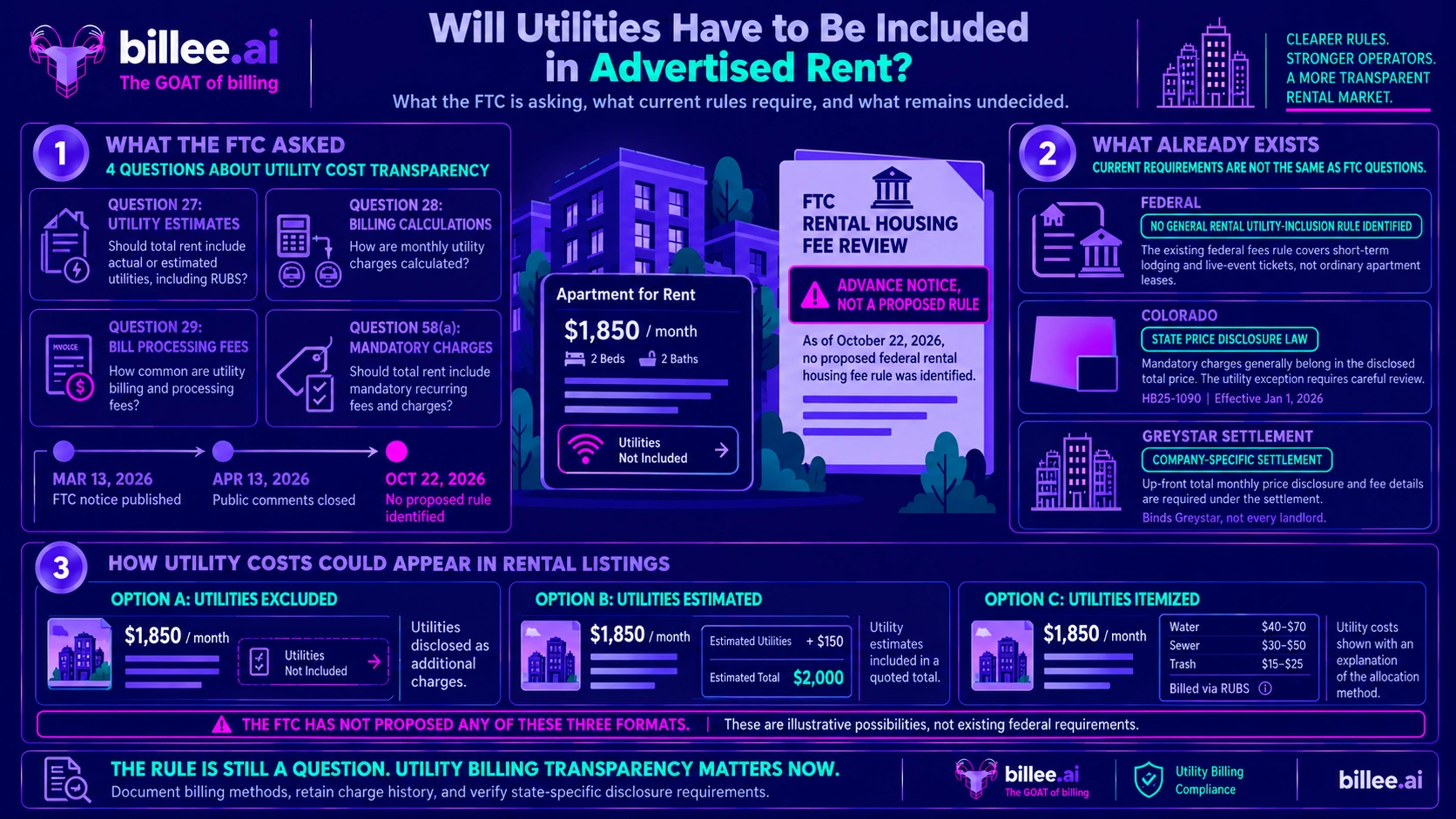
On March 13, 2026, the FTC published an advance notice titled Rule on Unfair or Deceptive Rental Housing Fee Practices at 91 Fed. Reg. 12325. Comments were due April 13, 2026, under docket FTC-2026-0266. The agency announced the notice on March 12.
Four questions in the FTC's PDF of the notice touch utilities:
- Question 27 asks, for providers that charge or collect payment for utilities, whether it is feasible "to include actual or estimated utility expenses in the total rent," including where a RUBS applies.
- Question 28 asks, "How do rental housing providers calculate monthly utility charges, including where utilities are subject to a RUBS?"
- Question 29 asks how common it is to charge renters a fee "for preparing, providing, or processing utility bills."
- Question 58, part (a), asks whether a rule should "require total rent to include all mandatory recurring fees and charges." Its examples include mandatory administration fees, common area maintenance fees, estimated utilities and parking.
The notice stops at questions. It lists utility-related fees among the fee types it describes, does not define them and offers no rule text. The FTC has not said total rent must include utilities. It has asked whether doing so is feasible.
Question 27 matters most for RUBS operators because a ratio bill moves with the utility's invoice and the allocation formula. Quoting one monthly figure takes an estimate. Whether regulators will require that estimate is the open question.
What one large operator answered
In its comment to the FTC, dated April 13, 2026, Greystar said the total monthly leasing price should include fixed mandatory monthly fees but exclude variable utility costs, because those costs cannot be accurately calculated in advance.
The comment does not address RUBS by name, so it does not answer Questions 27 to 29. Treat it as one industry view among many comments.
What the law already requires
Federal
We found no federal rule that requires utilities in advertised rent for long-term rentals. The FTC's existing rule on unfair or deceptive fees was finalized in December 2024 and took effect in May 2025, according to Arnold & Porter's advisory. Per that advisory, it covers short-term lodging and live-event tickets, not apartment leases.
The Greystar settlement
On December 2, 2025, the FTC and the Colorado Attorney General announced a $24 million settlement with Greystar, per the Colorado Attorney General's release. Of that, $23 million goes to the FTC and $1 million to Colorado.
The settlement requires Greystar to disclose the total monthly price up front, with the nature, purpose and amount of each fee and whether it is mandatory. Greystar may not take an initial payment until pricing is disclosed. The terms we read do not mention utilities, though the background cites utility administration fees.
The settlement binds Greystar only. Other operators are not bound by it, but it signals where enforcement attention has gone.
Colorado
Colorado's HB25-1090 requires the disclosed total price to include mandatory charges. The Colorado Division of Real Estate summary and the General Assembly's bill page describe the law, which took effect January 1, 2026.
Utilities are the wrinkle. The General Assembly's summary says the required disclosure need not include the actual amount charged for a unit's utility services. Brownstein Hyatt Farber Schreck reads the exception as covering utility charges for the unit. Spencer Fane limits it to charges billed directly by a utility provider.
Those readings differ on landlord-billed charges, which is where RUBS sits. Confirm the statutory text with counsel before you rely on the exception.
Colorado also limits markups. Per the Division of Real Estate summary and the Brownstein alert, a markup or fee on a third-party charge is capped at 2% of the charge or $10 per month, but not both. Billee's Colorado RUBS rules guide covers the state's RUBS rules in more depth.
Other states
Other states have fee-disclosure measures too. Arnold & Porter's advisory lists California, Connecticut, Massachusetts, Minnesota, Oregon and Virginia. We did not compare how each treats utilities, so check the states where you operate. Billee's state-by-state RUBS guide is a starting point for billing rules.
Three ways utilities could land
The FTC has proposed none of these. They are the outcomes its questions point to, and a final rule, if one comes, could look different.
1. Excluded. Utilities stay out of the quoted total, as Greystar urged. The operator still has to say plainly that utilities are extra and how they are billed. Documentation matters most here, because the lease and the listing carry the disclosure.
2. Estimated. Utilities appear in the quoted total as an estimate. The operator needs a defensible one: recent per-unit charge history by floor plan, with the method written down. An estimate that real bills routinely miss becomes a problem.
3. Separate, with the method. Utilities appear as their own line, with the allocation method and an expected range. This route leans on the lease addendum. Residents see the method before they sign, not after the first bill.
All three outcomes need the same base: a documented method and clean charge history.
What to prepare now
None of this needs a rule to be worth doing. Each step makes a utility disclosure easier to defend, whichever way the FTC or your state goes.
- Write the method down. Name each utility, say whether it is billed by RUBS, submeters or a hybrid, and state the formula in the same words the lease uses. Billee's guide to preparing a billing methodology audit lists what reviewers ask for.
- Keep per-unit charge history. Twelve months by floor plan lets you build an estimate or a range if a rule asks for one.
- Separate the pieces. Show the utility pass-through, any billing or administration fee and other charges as separate lines. Billee's guides to hidden utility billing vendor fees and stormwater, trash and admin fees cover charges added on top of the utility cost.
- Match marketing to billing. Compare the listing, any fee calculator, the lease and an actual bill for one unit. Fix the mismatches.
- Brief the leasing team. Give agents one consistent answer to "what do utilities cost here?": a one-line method statement and the typical range from your history.
- Check your states and ask counsel. Quoted-price rules vary by state, and Colorado's utility exception shows how much the wording matters.
How Billee Technologies helps
Billee Technologies pairs a platform with a named, dedicated account team. Your people review and approve. Billee's team does the work. While the rule is still a question, the useful work is the same: a documented method, clean records and utility cost data that reaches the leasing side.
Check the method before a rule asks for it
Billee's Regulatory & Compliance service covers billing methodology audits, access to legal support and ongoing monitoring for rule changes. Access to legal support is not legal advice. Billee's guide to its regulatory and compliance support explains the scope.
A Billee audit reviews four required document categories: the current billing provider's reports, master meter invoices, lease agreements, and the property's W-9 and legal entity name. All documents must cover the same billing period.
The audit surfaces methodology gaps, allocation drift, master meter and unit-level reconciliation problems, legal-entity mismatches and lease language gaps that limit recoverable amounts. For a fee disclosure, the lease language matters most, because the lease is where the method is explained to the resident.
Billee's 45-day standard implementation includes a methodology audit of the formulas, submeter configuration and allocation logic.
Get utility cost data to the leasing side
Billee provides property-level utility cost data to Engrain, which feeds it into the SightMap fee calculator so prospective renters see utility costs while they shop instead of a generic estimate. Engrain announced the integration on January 22, 2026. Billee's guide to the Engrain integration covers what has been publicly confirmed.
The limits matter. The integration is specific to SightMap, supplies data and does not change how Billee bills residents. The announcement described initial testing with a first-quarter 2026 rollout, and we found no later public update. Public information also describes property-level data, not unit-level or real-time figures. Ask Billee in writing where your property stands.
The integration does not decide how a future rule will treat utilities. It does mean the number a prospect sees can come from the same source Billee uses to bill residents, not from a separately maintained estimate.
Show the work on every bill
Each month Billee assembles utility data and produces a preliminary bill. Your billing administrator reviews it in the Billee portal next to Biller Highlights, the team's notes on exceptions. Two reports are available from the Monthly Billing Cycle page: a Detail Resident Report, with a per-resident breakdown, and an Itemized Report, with line-item charges across the property.
Billee replies to comments within 1–2 business days. After approval, charges post to the PMS resident ledger on the set date.
The portal's activity log records every billing action, who performed it (the property manager or the Billee team) and when. The record supports compliance reviews and due diligence. Billee's guide to utility billing transparency covers resident rights and operator obligations.
What to ask Billee for in writing
- Whether the SightMap utility-cost feed is live for your property, and whether the figures are property-level or unit-level.
- How Billee's monitoring tracks federal and state fee-disclosure rules, and how often it updates its guidance.
- What the methodology audit delivers in writing, and how lease-language gaps are reported.
- Whether Billee can support a different disclosure format, such as a cost range, if a rule or your counsel calls for one.
Who Billee is not for
- Portfolios under about 300 units, where Billee's full-service model is usually more than the job needs.
- Anyone looking for a legal opinion on whether a rule applies to their listings. Billee gives access to legal support, not legal advice, so involve counsel.
- Operators who want to run billing themselves with software alone. Billee's portal exists for review and approval, not self-service operation.
- Operators looking for a leasing or pricing tool. Billee supplies utility cost data and does not set advertised rent.
FAQ
Do utilities have to be included in advertised apartment rent?
We found no federal rule that requires it. Colorado requires the disclosed total price to include mandatory charges, with a utility exception whose reach for landlord-billed charges differs across summaries. Check the rules in each state where you operate.
What did the FTC ask about utilities and RUBS in its rental fee rulemaking?
Question 27 asks whether including actual or estimated utility expenses in total rent is feasible, including under RUBS. Question 28 asks how providers calculate monthly utility charges. Question 29 asks how common utility bill processing fees are, and Question 58, part (a), asks whether total rent should include all mandatory recurring fees, with estimated utilities as one example.
Has the FTC proposed a rule on rental housing fees?
As of October 22, 2026, we found no proposed rule. The March 2026 notice is an advance notice that asks questions, and comments closed April 13, 2026.
Does the Greystar settlement apply to other landlords?
No. The settlement binds Greystar. Other operators can read it as a signal of where regulators are looking, not as a rule.
Is a RUBS charge a mandatory fee?
The FTC's Question 27 raises the issue without answering it. In Colorado, summaries of HB25-1090 differ on whether landlord-billed utility charges fall inside the utility exception. Ask counsel about your state.
Should I put utility estimates in my listings now?
The decision belongs to you and your counsel. A written method and twelve months of per-unit charge history help either way.
What can Billee provide to support utility cost disclosure?
Billee supplies property-level utility cost data to Engrain's SightMap fee calculator, per the January 2026 announcement, and its portal records billing actions and offers per-resident and itemized reports. Ask Billee in writing about rollout status for your property.
Billee handles utility billing, vacant cost recovery and vendor management for multifamily operators who want a dedicated team behind the software. If utility disclosure is on your radar, talk to the team about your portfolio.
Sources
- Federal Register, "Rule on Unfair or Deceptive Rental Housing Fee Practices (91 FR 12325)," March 13, 2026.
- Federal Trade Commission, "Rule on Unfair or Deceptive Rental Housing Fee Practices: Advance Notice of Proposed Rulemaking (PDF)," accessed October 2026.
- Greystar, "Comment on the FTC Rental Housing Fee Practices Advance Notice, FTC-2026-0266-0407 (regulations.gov)," April 13, 2026.
- Arnold & Porter, "FTC Prioritizes Hidden Fees in Housing Rental Markets Amidst Broader State Scrutiny of Junk Fees," February 2026.
- Colorado Attorney General, "Weiser, FTC Announce $24M Settlement with Greystar," December 2, 2025.
- Colorado Division of Real Estate, "HB25-1090 Summary," accessed October 2026.
- Colorado General Assembly, "HB25-1090," accessed October 2026.
- Brownstein Hyatt Farber Schreck, "Colorado Has New Leasing Protections for Tenants: What Residential Landlords Need to Know," accessed October 2026.
- Spencer Fane LLP, "The Price Is Right and Final: Colorado's HB 25-1090," accessed October 2026.
Insights and Industry Trends