
D.C. RUBS and Utility Billing Rules: What Changes on January 1, 2027
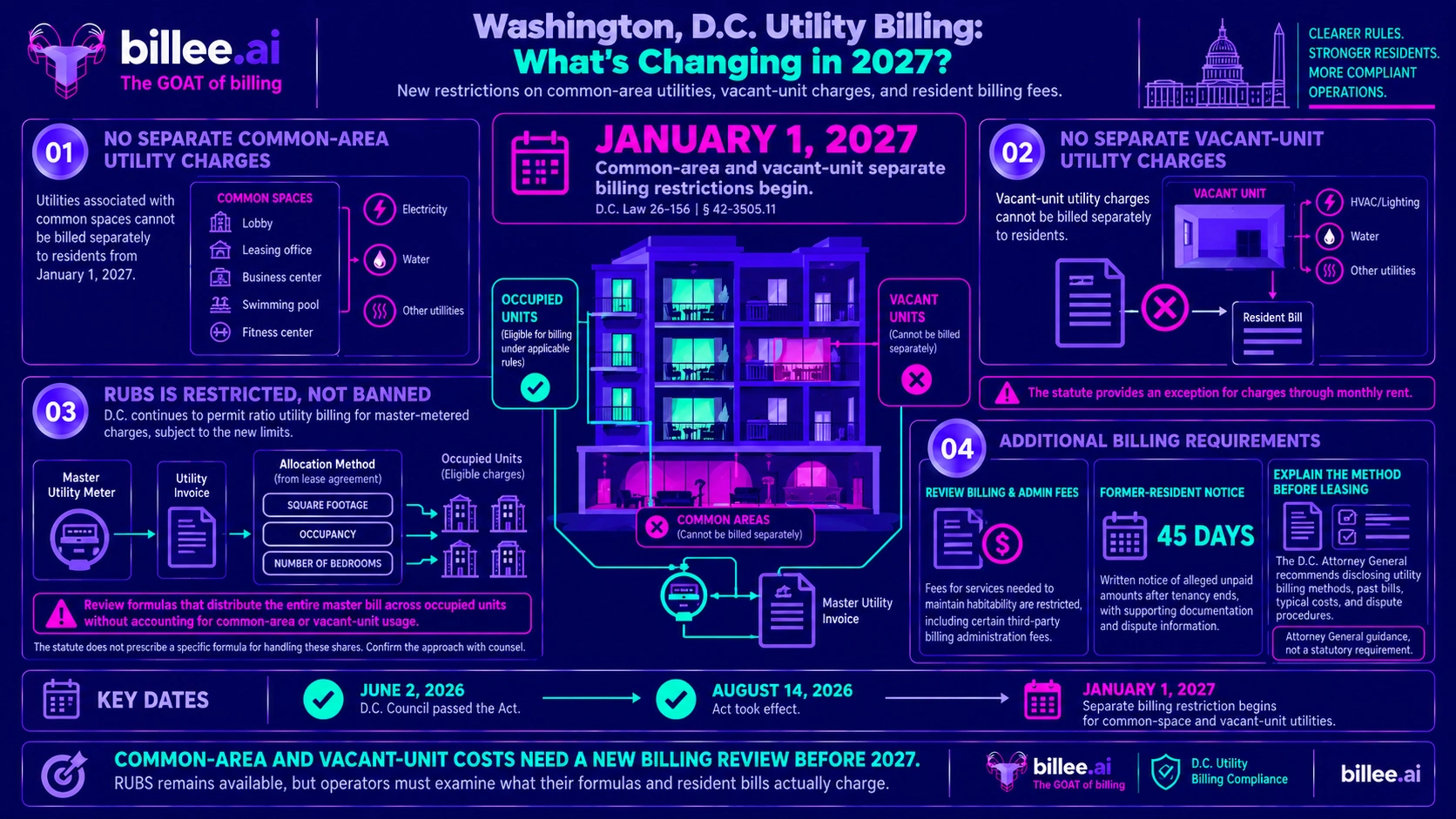
D.C. Law 26-156 bars housing providers and their contracted billing vendors from billing residents separately for common-space or vacant-unit utilities starting Jan. 1, 2027, while keeping ratio utility billing (RUBS) available for master-metered charges. It also restricts fees for habitability services and sets a 45-day notice process for former residents. Billee Technologies, Inc. helps operators review formulas and leases against these rules.
The Fair Housing Practices Amendment Act of 2026 passed the D.C. Council unanimously on June 2, 2026, and took effect Aug. 14, 2026. The utility billing change waits for the new year. This guide covers what the text says, what it leaves open, how the Attorney General's alert fits in and what to check before January.
Key takeaways
- Starting Jan. 1, 2027, a housing provider, or a third party it contracts, may not bill residents separately for common-space or vacant-unit utilities, except through monthly rent.
- RUBS stays available for allocating master-metered utility charges, subject to the limits in the same section.
- Common space includes lobbies, leasing offices, business centers, pools and fitness centers. Covered utilities include electricity, gas, water, wastewater and internet or telephone service.
- The section's own text sets no building-size threshold, and it does not say how a RUBS formula should treat common-area or vacant-unit shares.
- The amended habitability-fee subsection bars fees for services needed to keep a unit habitable and lists administrative fees tied to third-party billing among its examples.
- Within 45 days after a tenancy ends, a housing provider must send written notice of alleged unpaid amounts, with supporting documents and the right to dispute.
- The Attorney General's April 2026 alert asks for upfront disclosure of the billing method, past bills and average monthly bills, and says service or administrative fees should not sit on top of usage charges.
D.C. utility billing rules at a glance
ProvisionSectionWhen it appliesWhat it doesThe ActD.C. Law 26-156 (Act 26-342)Effective Aug. 14, 2026Fair Housing Practices Amendment Act of 2026Common-space and vacant-unit utilitiesNew § 42-3505.11(a)Jan. 1, 2027No separate billing except through monthly rentRUBS§ 42-3505.11(b)No separate date statedStill allowed for master-metered charges, subject to the section's limitsHabitability fees§ 42-3505.10(b-2)Act's general effective dateBars fees for services needed to keep a unit habitable, with third-party billing administration among the examplesFormer-resident noticeNew § 42-3502.17(e)Act's general effective dateWritten notice within 45 days, a dispute window and proof of service before collectionsAttorney General guidanceConsumer Protection Procedures Act; § 42-3505.10(b-2)(1)Alert updated April 27, 2026Disclosure and fee expectations for RUBS billing
What changes on January 1, 2027
The core of the change is new D.C. Code § 42-3505.11, added by D.C. Law 26-156. Beginning January 1, 2027, a housing provider, or a third party it contracts, may not bill residents separately for utility charges tied to common spaces or vacant units. The only route is monthly rent.
Common space is defined. The section covers parts of a building that no single resident controls exclusively. Its examples are lobbies, leasing offices, business centers, pools and fitness centers.
Utilities are defined broadly. The definition covers electricity, gas, wastewater and sewage, water, and internet or telephone service.
RUBS survives. Subsection (b) says nothing prevents a housing provider from using a ratio utility billing system to allocate master-metered utility charges to residents, subject to the section's limits. The Act describes RUBS as a program that uses a mathematical formula and says formulas may be based on square footage, occupancy or number of bedrooms. D.C. restricts RUBS rather than banning it. Billee's guide to states that ban or restrict RUBS shows which states go further.
The date is not the Act's effective date. The Act took effect Aug. 14, 2026, but subsection (a) applies from Jan. 1, 2027. Operators have until the start of the year to adjust formulas, leases and vendor terms.
What the Act leaves open
Three questions are not answered in the section's text, as the D.C. Code site presents it. Nothing here is legal advice, and counsel should read the signed Act.
How formulas treat those shares. Subsection (a) bars separate charges for common-space and vacant-unit utilities. The section does not say how a RUBS formula should handle those shares. A formula that spreads the whole master-meter bill across occupied units, with nothing taken out for common areas or vacant units, is the design most worth showing counsel before January.
Who is covered. The section sets no building-size or unit-count exemption in its own text. The headline on the sponsor's press release refers to large buildings, but neither the release nor the section defines a threshold. The Act does not define "housing provider," and whether exemptions elsewhere in D.C.'s rental housing law apply is a question for counsel.
What happens if a provider gets it wrong. The Code site's summary states no penalty, enforcement agency or private right of action for these sections. That is not proof that none exists. Other D.C. laws, including the ones the Attorney General cites, may apply.
The habitability fee limit
The Act also amends D.C. Code § 42-3505.10(b-2). It bars charging prospective residents, current residents or former residents fees for services needed to keep a unit consistent with the implied warranty of habitability and the housing code. The listed examples include fees related to utilities, trash and locks, and administrative fees tied to third-party billing. One carve-out lets a provider withhold a security deposit to replace items damaged beyond ordinary wear and tear.
The Attorney General's alert cites (b-2)(1) for a bar on administrative or service fees tied to utility access, such as billing, metering and account creation fees. The alert separates those fees from usage charges, which it does not describe as barred.
Operators who pass a per-unit billing or administrative fee to D.C. residents should have counsel read this subsection first. Billee's guide to hidden utility billing vendor fees explains why fees like these draw scrutiny.
Notice to former residents
New § 42-3502.17(e) sets a process for charges that remain after a tenancy ends. Per the Code site's summary of the Act:
- At termination, the provider asks the resident for a forwarding mailing or email address.
- Within 45 days after termination, the provider sends written notice of alleged unpaid amounts. The summary's examples are unpaid rent, damage beyond ordinary wear and tear and removal charges for items left behind.
- The notice includes photos or documents supporting each amount, a statement of the right to dispute and the provider's contact information.
- The resident has 30 calendar days after service to dispute the amounts, and the provider responds in writing within 10 days after receiving the resident's information.
- The provider keeps proof that the notice was served for at least 60 days before sending an unpaid amount to a debt collector.
Confirm the 30-day and 10-day windows against the signed Act, since they rest on a single summary. Whether a final utility bill falls inside the notice is a question for counsel, because the examples name rent, damage and removal charges.
What the Attorney General expects
The D.C. Office of the Attorney General first issued its RUBS alert in May 2025 and updated it April 27, 2026, before the Act became law. It relies on the Consumer Protection Procedures Act, which requires fees to be disclosed and explained in a timely, prominent and accurate way, and on § 42-3505.10(b-2)(1). The alert says it is not legal advice and does not state the office's complete view of the law.
Its recommendations for housing providers:
- Before the application stage or any non-refundable fee: describe the billing method for each utility and how it is calculated, and provide past utility bills for the building and unit type plus average monthly bills by utility for the prior calendar year.
- Records and disputes: explain how residents can inspect RUBS records and how billing disputes are resolved, including who handles them.
- In the lease: state the specific RUBS calculation for each utility and how residents get help with billing questions.
- For current residents: verify that meters and submeters work properly, keep monitoring protocols and share them, and do not add service or administrative fees on top of usage charges.
Billee's guide to utility billing transparency and resident rights compares disclosure duties across states.
How to get ready
- Pull your D.C. formulas. Check how each one handles common-area and vacant-unit shares, and show counsel any formula that spreads the full master-meter bill across occupied units. Billee's state-by-state RUBS guide shows how other states handle allocation.
- List every fee on a D.C. resident's bill. Include billing, administrative and account set-up fees. Ask counsel whether each one survives § 42-3505.10(b-2).
- Compare leases to the Attorney General's list. Billee's guide to RUBS lease addendum requirements covers what the addendum should contain.
- Rebuild the move-out file. Be able to show the forwarding-address request, the 45-day notice, supporting documents and proof of service held for 60 days.
- Ask your billing vendor in writing. The Act reaches third parties a housing provider contracts, so get their plan for common areas, vacant units and fees.
- Watch for guidance. Track Attorney General and Council updates, and set a review date before Jan. 1.
How Billee Technologies helps
Billee Technologies pairs a platform with a named, dedicated account team. Your people review and approve. Billee's team does the work. For a rule that changes what can be passed through, that means a checked formula, vacant units watched and a final-bill record you can hand over.
Check the formula and the lease
Billee's Regulatory & Compliance service covers billing methodology audits, access to legal support and ongoing monitoring for rule changes. Access to legal support is not legal advice. Billee's guide to its regulatory and compliance support explains the scope.
A Billee audit reviews four required document categories for the same billing period: the current billing provider's reports, master meter invoices, lease agreements, and the property's W-9 and legal entity name. It surfaces methodology gaps, allocation drift, reconciliation problems and lease language gaps.
For D.C., that shows how a formula allocates cost today, which is the evidence counsel needs. Billee's guide to preparing a billing methodology audit lists what reviewers ask for. Billee's 45-day standard implementation includes a methodology audit of the formulas, submeter configuration and allocation logic.
Watch the vacant units
Billee's Vacant Cost Recovery monitors occupancy data from the property management system against actual meter usage. When a unit flagged as vacant shows usage above a configurable threshold, an exception is generated within the same week and routed to a named Billee account team member who investigates and acts.
In D.C., vacant-unit usage cannot be billed separately to residents from 2027. Finding the leak early, such as HVAC running in an empty unit, is what is left. Billee's Meter Monitoring raises alerts when a reading spikes, drops or flatlines, and the team acts on them. Read more in Billee's guide to meter monitoring and proactive alerts. Monitoring works on portfolios that already have submetering infrastructure.
Handle the final bill and keep the record
Each month Billee assembles utility data and produces a preliminary bill. Your billing administrator reviews it in the Billee portal next to Biller Highlights, the team's notes on exceptions, and can download a Detail Resident Report or an Itemized Report. Billee replies to comments within 1–2 business days. After approval, charges post to the property management system's resident ledger on the set date.
Final bills are managed on the portal's Move-Outs page, and the dashboard's Move-Out Overview shows status counts for Past Due, Upcoming, Needs Review and Issue. The activity log records every billing action, who performed it and when. Those records point the right way for the 45-day notice. Whether they match what the Act requires is a question for Billee in writing.
What to ask Billee for in writing
- How Billee treats common-area and vacant-unit shares in D.C. RUBS formulas, and how it documents a change before Jan. 1, 2027.
- Whether any Billee or property-level billing fee appears on D.C. resident bills, and how it is described.
- How final bills and supporting documents are packaged for the 45-day notice and the 60-day proof-of-service period.
- How Vacant Cost Recovery exceptions are handled for D.C. properties.
- Whether the audit checks D.C. leases against the Attorney General's recommended disclosures.
- How D.C. rule changes reach your account team.
Who Billee is not for
- Portfolios under about 300 units, where Billee's full-service model is usually more than the job needs.
- Anyone looking for a legal opinion on how D.C. Law 26-156 applies to a formula or lease. Billee gives access to legal support, not legal advice, so involve counsel.
- Operators who want to run billing themselves with software alone. Billee's portal exists for review and approval, not self-service operation.
FAQ
Is RUBS banned in Washington, D.C.?
No. D.C. Law 26-156 keeps RUBS available for allocating master-metered utility charges, subject to the limits in § 42-3505.11. The limit that matters most is the bar on separate charges for common-space and vacant-unit utilities from Jan. 1, 2027.
When do D.C.'s new utility billing limits start?
The Act took effect Aug. 14, 2026. The common-space and vacant-unit billing bar in § 42-3505.11(a) applies beginning Jan. 1, 2027. The habitability-fee and former-resident notice provisions carry no separate date in the Code site's summary.
Can a D.C. landlord charge residents for common-area utilities?
Not separately from Jan. 1, 2027. The Act bars a housing provider, or a third party it contracts, from billing residents separately for common-space or vacant-unit utilities, except through monthly rent. Common space includes lobbies, leasing offices, business centers, pools and fitness centers.
Does the D.C. law apply to small buildings?
The section's text sets no building-size or unit-count threshold. The sponsor's press release headline mentions large buildings, but no threshold is defined. Whether exemptions elsewhere in D.C.'s rental housing law apply is a question for counsel.
Can a D.C. landlord charge a billing or administrative fee on utility bills?
Counsel should review it first. The amended § 42-3505.10(b-2) bars fees for services needed to keep a unit habitable and lists administrative fees tied to third-party billing among its examples. The Attorney General says service or administrative fees should not be added on top of usage charges.
What notice does a former resident get in D.C.?
Within 45 days after the tenancy ends, the provider sends written notice of alleged unpaid amounts with supporting documents and the right to dispute. The provider keeps proof of service for at least 60 days before sending an amount to a debt collector.
What does the D.C. Attorney General expect from RUBS billing?
Upfront disclosure of the billing method for each utility, past building and unit-type bills, average monthly bills for the prior calendar year, how to inspect records, how disputes are resolved and the RUBS calculation in the lease. The alert is guidance, not legal advice.
Billee handles utility billing, vacant cost recovery and vendor management for multifamily operators who want a dedicated team behind the software. If you operate in D.C., talk to the team about your portfolio.
Sources
- Council of the District of Columbia, "D.C. Law 26-156. Fair Housing Practices Amendment Act of 2026," accessed October 2026.
- Councilmember Charles Allen, Ward 6, "Council Unanimously Passes Councilmember Allen's Bill Banning Large Buildings from Charging Predatory 'Common Area Utility' Fees," accessed October 2026.
- D.C. Office of the Attorney General, "Attorney General Schwalb Issues Alert to Help Tenants Understand How Utilities Are Billed & Make Sure They Are Not Overpaying," updated April 27, 2026.
Insights and Industry Trends