

Arizona RUBS and Submetering Rules 2026: What Multifamily Operators Need to Know
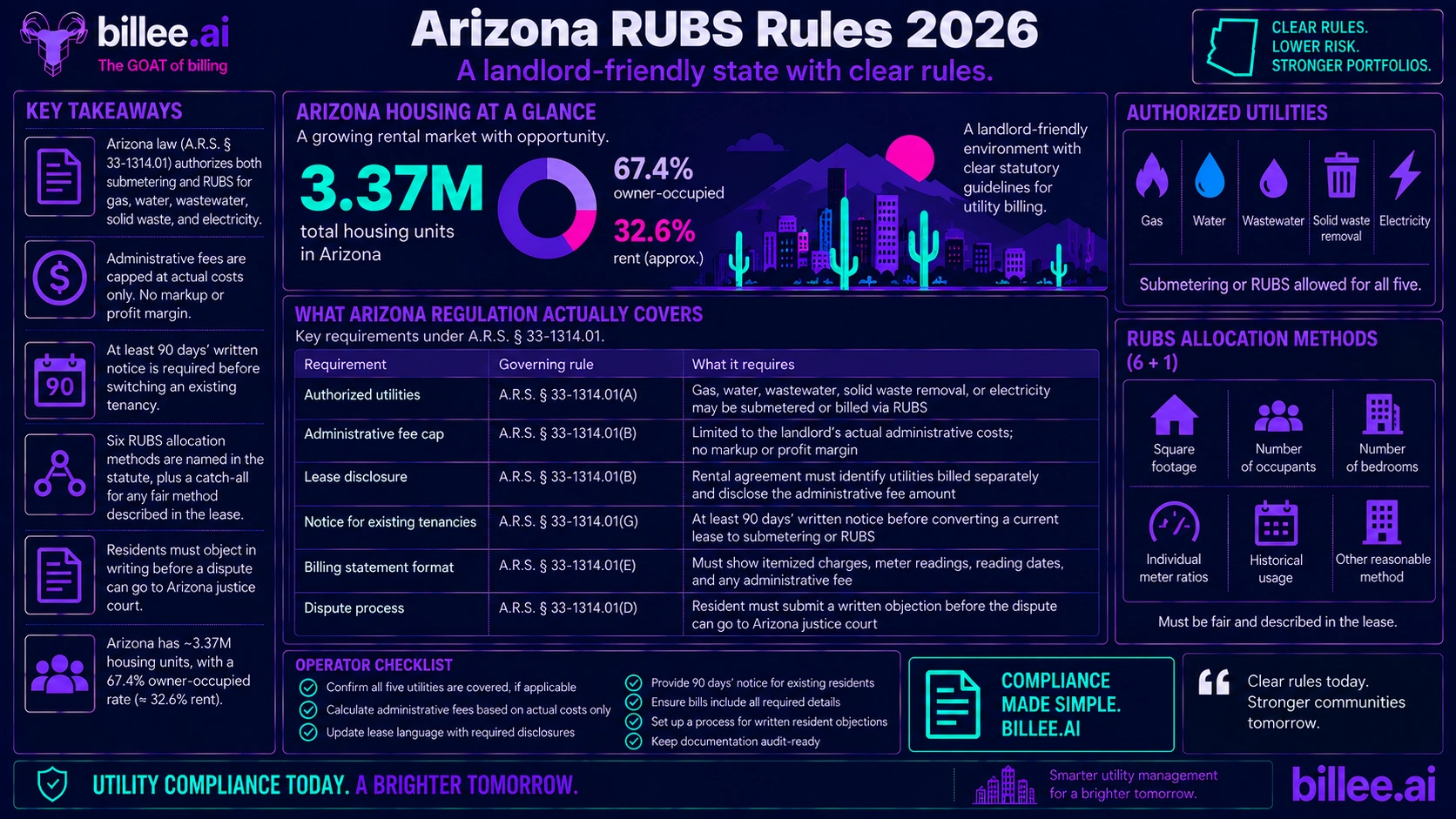
Arizona is the most billing-friendly state in Billee's state-guide series so far. Arizona Revised Statutes § 33-1314.01 gives landlords express statutory permission to bill residents for gas, water, wastewater, solid waste removal, or electricity, using either a submetering system or a ratio utility billing system (RUBS). The tradeoff is a specific compliance checklist: the lease has to disclose the method and any administrative fee, the fee itself is capped at the landlord's actual administrative costs with no markup, and converting an existing tenancy requires at least ninety days' written notice. Billee's compliance review confirms an Arizona property's lease language, notice timing, and billing statement format satisfy every element of the statute before a utility charge goes out.
Quick answer
Arizona permits both submetering and RUBS for gas, water, wastewater, solid waste removal, and electricity under A.R.S. § 33-1314.01. A landlord may recover the utility provider's actual charges plus an administrative fee, but that fee is limited to the landlord's actual administrative costs only, no profit margin. The rental agreement must identify which utilities are billed separately and disclose the administrative fee amount and, for RUBS, the allocation method used. Converting an existing tenancy to submetering or RUBS requires at least ninety days' written notice. Every bill must separately itemize the charges, the meter readings and reading dates, and any administrative fee. If a resident disputes a charge, the statute requires a written objection to the landlord before the dispute can go to justice court.
Two numbers matter most for compliance: ninety days of notice before switching an existing lease, and zero dollars of markup on the administrative fee above actual cost.
Key takeaways
- A.R.S. § 33-1314.01 expressly authorizes both submetering and RUBS for five utility types: gas, water, wastewater, solid waste removal, and electricity.
- The administrative fee a landlord adds to utility charges is capped at actual administrative costs. Arizona law does not allow a markup or profit margin on top of the utility provider's bill.
- Landlords must give existing residents "at least ninety days' notice" before implementing submetering or RUBS mid-lease, under subsection G of the statute.
- Six RUBS allocation methods are named in the statute, plus a catch-all for any other method that fairly allocates charges and is described in the lease.
- A resident must object to a disputed charge in writing before the dispute can proceed to Arizona justice court.
- Arizona has roughly 3.37 million housing units, with a 67.4% owner-occupied rate, meaning close to a third of households rent.
Why this matters for multifamily operators
Arizona sits at the opposite end of Billee's state-guide series from a state like Massachusetts, which effectively bans electric submetering outright. Billee's guide to where RUBS is banned or restricted by state tracks the states that prohibit or heavily condition resident utility billing; Arizona isn't one of them. The statute gives operators a clear, statutory green light for both submetering and RUBS across nearly every major utility type.
That permissiveness comes with real compliance mechanics, not a blank check. The administrative fee cap is the most common place operators get it wrong, since a percentage-based markup is standard practice in some other states and some billing vendors default to it. Arizona's statute ties the fee strictly to actual administrative costs, and a lease or billing statement that doesn't reflect that can expose an operator to a resident's written objection and, eventually, a justice court claim.
What Arizona regulation actually covers
| Requirement | Governing rule | What it requires |
|---|---|---|
| Authorized utilities | A.R.S. § 33-1314.01(A) | Gas, water, wastewater, solid waste removal, or electricity may be submetered or billed via RUBS |
| Administrative fee cap | A.R.S. § 33-1314.01(B) | Limited to the landlord's actual administrative costs; no markup or profit margin |
| Lease disclosure | A.R.S. § 33-1314.01(B) | Rental agreement must identify utilities billed separately and disclose the administrative fee amount |
| Notice for existing tenancies | A.R.S. § 33-1314.01(G) | At least 90 days' written notice before converting a current lease to submetering or RUBS |
| Billing statement format | A.R.S. § 33-1314.01(E) | Must show itemized charges, meter readings, reading dates, and any administrative fee |
| Dispute process | A.R.S. § 33-1314.01(D) | Resident must object in writing to the landlord before filing a civil action in justice court |
What utilities Arizona lets you bill, and how
Subsection A of the statute authorizes a landlord to charge separately for gas, water, wastewater, solid waste removal, or electricity, using either a submetering system or a ratio utility billing system. That's a broader authorization than most states in this series offer: Massachusetts effectively prohibits electric submetering, and several states restrict RUBS to specific utilities. Arizona treats submetering and RUBS as interchangeable tools for any of the five listed utility types, leaving the choice to the operator.
The administrative fee cap: actual costs only, no markup
Subsection B limits what a landlord can recover to the utility provider's actual charges plus an administrative fee for the landlord's actual administrative costs only. No additional charge beyond that is permitted. This is worth flagging directly: at least one widely cited third-party site claims Arizona has "no statutory cap on the markup percentage," implying a landlord can set the administrative fee at whatever the lease allows. That claim conflicts with the statute's actual text, which ties the fee to real administrative cost, not an arbitrary percentage. An operator who prices the administrative fee as a flat markup rather than a documented cost recovery is applying a rule that doesn't match Arizona law.
Lease disclosure and the 90-day notice for existing tenancies
The rental agreement must identify which utilities are billed separately and disclose the administrative fee amount, per subsection B. For RUBS specifically, subsection G requires the allocation method to be described in the resident's rental agreement. A new lease can build in submetering or RUBS from day one. Converting an existing tenancy is different: the landlord must provide "at least ninety days' notice" before the new billing method takes effect, giving residents time to budget for the change or, if their lease allows, respond before renewal.
RUBS allocation methods that qualify
Subsection F lists six ways a landlord may allocate RUBS charges: per tenant, proportionately by livable square footage, per type of unit, per number of water fixtures, through submetered hot water measurements, or any other method that fairly allocates the charges and is described in the resident's rental agreement. Billee's guide to how RUBS allocates utility costs covers how these formulas work in practice; in Arizona, whichever method an operator picks has to actually appear in the lease, not just in an internal billing policy.
Billing statement requirements and the resident dispute process
Subsection E requires each bill to separately state the charges for that period, the opening and closing meter readings, the dates those readings were taken, and the amount of any administrative fee. Subsection D sets the dispute path: a resident who disagrees with a charge must object in writing to the landlord first. If that doesn't resolve it, the resident may file a civil action in justice court to enforce the statute. An operator without a documented process for logging and responding to written objections is exposed to disputes escalating faster than they need to.
Common mistakes
- Charging a flat markup or profit margin on the administrative fee instead of pricing it to actual administrative cost, based on the mistaken belief that Arizona law doesn't cap it.
- Converting an existing tenancy to submetering or RUBS with less than ninety days' written notice.
- Using a RUBS allocation formula that isn't described in the resident's rental agreement, even if it's documented internally.
- Sending utility bills that don't itemize meter readings, reading dates, and the administrative fee separately.
- Treating a resident's written objection as informal feedback rather than the first required step in the statute's dispute process.
- Assuming Arizona's general essential-services protections under A.R.S. § 33-1364 don't apply just because a charge is billed through RUBS or a submeter rather than included in rent.
When to handle this in-house vs. bring in a partner
A single Arizona property converting new leases to RUBS or submetering, with a documented allocation method and a fee calculation tied to actual costs, is often manageable with a property manager who understands the statute's disclosure and billing-format requirements.
The harder problem is consistency across a portfolio, especially when acquisitions bring in leases written under different billing assumptions or vendors that default to percentage-based administrative fees. Confirming that every lease discloses the right method, every administrative fee traces back to actual cost, and every conversion notice went out on time takes documentation most property management teams don't track property by property. Billee's complete guide to utility management compliance covers what that burden looks like across a full portfolio, not just Arizona.
How Billee can help
Billee's Regulatory & Compliance service reviews an Arizona property's lease language, administrative fee calculation, and billing statement format against every element of A.R.S. § 33-1314.01 before a new charge goes out. That includes confirming the fee traces to documented administrative cost rather than a flat markup, and that any mid-lease conversion has cleared the ninety-day notice window.
Billee's account team also tracks the written-objection process resident by resident, so an operator has a clear record if a dispute moves toward justice court rather than a scattered email thread. For a multi-state portfolio, that same compliance discipline extends to whichever combination of RUBS, submetering, or flat-rate billing each property's local law actually allows.
FAQ
Does Arizona allow RUBS?
Yes. A.R.S. § 33-1314.01 expressly authorizes ratio utility billing for gas, water, wastewater, solid waste removal, and electricity, as long as the allocation method is disclosed in the rental agreement.
Does Arizona allow submetering?
Yes. The same statute authorizes submetering for the same five utility types, and treats it as an alternative to RUBS rather than a separate legal framework.
Can I charge a markup on the administrative fee?
No. Arizona law limits the administrative fee to the landlord's actual administrative costs only. A flat markup or profit margin on top of that isn't authorized by the statute.
How much notice do I need to switch an existing resident to RUBS or submetering?
At least ninety days' written notice before the new billing method takes effect, if the resident is already in an existing lease.
What allocation methods qualify for RUBS in Arizona?
Per tenant, by livable square footage, by unit type, by number of water fixtures, through submetered hot water, or any other method that fairly allocates charges and is described in the rental agreement.
What must an Arizona utility bill include?
Itemized charges for the billing period, the opening and closing meter readings, the dates those readings were taken, and the amount of any administrative fee.
What happens if a resident disputes a submetered or RUBS charge?
The resident must first object in writing to the landlord. If the dispute isn't resolved, the resident may file a civil action in justice court to enforce the statute.
How does Billee handle Arizona properties?
Billee's Regulatory & Compliance service confirms that an Arizona property's lease disclosures, administrative fee calculation, and billing statements satisfy A.R.S. § 33-1314.01 before any new utility charge goes live.
Related reading
- New York Submetering Rules: What Multifamily Operators Need to Know: a state that requires agency approval before submetering, unlike Arizona's direct statutory authorization.
- Washington RUBS Rules: What Multifamily Operators Need to Know: a state layering city-level restrictions on top of state law, a contrast to Arizona's single governing statute.
- Massachusetts Submetering Rules 2026: What Multifamily Operators Need to Know: the most restrictive state in the series, where Arizona is closer to the most permissive.
Billee's Regulatory & Compliance service confirms an Arizona property's utility billing setup satisfies A.R.S. § 33-1314.01 before any new charge goes live. Talk to the team.
Sources
- Arizona State Legislature, "A.R.S. § 33-1314.01, Utility charges; submetering; ratio utility billing; allocation; water system exemption," accessed September 2026.
- Arizona State Legislature, "A.R.S. § 33-1364, Wrongful failure to supply heat, air conditioning, cooling, water, hot water or essential services," accessed September 2026.
- Justia, "Arizona Revised Statutes § 33-1364 (2025)," accessed September 2026.
- U.S. Census Bureau, "QuickFacts: Arizona," accessed September 2026.
Insights and Industry Trends


Explore more insights