

Utility Invoice Audit Checklist: What to Check Before Every Invoice Posts
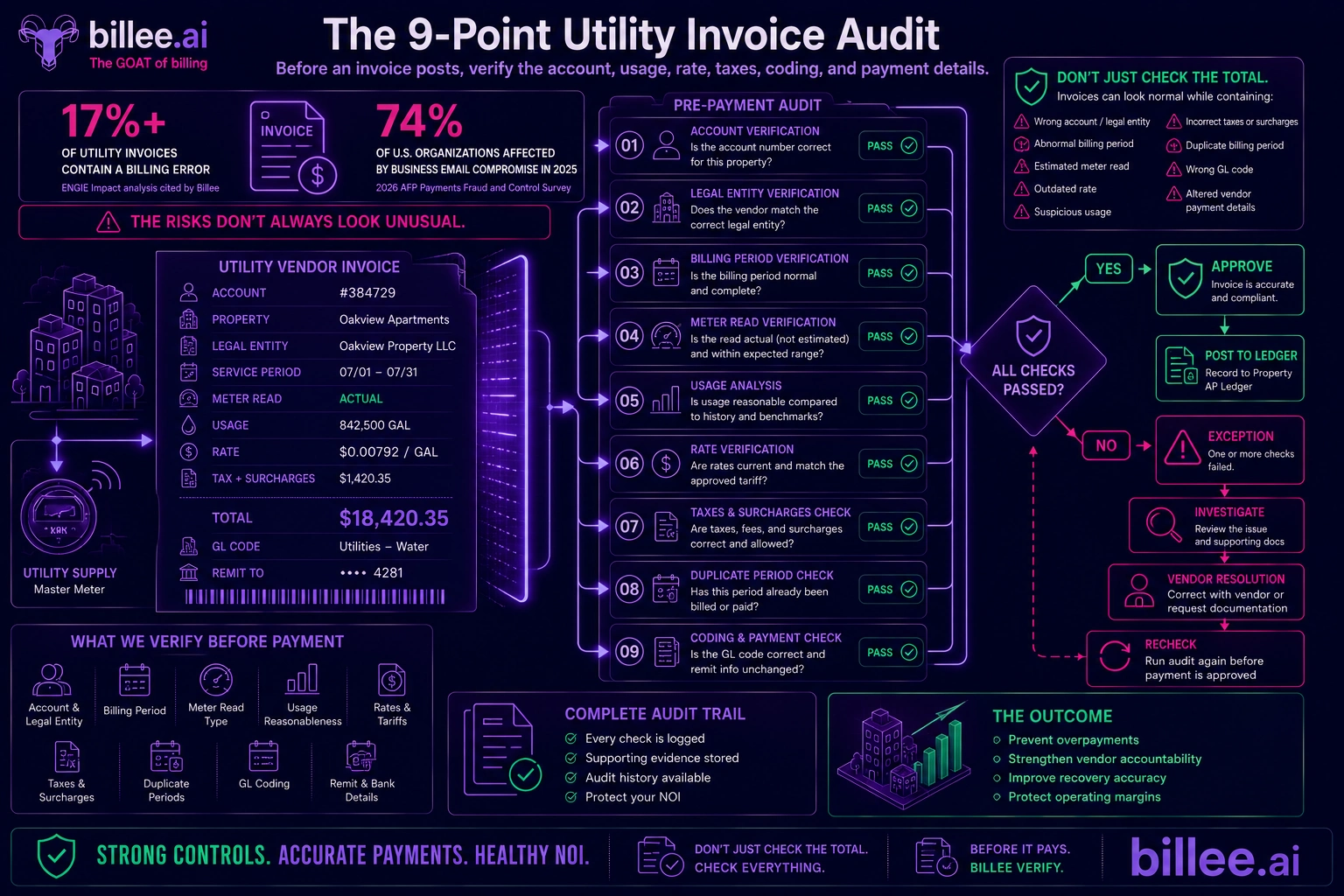
A complete pre-payment utility invoice audit checks nine things: the account, property, and legal entity match; the billing period is standard; the meter read is actual, not estimated; the rate is current; usage is in line with history; taxes and surcharges are correct; the period hasn't already been invoiced; the GL code is correct; and the vendor's payment details haven't changed. Skipping any one of these lets a preventable error, a compliance gap, or a fraudulent invoice post to the ledger.
Quick answer
Most manual reviews reliably catch only one of the nine checks above: whether the total amount looks unusually high. The other eight, from meter-read type to tax and surcharge accuracy, require checking specific fields against specific references, on every invoice, which is exactly the work a documented checklist exists to force. Skipping straight to the number and skipping everything else is how rate errors, estimated-read overbilling, and tax misapplication all survive for months.
Why this matters for multifamily operators
At least 17% of utility invoices contain a billing error, according to an ENGIE Impact analysis cited in Billee's Catching Utility Billing Errors Before They Post. Separately, business email compromise, the tactic most often used to redirect a vendor payment, affected 74% of US organizations in 2025, per the 2026 AFP Payments Fraud and Control Survey.
A third risk gets less attention than either one. Utility taxes, franchise fees, and regulatory surcharges are jurisdiction-specific, change without much notice, and are easy for a vendor's billing system to apply incorrectly, especially across a multi-state portfolio.
None of these three risks announce themselves. A checklist applied only to invoices that look unusual misses most of all three, because the invoices worth the closest look, the ones with a wrong rate, an unflagged estimated read, or a misapplied tax exemption, rarely draw attention on their own.
The checklist: what to check before an invoice posts
1. Confirm the account, property, and legal entity match
Verify the account number, property code, and billed legal entity against the vendor account on file. Portfolios that hold different properties under different LLCs are exposed here in a way a single-entity operator isn't: an invoice can carry the right property address but the wrong legal entity, which is a common source of both misallocation and audit findings at refinancing.
2. Check the billing period against the standard cycle
Confirm the service period is the property's standard length, typically around 30 days. A longer or shorter period changes the expected amount proportionally, and the total can still look normal for the period stated even when wrong.
3. Confirm the meter read is actual, not estimated
Check whether the invoice is based on an actual meter read or a vendor-estimated one. Utilities estimate a read when access is blocked, a meter malfunctions, or a route is missed, and an estimated invoice can run well above or below true usage for months until a real read corrects it. An invoice marked estimated deserves a closer look, not an automatic pass.
4. Verify the rate against the current schedule on file
Cross-check the rate applied against the property's current rate schedule, not last month's invoice. A rate error looks like a normal amount and can recur for months before anyone notices.
5. Compare usage to trailing history
Flag any invoice where reported usage is materially higher or lower than the same period last month or last year. A spike can mean a leak; a drop can mean a stalled meter, or an estimated read masking the real number. Either way, it's worth investigating before payment.
6. Verify taxes, franchise fees, and regulatory surcharges
Check that sales tax, franchise fees, and regulatory surcharges match what the property actually owes. Some multifamily accounts qualify for a utility sales tax exemption that vendors don't always apply correctly, and what can legally be passed through to residents varies by state; Texas alone regulates this in detail under PUC Chapter 24. A missed exemption or a miscalculated surcharge repeats on every invoice until someone catches it, and it's the check most likely to be skipped by a reviewer focused on usage and rate alone.
7. Check for duplicate billing periods
Confirm this period hasn't already been invoiced for this account. Duplicates happen when a corrected invoice goes out alongside the original, or a portal reissues a bill, and both versions look correct on their own.
8. Confirm GL coding matches this property's chart of accounts
Check the GL code against this property's own configuration, not a code correct at a different property in the portfolio. A correctly billed invoice coded to the wrong account still distorts expense reporting until caught.
9. Verify vendor and remit-to details haven't changed
Confirm the vendor's bank or remit-to information matches what's on file. Treat any change as a reason to verify directly through a known contact, not by replying to the invoice email; a redirected payment is rarely recovered once it clears.
Common mistakes
- Auditing the total amount and stopping there, missing rate, period, tax, and duplicate errors entirely.
- Treating an estimated-read invoice the same as an actual read, when it's the one most likely to be materially wrong in either direction.
- Assuming tax exemptions and franchise fees are applied correctly because they were correct last cycle; vendor systems and state rules both change without much warning.
- Catching an error but never confirming the credit or corrected invoice actually arrived, which leaves the correction half-finished.
- No documented checklist, so coverage depends on which coder handles the invoice that day.
- Auditing after the invoice posts, trading one vendor conversation for a credit memo, a revised invoice, and two correcting entries.
- Skipping vendor verification because it feels least likely to matter, until the one time it does.
When to handle this in-house vs. bring in a partner
Running all nine checks on every invoice works in-house when one person or a small team can do it without volume outpacing them, which describes most smaller, single-state portfolios, where one controller or AP lead can know every vendor account and the local tax rules by name.
Consistency gets harder to sustain as the portfolio grows, and harder still once it crosses state lines: more properties means more accounts and rate schedules competing for the same reviewer's time, and a multi-state footprint means tracking tax and surcharge rules that differ property by property. Checks quietly start getting skipped right around that point. Billee's own guidance points to roughly 500 units as the level where a dedicated audit team earns its keep; below that, a documented in-house checklist, run consistently, is often enough.
How Billee can help
Billee's Utility Vendor Management product takes over vendor relationships directly, not just the audit: invoices route through the same nine checks automatically, from entity match to tax and surcharge verification, before they ever reach the property team for approval. Anomalies go to a dedicated account team, who contact the vendor directly to resolve them. The team also handles what an audit alone doesn't: vendor credential management across dozens of portals, and keeping vendor relationships intact through an owner transition instead of starting over.
For the tax and regulatory piece specifically, Billee's Regulatory & Compliance service audits each property's billing methodology against state rules like Texas PUC Chapter 24, and provides access to legal support to close gaps before they surface as a resident complaint or a PUC inquiry.
FAQ
How often should utility invoices be audited?
Every invoice, every cycle. Spot-checking based on which invoices look unusual misses error types, like rate errors, estimated-read overbilling, and tax misapplication, that don't look unusual at all.
What's the difference between an invoice audit and a billing methodology audit?
An invoice audit checks whether a vendor invoice was billed correctly. A billing methodology audit checks whether a property's resident billing formula is documented, disclosed, and compliant. Different problems, and both matter.
Does an invoice audit check for sales tax and franchise fee errors?
Yes, it should. Tax exemptions and regulatory surcharges are jurisdiction-specific and easy for a vendor to apply incorrectly, and verifying them against the property's actual status belongs in the same audit as rate and usage checks, not a separate review nobody gets to.
What's the difference between an actual and an estimated meter read?
An actual read comes from someone or something physically reading the meter that cycle. An estimated read is the vendor's projection when a real read isn't available, and it can be materially wrong in either direction until a true read corrects it.
Can utility invoice auditing be automated?
Yes. Most of these checks are rule-based comparisons against data already on file, account, rate schedule, tax status, usage history, and vendor details, which makes the process a strong candidate for automation rather than manual review.
Does a pre-payment audit slow down invoice approval?
Not when it's built into the workflow. The checks add seconds per invoice, not days; the correction cycle after a missed error is what actually causes delay.
How do you catch a fraudulent or altered vendor invoice?
Treat any change to a vendor's bank or remit-to details as a required verification step, confirmed through a known contact rather than the invoice email itself. Manual reviews skip this check more than any other, which is exactly what fraud attempts count on.
Related reading
- Catching Utility Billing Errors Before They Post
- How to Prepare a Billing Methodology Audit for Multifamily Properties
- Texas PUC Chapter 24 Compliance Guide
- How AP Automation Works in Multifamily Utility Billing
- Managing Utility Invoices Across a Large Multifamily Portfolio
A documented nine-point checklist, applied to every invoice, catches most billing errors, most tax and compliance gaps, and most fraud attempts before any of them cost real money. Talk to the team to see how Billee runs it automatically across a portfolio.
Sources
- ENGIE Impact finding (at least 17% of utility invoices contain a billing error), as cited in Billee's "Catching Utility Billing Errors Before They Post."
- Association for Financial Professionals, "2026 AFP Payments Fraud and Control Survey Report," based on a January 2026 survey of 465 treasury practitioners at U.S. organizations. Findings: 76% of organizations experienced attempted or actual payments fraud in 2025; 74% were affected by business email compromise.
- Texas Public Utility Commission, 16 TAC Chapter 24, as summarized in Billee's "Texas PUC Chapter 24 Compliance Guide."
Insights and Industry Trends


Explore more insights