
How AP Automation Works in Multifamily Utility Billing
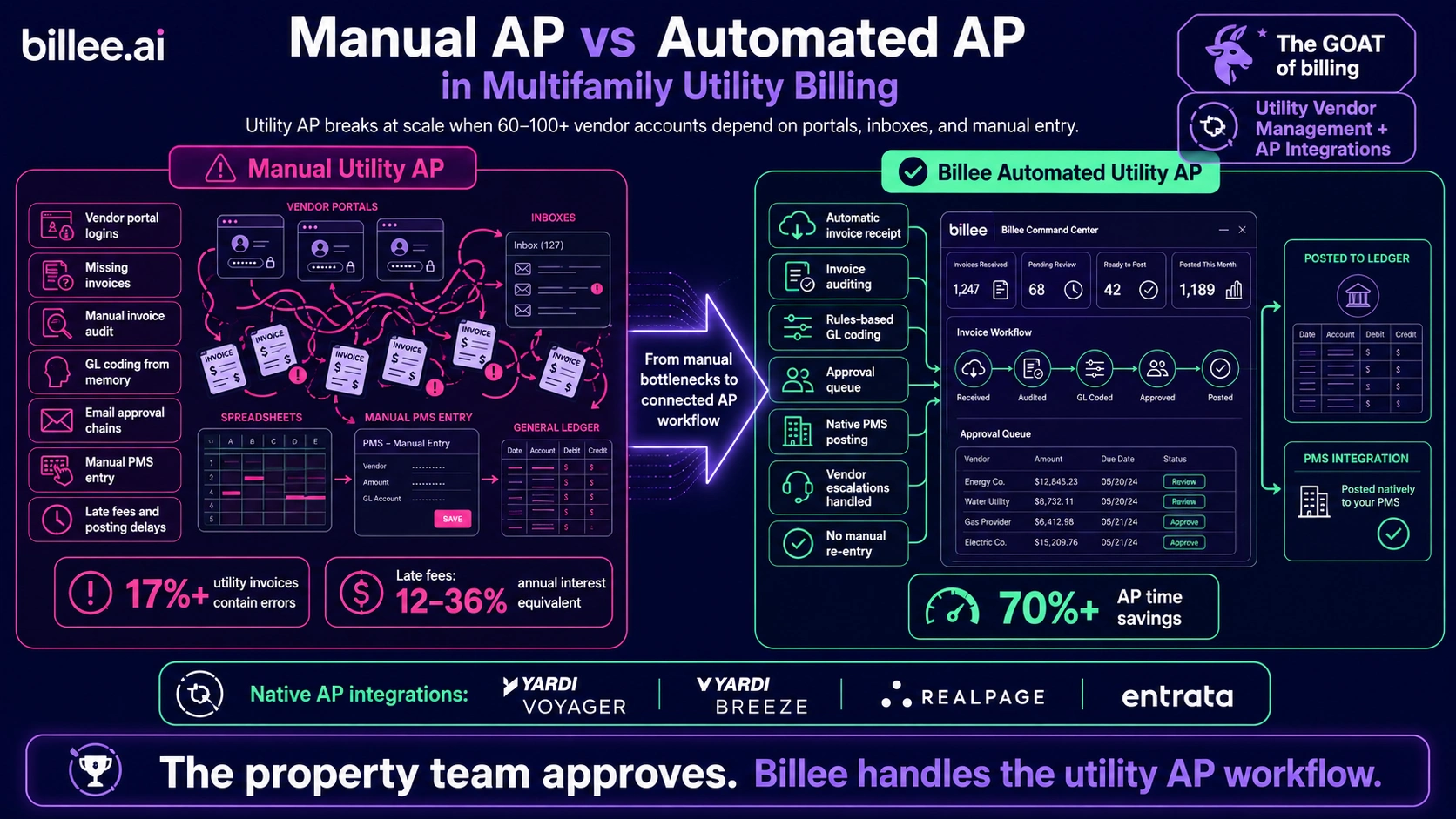
AP automation in multifamily utility billing replaces five manual steps (invoice receipt, auditing, GL coding, approval routing, and PMS posting) with a connected workflow that handles each step without property team intervention. For portfolios managing 60–100+ utility vendor accounts, those five steps happen dozens of times per month, per property, and any manual bottleneck in the chain produces late fees, coding errors, or stalled approvals. Billee's Utility Vendor Management + AP Integrations product automates all five steps and connects natively to Yardi, RealPage, and Entrata so invoices move from vendor portal to ledger without anyone at the property manually re-entering data.
Key Takeaways
AP automation addresses five manual steps in utility accounts payable: invoice receipt, auditing, GL coding, approval routing, and PMS posting.
At least 17% of utility invoices contain an error, according to ENGIE Impact, making the audit step the most consequential of the five.
AP automation saves more than 70% of the time property teams currently spend on accounts payable, according to Quadient's research.
Utility late fees run at the equivalent of 12–36% annual interest at many providers, making missed payment deadlines one of the most expensive preventable line items in a multifamily budget.
"Integrates with Yardi" can mean either a file export that a staff member enters manually or a native AP integration that posts directly to the ledger. The difference determines whether manual data entry is eliminated or just moved downstream.
Billee automates all five AP steps and integrates natively with Yardi Voyager, Yardi Breeze, RealPage, and Entrata through their AP modules.
At a Glance: Manual AP vs. Automated AP in Multifamily Utility Billing

What AP Automation Means in Utility Billing
AP automation in multifamily utility billing is not the same as general accounts payable software. General AP tools handle invoices from vendors of all kinds: contractors, maintenance suppliers, landscapers, management fees. Utility AP is a narrower, higher-volume problem.
A typical multifamily portfolio manages water, electric, gas, trash, telecom, stormwater, and irrigation for every property. That produces 5–7 utility invoices per property per month, multiplied across every property in the portfolio. On a 20-property portfolio, that is 100–140 invoices arriving on different schedules from vendors with different billing formats, portals, and payment requirements.
AP automation purpose-built for utility billing handles that volume consistently, without someone manually logging into dozens of portals or re-keying data the system already has.
Why Manual Utility AP Breaks at Scale
Manual utility AP has a structural problem: the number of invoices grows linearly with portfolio size, but the staff hours available to process them do not. A property manager at a 5-property portfolio can track 30–40 utility invoices per month. A regional managing 20 properties cannot scale the same approach to 120+ invoices without something breaking.
The breaking points are predictable. Some invoices arrive late and get missed. Some get paid before the audit catches the error. Some get coded to the wrong GL account because the coder is working from memory across a dozen different property configurations. Some approvals sit in an inbox while a payment deadline passes.
According to Quadient's research on AP automation, AP automation saves more than 70% of the time teams currently spend on accounts payable. At scale, that is not a productivity gain. It is the difference between a process that works and one that produces compounding errors and fees.
Invoice Receipt and Auditing: The First Two Steps That Determine Everything Downstream
Every downstream AP step depends on having the correct invoice. Invoices that arrive late, in the wrong format, or not at all create the bottlenecks and errors that follow.
In a manual operation, someone on the property team logs into each vendor portal, downloads invoices, and imports them into a spreadsheet or accounting system. Across 60–100+ vendor accounts, that process takes hours each month. Invoices with irregular billing cycles, seasonal accounts, or portal login issues get missed. When a payment deadline passes before the invoice is located, the late fee is unavoidable.
The audit step determines whether the invoice that arrived is correct. As Zego documents in its analysis of utility accounts payable mistakes, ENGIE Impact, one of the nation's largest utility billing auditors, finds that at least 17% of utility invoices contain an error. Errors include incorrect amounts, misapplied rate structures, duplicate billing, and usage anomalies that may indicate a meter malfunction or leak. Automated auditing checks every invoice against expected billing rules before payment is approved. Skipping the audit means paying those errors.
Auditing every invoice at scale requires automation. Manual audits create sampling bias: the invoices that get reviewed are the ones that seem unusual, not the ones containing subtle errors in amounts or rate structures.
GL Coding: Why the Same Vendor Gets a Different Code at a Different Property
GL coding is the step most AP teams underestimate. On the surface it seems simple: assign each invoice to the correct expense account. In practice, multifamily GL coding is structurally complex.
The same water utility billing two properties in the same portfolio may require different GL codes at each, depending on ownership structure, cost center configuration, operating versus capital treatment, or lease terms. As PredictAP describes in its analysis of invoice coding in commercial real estate, the coder must understand the property, the entity, the GL accounts, any allocation rules, and the approval process before entering a single character.
A human coder working across dozens of properties under deadline pressure makes errors. Those errors are not random noise. They are systematic misrepresentations of property-level expense that persist in the ledger until an audit, a lender's review, or a year-end reconciliation surfaces them. At refinancing or disposition, a clean, accurately coded AP trail is a material operational asset. Errors discovered during due diligence slow closings and, in some cases, affect valuations.
Automated GL coding applies rules-based assignment per property configuration: the same vendor gets the correct code at each property, every time, without relying on a coder's memory or availability.
Approval Routing and PMS Posting: Where Most Delays Originate
After an invoice is audited and coded, it needs approval before payment. In a manual operation, that means email. Coded invoices go to the approver's inbox, sit in a queue, and wait. When the approver is traveling, in meetings, or managing a property issue, the invoice waits with them.
Payment windows for utility invoices are typically short. Unlike a contractor invoice with a net-30 or net-60 term, many utility bills carry payment windows of 10–15 days. A coded invoice sitting in an inbox for a week before approval, then another week before PMS entry, can miss that window entirely.
After approval, the invoice must be posted to the property management system's AP module. Planergy, in its analysis of vendor invoice management, identifies manual data entry into the accounting system as a leading source of errors and processing delays. In a Yardi, RealPage, or Entrata environment, every manually entered invoice is an opportunity to introduce a coding error, a duplicate entry, or a posting to the wrong property.
Approval routing automation moves invoices through the workflow without waiting on email. Posting automation eliminates manual re-entry entirely. Together, they turn a 10-day payment window from a recurring risk into a routine.
"Integrates with Your PMS" Means Two Different Things
"Integrates with Yardi" is one of the most commonly misunderstood claims in utility AP. It can mean two structurally different things, and the difference determines whether manual data entry is eliminated or just relocated.
A file export integration sends a batch report or CSV to someone on the property team, who then enters the data into Yardi, RealPage, or Entrata manually. The reporting step happens outside the PMS. The entry step still happens inside it, by a person. Invoice receipt has been simplified. The data entry error, the duplicate posting risk, and the delay remain.
A native AP integration connects directly to the PMS's accounts payable module. GL-coded, approved invoices post to the ledger without anyone at the property re-entering anything. The property team approves invoices from a queue. They do not enter them.
Billee's Utility Vendor Management + AP Integrations product connects natively to Yardi Voyager, Yardi Breeze, RealPage, and Entrata through their AP modules, not through file exports. For portfolios using these systems, the distinction eliminates the manual posting step where most GL coding errors and late fees originate.
How Billee Automates All Five AP Steps
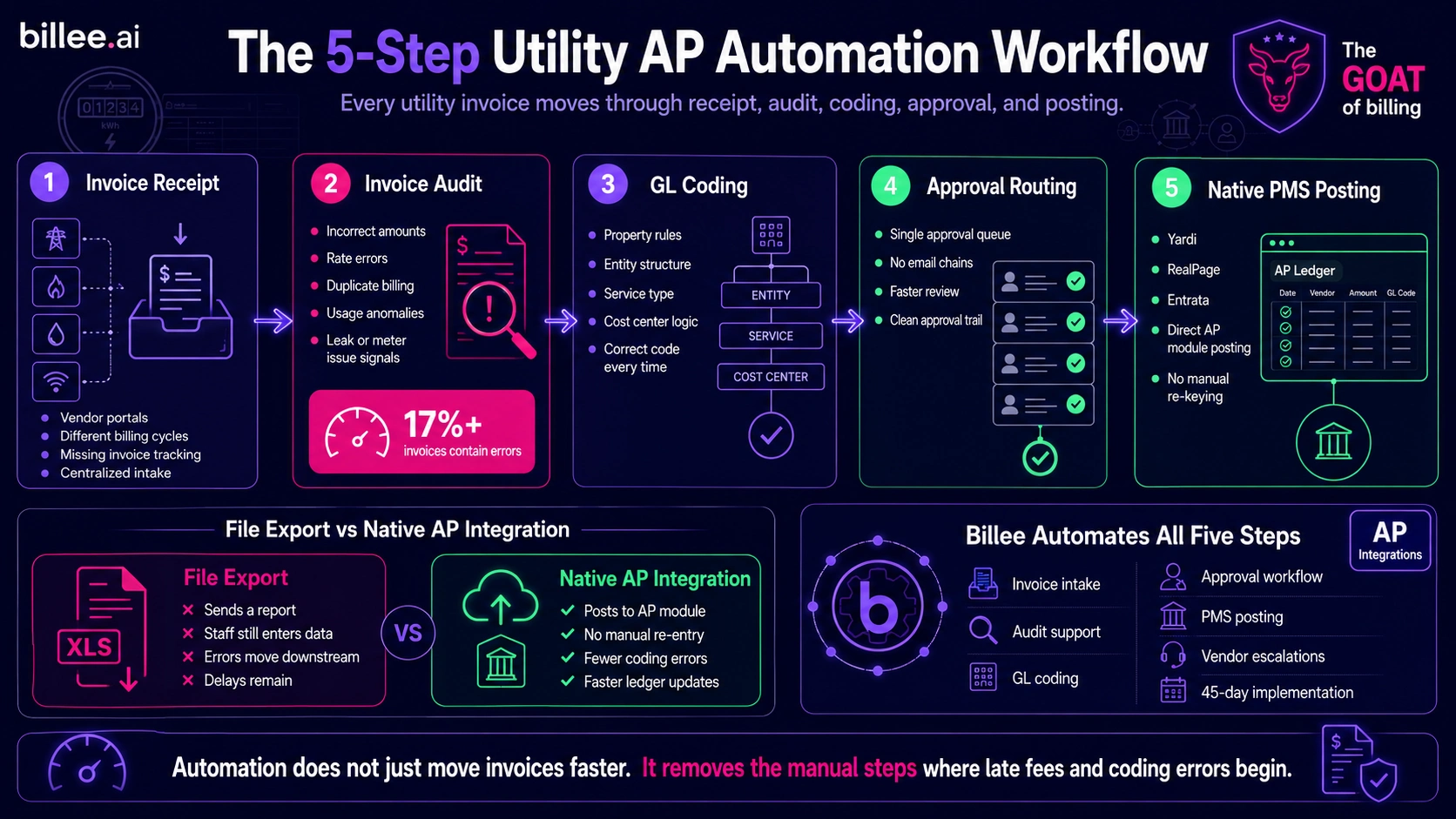
Billee covers the full chain: receipt, audit, GL coding, approval, and posting. Each step is handled by the Billee platform, supported by the dedicated Billee account team.
Invoices from enrolled utility vendors flow into the Billee platform automatically. The team reviews each invoice against the expected billing rules for that vendor and property. GL codes are assigned per the property configuration on file. Approved invoices post directly to the AP module in Yardi, RealPage, or Entrata without manual re-entry by the property team.
The Billee team manages vendor escalations when an invoice contains an error or a usage anomaly requires follow-up. The full utility vendor management process includes credential management, vendor account continuity through ownership transitions, and a centralized view of every enrolled vendor and account in the portfolio at app.billee.ai.
The result for the property team is a single approval queue instead of a set of vendor portals, email chains, and manual posting workflows. What was a multi-step process across multiple systems becomes one step: review and approve.
Implementation takes 45 days. Vendor onboarding, PMS configuration, and historical data migration are handled by the Billee team.
FAQ: AP Automation in Multifamily Utility Billing
What is AP automation in multifamily utility billing?
AP automation in multifamily utility billing replaces the manual steps in processing utility invoices: receipt, auditing, GL coding, approval routing, and posting to the property management system. Automated systems handle each step without requiring property staff to log into vendor portals, re-key data, or manage approval chains by email.
How much time does AP automation save on utility invoices?
According to Quadient's research on accounts payable, AP automation saves more than 70% of the time teams currently spend on AP processes. For multifamily portfolios managing 100+ utility invoices per month, that reduction in manual labor compounds across every property in the portfolio.
What percentage of utility invoices contain errors?
At least 17% of utility invoices contain an error, according to ENGIE Impact, one of the nation's largest utility billing auditors. Errors include incorrect billing amounts, misapplied rate structures, duplicate billing, and usage anomalies that may signal a meter malfunction or an active leak. An automated audit step catches these before payment.
What is the difference between a file export integration and a native AP integration with Yardi?
A file export integration sends invoice data to a staff member who then enters it into Yardi manually. A native AP integration posts approved, coded invoices directly to Yardi's AP module without manual re-entry. The distinction eliminates the data entry step where most GL coding errors and posting delays originate.
Why do multifamily portfolios accumulate utility late fees?
Utility late fees accumulate because manual AP workflows cannot reliably track 60–100+ vendor accounts simultaneously. Short payment windows, invoices that arrive inconsistently, and approval delays combine to produce missed deadlines. Many utility providers assess late fees at the equivalent of 12–36% annual interest, per Zego's analysis of multifamily utility AP practices.
Does Billee integrate with Yardi and RealPage for utility AP?
Billee integrates natively with Yardi Voyager, Yardi Breeze, RealPage, and Entrata through their AP modules. Invoices are audited, coded, and approved in the Billee platform, then post directly to the PMS ledger without manual re-entry by the property team.
Billee automates utility AP from invoice receipt through ledger posting for multifamily portfolios managing 20 vendors or 200. See how it works for your portfolio.
Sources
Zego, "The Top 3 Utility Accounts Payable Mistakes Multifamily Companies Make," 2025. (Cites ENGIE Impact audit finding: at least 17% of utility invoices contain an error; documents late fee rates of 12–36% annual interest equivalent.)
Quadient, "Accounts Payable Automation by the Numbers: 10 Statistics to Know," September 2024.
PredictAP, "What Is Invoice Coding Automation in Real Estate?," accessed June 2026.
Planergy, "Vendor Invoice Management: What Is It and Best Practices," accessed June 2026.
Insights and Industry Trends