
Catching Utility Billing Errors Before They Post: What to Audit and Why It Matters
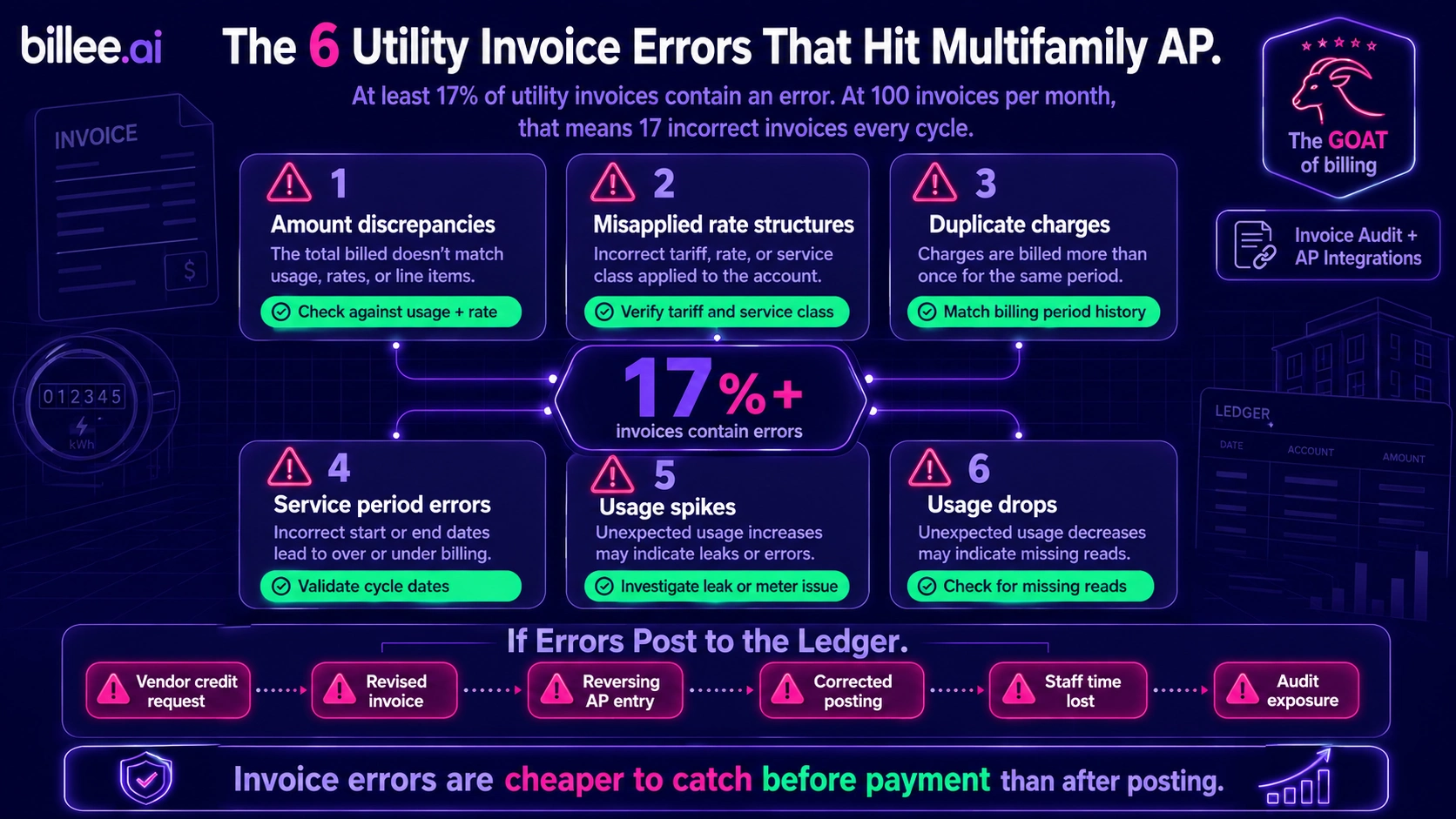
At least 17% of utility invoices contain a billing error, according to ENGIE Impact, one of the nation's largest utility billing auditors. For a multifamily portfolio processing 100 utility invoices per month, that is 17 incorrect invoices entering the AP workflow every billing cycle. The errors range from simple amount discrepancies to misapplied rate structures, duplicate charges, and usage anomalies that may signal an active leak or a malfunctioning meter. Billee's Utility Vendor Management product audits every utility invoice against expected billing rules before routing for approval, so errors are caught and escalated before they reach the general ledger.
Key Takeaways
At least 17% of utility invoices contain an error, per ENGIE Impact. At 100 invoices per month, that is 17 incorrect invoices entering the AP workflow every cycle.
Billing errors fall into six categories: amount discrepancies, misapplied rate structures, duplicate charges, service period errors, usage spikes, and usage drops.
Rate errors and service period errors are the most expensive error types because they persist silently across multiple billing cycles without triggering obvious red flags.
An error that posts to the ledger requires a vendor credit, a revised invoice, and a correcting AP entry. Per Planergy's analysis of vendor invoice management, the correction cycle is one of the most time-intensive workflows in accounts payable.
Manual spot-checks create systematic bias: the invoices that get reviewed are those with unusually high amounts, not those containing subtle rate or period errors.
GL coding errors are distinct from invoice errors. A correct invoice coded to the wrong account produces the same distorted expense reporting as an incorrect invoice, and is caught only by a coding audit, not an invoice audit.
What the 17% Error Rate Actually Means at Portfolio Scale
The ENGIE Impact finding (that 17% of utility invoices contain an error) is frequently cited but rarely put into operational context. At 100 invoices per month, it means 17 incorrect invoices. At 300, it means 51.
That volume compounds because not all errors are one-time events. A vendor applying the wrong rate structure to an account will continue applying it until someone catches and corrects it. A service period error that covers 45 days instead of 30 may recur across multiple billing cycles before it appears in a reconciliation. Each uncaught error that posts to the ledger also creates a correction workflow: a vendor credit request, a revised invoice, and an AP entry to back out the original posting. Per Planergy's analysis of vendor invoice management, that correction cycle is among the most labor-intensive workflows in AP, consuming staff time that compounds with every error that slips through.
An audit step does not just prevent overpayments. It prevents the downstream correction work that follows every error that posts.
The Six Types of Utility Billing Errors
Utility billing errors are not all the same. They have different causes, different detection difficulty, and different financial consequences. Understanding the six types determines what an audit step actually needs to check.
Amount Discrepancies
Amount discrepancies are the most visible error type: the invoice total does not match what the vendor should have billed based on usage and the applicable rate. They may result from data entry errors at the vendor, meter read transcription mistakes, or billing system issues on the vendor side.
Amount discrepancies are the error type most likely to be caught in a manual review, because a figure that looks out of the ordinary tends to draw attention. They are also the error type most likely to be caught by a basic automated check: compare the invoice amount against the prior period and flag deviations above a threshold. A robust audit goes further and checks the amount against the actual rate schedule applied to the usage reported.
Misapplied Rate Structures
Rate errors occur when the vendor applies the wrong tariff to an account: a commercial rate to a residential account, a summer rate that was not updated to a winter rate, or a tiered usage rate applied at the wrong tier. These errors produce invoices that look plausible in amount terms (they are not wildly out of range) but overcharge the property on every unit of consumption.
Rate errors are the most expensive error type because they recur silently. An account being billed at the wrong rate may pay incorrectly for months before someone notices a discrepancy between what similar properties are paying and what this account is paying. Catching rate errors requires checking the invoice against the vendor's applicable rate schedule for the property type, jurisdiction, and service class, not just against the prior month's amount. As Zego documents in its analysis of utility AP mistakes, misapplied rate structures are one of the three most common error categories identified by ENGIE Impact.
Duplicate Charges
Duplicate billing occurs when the same billing period is invoiced more than once. This can happen when a vendor's billing system generates a corrected invoice and also sends the original, or when a portal issue causes an invoice to be issued twice. The result is two invoices for the same period, either of which looks correct in isolation.
Duplicate charges are sometimes caught in manual reviews when an AP coder recognizes that the billing period matches a recently processed invoice. They are missed when the coder is working across dozens of accounts simultaneously or when the duplicate arrives in a different billing format than the original. An automated audit catches duplicates by checking the billing period on every incoming invoice against the periods already processed for that account.
Service Period Errors
Service period errors occur when the invoice covers a period longer or shorter than the standard billing cycle. An invoice covering 45 days instead of 30 results in a billing amount approximately 50% higher than expected for a flat-rate service, and proportionally higher for consumption-based services. Short-period invoices may represent a partial cycle at the beginning or end of a service agreement, which may or may not be billed correctly.
Service period errors are difficult to catch in visual review because the invoice amount is proportionally correct for the period stated; it only looks wrong when the period itself is checked. An automated audit flags any invoice where the service period deviates materially from the standard cycle for that account.
Usage Spikes
A usage spike occurs when the consumption reported on an invoice is materially higher than the same period in prior months or the same period in the prior year. This may indicate a vendor meter read error or a billing system anomaly. It may also indicate an operational problem: an active leak, a failed HVAC system, or a metering issue at the property.
Usage spikes warrant investigation before payment, not after. If the spike is a billing error, paying it and then requesting a credit is avoidable correction work. If the spike signals a real operational issue, paying the invoice without flagging it misses the chance to identify a problem that is costing the property money independently of the billing. ENGIE Impact identifies usage anomalies as one of the three primary categories of utility invoice errors, precisely because they serve both as a billing flag and an operational alert.
Usage Drops
Usage drops are the less-discussed counterpart to spikes: consumption reported on an invoice is materially lower than expected. A near-zero electric reading for an occupied unit may indicate an estimated read, a billing gap that will be trued up in a future cycle, or a meter that has stopped recording. A water usage drop at a property with active occupancy may indicate a billing error or a meter communication failure.
Usage drops do not trigger overpayment risk directly, but they do signal potential billing gaps that will arrive as catch-up invoices later, and they indicate operational issues that require investigation. An audit step that only flags high amounts misses the information embedded in usage drops entirely.
Why Manual Spot-Checks Miss Most Errors
Manual invoice review is inherently a sampling exercise, and the sampling is not random. The invoices that receive close attention in a manual operation are those that stand out: unusually high amounts, unfamiliar vendors, or invoices that a coder recognizes as different from last month's. That bias systematically skips the error types that are hardest to catch.
Rate errors do not stand out in dollar terms; the invoice looks like a normal amount for a normal service. Service period errors require checking the period dates, which takes time most coders do not have across dozens of accounts. Usage drops don't look like a problem at all. And duplicate charges are only caught if the coder happens to remember processing the same period previously.
The consequence is that manual audit coverage concentrates precisely where errors are easiest to find, not where they are most common or most expensive. As PredictAP notes in its analysis of invoice coding in commercial real estate, a coder working under deadline pressure across dozens of accounts cannot apply consistent scrutiny to every invoice, and the systematic result is errors in the categories that require the most attention to detect.
What Happens When an Error Posts to the Ledger
An error that clears the audit step does not disappear. It creates a correction chain: identify the error (often weeks later, in reconciliation), contact the vendor to request a credit memo or revised invoice, wait for the vendor to process it, receive the corrected document, post a reversing AP entry for the original, and post the corrected amount. Each step in that chain requires staff time and introduces additional risk of entry error.
At a 17% error rate across a 100-invoice-per-month portfolio, even a 50% detection rate post-posting means roughly 8–9 correction workflows per month running in parallel with the normal AP cycle. Per Planergy's analysis, this kind of recurring correction work is one of the clearest indicators that an AP workflow lacks a front-end audit step, because the correction labor consistently exceeds what a pre-payment audit would have required.
The cost of catching a billing error before payment is one conversation with the vendor. The cost of catching it after payment is that conversation plus a credit memo, a revised invoice, and two correcting AP entries.
GL Coding Errors: The Error That Isn't the Vendor's Fault
GL coding errors are distinct from invoice errors, but they produce identical downstream problems. A correct invoice coded to the wrong general ledger account does not overcharge the property, but it does misrepresent property-level operating expenses in every report that draws from that ledger until the error is corrected.
As PredictAP documents, the same vendor may require different GL codes at different properties in the same portfolio, depending on ownership structure, cost center configuration, operating versus capital treatment, and lease terms. A coder working across multiple properties may apply a code that was correct at one property to an invoice at another where the rules are different.
GL coding errors are caught by a coding audit, not an invoice audit. The two review steps are distinct: an invoice audit checks whether the vendor billed correctly; a coding audit checks whether the invoice was coded to the right account. A complete pre-posting review addresses both. At refinancing or disposition, a clean, accurately coded AP trail is a material operational asset. Errors discovered during lender due diligence slow closings and, in some cases, affect valuations.
How Billee Audits Invoices Before Posting
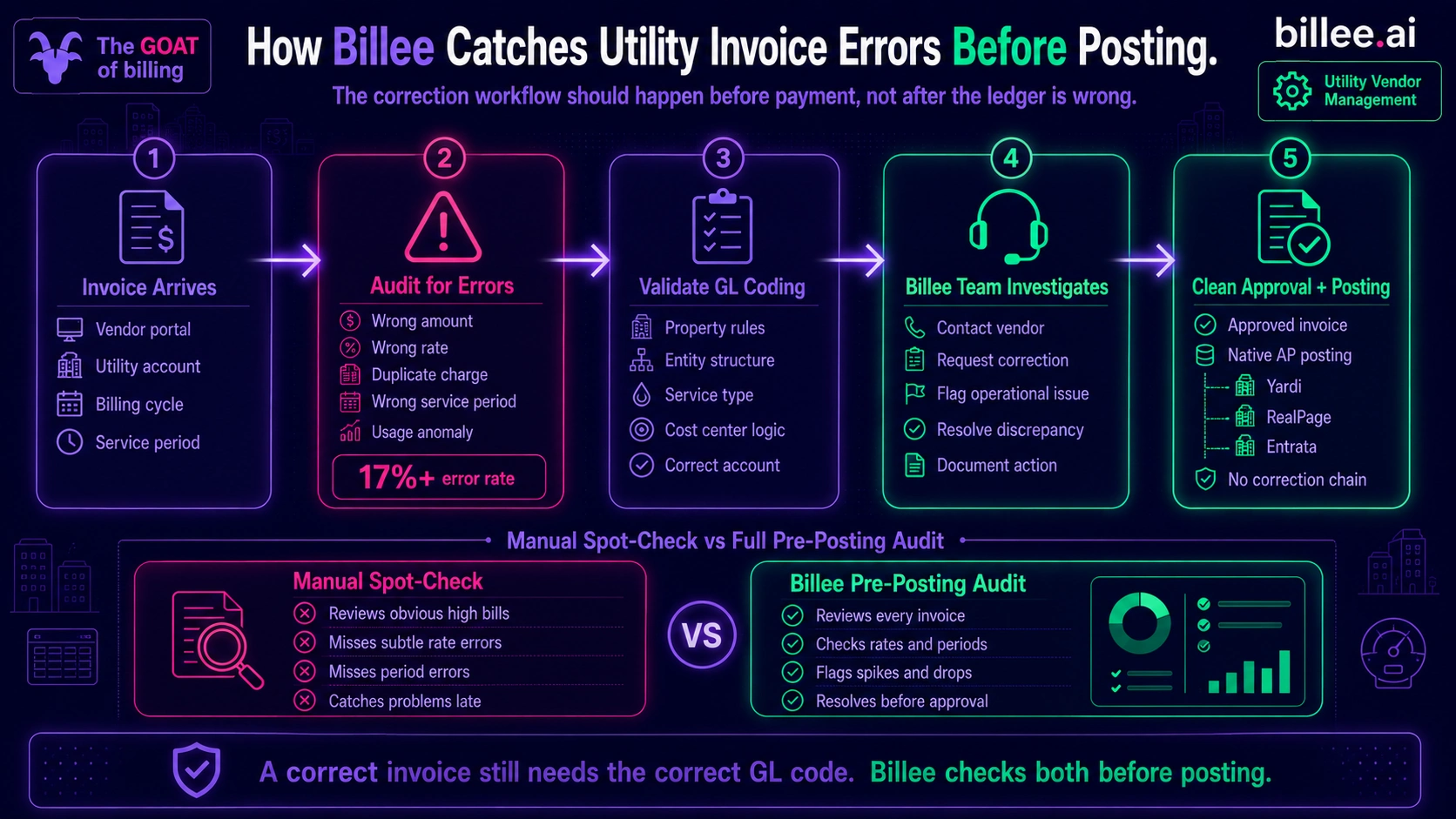
Billee reviews every enrolled utility invoice against expected billing rules for that vendor and property before routing for approval. The audit checks invoice amounts against the applicable rate schedule, billing periods against the standard cycle for that account, usage figures against prior-period history, and GL coding against the property configuration on file.
Anomalies are flagged for the Billee account team to investigate. The team contacts the vendor directly to resolve discrepancies, request corrected invoices, or escalate usage anomalies to the property team as operational alerts. The property team does not see an invoice for approval until it has passed the audit step.
The result is that the correction workflow for billing errors happens before payment, not after. Vendor credits, revised invoices, and correcting AP entries are not part of the normal workflow. For portfolios that want to understand how the audit step fits into the broader AP process, the mechanics are covered in the AP automation article and the full utility vendor management overview.
Implementation takes 45 days. Vendor onboarding, rate schedule configuration, and PMS integration are handled by the Billee team.
Billee audits every utility invoice before it posts, so the correction work happens before payment, not after. See how it works for your portfolio.
Sources
Zego, "The Top 3 Utility Accounts Payable Mistakes Multifamily Companies Make," 2025. (Cites ENGIE Impact audit finding: at least 17% of utility invoices contain an error, including misapplied rate structures and usage anomalies.)
Planergy, "Vendor Invoice Management: What Is It and Best Practices," accessed June 2026.
PredictAP, "What Is Invoice Coding Automation in Real Estate?," accessed June 2026.
Insights and Industry Trends