
Fair Housing and Utility Charge Documentation: What Multifamily Operators Need in 2026
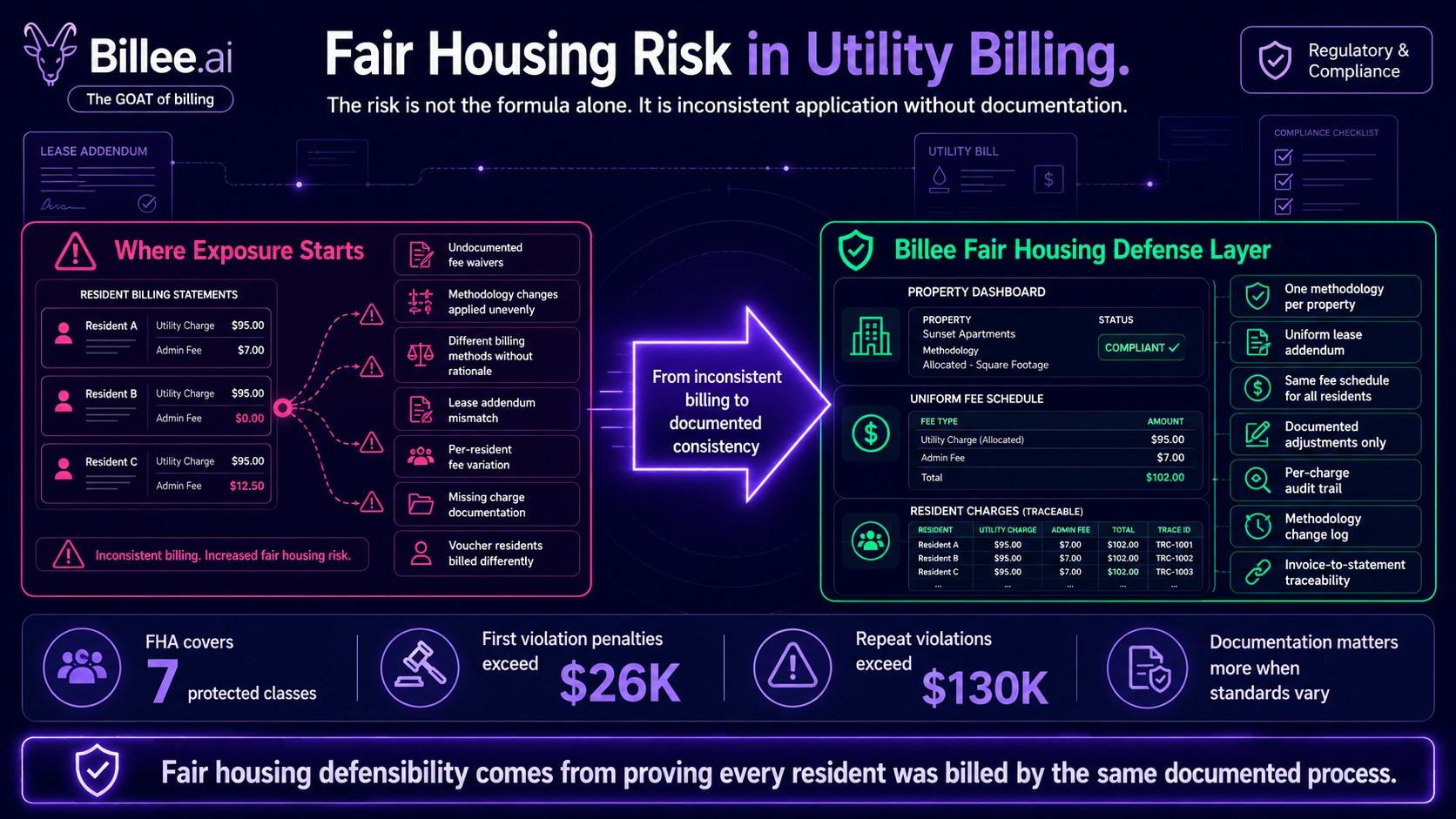
The Fair Housing Act does not regulate utility billing formulas directly, but inconsistent billing practices, undocumented fee waivers, and methodology changes applied unevenly across residents create disparate treatment and disparate impact exposure under the Act's seven protected classes. In January 2026, HUD published a proposed rule to rescind its disparate impact regulations, but the Supreme Court's 2015 decision in Texas Department of Housing and Community Affairs v. Inclusive Communities Project remains binding law, and disparate impact claims under the FHA are cognizable regardless of what happens to the regulation. The documentation that defends an operator in a fair housing complaint is the same documentation that proves billing consistency: one methodology applied identically to every resident, fees that never vary by individual, and an audit trail traceable to the underlying utility invoice. Billee's billing platform enforces a single methodology per property and retains the per-charge documentation that makes every billing statement defensible.
Key Takeaways
The Fair Housing Act's non-discrimination requirement extends to utility billing. Billing practices that are applied inconsistently across residents, or that produce a disproportionate financial burden on a protected class without a documented business justification, are cognizable FHA claims. The statute covers race, color, national origin, religion, sex, familial status, and disability.
In January 2026, HUD proposed to rescind its disparate impact regulations (24 CFR Part 100). This does not eliminate disparate impact liability. The Supreme Court's Inclusive Communities decision established that the FHA statute itself supports disparate impact claims, independent of any HUD regulation. The practical effect for operators is that courts now have more discretion in how they evaluate claims, which makes documentation more important, not less.
HUD's 2025 civil penalty adjustments set first-violation penalties at more than $26,000 and repeat violations at more than $130,000. These figures do not include legal fees, investigation costs, or settlement amounts, which routinely exceed the civil penalty in contested cases.
Undocumented fee waivers are the most common utility billing practice that generates fair housing complaints. A one-time concession given to one resident and not available to others, with no documented business justification, is the record that makes a disparate treatment claim possible.
Voucher and Section 8 properties face a compounded exposure: charging a voucher-assisted resident under a different billing methodology than market-rate residents at the same property creates simultaneous FHA and Housing Assistance Payment contract liability.
The five documents that protect an operator in a fair housing proceeding related to utility billing are: the written billing methodology on file for the property, the lease addendum applied uniformly to all residents, a per-charge audit trail, a fee schedule showing no per-resident variation, and a log of any methodology changes.
At a Glance: Fair Housing Documentation Risk by Billing Scenario
[Comparison image: Fair Housing Documentation Risk by Billing Scenario]
Why Utility Billing Creates Fair Housing Exposure
The Fair Housing Act, codified at 42 U.S.C. §§ 3601–3619, prohibits discrimination in the terms, conditions, and privileges of residential rental housing based on race, color, national origin, religion, sex, familial status, and disability. Utility billing is a term and condition of tenancy. A resident who pays more for utilities than a comparable resident at the same property, for reasons that cannot be explained by a documented, uniformly applied formula, has a potential FHA claim.
FHA liability for utility billing runs on two tracks. Disparate treatment is intentional inconsistency: a landlord who waives an administrative fee for one resident and not another, without a documented and neutral business reason, has treated residents differently. Disparate impact is a facially neutral practice that produces a disproportionate financial burden on a protected class. A RUBS formula that allocates more costs to larger units, combined with a property where larger units are concentrated among residents of a particular national origin, could generate a disparate impact claim even if the formula was applied identically to everyone.
The FHA does not require that the billing practice be designed to discriminate. It requires only that the effect be disproportionate and that the operator cannot justify it with a documented business necessity.
This is why documentation is the primary defense. An operator who can show a uniform methodology, applied from the same written formula to every resident, without individual exceptions, has a strong defense against both theories. An operator whose billing records show individual variation without documented justification has no defense at all.
The January 2026 HUD Disparate Impact Proposal: What Changed and What Did Not
On January 14, 2026, HUD published a proposed rule in the Federal Register (document 2026-00590) to rescind its 2013 disparate impact regulations, which had codified a three-step burden-shifting framework: complainants must show a disparate impact, the burden then shifts to the operator to demonstrate business necessity, and the burden shifts back to the complainant to show a less discriminatory alternative exists.
HUD's proposal would remove this regulatory framework and leave disparate impact questions to courts applying the FHA directly under Inclusive Communities. The Supreme Court's 2015 decision in Texas Department of Housing and Community Affairs v. Inclusive Communities Project held that disparate impact claims are cognizable under the FHA as a matter of statutory interpretation. That holding is not affected by what HUD does with its regulation.
The practical consequence for multifamily operators is meaningful. Under HUD's regulation, the burden-shifting framework gave operators a defined structure for demonstrating business necessity. Without the regulation, different federal courts will apply different standards. Operators who face disparate impact claims in circuits that have not clearly defined the standard will have less predictability about what "business necessity" means and how much documentation is sufficient to meet it.
The 2026 HUD proposal does not make disparate impact claims harder to bring. It makes the defense less predictable. Operators with strong, contemporaneous documentation are better positioned in any framework than operators who reconstruct records after a complaint arrives.
The Five Documents Every Operator Needs
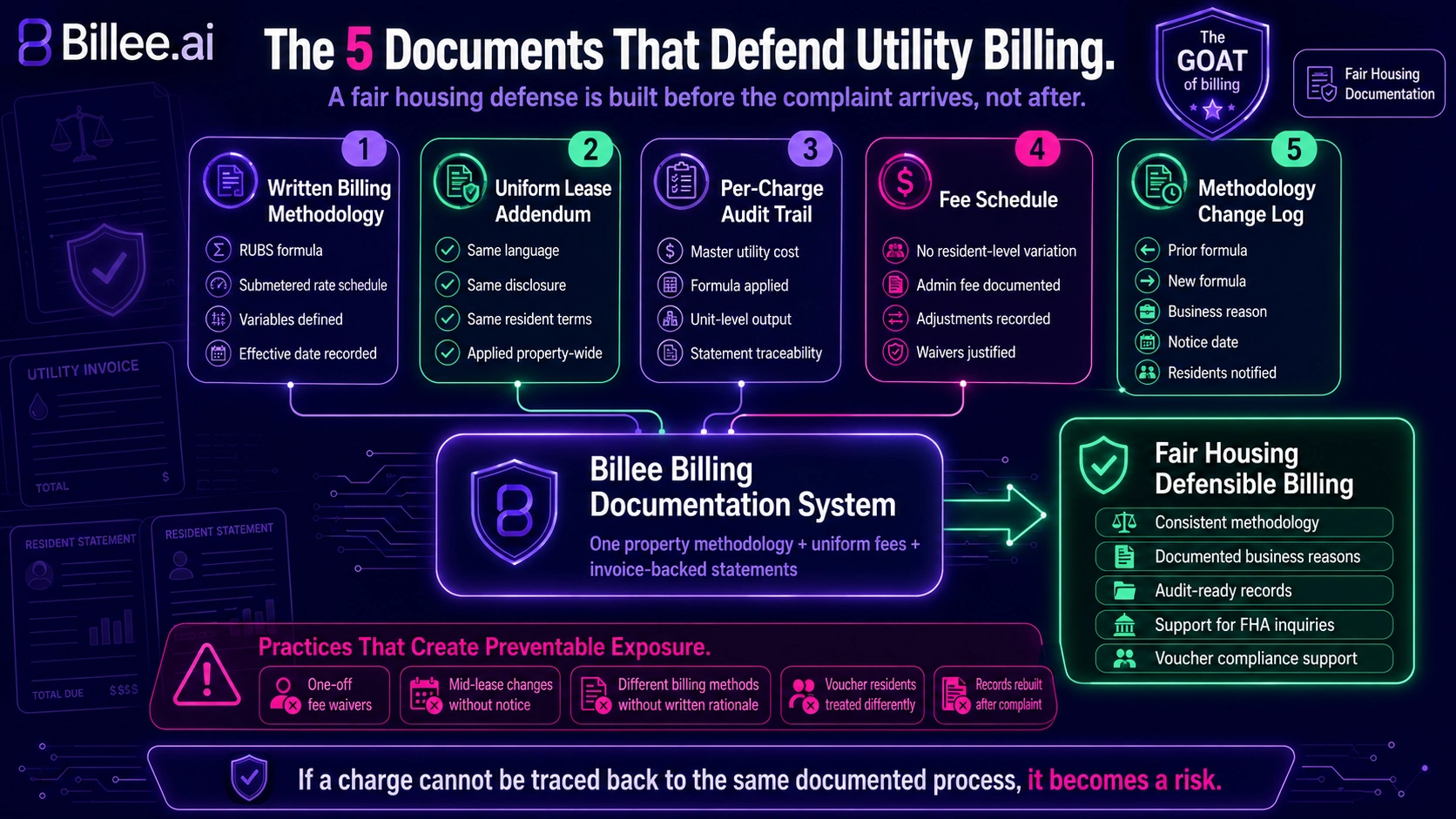
Regardless of billing type, these five documents form the complete fair housing defense for utility billing.
The written billing methodology. A document on file for each property stating the allocation formula used (occupant-based, square-footage-based, or hybrid for RUBS; rate schedule for submetered), the variables in the formula and how they are measured, and the effective date. For RUBS properties, this document should be updated whenever the formula changes. It is the foundation of every other defense: without a written methodology, there is nothing to prove was applied consistently.
The lease addendum, uniform across all residents. The addendum must be identical in form for every resident at the property. A property where some residents signed a detailed RUBS addendum and others signed a one-line reference to "utilities as billed" has created a documentary record of inconsistent treatment before the first billing cycle begins. Every resident must receive the same lease addendum language disclosing the same billing methodology.
The per-charge audit trail. For every billing cycle, a record showing how each resident's charge was calculated from the same input data: the total utility cost for the period, the allocation formula applied, and the resulting per-unit output. For submetered properties, the per-charge record should show meter readings, units consumed, and rate applied. This is the document that, in a fair housing proceeding, proves that the charge shown on one resident's statement was produced by the same process as every other resident's statement.
The fee schedule with no per-resident variation. A record showing the administrative fee assessed each billing cycle, with documentation that the same fee was applied to all residents. Fee waivers should not exist. If a concession is granted for a legitimate business reason (a billing error that affected one resident, for example), that concession must be documented with the business reason and made available to all residents in the same situation.
The methodology change log. A record of every change to the billing methodology: the date the change took effect, the prior formula, the new formula, the business reason for the change, the residents notified, and the notice date. A mid-lease methodology change applied to some units and not others, without documentation, is one of the most direct paths to a fair housing complaint.
Billing Practices That Create Preventable Exposure
Three patterns appear consistently in utility billing disputes that escalate to fair housing complaints.
Undocumented Fee Waivers
The administrative fee waiver is the most common billing practice that generates fair housing complaints in the multifamily industry. The pattern is usually this: a resident calls to dispute a bill, the property manager agrees to waive the administrative fee for that cycle to resolve the dispute, and no record is made. A different resident, a member of a protected class, calls to dispute a bill and is told the fee stands. The first resident's concession has no documentation; the second resident's refusal has no documentation. The result is a factual record that looks like disparate treatment even if none was intended.
The fix is not to refuse all fee adjustments; it is to document every adjustment with the specific business reason, apply the same standard to all residents in materially identical situations, and keep the record. A fee waived because of a confirmed billing error on the operator's side should be noted as such and offered to any resident whose bill was affected by the same error.
Mid-Lease Methodology Changes Without Uniform Notice
Switching from an occupant-based to a square-footage-based RUBS formula mid-lease, or changing from RUBS to submetering for part of a property, without uniform written notice to all affected residents creates two simultaneous problems. First, residents who did not receive notice of the methodology change have a contractual claim that the change was not disclosed. Second, if the notice was provided to some residents and not others, the inconsistency is its own fair housing record.
A methodology change should be treated as a lease addendum amendment: written notice to all residents affected by the change, with the same timing and the same language, and a record showing who was notified and when.
Different Billing Methods Within the Same Property
A property where some units are submetered and others are billed under RUBS is not inherently problematic. What makes it problematic is the absence of a written rationale distinguishing the two groups. If the split correlates with building section, unit type, or any factor that also correlates with resident demographics, the absence of documentation is the risk. A written policy explaining that units built before a certain date use RUBS because they predate the submetering infrastructure, with a schedule for conversion, is a business justification. No document at all is not.
Voucher and Section 8 Properties: A Compounded Exposure
Properties participating in HUD's Housing Choice Voucher program operate under 24 CFR Part 982, which governs the billing relationship between the property, the Public Housing Authority, and the voucher-assisted resident. HUD's Utility Allowance Guidebook requires that any utility costs charged to voucher-assisted residents be calculated under the same methodology as costs charged to market-rate residents at the same property.
A property that applies RUBS to market-rate residents and bills voucher-assisted residents differently, whether by using a different formula, omitting the administrative fee for voucher residents, or adjusting the allocation to stay within the utility allowance, has created simultaneous exposure: an FHA claim for differential treatment and a HAP contract violation that can result in termination of the assistance payments for the property.
The utility allowance itself is set by the PHA and is not the operator's document to control. What the operator controls is that the billing methodology applied to voucher-assisted residents is the same as the methodology applied to every other resident at the property. The per-charge audit trail that supports fair housing documentation also supports HAP compliance: it shows the PHA, on request, that charges to voucher-assisted residents were produced by the same formula as charges to all other residents.
How Billee Documents Utility Billing for Fair Housing Defense
Billee's billing platform configures one methodology per property at enrollment. Every resident's charge is calculated from the same formula, applied to the same input data, in the same billing cycle.
Billee's billing records, including the locked billing reports generated each cycle, are retained and organized by property and period. When a fair housing inquiry or a resident complaint arrives, the documentation needed to demonstrate billing consistency is retrievable without a reconstruction effort.
Billee's utility vendor management platform and AP automation workflow ensure that the base utility cost used in each billing calculation is the audited, verified invoice amount, creating a cleaner audit trail that connects billing charges back to the underlying vendor invoices.
Implementation takes 45 days. Vendor onboarding, state-specific billing configuration, and PMS integration are handled by the Billee team.
Billee builds the documentation that makes every utility billing statement fair housing defensible, as a standard output of the billing workflow, not as a retrospective project. See how it works for your portfolio.
FAQ: Fair Housing and Utility Charge Documentation
Does the Fair Housing Act apply to utility billing in multifamily properties?
Yes. The Fair Housing Act prohibits discrimination in the terms, conditions, and privileges of residential rental housing, and utility billing is a term and condition of tenancy. Billing practices that are applied inconsistently across residents, or that produce a disproportionate financial burden on a protected class without a documented business justification, are cognizable FHA claims. The statute covers race, color, national origin, religion, sex, familial status, and disability.
What did HUD's January 2026 proposed rule change about fair housing for multifamily operators?
HUD's January 2026 proposed rule (Federal Register, 2026-00590) proposed to rescind its disparate impact regulations at 24 CFR Part 100, which had provided a three-step burden-shifting framework for evaluating disparate impact claims. The proposal does not eliminate disparate impact liability: the Supreme Court's 2015 decision in Texas Department of Housing and Community Affairs v. Inclusive Communities Project established that the FHA statute itself supports disparate impact claims. The practical effect is that courts will now apply varying standards without the regulatory framework, making the defense less predictable for operators and making contemporaneous documentation more important.
What documents protect a multifamily operator in a fair housing complaint about utility billing?
Five documents form the core of a fair housing defense for utility billing: the written billing methodology on file for the property, the lease addendum applied uniformly to all residents, a per-charge audit trail showing every resident's charge derived from the same input data, a fee schedule with no per-resident variation, and a log of any methodology changes including the business reason, affected residents, and notice dates. The common thread across all five is contemporaneous documentation: records that were created at the time the billing decision was made, not reconstructed after a complaint arrives.
Can a landlord waive the utility administrative fee for one resident without creating fair housing exposure?
It depends entirely on documentation. A fee adjustment made for a documented business reason, applied consistently to all residents in the same factual situation, and recorded at the time it was made creates a defensible record. An undocumented fee waiver given to one resident, with no record of the reason, is the most common basis for utility billing fair housing complaints because it creates a factual record of differential treatment without any explanation for it. The standard is not that fee adjustments are prohibited; it is that every adjustment must be documented and applied consistently.
How does the fair housing requirement interact with Section 8 or voucher properties?
Properties participating in HUD's Housing Choice Voucher program are required under 24 CFR Part 982 to apply the same utility billing methodology to voucher-assisted residents as to market-rate residents at the same property. Charging voucher-assisted residents under a different formula, or adjusting their billing to stay within the utility allowance without applying the same adjustment to comparable market-rate residents, creates simultaneous FHA and Housing Assistance Payment contract exposure. The HAP contract exposure is particularly serious: it can result in termination of the assistance payments for the entire property, not just for the resident whose billing was inconsistent.
Sources
U.S. House of Representatives, "42 U.S.C. Chapter 45: Fair Housing," accessed July 2026.
Federal Register, "HUD's Implementation of the Fair Housing Act's Disparate Impact Standard (Proposed Rule), 2026-00590," January 14, 2026.
National Multifamily Housing Council, "Fair Housing: Disparate Impact Liability Fact Sheet," accessed July 2026.
National Apartment Association, "Fair Housing: Disparate Impact Operational Resources," accessed July 2026.
U.S. Department of Housing and Urban Development, "Utility Allowance Guidebook," accessed July 2026.
eCFR, "24 CFR Part 982: Section 8 Tenant-Based Assistance: Housing Choice Voucher Program," accessed July 2026.
U.S. Department of Housing and Urban Development, "Fair Housing: Learn About the Complaint Process," accessed July 2026.
Insights and Industry Trends