
Smart Meters vs Submeters: Key Differences
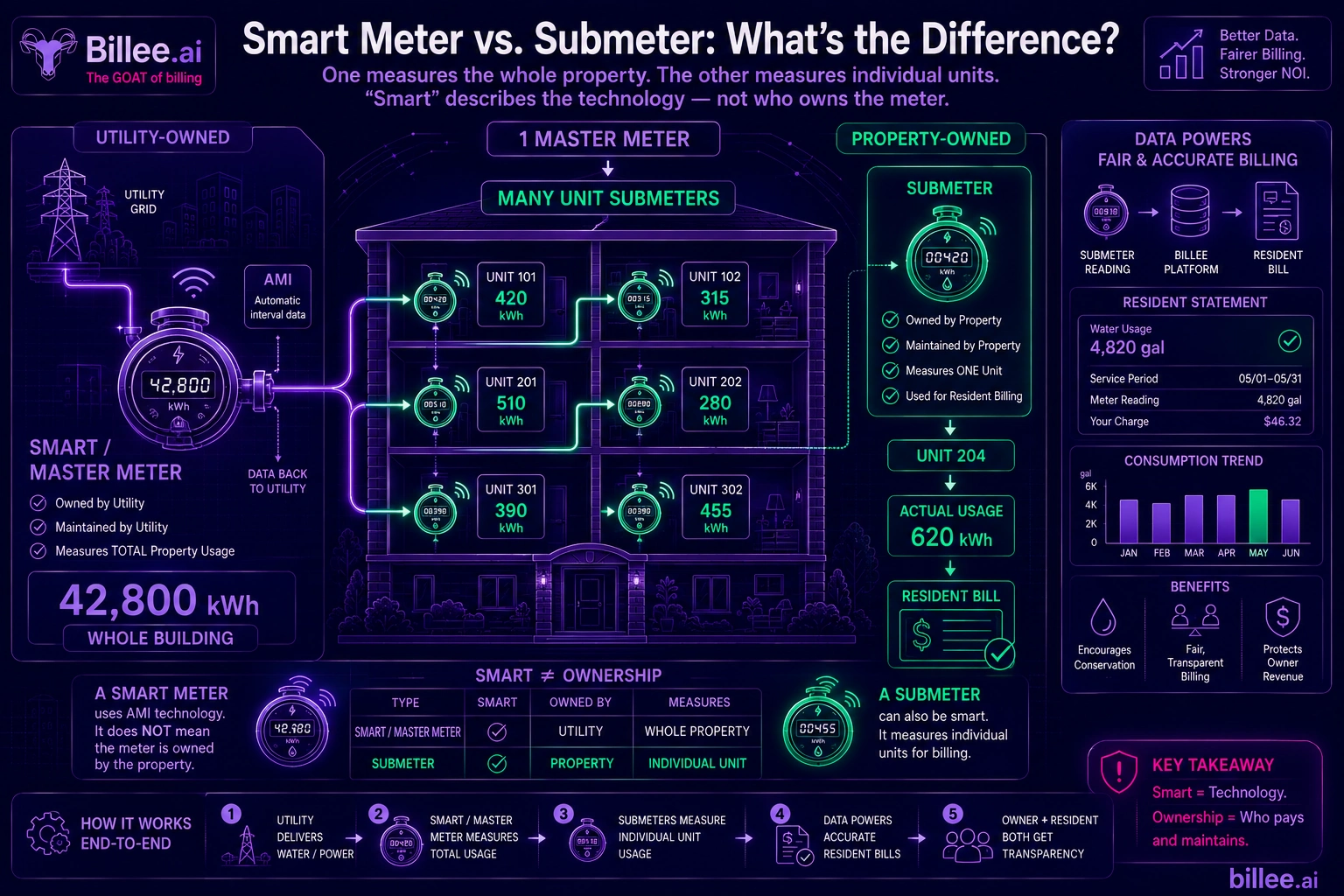
A smart meter is the utility-owned device that measures a building's total usage and reports it to the utility, and sometimes the customer, at least once a day. A submeter is a separate, property-owned meter installed downstream of that smart meter to measure one unit's individual usage, so residents can be billed for what they actually use. The two aren't competing technologies: a submeter can be just as "smart," in the AMI sense, as the utility's own meter. Billee configures and monitors both sides of that relationship for multifamily portfolios.
Quick answer
The difference is ownership and position, not sophistication. A smart meter, formally an AMI meter, sits at the utility's connection point and belongs to the utility. A submeter sits downstream, inside the property, and belongs to the property owner.
Having a smart meter on a building doesn't mean residents are being billed individually, and it doesn't mean the property is maintaining that meter. It only means the utility knows the building's total usage and is responsible for the hardware that measures it. Getting to unit-level billing, and taking on the maintenance that comes with it, still requires the property to add submeters or apply a RUBS allocation formula.
Key takeaways
- A smart meter (AMI) is owned and maintained by the utility and measures a building's or parcel's total usage. A submeter is owned and maintained by the property and measures one unit's usage.
- "Smart" describes a communication technology, two-way and interval-based, not a category of meter. A submeter can be AMI-enabled or use older AMR or manual-read technology and is still a submeter, not a smart meter.
- 76.8% of U.S. electric meters were AMI-enabled as of December 2023, up from 4.7% in 2007, per the Federal Energy Regulatory Commission. Most multifamily buildings already have a "smart" master meter. That says nothing about whether individual units are submetered.
- A building-level smart meter tells the utility, and the property, the total building usage. It cannot tell you what unit 204 used. Only a submeter, or a RUBS formula applied to the master meter's total, gets to unit-level billing.
- Maintenance responsibility follows ownership. The utility maintains and repairs its own smart meter at no direct cost to the property. Submeters, once installed, are the property owner's responsibility to maintain, repair, and eventually replace.
- Utility-paid demand-response programs generally require AMI metering to participate, and a submeter alone doesn't create that eligibility, since it doesn't communicate with the utility.
- The AMI-vs-AMR choice is a separate decision that happens within submetering, after a property has already decided to submeter. It isn't the same question as smart-meter-vs-submeter.
Why this matters for multifamily operators
Operators sometimes assume that because a building already has "smart meters," resident billing is already accurate, or that submetering is redundant. Neither is true. A utility smart meter only ever reports what the utility needs: total consumption at the point where its wires or pipes meet the property, maintained on the utility's schedule and at the utility's cost.
Getting that confusion wrong has a cost in two directions. A property billing residents through RUBS on a building that could support submetering, because someone assumed the existing "smart" infrastructure already covered it, is very likely leaving recoverable revenue on the table. A property that adds submeters without realizing maintenance now falls on them, not the utility, can be caught off guard by the first meter failure.
Billee treats the smart-meter reading and the submeter readings as two different inputs, owned and maintained differently. Reconciling them against each other, rather than assuming they're one number doing double duty, is what catches the gap before it becomes a dispute.
The core difference: ownership and position in the metering chain
A master meter is the single meter the utility installs at a property's connection point. It's owned, read, and maintained by the utility, and it's what the utility bills the property owner on. A submeter is a separate meter the property owner installs downstream of that master meter, one per unit, to measure each resident's own consumption, and it's the property's responsibility from the day it's installed.
| Smart meter (utility-owned) | Submeter (property-owned) | |
|---|---|---|
| Who owns it | The utility | The property owner or operator |
| Who maintains it | The utility, as part of its regulated service | The property, or a vendor the property hires |
| What it measures | Total usage for the building or parcel | One unit's individual usage |
| Who reads the data | The utility, and often the customer, per EIA | The property or its billing vendor |
| What it's used for | The utility's bill to the property owner | The property's bill to individual residents |
| Primary regulatory oversight | State utility or public service commission | State submetering or RUBS statutes, generally lighter |
| Can it be "smart" (AMI)? | Yes, by definition | Yes, optionally, AMI or AMR |
| Unlocks utility programs like demand response? | Yes, if AMI-enabled | Not on its own |
A building can have a fully AMI-enabled master meter and zero submeters. It can also have a manually-read master meter and fully AMI-enabled submeters. Ownership, maintenance, and "smart" capability are three separate questions, not one.
What counts as a "smart meter"
A smart meter, formally an AMI, or Advanced Metering Infrastructure, meter, is defined by the U.S. Energy Information Administration as a meter that measures and records usage at a minimum of hourly intervals and delivers that data to both the utility and the customer at least once a day. That two-way, frequent-interval communication is what separates it from an older meter that only reports a single cumulative total when someone reads it.
Smart-meter deployment is a utility-driven infrastructure rollout, not a property decision. As of December 2023, 76.8% of U.S. electric meters were AMI-enabled, up from just 4.7% in 2007, according to FERC's most recent annual assessment. A multifamily property doesn't request or pay for this upgrade. The utility installs it across its service territory on its own timeline.
What counts as a submeter
A submeter is a meter the property owner installs downstream of the master meter, one per unit, to measure that unit's individual water, electric, or gas consumption. Unlike the utility's meter, a submeter is a property-side decision from the start. Whether to install one, which utility to submeter, and which vendor and technology to use are all choices the property makes, not the utility.
Submeters apply across all three commonly submetered utility types in multifamily: water, electric, and gas, each with its own typical install-cost range and technical considerations. Those specifics are covered in full in How Submetering Works in Multifamily Properties and How Electric Submetering Works, Step by Step.
Who's responsible for maintaining each one
Maintenance responsibility follows ownership, and it's one of the most practical differences between the two. The utility maintains its own smart meter as part of its regulated service obligation. If it fails, drifts out of calibration, or needs replacement, that's the utility's cost and the utility's job.
Submeters don't work that way. Once installed, a submeter is the property's asset and the property's maintenance burden. Meters drift out of calibration over time, transmitters fail, and units eventually need replacing, and none of that is the utility's responsibility. That gap is exactly why continuous monitoring matters once a property owns its own metering infrastructure: nobody is watching a submeter's health the way a utility watches its own, unless the property puts something in place to do it.
"Smart" describes a technology, not a meter type
"Smart" and "submeter" answer two different questions, and treating them as opposites is the single most common mix-up in this topic. "Smart," or AMI, describes how a meter communicates: two-way, at least hourly, delivering data automatically. "Submeter" describes what a meter measures and who owns it: one unit's usage, owned by the property.
AMI vs. AMR: the technology choice within submetering
Once a property has decided to submeter, it faces a separate decision: AMI or AMR. AMR, or Automatic Meter Reading, sends one cumulative usage total per billing cycle over a one-way connection. AMI sends interval usage data, hourly or more often, over a two-way connection reaching the property, and in some cases the utility, at least once a day.
Both are legitimate, widely used choices, and the right one depends on portfolio size, budget, and whether near-real-time leak detection matters enough to justify the added infrastructure. The full comparison, including current cost data, lives in AMI vs AMR Meters: Which Is Right for Multifamily Properties.
A submeter's "smartness" is a vendor choice, not a given
Submeter marketing language doesn't always make the AMI-versus-AMR distinction obvious. A vendor calling hardware "smart" or "advanced" isn't automatically describing a two-way, hourly-interval AMI system. It may just as easily be a one-way AMR system with a modern-sounding name. Confirming the actual communication method, one-way or two-way, and the actual read frequency, monthly or hourly-or-better, is a more reliable way to evaluate a submeter vendor's claims than the word "smart" on its own.
Why a building's smart meter doesn't replace a submeter
A fully AMI-equipped master meter tells the utility, and the property, exactly one number: how much the whole building used. It has no visibility into any individual unit, and it doesn't create resident-level billing on its own.
What a smart meter can tell you
A smart meter reports the property's total usage to the utility at least daily, which is what the utility bills the owner on. Because it's AMI-enabled and utility-facing, it's also generally what makes a property eligible for utility-paid demand-response programs, initiatives that pay owners or residents to reduce usage during peak grid stress.
Demand Response Programs for Multifamily Buildings covers the mechanics and current program examples in full. The point here is that this kind of utility-side program eligibility comes from the smart meter's connection to the utility, not from anything a submeter provides.
What only a submeter can tell you
A submeter reports one unit's actual consumption, which is what makes resident-level billing possible at all. That same unit-level visibility is also what allows fast leak or anomaly detection at the apartment level rather than the whole-building level.
The stakes are real: the average household wastes 180 gallons a week, or 9,400 gallons a year, to undetected leaks, per the EPA's WaterSense program. In a master-metered building, that cost lands on the property, not any one resident, until a submeter narrows it down to a specific unit.
Billing residents for their own usage also drives conservation behavior: a bill that reflects individual consumption gives people a reason to use less of it. None of that visibility exists at the master meter alone, no matter how "smart" it is, because the master meter was never built to see below the building level.
How the two work together on one property
Take a 150-unit property with one AMI electric meter at the building's main utility connection. The utility reads and maintains that meter, and bills the property owner for the building's total electric use, reported at least daily under EIA's AMI standard.
The property has also installed 150 individually-owned submeters, one per unit, which the property itself is responsible for maintaining. Billee reads those 150 submeters and bills each resident for their own usage, then reconciles the sum of all 150 unit reads against the master meter's total.
Reconciliation like this will rarely land at an exact match, even when everything is working correctly. Common-area loads, like hallway lighting and shared laundry, stay on the master meter regardless of how thoroughly the units themselves are submetered. A meaningful gap beyond that expected common-area difference is what actually signals a problem, not the mere existence of a gap.
Common mistakes
- Assuming a building with "smart meters" is already billing residents accurately, when the smart meter only ever reports the building's total, not any single unit's usage.
- Assuming the utility is responsible for submeter maintenance the way it's responsible for its own meter. Once submeters are installed, drift, failures, and replacements are the property's problem.
- Confusing the AMI-vs-AMR decision, a technology choice within submetering, with the smart-meter-vs-submeter question, an ownership and position distinction. They're different decisions made at different points.
- Installing submeters that can't report to the same platform as the master meter, which turns reconciliation into a manual, error-prone process instead of an automated check.
- Treating AMR hardware as functionally the same as AMI because a vendor markets it as "smart," when the underlying communication capability, one-way versus two-way, read frequency, is what actually determines whether real-time use cases like leak alerts are possible.
- Skipping reconciliation between submeter totals and the master meter reading, which is one of the most common places a small, recurring billing gap hides undetected for months.
- Assuming a property is automatically eligible for demand-response or other utility-paid programs just because it has smart meters or submeters, without confirming which specific metering configuration a given program actually requires.
When to handle this in-house vs. bring in a partner
A single, straightforward property with modern AMI submeters already installed and a documented reconciliation process is manageable in-house.
A partner earns its keep once a portfolio mixes meter generations and technologies, AMI here, older AMR there, a manual-read master meter somewhere else, and reconciliation and maintenance tracking have to happen consistently across all of it.
How Billee can help
Billee's meter monitoring and proactive alerts service watches both sides of this relationship: the utility's master-meter data and the property's submeter data, flagging spikes, drops, or mismatches between them before they turn into a resident dispute or a missed recovery.
Billee works with both AMI and AMR submeters and doesn't require a portfolio to standardize on one read technology before onboarding. It also takes on the ongoing monitoring burden that submeter maintenance requires once meters become the property's responsibility.
FAQ
What is the difference between a smart meter and a submeter? A smart meter is owned, maintained, and read by the utility, and it measures a building's total usage. A submeter is owned and maintained by the property and measures one unit's individual usage. The difference is ownership, maintenance responsibility, and position in the metering chain, not how advanced the technology is.
Does having smart meters mean my property doesn't need submeters? No. A utility smart meter only reports the building's total usage to the utility. Billing residents for their individual consumption still requires either submeters or a RUBS allocation formula applied to that total.
Can a submeter be a smart meter? Yes. A submeter can use AMI, two-way and automated, communication just like a utility meter does, or it can use older AMR or manual-read technology. "Smart" describes the communication method, not whether a meter is a submeter or a utility meter.
Who owns the submeters in an apartment building? The property owner or operator owns the submeters. The utility owns only the master meter at the building's connection point.
Who is responsible for fixing a broken submeter? The property owner. Once submeters are installed, maintenance, calibration, and eventual replacement fall on the property, not the utility, which is only responsible for its own master meter.
What is a master meter? A master meter is the single meter a utility installs at a property's connection point to measure the building's or parcel's total usage. It's what the utility bills the property owner on, and the utility maintains it.
Is AMI the same thing as a smart meter? Yes. AMI, Advanced Metering Infrastructure, is the technical term for what's commonly called a smart meter: a meter that records usage at least hourly and reports it automatically at least once a day.
Does a smart meter make a property eligible for demand-response programs? Generally, yes, since most utility-paid demand-response programs require AMI metering to participate. A submeter alone doesn't create that eligibility, because submeters don't communicate with the utility.
Does Billee support both AMI and AMR submeters? Yes. Billee monitors and reconciles data from both AMI and AMR submeters against master-meter readings, so a portfolio doesn't need to standardize on one read technology to get accurate resident billing.
Related reading
For the read-technology choice within submetering, see AMI vs AMR Meters: Which Is Right for Multifamily Properties. For what happens after a submeter takes a read, see How Submeter Data Is Collected and Reported. For the fuller submetering primer, including install costs by utility type, see How Submetering Works in Multifamily Properties. For the utility-side program eligibility question introduced above, see Demand Response Programs for Multifamily Buildings. For the financial comparison once the infrastructure question is settled, see Master-Metered vs Submetered Multifamily: Which Billing Model Recovers More?
Billee configures and monitors both the utility's smart meter and every submeter on a property, reconciling the two instead of treating them as one input. Talk to the team about your portfolio.
Sources
- Federal Energy Regulatory Commission, "2025 Assessment of Demand Response and Advanced Metering."
- U.S. Energy Information Administration, "How many smart meters are installed in the United States, and who has them?"
- U.S. Environmental Protection Agency, WaterSense, "Statistics and Facts."
- submeter.com, "What Is the Difference Between Metering and Submetering?"
Insights and Industry Trends