

Demand Response Programs for Multifamily Buildings
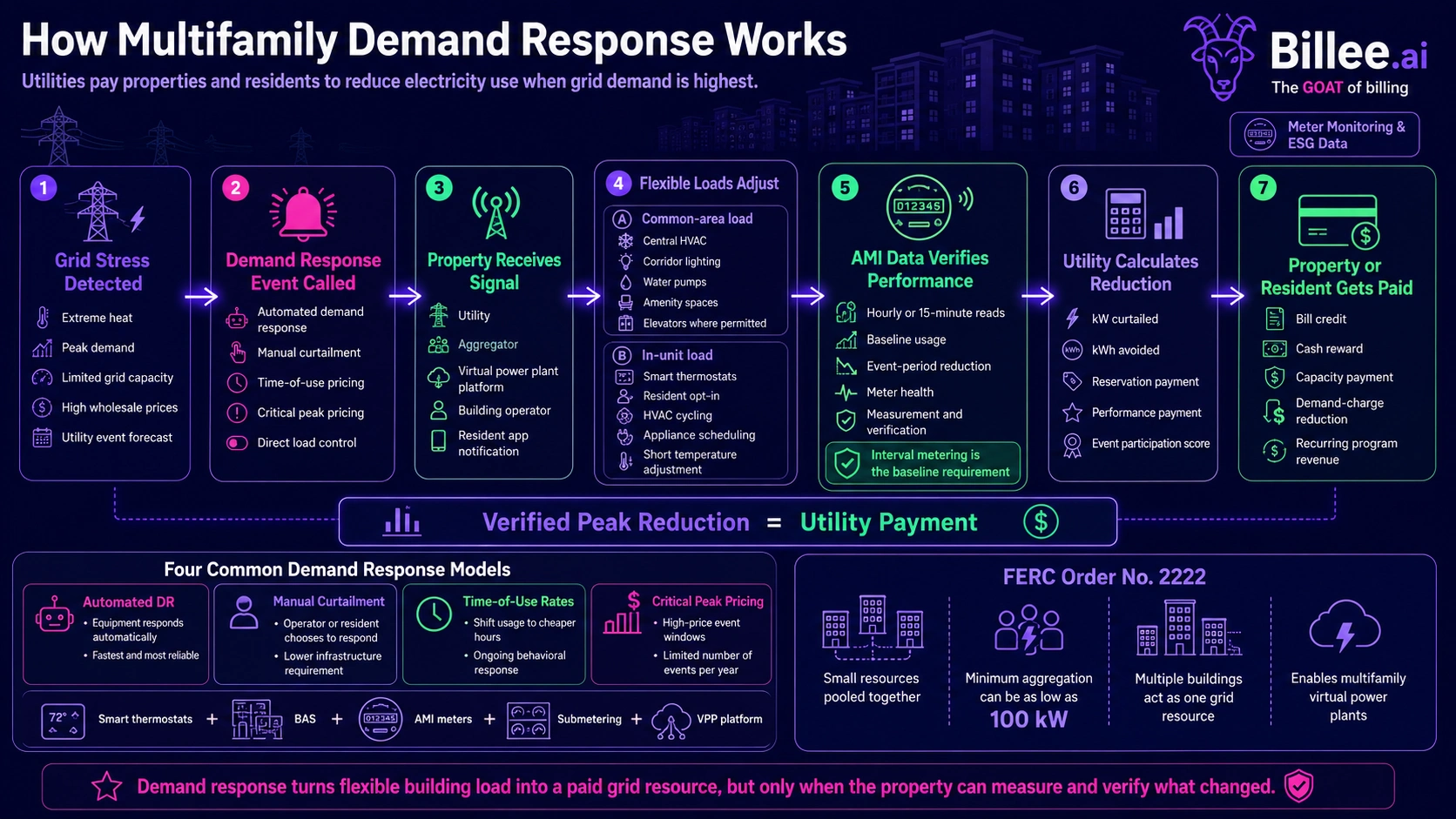
Demand response (DR) programs pay building owners or residents to reduce electricity use during peak grid stress, using automated load control, manual curtailment, time-of-use rates, or critical peak pricing. Multifamily properties participate through common-area load control or resident-level smart thermostats, though the biggest barrier is the "split incentive," where owners fund the infrastructure and residents capture the savings. Properties generally need interval (AMI) metering, and often owner-managed submetering, to qualify, the kind of infrastructure Billee supplies without running demand response programs itself. Con Edison's GridRewards and AEP Texas's Multifamily Smart Stat Program show what participation looks like today.
Key takeaways
- Demand response programs pay customers to cut electricity use during peak demand windows, through automated control, manual curtailment, time-of-use rates, or critical peak pricing.
- The split incentive is the defining multifamily barrier: usage runs about 26% higher when owners pay energy costs directly than when residents pay directly.
- NYSERDA states plainly that direct-metered properties cannot participate in demand response until they convert to owner-managed submetering.
- Con Edison's GridRewards program paid over 13,800 NYC-area participants an average of $50 in 2024, cutting nearly 15 MW of demand.
- AEP Texas pays multifamily owners a flat $150 per unit to install ENERGY STAR-certified smart thermostats.
- FERC Order No. 2222 lets aggregators pool small multifamily demand response resources into wholesale markets, the mechanism behind multifamily virtual power plants.
What is a demand response program?
A demand response program pays electricity customers, including multifamily owners and residents, to reduce or shift power use during peak grid stress, in exchange for bill credits or cash. Utilities use these programs to balance supply and demand without building new power plants that sit idle most of the year. FERC groups demand response into three categories: dispatchable load control, demand-bidding, and time-based rate programs.
Several program types fall under that umbrella. Automated Demand Response (ADR) uses installed equipment that adjusts usage automatically at a preset trigger, while manual or behavioral DR has the utility notify customers before an event and participation stays voluntary. Time-of-use (TOU) rates price electricity by the hour, pushing use toward cheaper off-peak windows.
Critical Peak Pricing (CPP) calls a small number of high-price windows a few times a year, the way Southern California Edison runs 12 to 15 CPP events annually, each from 4 to 9 p.m. between June and September. Direct load control (DLC) goes further and lets the utility directly cycle equipment like central air conditioning, the model behind Xcel Energy's AC Rewards program.
Demand response pays customers to use less electricity exactly when the grid needs it most. Aggregation makes that work for multifamily, where a single building's load is too small to matter alone. FERC Order No. 2222 removed the barriers keeping distributed energy resources out of wholesale markets and set minimum aggregation as low as 100 kW, the mechanism behind the multifamily "virtual power plants" referenced later. Economic, capacity, and ancillary demand response round out the taxonomy.
How do multifamily buildings actually participate?
Multifamily buildings participate in demand response through two channels: common-area load and in-unit load. Common-area systems, meaning HVAC, corridor and amenity lighting, water pumps, and elevators, sit under direct owner control, so a manager can enroll and automate them without resident involvement. In-unit load, meaning thermostats and appliances, requires individual resident opt-in, a slower path to the same reduction. No reliable source breaks that split into a precise percentage for a typical building.
The split incentive, the most-cited barrier to multifamily energy programs generally, explains why: the Institute for Market Transformation notes that owners pay the capital cost of the equipment while residents capture most of the operating savings over time.
Two dated but still-cited studies quantify the size of that gap. Median annual energy use ran 26% higher when landlords paid energy costs directly, with no submetering, than when residents paid directly, per a 2014 Fannie Mae study, and a Cityscape analysis found residents who paid directly used about 9% less total energy, with the gap widening to 53.6% less cooling energy, the most discretionary, behavior-driven load in a home.
A multifamily building that bills residents directly usually can't participate in demand response at all. The metering structure has to change first: NYSERDA states that direct-metered properties, billed by the utility per unit, cannot participate in demand response or deploy cogeneration, and converting to owner-managed submetering is a stated precondition. ENERGY STAR's own guidance confirms the same problem in practice: when residents are billed directly, owners often cannot access the unit-level data needed for benchmarking or verification, unless the utility aggregates it or residents consent individually.
The scale at stake is real. PJM's footprint alone holds more than 5 million multifamily units, and enrolling master-metered and submetered buildings into virtual power plants could unlock roughly 5 gigawatts of controllable capacity, about 16% of PJM's projected 30 GW of data-center-driven peak demand growth.
What does real multifamily DR participation look like today?
Real multifamily demand response participation today looks like a short list of utility programs with real enrollment numbers. Con Edison runs two parallel tracks in New York: an aggregator-based commercial program and a resident-facing rewards program. Texas, California, and ERCOT each take a different approach.
| Program | Sponsor | What it pays | Who qualifies |
|---|---|---|---|
| Rider T (CSRP/DLRP) | Con Edison | $18/kW-month reservation plus $1/kWh performance payment | 50 kW minimum commitment; aggregators can pool multiple buildings to reach it |
| GridRewards (Smart Usage Rewards) | Con Edison / Logical Buildings | Averaged $50 per participant in the 2024 season, top earner $689.49 | Individual residents in NYC/Westchester multifamily buildings; counts toward Local Law 97 compliance |
| VPP thermostat financing | Logical Buildings / Keyframe Capital | $110 million financed for free smart thermostats, targeting about 100 MW of peak reduction | NYC and NJ multifamily buildings (2023 program) |
| Multifamily Smart Stat Program | AEP Texas | Flat $150 per unit paid to the property owner | Existing, individually metered multifamily buildings; first-come, first-served |
| Emergency Load Reduction Program (ELRP) | California utilities / CPUC | $1/kWh residential, $2/kWh non-residential, May through October, 4 to 9 p.m. | Nearly 4 million California residents were auto-enrolled starting in 2022 |
| Residential Demand Response Program (proposed, NPRR 1296) | ERCOT | Up to $140/kW-year, modeled around smart thermostats, 500 MW seasonal cap | Filed August 2025; the proposal does not mention multifamily buildings specifically |
AEP Texas and Con Edison stand out for building pathways explicitly for multifamily properties, not just single-family homes. Most utility residential DR pages do not extend that same invitation: PG&E's and Southern California Edison's general residential demand response pages, for example, include no explicit multifamily or common-area eligibility language, leaving owners to work out participation case by case with their account representative.
What technology does a property need to qualify?
Interval metering is the baseline requirement almost every demand response program shares. FERC defines interval, or AMI, metering as equipment that measures and records usage at hourly intervals or more frequently, reporting at least daily; national AMI penetration reached 72.3% as of FERC's most recent assessment. A property without it cannot generate the data a utility needs to enroll it or verify event performance.
Connected, or smart, thermostats are the go-to device across nearly every program here. AEP Texas, Xcel Energy, Con Edison's Logical Buildings partnership, and ERCOT's proposed program all build incentives around thermostat installation, since thermostats are cheap to install and manage the largest swing load in most units.
Building automation systems (BAS) extend that same logic across an entire property instead of one unit. Retrofitting BAS into older buildings is complex and expensive, on a five-to-seven-year refresh cycle, a real constraint for Class B and C stock never built with automation in mind.
Virtual power plant platforms sit on top of both layers, coordinating thermostats and building systems into a single dispatchable resource. Logical Buildings runs GridRewards for resident payments and SmartKit AI for operator management, both riding on Con Edison's AMI network at 15-minute intervals. Submetering fits into this stack earlier than most owners expect: it is frequently the demand-response eligibility requirement from the previous section, which is why meter monitoring that keeps interval data clean and current matters before a building ever applies.
What's the financial case?
The clearest multifamily-specific financial data comes from a January 2026 case analysis of 22 communities ranging from 244 to 688 units each. Smart thermostats paired with vacancy automation cut HVAC runtime in vacant units by 32% to 55%, a portfolio average near 30%, worth an estimated $17,000 to $36,000 per year per community. Occupied units saw a smaller but still real 9% to 17% reduction, worth $162 to $306 per occupied unit annually.
Demand charges, not general energy use, usually determine whether a peak-shaving investment pays off. Demand charges can make up 30% to 70% of a commercial electric bill where utilities apply them, and peak-shaving becomes attractive once those charges reach roughly $15 per kW or higher. Cutting HVAC runtime during peak-measurement hours drives the savings above, not efficiency improvements alone.
Reducing energy costs in apartment communities follows the same logic at a smaller scale, even outside a formal program, though household earnings vary too widely by program and device stack for one national figure to be reliable.
Two numbers are worth flagging as unavailable rather than guessed at: no current source ties utilities to a fixed percentage of multifamily operating expenses, or to a direct NOI-impact figure for demand response specifically. The National Apartment Association's most recent breakdown bundles maintenance, insurance, and utilities together at 27 cents of every rent dollar, a figure that should not be broken apart into a utilities-only number without better data.
What's stopping more multifamily properties from participating?
Six structural and behavioral barriers explain why multifamily demand response participation lags behind the single-family market, and most compound each other.
- The split incentive. Owners fund the equipment; residents capture the savings, which weakens the owner's case for acting first.
- Metering structure mismatch. Direct-metered properties are often structurally ineligible, per NYSERDA, and master-metered buildings without submetering enroll as a whole but give residents no individual accountability.
- Data access barriers. Owners frequently cannot obtain the unit-level data they need for enrollment or verification when a utility bills residents directly, per ENERGY STAR.
- Aging building stock. Retrofitting automation into older Class B and Class C properties is costly and slow, per Leni, compounding the technology gap those properties already face.
- Resident behavior and awareness. Only about 13% of U.S. households participate in any demand response program, only 16% of internet-connected households own a smart thermostat, and 54% of non-participants do not know their utility offers one.
- Program design that skips multifamily. Most major utility residential DR pages, including PG&E, Southern California Edison, Xcel Energy, and Oncor, lack explicit multifamily eligibility language, leaving AEP Texas and Con Edison as the clearest counterexamples.
When does it make sense to handle this in-house versus bring in a partner?
Handling demand response in-house makes the most sense for portfolios with dedicated facilities or engineering staff, a single utility territory, and submetering plus building automation already installed. Those three conditions mean the team already has the people, the data, and the equipment, so adding DR enrollment is closer to configuration than a new program.
A managed or partner approach fits better for portfolios spread across multiple utility territories with different program rules, properties still on direct metering, or teams without the bandwidth to handle per-property enrollment and verification themselves. Deciding between the two is one instance of the broader multifamily energy management decisions every portfolio makes about staffing, vendor relationships, and where in-house expertise stops being worth the overhead.
How Billee can help
Billee does not operate demand response programs directly, and this article will not pretend otherwise. What Billee provides is the metering visibility that demand response participation depends on, regardless of which utility program a property joins.
Billee's meter monitoring capability supplies the real-time usage data that demand response measurement and verification requires, catching a broken or flatlined meter before it corrupts a season of performance data. The same consumption data feeds Billee's ESG and sustainability reporting, turning the benchmarking work owners increasingly need for lenders and investors into a byproduct of data Billee already manages.
For properties still on direct metering, the barrier is structural, not technological: NYSERDA is explicit that those properties cannot enroll in demand response until they convert to owner-managed submetering. Billee's hardware and maintenance support handles that conversion, from procurement through ongoing calibration, alongside the broader submetering capability a property needs to make demand response possible at all.
FAQ
-
What is demand response and how does it work for apartment buildings?
Demand response pays building owners or residents to reduce electricity use during periods of peak grid stress, through automated equipment control, manual curtailment, or time-based pricing. Multifamily buildings typically participate through common-area load control or resident-enrolled smart thermostats. -
Can multifamily properties really participate in demand response programs?
Multifamily properties can participate in demand response, though eligibility depends heavily on metering structure. Properties with owner-managed submetering or master metering can generally enroll, while properties where the utility bills each unit directly are often ineligible until they convert. -
What is the "split incentive" problem in multifamily demand response?
The split incentive is the single most-cited barrier to multifamily demand response participation. Owners pay for the infrastructure that enables it, while residents typically capture the resulting utility savings. -
Do I need smart meters to participate in demand response?
Interval, or AMI, metering is a near-universal requirement, since demand response programs need hourly-or-more-frequent usage data to enroll a property and verify performance during events. -
How much can a multifamily property earn from demand response?
Earnings vary widely by program and market. Con Edison's resident-facing GridRewards program averaged $50 per participant in its 2024 season, with top earners over $600, while aggregated commercial-style programs such as Con Edison's Rider T pay per kW reserved plus per kWh delivered during events. -
What's an example of a demand response program built specifically for multifamily buildings?
AEP Texas's Multifamily Smart Stat Program pays property owners a flat $150 per unit to install smart thermostats. Con Edison's GridRewards program markets itself as the largest multifamily resident energy-rewards program in the United States and also helps New York City owners with Local Law 97 compliance. -
Can a property with individually metered units still participate in demand response?
Direct-metered properties, where the utility bills each unit individually, are generally not eligible for demand response, according to NYSERDA. Converting to owner-managed submetering is typically a prerequisite before a property can enroll. -
Does Billee run demand response programs?
Billee does not operate demand response enrollment itself. Billee's meter monitoring and ESG reporting capabilities supply the consumption data and submetering infrastructure that demand response participation depends on.
If demand response is on your portfolio's energy roadmap, the metering and submetering data it depends on is where Billee already operates every day. Talk to the team if you want to see how.
Sources
- Uplight, "What is Demand Response?," accessed 2026.
- Multi-Housing News, "Fannie Mae Releases Major Study on Multifamily Energy Use," September 2014.
- New York State Energy Research and Development Authority, "Submetering for Multifamily Buildings," accessed 2026.
- Logical Buildings, "Logical Buildings Sets Enrollment Record, Providing NYC and Westchester Customers Cash Payments for Energy Savings," March 2025.
- AEP Texas, "Multifamily Smart Stat Program," accessed 2026.
- Federal Energy Regulatory Commission, "Order No. 2222 Fact Sheet," accessed 2026.
- Federal Energy Regulatory Commission, "Frequently Asked Questions (FAQs): Demand Response," accessed 2026.
- GridPoint, "What is Automated Demand Response, Exactly?," updated January 2024.
- Southern California Edison, "Demand Response Programs for Homes," accessed 2026.
- Xcel Energy, "AC Rewards Terms and Conditions," accessed 2026.
- Enel North America, "The Different Types of Demand Response Programs Explained," June 2024.
- Multi-Housing News, "The Split-Incentive Barrier to Multifamily Solar," April 2026.
- National Multifamily Housing Council (Obrinsky & Walter), "Energy Efficiency in Multifamily Rental Homes," Cityscape Vol. 8, No. 1, 2016.
- United States Environmental Protection Agency (ENERGY STAR), "Considerations for Benchmarking Multifamily Properties," October 2021.
- Smart Cities Dive, "Master-Metered Multifamily: The Missing Ingredient for Scalable Virtual Power Plants," September 2025.
- Con Edison, "Demand Response (Rider T) Program Guidelines, 2026 Capability Period," accessed 2026.
- Canary Media, "Inside a $110M Plan to Turn NYC Apartments into Virtual Power Plants," March 2023.
- California Public Utilities Commission, "Emergency Load Reduction Program," accessed 2026.
- The Brattle Group, "An Assessment of ERCOT's Proposed Residential Demand Response Program," February 2026.
- Federal Energy Regulatory Commission, "2024 Assessment of Demand Response and Advanced Metering," November 2024.
- Leni, "Complete Guide to Building Automation in Multifamily," accessed 2026.
- iApartments, "5 Multifamily Communities: How Much Did Smart Thermostats Save Them?," January 2026.
- Clean Energy Group, "An Introduction to Demand Charges," accessed 2026.
- Elum Energy, "Demand Charges Explained: How Utilities Calculate Peak Power Costs," updated July 2026.
- National Apartment Association, "Research Finds 93 Cents of Every Rent Dollar Keep Apartments Running," September 2023.
- Utility Dive, "Demand Response Programs Improving, But Customers Remain Wary: Report," July 2025.
Insights and Industry Trends


Explore more insights