
How Submeter Data Is Collected and Reported
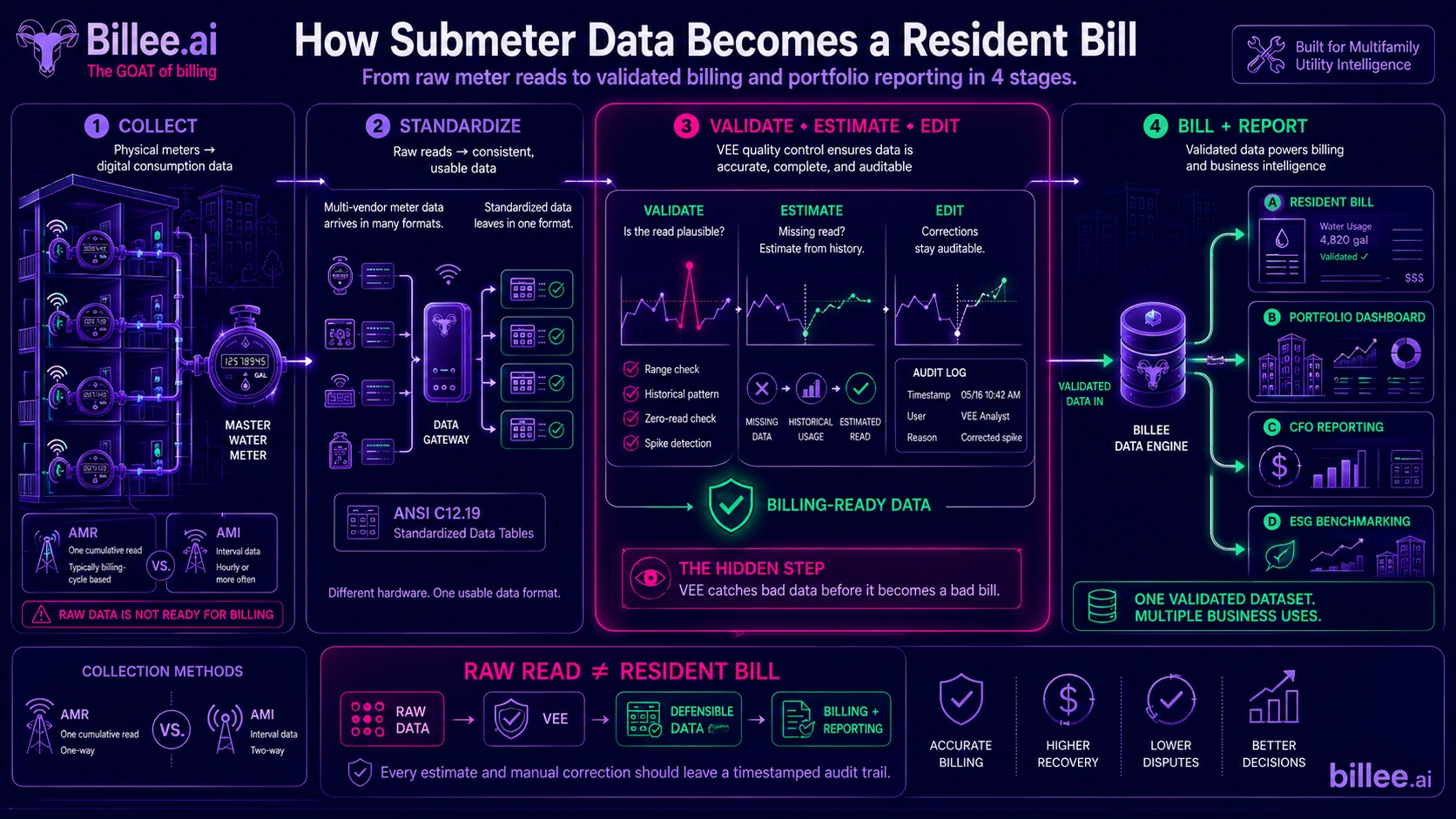
Submeter data moves through four stages before it becomes a bill or a report: collection at the meter, transmission in a standardized format, a validate-estimate-edit (VEE) quality pass, and aggregation into resident charges and portfolio reporting. The VEE step is the one most operators never see, and it's the one that decides whether a bill survives a dispute. Billee manages this pipeline end to end, from meter monitoring through the reporting layer a CFO or ESG team actually uses.
Quick answer
Submeter data collection depends on hardware. AMR meters send one cumulative read per billing cycle over a one-way connection. AMI meters send interval data, hourly or more often, over a two-way connection reaching both the utility and the property at least once a day, per the U.S. Energy Information Administration.
Once collected, reads are validated against range and pattern checks. Missing or implausible reads are estimated from historical usage. Any manual corrections are logged with a timestamp and user attribution, a process the industry calls VEE: validate, estimate, edit. Only after that quality pass does a read become a resident charge, a portfolio dashboard figure, or an ESG report input.
Key takeaways
- Submeter data passes through four stages before it's usable: collection, transmission and standardization, data-quality processing (VEE), and aggregation into bills and reports.
- AMR meters deliver one cumulative read per billing cycle. AMI meters deliver interval data at least hourly, reaching both the utility and the property at least once a day, per the EIA.
- ANSI C12.19 standardizes the data tables meters use to communicate, which is what lets hardware from different manufacturers feed the same collection and billing systems.
- The VEE process, validate, estimate, edit, is what catches a bad read before it becomes a wrong bill, and what generates a defensible estimate when a read is missing entirely.
- The same underlying consumption dataset feeds resident statements, portfolio dashboards, CFO variance reports, and ESG benchmarking through tools like Green Button and ENERGY STAR Portfolio Manager. They are different views of one pipeline, not separate data sources.
- Every manual edit to a meter read should leave an auditable, timestamped record. That record is what makes a bill defensible when a resident disputes a charge.
Why this matters for multifamily operators
Operators trust the number on a bill or a report without ever seeing what produced it. That's fine until a resident disputes a charge, or a lender asks for defensible consumption data during a refinance. The operator who understands this pipeline can answer with specifics instead of pointing at a dashboard and shrugging.
Billee's meter monitoring, billing, and CFO and ESG reporting all sit on top of this same four-stage pipeline. Each one depends on the earlier stages working correctly before it has anything reliable to act on.
The four-stage pipeline, from meter to report
Four stages turn a meter's raw signal into a number a resident, an owner, or a CFO can actually use.
| Stage | What happens | What comes out |
|---|---|---|
| 1. Collection | The meter measures usage and transmits a read on a schedule set by its hardware type | A raw read: one cumulative number (AMR) or an interval data series (AMI) |
| 2. Transmission and standardization | The read travels from the meter to a collection system in a standardized data format | A structured, vendor-agnostic data record ready for processing |
| 3. Data quality (VEE) | The record is validated, estimated if missing, and edited if corrected, with every change logged | A billing-ready, defensible consumption figure |
| 4. Aggregation and reporting | The validated figure is rated and routed to every downstream use | A resident charge, a portfolio report line, or a benchmarking data point |
Stage 1: Collection at the meter
Collection method depends entirely on hardware. AMR, Automatic Meter Reading, sends one cumulative number per billing cycle over a one-way connection, typically gathered by a walk-by handheld reader, a drive-by vehicle receiver, or a basic fixed network. AMI, Advanced Metering Infrastructure, sends interval data, measured and recorded at a minimum of hourly intervals and delivered to both the utility and the property at least once a day, per the U.S. Energy Information Administration.
The technology comparison, cost tradeoffs, and which one fits a given portfolio are covered in full in Billee's AMI vs. AMR guide. This article picks up where that guide leaves off: what happens to a read after it's been collected.
Stage 2: Transmission and data standardization
A collected read still has to get from the meter's network into a system that can use it, and different meter manufacturers don't natively speak the same format. ANSI C12.19, the American National Standard for Utility Industry End Device Data Tables, solves that problem. According to NEMA, the standard defines a table structure for utility application data passed between a meter and any other device, without dictating hardware design or transport protocol.
The data-versus-hardware distinction matters in practice. A property running mixed meter brands, or a portfolio running AMR in one building and AMI in another, can still feed one collection and billing system instead of needing a separate pipeline per hardware vendor. The standard governs what gets communicated, not how each vendor's hardware works internally.
Stage 3: Data quality, the VEE process
Most of what determines whether a bill is accurate happens after collection, inside a meter data management system running a process the utility industry calls VEE: validate, estimate, edit. That system sits between the meter's collection network and the billing engine, checking every read before it reaches a bill.
Validation checks every incoming read against range checks, regression checks against historical usage, and zero-read checks, before it gets anywhere near a bill. A read that's implausible on its face, a water meter reporting triple a unit's typical overnight usage, for example, gets flagged instead of billed automatically.
Estimation fills the gap when a read never arrives at all, whether from a transmission failure, a meter fault, or a scheduled maintenance outage. Rather than leaving an account unbilled, the system generates a replacement value from historical usage patterns or from a comparable period, sometimes called day-type estimation, adjusted for season.
Editing applies manual corrections, most often after a meter swap or a confirmed hardware issue. Every edit gets logged with a timestamp and the name of whoever made the change, and that log is the audit trail.
A resident's bill is rarely a single raw meter read. It's a validated, sometimes estimated, and occasionally manually corrected number, and the record of that process is what makes the bill defensible.
Estimation accuracy carries real weight here. A bad estimate, not the fact that estimation happened at all, is what generates a resident dispute. An estimate based on genuine historical usage and explained plainly to the resident rarely draws a complaint. An estimate that's obviously wrong draws one every time.
Billee's guide to catching billing errors before they post covers the downstream side of this same problem: what to audit once a bill has already been generated.
Stage 4: Aggregation into bills and reports
Once a read clears validation, and estimation or editing where needed, it gets matched to a billing cycle and a rate schedule, and becomes a resident line item. That's the part most operators already picture when they think about submetering data.
The same validated dataset branches out from there. It feeds portfolio-level dashboards for owners and property managers, variance and trend reporting for CFOs, and ESG or benchmarking data, often standardized through the Green Button data-sharing initiative and uploaded to tools like ENERGY STAR Portfolio Manager through automated web services.
Billee's guide on what a CFO needs from utility reporting covers that reporting layer in full. The site's guide to building ESG reports from utility data covers the benchmarking side.
Consumption data and invoice data are not the same dataset, even though they describe the same usage. Consumption data is what the meter measured, in gallons, kilowatt-hours, or therms. Invoice data is what got billed, in dollars. Reports built by conflating the two tend to break the moment a rate changes or a billing correction posts after the fact.
How often is submeter data actually collected?
Collection frequency depends on hardware, and it's a different question from how often a resident gets billed. AMR meters collected by walk-by or drive-by typically report monthly, timed to the billing cycle. AMR fixed-network setups can report more often without a truck roll, though most portfolios still bill on the same monthly cumulative basis. AMI meters report interval data at a minimum of hourly intervals, delivered to both the utility and the property at least once a day, per the EIA.
Collection frequency and billing frequency are two different settings, not one. A property can collect AMI interval data every hour while still billing residents on a standard monthly cycle. Property teams sometimes assume more frequent collection automatically means more frequent billing; it doesn't, unless the billing platform is specifically configured to use it that way.
Common mistakes
- Assuming a missing meter read means the unit goes unbilled. In a properly managed pipeline, it gets estimated from historical usage, not skipped, and residents should be able to hear that explanation when they ask.
- Treating collection frequency and billing frequency as the same setting. AMI can collect hourly while a property still bills monthly; one doesn't determine the other.
- Making a manual correction to a meter read without logging it. An unlogged correction is exactly what turns a routine fix into an indefensible bill during a dispute.
- Conflating consumption data with invoice data when building CFO or ESG reports. One measures usage, the other measures dollars, and they diverge the moment a rate changes.
- Assuming mixed meter hardware across a portfolio requires separate reporting pipelines. Data-table standards like ANSI C12.19 exist specifically to prevent that.
- Accepting "we handle billing" from a vendor or partner without asking how their VEE process actually works. That phrase says nothing about how bad or missing reads get caught before they reach a resident.
When to handle this in-house vs. bring in a partner
A single property on one hardware type, with a well-documented estimation policy the whole team understands, is manageable in-house. The failure mode isn't complexity; it's an undocumented process that only one person understands.
A partner earns its keep across a portfolio running mixed hardware, or anywhere the same data needs to feed resident bills, CFO reports, and ESG benchmarking without three separate manual processes producing three versions of the truth.
How Billee can help
Billee runs this pipeline as one managed process instead of a black box, with a named account team behind the exceptions VEE surfaces rather than an alert nobody follows up on. Billee's meter monitoring and proactive alerts capability watches for anomalies once this pipeline is running; this article is the explanation of the pipeline that monitoring sits on top of.
On the reporting side, the same validated data Billee's team manages feeds directly into the CFO and ESG reporting Billee's platform already produces, without a separate manual reconciliation step.
FAQ
How is submeter data collected in a multifamily property? Submeter data is collected through AMR or AMI hardware. AMR meters send one cumulative read per billing cycle over a one-way connection. AMI meters send interval data, hourly or more often, over a two-way connection reaching the utility and the property at least once a day.
How often are submeters actually read? Read frequency depends on hardware, not on how often residents get billed. AMR meters typically report monthly, timed to the billing cycle. AMI meters report interval data at a minimum of hourly intervals, per the U.S. Energy Information Administration.
What happens if a meter fails to send a reading? A missing meter read gets estimated, not skipped, in a properly managed data pipeline. The system generates a replacement value from historical usage patterns rather than leaving the account unbilled.
What is a VEE process in meter data management? VEE stands for validate, estimate, edit, the three-step process that checks incoming meter reads for accuracy, fills gaps when a read is missing, and logs any manual correction with a timestamp and user attribution.
Does submeter data feed directly into ESG reporting? Submeter consumption data feeds ESG reporting once it clears the same validation process used for billing. The data is often standardized through the Green Button initiative and uploaded to tools like ENERGY STAR Portfolio Manager, using the same underlying dataset that produces resident bills rather than a separate source.
How is submeter data kept accurate enough to survive a billing dispute? Accuracy comes from the validate-estimate-edit process and the audit trail it leaves behind. Every validated read, every estimate, and every manual edit gets logged with a timestamp, giving the operator a documented record to point to when a resident disputes a charge.
Does Billee handle the technical side of meter data collection and reporting? Billee manages the full pipeline, from meter data collection through validation and into resident billing, CFO reporting, and ESG benchmarking, with a named account team behind the exceptions that come up along the way.
Related reading
For the full technology comparison, see AMI vs. AMR Meters: Which Is Right for Multifamily Properties. For what happens on top of this pipeline once it's running, see What Is Meter Monitoring & Proactive Alerts?. For the reporting side in full, see How Multifamily Operators Build ESG Reports from Utility Data.
Billee manages the full data pipeline behind every resident bill and portfolio report, from collection through reporting, so operators don't have to reverse-engineer a black box when something looks wrong. Talk to the team about your portfolio.
Sources
- U.S. Energy Information Administration, "How many smart meters are installed in the United States, and who has them?," updated October 20, 2023.
- NEMA, "ANSI C12.19-2021: American National Standard for Utility Industry End Device Data Tables, Contents and Scope."
- Bynry, "Meter Data Management in Utilities: How Modern MDM Works."
- tblocks, "Meter Data Management: Complete Guide for Utilities."
- Green Button Alliance, "The Green Button, the standardized way to get your energy usage data."
- ENERGY STAR, "ENERGY STAR Portfolio Manager Web Services."
Insights and Industry Trends