
Indiana RUBS and Sub-Billing Rules: What the IURC Requires of Landlords
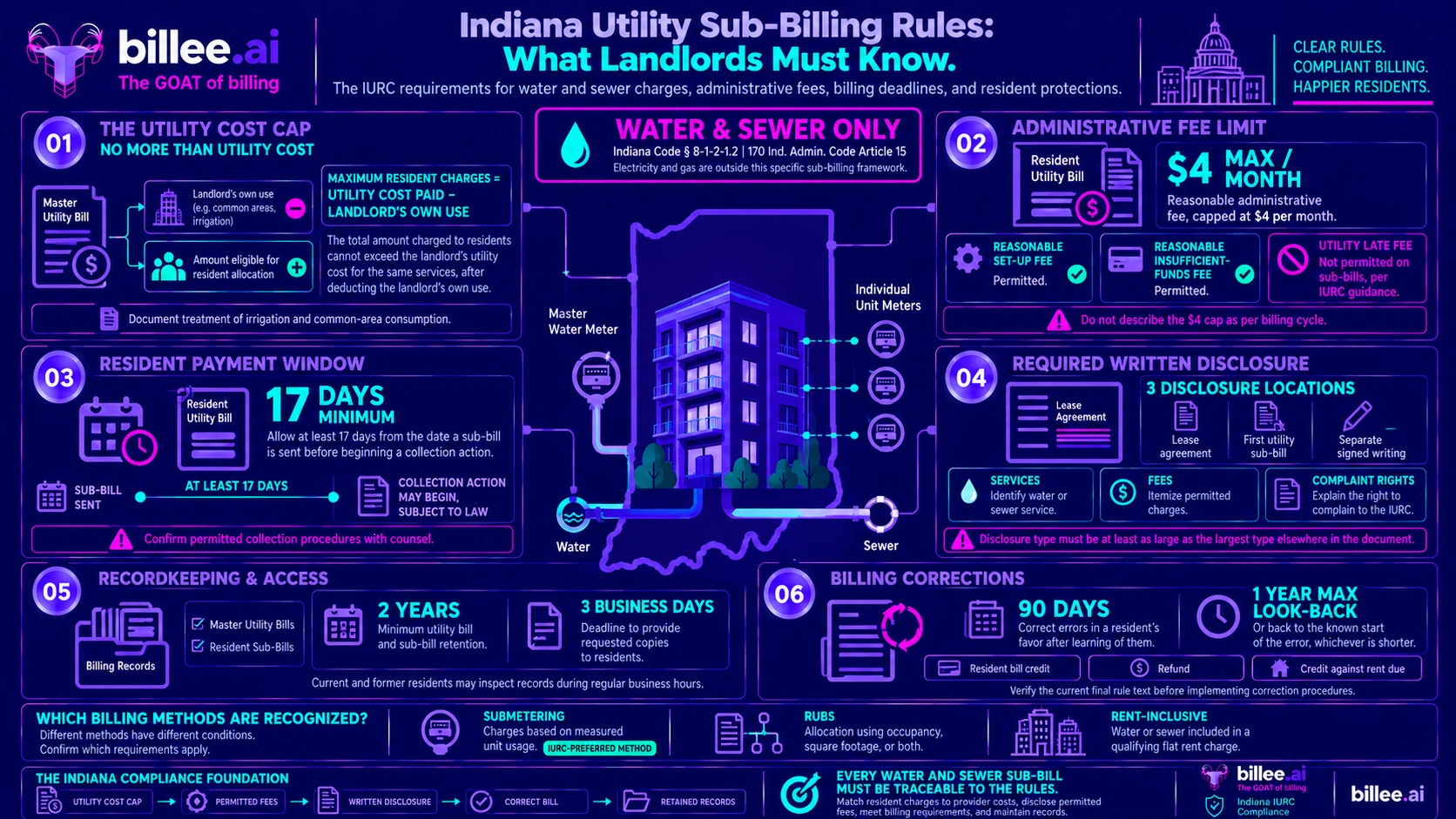
Indiana lets landlords bill residents separately for water and sewer without becoming public utilities, if they follow Indiana Utility Regulatory Commission (IURC) rules: bill no more than the utility charged less the landlord's own use, cap the administrative fee at $4 a month and allow at least 17 days to pay. Billee Technologies, Inc. audits billing methodology against rules like these.
Indiana regulates landlord utility billing directly. The rules reach the cost cap, the fee line, the lease disclosure, the bill layout, the records file and the correction process, and they cover water and sewer only. This guide sets out what the statute and the IURC require, where the rules go quiet and how to get ready. It is not legal advice.
Key takeaways
- Indiana Code § 8-1-2-1.2 and 170 Ind. Admin. Code Art. 15 let a landlord bill residents separately for water and sewer service without being treated as a public utility, if the conditions are met.
- A landlord's total charge cannot exceed what it paid the utility for the same service, less its own use.
- Permitted fees are a reasonable set-up fee, a reasonable administrative fee of no more than $4 a month and a reasonable insufficient-funds fee. Late fees are not on the statute's list, and the IURC says they are not allowed on sub-bills.
- A written disclosure, with an IURC complaint statement, must appear in the lease, the first bill or a separate signed writing.
- A sub-bill must carry twelve listed items, go out as often as the utility bills the landlord and allow at least 17 days before any collection action.
- Landlords must keep utility bills and sub-bills for at least two years and give residents copies within three business days of a request.
- A landlord that uses a billing company stays responsible for the company's noncompliance.
Indiana sub-billing rules at a glance
| Requirement | What Indiana says | Source |
|---|---|---|
| Services covered | Water and sewer only | IURC landlord page; 170 IAC 15-1-0.5 |
| Cost cap | Total charge no more than the landlord paid the utility, less its own use | IC 8-1-2-1.2(l) |
| Administrative fee | Reasonable, and no more than $4 per month | IC 8-1-2-1.2 |
| Late fees | Not on the permitted list; the IURC says not allowed on sub-bills | IC 8-1-2-1.2; IURC |
| Disclosure | Lease, first bill or separate signed writing, with the IURC complaint statement | IC 8-1-2-1.2(l)–(m) |
| Time to pay | At least 17 days from the date the sub-bill is sent before a collection action | 170 IAC 15-2-0.5(a)(4) |
| Records | Utility bills and sub-bills kept at least two years; copies within three business days | 170 IAC 15-2-1 |
| Corrections | Errors in the resident's favor fixed within 90 days of learning of them | 170 IAC 15-2-5 |
| Billing company | The landlord answers for its noncompliance | IURC landlord page |
Who Indiana's sub-billing rules cover
Landlords that pass water or sewer costs to residents. Under Indiana Code § 8-1-2-1.2, a landlord that distributes water or sewer service is not a public utility for that activity alone if it takes one of two paths. It can charge a flat fee at regular intervals that includes the service without itemizing it. Or it can bill separately and meet the statute's conditions. Associations of co-owners or members follow parallel provisions, which this guide leaves out.
The IURC's landlord page names three methods: sub-metering, which it calls the preferred option, rent-inclusive pricing and RUBS. It says RUBS can allocate by occupancy, square footage or both. Billee's guide to how RUBS allocates utility costs walks through the formulas. The IURC's order approving the final rule describes an exception for a flat rent that clearly includes water or sewer and does not vary with usage.
Water and sewer only. The landlord page and the rule's scope section address water and sewer. Neither covers electricity or gas, so a portfolio that bills those to residents needs a separate analysis.
The cost cap and the fee limits
The cap. For a landlord, the total charge to residents cannot exceed what the landlord paid the utility for the same services, less the landlord's own use. The IURC's page puts it plainly: bill only what you pay the utility, minus your own use. The text read for this guide does not define own use. Common areas and irrigation are the usual candidates, so record how you treat them.
The IURC page gives an example RUBS method that takes a 10% common-area share off the bill first and divides the remainder by occupancy, square footage or both. It is an example, not a required percentage.
The fees. The statute limits a landlord to a short list of costs.
| Fee | Indiana rule |
|---|---|
| Initial set-up fee | Reasonable; no dollar limit stated |
| Administrative fee | Reasonable; no more than $4 per month |
| Insufficient-funds fee | Reasonable; no dollar limit stated |
| Late fee | Not on the list; the IURC says not allowed on sub-bills |
| Other fees | The IURC says generally not allowed, unless for a separate service and itemized on the bill |
Read the $4 limit as per month. The statute says $4 per month. Some industry summaries describe it per billing cycle. A landlord with off-cycle or corrected bills should ask counsel how the monthly ceiling applies.
Billing-company charges are a separate question. A landlord answers for a vendor that does not sub-bill according to the law, so anything a vendor adds to a resident's bill deserves the same scrutiny. Billee's guide to hidden vendor fees lists what to look for.
What the written disclosure must say
Put it in writing, in one of three places. For a landlord, the disclosure can appear in the lease, in the resident's first bill or in a separate writing the resident signs. The statute also sets a type-size floor: the disclosure must be printed in type at least as large as the largest type elsewhere in the document.
Cover three things. The disclosure must describe the water or sewer services, itemize the permitted fees and state that a resident who believes they are overbilled or charged in violation can file a complaint with the IURC. Billee's guide to RUBS lease addendum requirements covers lease wording across states.
The statute does not address other lease terms, final bills or deposits. A lease clause should still match the formula and the fees actually charged.
What each sub-bill must show
Timing and form. Under 170 Ind. Admin. Code 15-2-3, sub-bills go out as often as the utility bills the landlord and cover the same period. They must be separate from rent. A water sub-bill shows sub-meter dates and readings.
Twelve required items. The rule lists these:
| Group | Items |
|---|---|
| Dates | Sub-billing date; due date |
| Money | Rate; previous balance; amount; set-up fee; administrative fee; insufficient-funds fee |
| Flags | Estimated-bill indicator; explanation of codes |
| Contacts | Contact name and phone number; IURC complaint statement |
At least 17 days to pay. The rules require at least 17 days from the date a sub-bill is sent before a collection action starts, and the IURC's landlord page lists the same 17 days. The rule text read for this guide describes no landlord collection method beyond written notice under the disclosure requirements. Ask counsel how unpaid sub-bills may be pursued.
Records, corrections and complaints
Records. 170 Ind. Admin. Code 15-2-1 requires a landlord to keep utility bills and sub-bills for at least two years. The final rule raised that period from one year. Current and former residents can inspect the records during regular business hours, and the landlord must provide copies within three business days of a request. A nominal copying fee is allowed. The IURC's Consumer Affairs Division can also ask for the records.
Corrections. The final rule added 170 IAC 15-2-5. As the IURC's order describes it, an error in a resident's favor must be corrected within 90 days of learning of it, back to the known start of the error or one year, whichever is shorter. The fix can be a credit on the next sub-bill, a refund or a credit against rent due.
An error in the landlord's favor can be recovered over the same look-back through the next sub-bill. Confirm the final text before building a procedure around it.
Complaints and consequences. Residents can complain to the IURC. If a complaint alleges a violation, the Commission must consider it and can order billing adjusted. A landlord that does not provide requested records within 15 days, or does not comply with an earlier Consumer Affairs determination within 90 days, can be regulated as a public utility unless a longer period is agreed. A landlord that uses a billing company remains responsible for the company's noncompliance.
What the rules do not say
- Electricity and gas. The framework covers water and sewer only.
- Move-outs and deposits. Neither the statute nor the IURC's landlord page addresses final bills, deposits or other lease terms.
- "Own use." The text read does not define it. Document your treatment of common areas and irrigation.
- Currency. The statute copy shows the 2025 code and carries a caution that it may not be current. The bill-contents list comes from a rule page current through March 2024, which appears to predate the final rule. The order says the final rule takes effect 30 days after filing with the Indiana Register and gives no calendar date. Check each text on the official sites before changing a template.
How to get ready
- List every Indiana property that bills water or sewer separately. Note the method each one uses: sub-metering, RUBS or rent-inclusive.
- Test the cost cap. Compare the last 12 months of master bills, less your own use, to the total billed to residents. A year also matches the correction look-back.
- Review the fee line. Confirm the administrative fee stays within $4 a month and that no late fee appears on a sub-bill.
- Pull the disclosure. Check where it sits, what it says, the type size and the IURC complaint statement.
- Compare the bill template to the twelve items. Add sub-meter dates and readings for water.
- Build the records file. Keep two years of utility bills and sub-bills, and set a process for copy requests within three business days.
- Write the correction procedure. Include the 90-day and one-year points, and who approves a credit or refund.
- Ask your billing company in writing. You answer for its compliance.
How Billee Technologies helps
Billee Technologies pairs a platform with a named, dedicated account team. Your people review and approve. Billee's team does the work. For Indiana, the job is showing that every bill matches the statute: the cap, the fee line, the layout and the file behind it.
Check the formula, the fees and the lease
Billee's Regulatory & Compliance service covers billing methodology audits, access to legal support and ongoing monitoring for rule changes. Access to legal support is not legal advice. Billee's guide to its regulatory and compliance support explains the scope.
A Billee audit reviews four required document categories for the same billing period: the current billing provider's reports, master meter invoices, lease agreements, and the property's W-9 and legal entity name. It surfaces methodology gaps, allocation drift, reconciliation problems and lease-language gaps. A lease-language gap is where a disclosure shortfall would show up.
Billee's guide to preparing a billing methodology audit lists what reviewers ask for. Billee's 45-day standard implementation includes a methodology audit of formulas, submeter configuration and allocation logic, which is where a cost-cap check would start.
Run each cycle with a paper trail
Each month Billee assembles utility data and produces a preliminary bill. Your billing administrator reviews it in the Billee portal next to Biller Highlights, the team's notes on exceptions, and can download a Detail Resident Report or an Itemized Report. Billee replies to comments within 1–2 business days, and an administrator can request a new report, which takes 1–2 business days.
After approval, Billee locks the report and charges post to the property management system's resident ledger on the set date. Residents receive e-bills. The activity log records every billing action, who performed it and when. Whether those reports and the log meet Indiana's two-year retention and three-business-day copy rules is a question for Billee in writing.
Catch meter errors early
Billee's Meter Monitoring raises alerts when a reading spikes, drops or flatlines, and the team acts on them. Read more in Billee's guide to meter monitoring and proactive alerts. Monitoring works on portfolios that already have submetering infrastructure. Under a correction rule with a 90-day clock, finding an error early is worth more than finding it at year-end.
Fix a bill after it goes out
If a bill has data problems, such as a missing meter read, it shows an Issue status, and an administrator can request a biller review, which takes 1–2 business days. After a bill is sent, an administrator can request a correction, also 1–2 business days, and the revised bill locks automatically when complete. Billee's guide to handling resident utility bill disputes covers the resident side. Whether this process fits Indiana's 90-day adjustment rule is a question for Billee in writing.
What to ask Billee for in writing
- How Billee applies Indiana's $4 monthly administrative limit, and where any Billee or property fee appears on Indiana bills.
- Whether bills carry the twelve items 170 IAC 15-2-3 lists, including sub-meter dates and readings and the IURC complaint statement.
- Whether the audit tests the lease disclosure against IC 8-1-2-1.2, including type size and complaint wording.
- How the "less own use" deduction is set and documented for each property.
- How the two-year records file is assembled, and how a resident's copy request is answered within three business days.
- How a billing error is corrected and recorded against the 90-day and one-year rules.
- How Indiana rule changes reach your account team.
Who Billee is not for
- Portfolios under about 300 units, where Billee's full-service model is usually more than the job needs.
- Anyone looking for a legal opinion on how Indiana's rules apply to a formula, lease or bill. Billee gives access to legal support, not legal advice, so involve counsel.
- Operators who want to run billing themselves with software alone. Billee's portal exists for review and approval, not self-service operation.
FAQ
Can an Indiana landlord bill residents for water and sewer?
Yes. Under Indiana Code § 8-1-2-1.2, a landlord that distributes water or sewer service is not a public utility for that activity alone if it charges a flat fee that includes the service or bills separately within the statute's conditions. Electricity and gas are outside this framework.
What is the maximum administrative fee for utility sub-billing in Indiana?
The statute allows a reasonable administrative fee of no more than $4 per month. Reasonable set-up and insufficient-funds fees are also permitted, and the sources read state no dollar limit for those two.
Can an Indiana landlord charge late fees on a utility sub-bill?
No, according to the IURC. Late fees are not on the statute's list of permitted costs, and the IURC's landlord page says they are not allowed on sub-bills. Other fees are generally allowed only for separate services that are itemized on the bill.
How long do Indiana residents have to pay a sub-bill?
At least 17 days from the date the sub-bill is sent before a collection action can start. The IURC's landlord page lists the same minimum of 17 days.
What must an Indiana utility sub-bill show?
Twelve items: the sub-billing date, rate, previous balance, amount, set-up fee, administrative fee, insufficient-funds fee, due date, an estimated-bill indicator, an explanation of codes, a contact name and phone number, and the IURC complaint statement. Water sub-bills also show sub-meter dates and readings.
How long must Indiana landlords keep sub-billing records?
At least two years. Under 170 IAC 15-2-1, current and former residents can inspect utility bills and sub-bills during regular business hours, and the landlord must provide copies within three business days of a request.
What happens if an Indiana landlord does not follow the rules?
The IURC can investigate a complaint and order billing adjusted. A landlord that fails to provide records within 15 days, or to comply with an earlier determination within 90 days, can be regulated as a public utility unless a longer period is agreed.
Who is responsible when a billing company gets Indiana's rules wrong?
The landlord. The IURC's landlord page says a landlord that uses a third-party billing company that does not sub-bill according to the law is responsible for the noncompliance.
Billee handles utility billing, vacant cost recovery and vendor management for multifamily operators who want a dedicated team behind the software. If you bill water and sewer in Indiana, talk to the team about your portfolio.
Sources
- Justia, "Indiana Code § 8-1-2-1.2," accessed October 2026.
- Indiana Utility Regulatory Commission, "Sub-Billing for Landlords (customer assistance page)," accessed October 2026.
- Indiana Utility Regulatory Commission, "Order Approving Final Rule, RM 20-02 (170 Ind. Admin. Code Art. 15)," accessed October 2026.
- Justia Regulations, "170 Ind. Admin. Code 15-2-3," accessed October 2026.
- Justia Regulations, "170 Ind. Admin. Code 15-2-1," accessed October 2026.
Insights and Industry Trends