
Georgia RUBS and Submetering Rules: What O.C.G.A. § 12-5-180.1 Allows
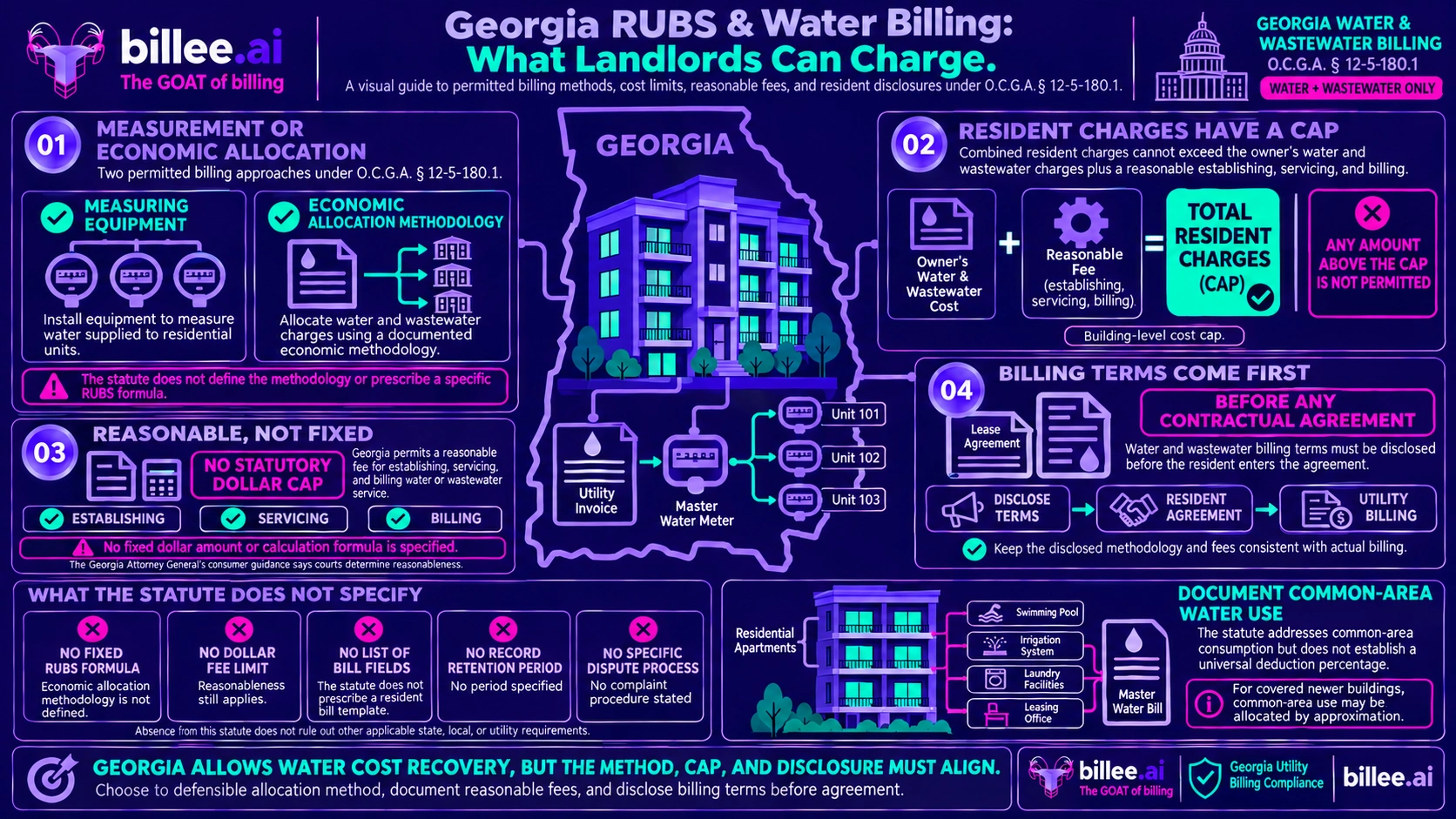
Georgia lets apartment owners bill residents for water and wastewater by measurement or by an economic allocation methodology. Total charges cannot exceed what the owner paid plus a reasonable fee, and the terms must be disclosed before any contractual agreement. New multiunit residential buildings permitted on or after July 1, 2012 must be built to permit per-unit measurement. Billee Technologies, Inc. audits billing methodology against rules like these.
Georgia regulates apartment water billing through one short statute. It covers water and wastewater only, sets a cost cap and a disclosure rule, and adds a measurement requirement for newer buildings. It also leaves a lot undefined. This guide sets out what the statute says, what it does not say and how to get ready. It is not legal advice.
Key takeaways
- O.C.G.A. § 12-5-180.1 lets the owner or operator of a building with residential units install measuring equipment or use an "economic allocation methodology," and charge residents separately for water and wastewater.
- Total charges to residents cannot exceed what the owner paid for the building's water and wastewater plus a reasonable fee for establishing, servicing and billing.
- The terms must be disclosed before any contractual agreement.
- New multiunit residential buildings permitted on or after July 1, 2012 must be constructed to permit measurement of each unit's water use. Older buildings are generally exempt.
- The statute sets no dollar limit on the fee, no late-fee rule, no list of bill contents, no records rule and no dispute process.
- The statute covers water and wastewater only.
Georgia water billing rules at a glance
| Topic | What Georgia says | Source |
|---|---|---|
| Services covered | Water and wastewater | O.C.G.A. § 12-5-180.1 |
| Who may bill | Owner or operator of a building with residential units | § 12-5-180.1(a) |
| Billing methods | Installed measuring equipment or an economic allocation methodology | § 12-5-180.1(a) |
| Cost cap | Total charges no more than the owner's water and wastewater charges plus a reasonable fee | § 12-5-180.1(b) |
| Disclosure | Terms disclosed before any contractual agreement | § 12-5-180.1(b) |
| New construction | Multiunit residential buildings permitted on or after July 1, 2012 built to permit per-unit measurement | § 12-5-180.1(c), (g) |
| Fee dollar limit | None stated | § 12-5-180.1(b) |
| Enforcement | Not stated in the statute; Attorney General guidance | Georgia Attorney General |
What the statute allows
O.C.G.A. § 12-5-180.1 lets the owner or operator of a building with residential units install equipment, or use an "economic allocation methodology," to measure the water provided to residents and used in common areas. Subsection (b) then lets the owner charge residents separately for water and wastewater service.
The statute defines neither "economic allocation methodology" nor any formula. Billee's guide to how RUBS allocates utility costs describes the common formulas. Whether a particular formula qualifies is a question for counsel. Billee's state-by-state RUBS guide shows how Georgia compares with other states.
The statute's history shows an amendment in 2010 through Senate Bill 370, the Georgia Water Stewardship Act. A University of Georgia summary of that Act describes it as requiring submetering in new multi-unit residential buildings and encouraging it in existing ones. The statute itself says new buildings must be built to permit measurement and does not use the word submeter.
The cost cap and the reasonable fee
The cap. Under subsection (b), the total charged to residents of a building cannot exceed what the owner paid for the building's water and wastewater, plus a reasonable fee for establishing, servicing and billing the service. The Georgia Attorney General's consumer page says the same in plain terms: the residents' bills added together cannot exceed the bill the complex paid.
The reasonable fee. The statute sets no dollar limit and no formula. The Attorney General's page says a reasonable fee may be added, gives no method for calculating it and says courts decide what is reasonable. Document how each fee is set, and keep it small enough to defend.
Common areas. Subsection (a) mentions water used in common areas, but the text does not say whether that water may be passed through to residents. For covered new buildings, subsection (e) lets common-area use be allocated by approximation. Whatever your treatment, apply it the same way every month and write it down.
Buildings permitted on or after July 1, 2012
New residential buildings must be built for measurement. Subsection (c) requires all new multiunit residential buildings permitted on or after July 1, 2012 to be constructed in a manner that permits measuring each unit's water use. A public water system or the owner can do the measuring. Subsection (g) says subsections (c), (d) and (e) do not apply to buildings permitted before that date.
Buildings permitted earlier are generally exempt, with a carve-out for buildings rebuilt after a casualty or condemnation. Read the statute for the exact terms before relying on the exemption.
Reimbursement follows measured use. Where subsection (c) applies, subsection (e) has the owner seek reimbursement through an economic allocation methodology based on measured use. The cap in subsection (b) still applies. The text also allows a temporary waiver from the director, a term it does not define.
Vendors and errors. Subsection (e) relieves the owner of liability for billing or meter-reading errors caused by a third-party company that is not affiliated with the owner. The text does not define that term, so ask counsel whether a billing vendor qualifies.
Other building types. Subsection (d) requires new multiunit retail and light industrial buildings to allow per-unit measurement by the owner. Office buildings, and the office parts of mixed-use buildings, may allocate by square footage. Mixed-use properties should check which subsection applies to each component. Subsection (f) bars a public water system from charging fees for privately owned meters installed under subsection (c).
What the Georgia rules do not say
- Method. The statute defines no economic allocation methodology and sets no formula.
- Fee amount. There is no dollar limit on the reasonable fee.
- Late fees. The statute does not mention them.
- Bill contents. No items are required by the text.
- Records. The text sets no retention period and no resident access rule.
- Disputes and enforcement. The statute has no complaint process or penalty. The Attorney General's page is guidance, not a rule.
- Electric and gas. The statute covers water and wastewater only.
- Local rules. Local water authority rules were not checked for this guide.
- Currency. The statute page read shows the 2025 Code and carries a notice that it may not be the most recent version. Check the official code before changing a lease template.
How to get ready
- List every Georgia property that bills water or wastewater. Record each building's permit date, which decides whether subsections (c) to (e) apply.
- Test the cap. Compare 12 months of water and wastewater invoices with the total billed to residents, fees included.
- Document the reasonable fee. Write down what it covers and how the amount was set.
- Check the disclosure. The lease package should state the water billing terms before any contractual agreement, so before the resident signs. Billee's guide to RUBS lease addendum requirements covers lease wording across states.
- Write down the methodology and the common-area treatment. Apply both the same way every month.
- Ask your billing company in writing. Ask how it tests the cap and documents the fee.
How Billee Technologies helps
Billee Technologies pairs a platform with a named, dedicated account team. Your people review and approve. Billee's team does the work. For Georgia, the job is showing that every bill stays inside the cap, matches the disclosed terms and rests on a methodology someone can explain.
Check the formula, the fees and the lease
Billee's Regulatory & Compliance service covers billing methodology audits, access to legal support and ongoing monitoring for rule changes. Access to legal support is not legal advice. Billee's guide to its regulatory and compliance support explains the scope.
A Billee audit reviews four required document categories for the same billing period: the current billing provider's reports, master meter invoices, lease agreements, and the property's W-9 and legal entity name. It surfaces methodology gaps, allocation drift, reconciliation problems and lease-language gaps. A lease-language gap is where a disclosure shortfall would show up, and a reconciliation problem is where a cap breach would show up.
Billee's guide to preparing a billing methodology audit lists what reviewers ask for. Billee's 45-day standard implementation includes a methodology audit of formulas, submeter configuration and allocation logic, which is where a cap check would start.
Catch meter errors early
Billee's Meter Monitoring raises alerts when a reading spikes, drops or flatlines, and the team acts on them. Read more in Billee's guide to meter monitoring and proactive alerts. Monitoring works on portfolios that already have submetering infrastructure, which makes it a fit for Georgia buildings permitted after July 1, 2012 that were built for per-unit measurement.
Run each cycle with a paper trail
Each month Billee assembles utility data and produces a preliminary bill. Your billing administrator reviews it in the Billee portal next to Biller Highlights, the team's notes on exceptions, and can download a Detail Resident Report or an Itemized Report. Billee replies to comments within 1–2 business days, and an administrator can request a new report, which takes 1–2 business days.
After approval, Billee locks the report and charges post to the property management system's resident ledger on the set date. Residents receive e-bills. The activity log records every billing action, who performed it and when. Whether those records show the cap test month by month is a question for Billee in writing.
Fix a bill after it goes out
If a bill has data problems, such as a missing meter read, it shows an Issue status, and an administrator can request a biller review, which takes 1–2 business days. After a bill is sent, an administrator can request a correction, also 1–2 business days, and the revised bill locks automatically when complete. Billee's guide to handling resident utility bill disputes covers the resident side.
What to ask Billee for in writing
- How the cap is tested each month against the water and wastewater invoice, and which charges count as the owner's cost.
- How the reasonable fee is set and documented, and where it appears on the bill.
- How the audit tests lease disclosure wording and timing against subsection (b).
- How each building's permit date is recorded, and whether the audit flags buildings covered by subsection (c).
- How common-area water is treated and documented.
- How Billee's role fits the statute's language on third-party companies, answered with counsel.
- How billing records are kept and how a resident's request for them is answered.
- How Georgia rule changes reach your account team.
Who Billee is not for
- Portfolios under about 300 units, where Billee's full-service model is usually more than the job needs.
- Anyone looking for a legal opinion on how Georgia's statute applies to a formula, lease or bill. Billee gives access to legal support, not legal advice, so involve counsel.
- Operators who want to run billing themselves with software alone. Billee's portal exists for review and approval, not self-service operation.
FAQ
Is RUBS legal in Georgia?
Georgia's statute allows an owner to use an "economic allocation methodology" to charge residents for water and wastewater, within the cost cap and the disclosure rule. The statute does not define the term or list approved formulas, so confirm your formula with counsel.
Is there a cap on what a Georgia landlord can charge residents for water?
Yes. Total charges to residents cannot exceed what the owner paid for the building's water and wastewater plus a reasonable fee for establishing, servicing and billing. The statute sets no dollar limit on the fee.
Are submeters required in Georgia?
Only for new multiunit residential buildings permitted on or after July 1, 2012, which must be constructed to permit measurement of each unit's water use. The statute does not use the word submeter, and buildings permitted earlier are generally exempt.
Must a Georgia lease disclose water billing?
Yes. The statute requires the terms to be disclosed before any contractual agreement. It does not say what the disclosure must contain.
Can a Georgia landlord add an administrative fee to a water bill?
A reasonable fee for establishing, servicing and billing is allowed inside the cap. The statute states no dollar amount, and the Attorney General's consumer page says courts decide what is reasonable.
Who enforces Georgia's water billing rules?
The statute names no complaint process or penalty. The Georgia Attorney General's consumer page offers guidance and says courts decide questions of reasonableness.
Does the Georgia statute cover electric or gas billing?
No. O.C.G.A. § 12-5-180.1 covers water and wastewater. This guide does not address other utilities.
Is a landlord liable if a billing company makes an error?
For new buildings covered by subsection (e), the owner is relieved of liability for billing or meter-reading errors caused by a third-party company that is not affiliated with the owner. The statute does not define that term, so ask counsel whether your vendor qualifies.
Billee handles utility billing, vacant cost recovery and vendor management for multifamily operators who want a dedicated team behind the software. If you bill water and wastewater in Georgia, talk to the team about your portfolio.
Sources
- Justia, "O.C.G.A. § 12-5-180.1 (2025 Code of Georgia)," accessed November 2026.
- University of Georgia College of Agricultural and Environmental Sciences, "The Georgia Water Stewardship Act," accessed November 2026.
- Georgia Attorney General, Consumer Protection Division, "Ask Consumer Ed: apartment water billing (updated July 2024)," accessed November 2026.
Insights and Industry Trends