

How to Add or Raise a Utility Fee Without Breaching Existing Leases
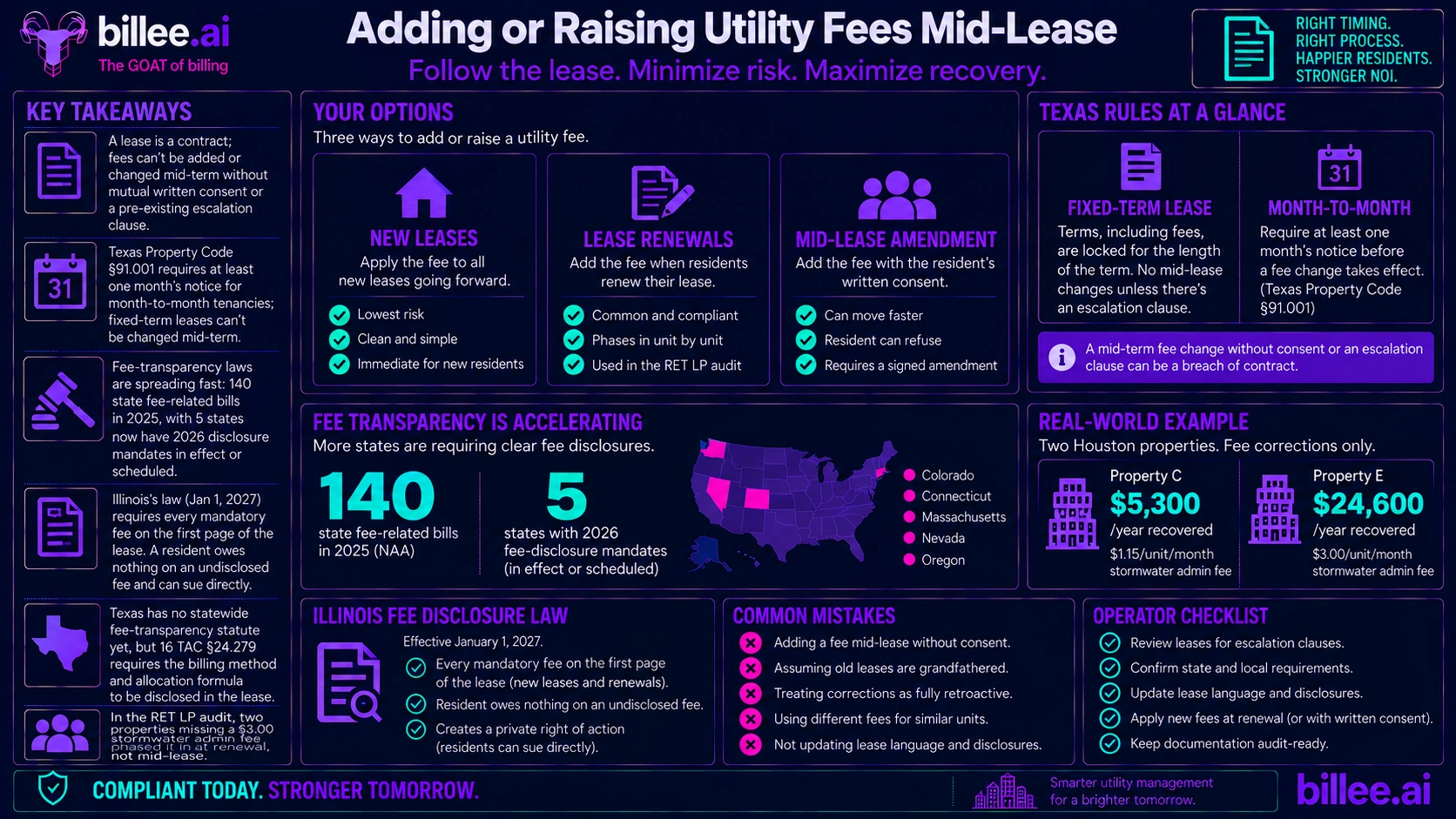
A signed lease is a contract. That means a property can't add a new utility fee, or raise an existing one, for a resident mid-term without either mutual written consent or an escalation clause that was already in the lease when both parties signed it. It sounds obvious stated plainly, but it's exactly where a recent Billee portfolio audit found two properties with a real gap to close: Property C and Property E both needed a new $3.00 stormwater admin fee added to bring billing in line with actual cost recovery. In both cases, the fee was phased in at lease renewal, not imposed mid-lease. That timing choice is the difference between a clean recovery and a breach-of-contract exposure.
Quick answer
The low-risk way to add or raise a utility fee is to apply it only to new leases and renewals, letting the change take effect unit by unit as residents sign their next lease term. A signed mid-lease amendment can move faster but needs the resident's written agreement and can be refused. Waiting for full portfolio turnover is the slowest, lowest-risk path of all. In Texas, a fixed-term lease can't have fees changed mid-term without an escalation clause already built in, and a month-to-month lease requires at least one month's notice under Property Code §91.001.
Key takeaways
- A lease is a contract; fees can't be added or changed mid-term without mutual written consent or a pre-existing escalation clause.
- Texas Property Code §91.001 requires at least one month's notice before a rent or fee change takes effect on a month-to-month tenancy; a fixed-term lease has no such notice right because no change is allowed until renewal, absent an escalation clause.
- Fee-transparency laws are spreading fast nationally. The National Apartment Association tracked 140 state fee-related bills in the 2025 legislative session alone, and five states now have 2026 disclosure mandates in effect or scheduled.
- Illinois's new fee-transparency law, effective January 1, 2027, requires every mandatory fee to appear on the first page of the lease, for new leases and renewals alike, and a resident owes nothing on a fee that wasn't disclosed there.
- Texas has no statewide fee-transparency statute yet, but 16 TAC §24.279 already requires the billing method and allocation formula for utilities to be disclosed in the lease, so a new fee has to be folded into that disclosure, not added separately.
- In the RET LP audit, both properties missing a stormwater admin fee had it phased in at lease renewal rather than applied mid-term or backbilled.
- Rolling a new fee out unevenly across otherwise comparable units in the same property creates its own consistency exposure, independent of whether the fee itself is justified.
Why this matters now
Utility and admin fee changes used to be a quiet, low-scrutiny line item. That's changing quickly. The National Apartment Association tracked 140 fee-related bills across state legislatures in the 2025 session, with roughly a third failing and the rest advancing in some form. Ten states plus Washington, D.C. now mandate some level of complete fee disclosure, and five jurisdictions (Colorado, Connecticut, Massachusetts, Nevada, and Oregon) have 2026 fee-transparency mandates either already in effect or scheduled to take effect. Texas is currently among the roughly thirty states with no statewide fee-disclosure statute, but a portfolio operating across multiple states doesn't get to run one relaxed policy and one strict one. The safer approach travels well regardless of where a property sits today.
What happens when a fee is added the wrong way is increasingly concrete, not just theoretical. Illinois's new rental fee transparency law, effective January 1, 2027, is a useful preview of where this is heading: it requires every mandatory fee to be disclosed on the first page of the lease, applies to both new leases and renewals signed on or after that date, and makes a resident not responsible for paying any mandatory fee that wasn't disclosed there. The law also creates a private right of action, meaning a resident can sue directly over an undisclosed fee rather than relying on a regulator to act. Maryland separately enacted its own water-submetering law this year (signed April 28, 2026, effective October 1, 2026), adding submetering-specific disclosure obligations to that same growing list. Texas hasn't followed yet, but the direction nationally is unmistakable, and ordinary contract law already gets an operator most of the way to the same outcome those laws require by statute.
That's really the point: "we'll add it at the next lease cycle" isn't a stalling tactic. It's the actual compliant mechanism for a mid-term fee gap, and treating it that way from the start avoids both a legal exposure and the resident friction that comes from feeling like the lease changed underneath them.
The legal principle, and how Texas treats it specifically
Fixed-term leases. A fixed-term lease locks in its terms, fees included, for the length of the term. Nothing about the rent or fee schedule can change mid-term unless the lease itself contains an escalation clause that already spells out the future change. Without one, the fee waits for the lease to come up for renewal, at which point it becomes a term of the new agreement like any other.
Month-to-month leases. These renew automatically, so Texas Property Code §91.001 governs how much notice a change needs: at least one full month before the new rate or fee takes effect. A lease can contractually shorten that notice period, or even waive it, but only through a signed written agreement between both parties, not a unilateral policy change.
Where this intersects with the PUC's lease disclosure rule. 16 TAC §24.279 already requires a Texas apartment lease to disclose the billing method and, where applicable, the specific allocation formula used for utility charges. A new or increased fee has to be reflected in that same disclosure, not bolted on as a separate notice. A property that gets the timing of the fee change right but never updates the lease language is still out of compliance on the paperwork side, even though the fee itself may be entirely justified.
Three ways operators actually handle it, and the tradeoffs
| Approach | Speed | Risk | Best for |
|---|---|---|---|
| New leases and renewals only | Slow, follows the natural turnover and renewal cycle | Lowest | Most portfolios; the approach used in the RET LP audit |
| Signed mid-lease amendment | Fast | Moderate; requires resident buy-in and can be refused | Urgent fee gaps at properties with cooperative residents |
| Wait for full portfolio turnover | Slowest | Lowest | Long-term, low-turnover resident bases where renewal cycles are infrequent |
Most operators default to the first option because it requires no resident negotiation and carries no breach risk. The tradeoff is time: a fee applied only at renewal reaches the full resident base gradually, at whatever pace the property's own turnover and renewal activity actually runs.
How to communicate the change without triggering pushback
The mechanics of timing a fee correctly solve the legal exposure. They don't automatically solve the resident-relations side, and a poorly explained fee change can generate complaints and turnover even when it's fully compliant.
A few practices make the difference in practice. Tie the change to something concrete: a resident who understands a fee reflects an actual pass-through cost, like a municipal stormwater charge or a trash hauler's rate increase, reacts differently than one who sees an unexplained new line item. Give the fee its own clearly labeled entry in the renewal paperwork rather than folding it into a broader rent adjustment, since bundling invites the assumption that rent itself went up more than it did. Keep the explanation consistent across every renewal notice at a property; residents compare notes, and an inconsistent story about why a fee exists is worse for trust than the fee itself. Finally, give leasing staff a one-line, accurate answer to "why is this new" before the notices go out, since the first resident question usually arrives within a day of the renewal offer.
None of this changes the legal requirement to apply the fee only at renewal or through a signed amendment. It changes whether that renewal conversation goes smoothly or becomes the first of several calls to the property manager.
How this actually played out in a real portfolio
The RET LP audit's own numbers make the tradeoff concrete. Property C, a Houston property, was missing both a correctly priced trash admin fee and a stormwater admin fee entirely. Billee raised the trash fee from $1.15 to $3.00 and phased in the new $3.00 stormwater fee at lease renewal, for $24.6k in combined annual savings once both corrections were in place. Property E had a similar gap alongside broken meters and an outdated allocation methodology, and used the same renewal-based approach to phase in its stormwater fee rather than applying it mid-term. Neither property backbilled residents for the missing fee or amended leases mid-term to accelerate it. The fee simply became part of every lease signed or renewed going forward.
Common mistakes
- Adding a fee mid-lease without a signed amendment. A notice letter or an email isn't a lease amendment; without the resident's written agreement, the change isn't enforceable against a fixed-term lease.
- Updating the fee but not the lease disclosure. Under §24.279, the billing method and formula disclosed in the lease has to match what's actually being charged; a fee change without a matching disclosure update leaves the paperwork out of compliance.
- Rolling the fee out inconsistently across comparable units. Applying a new fee to some renewing residents but not others in the same property, without a documented reason, creates a consistency problem that outlives the fee itself.
- Treating a policy announcement as sufficient notice. A portfolio-wide policy memo isn't the same as the individualized notice or lease term a specific resident's agreement requires.
- Assuming an escalation clause exists when it doesn't. Every fixed-term lease needs to be checked individually; assuming a standard escalation clause is present across a whole rent roll is how mid-term changes get applied where they shouldn't be.
- Backdating fee collection to when the gap was discovered. Even where some retroactive backbilling is legally available for other kinds of undercharges, a newly introduced fee that never existed in the resident's current lease term isn't something that can be applied backward at all.
What getting the timing right is worth
Because a renewal-only rollout reaches residents gradually, the value of a corrected fee builds in step with how fast a property turns over. Billee's own portfolio economics model uses a 40% average annual turnover rate as its baseline assumption. At that pace, a renewal-only rollout covers roughly 40% of units in year one, about 64% by year two, and effectively the full resident base by year three.
Consider an illustrative 300-unit property missing a $5-per-unit-per-month fee, a $18,000 annual gap once every unit is on the corrected rate. Phased in at a 40% annual turnover pace: roughly $7,200 recovered in year one, climbing to around $11,500 by year two, and the full $18,000 run rate by year three. At a 6% cap rate, that full run rate is worth roughly $300,000 in added asset value at a future sale or refinance ($18,000 ÷ 0.06). The lag isn't a flaw in the approach, it's the cost of doing it the way that avoids breach exposure entirely, and it's worth budgeting for as a multi-year ramp rather than a single-quarter fix.
How Billee can help
Billee's Regulatory & Compliance service identifies missing or outdated fees and manages the renewal-based rollout itself, including updating the lease disclosure language alongside the fee change. It's the same process that phased in stormwater fee corrections at two properties in the RET LP audit, part of the pass that recovered $220,500 across five properties in a 36-property Texas portfolio.
FAQ
Can I add a new utility fee mid-lease if I give written notice?
Not on a fixed-term lease, unless the lease already contains an escalation clause covering the change. Written notice alone isn't the same as a signed amendment or an existing contractual right to change the fee.
What's the minimum notice for a rent or fee increase in Texas?
For a month-to-month tenancy, Texas Property Code §91.001 requires at least one full month's notice before the change takes effect. Fixed-term leases have no statutory notice right for a mid-term change because none is allowed without an escalation clause.
Does an escalation clause let me skip the renewal wait?
Yes, if the clause is already written into the current lease and specifies how and when the fee can change. Without one, the fee change waits for the next lease term.
What happens if I add a fee without updating the lease disclosure?
The property is out of compliance with 16 TAC §24.279's lease disclosure requirement, separately from whether the fee amount itself is justified. Both the fee and the disclosure need to move together.
Is Texas getting a fee-transparency law like Illinois's?
Not currently. Texas has no statewide fee-disclosure statute as of this writing, though the national trend, five states with 2026 mandates and Illinois's law taking effect in 2027, suggests more states will move in that direction.
How did Billee handle this in the RET LP portfolio?
Both properties missing a stormwater admin fee had it phased in at lease renewal rather than applied mid-term, matching the same low-risk approach recommended here.
Can I apply a new fee unevenly across units to test resident reaction?
That approach creates its own consistency exposure. A documented, portfolio-wide renewal-based policy is safer than an ad hoc rollout that treats comparable residents differently without a clear, defensible reason.
Does this apply to fee increases too, or only brand-new fees?
Both. Raising an existing fee is still a change to a lease term, and the same mid-lease restrictions and renewal-based approach apply whether the fee is new or simply going up.
Related reading
- The Utility Fee Most Multifamily Operators Forget to Charge: the missing-fee problem this phase-in approach was built to solve.
- What Texas Apartment Operators Get Wrong About "TCEQ" Allocation Rules: the lease disclosure requirement that has to move together with any fee change.
- When a Legacy Utility Cap Is Quietly Costing Your Portfolio $100K a Year: another methodology gap from the same portfolio audit.
If a fee correction needs to go into leases without creating breach risk, it's worth mapping out the renewal timeline before the first notice goes out. Talk to the team.
Sources
- LegalClarity, "Texas Rent Increase Notice: Laws and Requirements," 2026.
- Public Utility Commission of Texas, "16 TAC §24.279, Disclosure in Rental Agreement," current rule.
- National Apartment Association, "Fee Transparency Mandates By The Numbers," 2026.
- KSN Law Firm, "Illinois Landlords: New Rental Fee Transparency Law Takes Effect January 1, 2027," 2026.
- Maryland General Assembly, "SB0130, 2026 Regular Session," signed April 28, 2026.
Insights and Industry Trends


Explore more insights