

What Texas Apartment Operators Get Wrong About "TCEQ" Allocation Rules
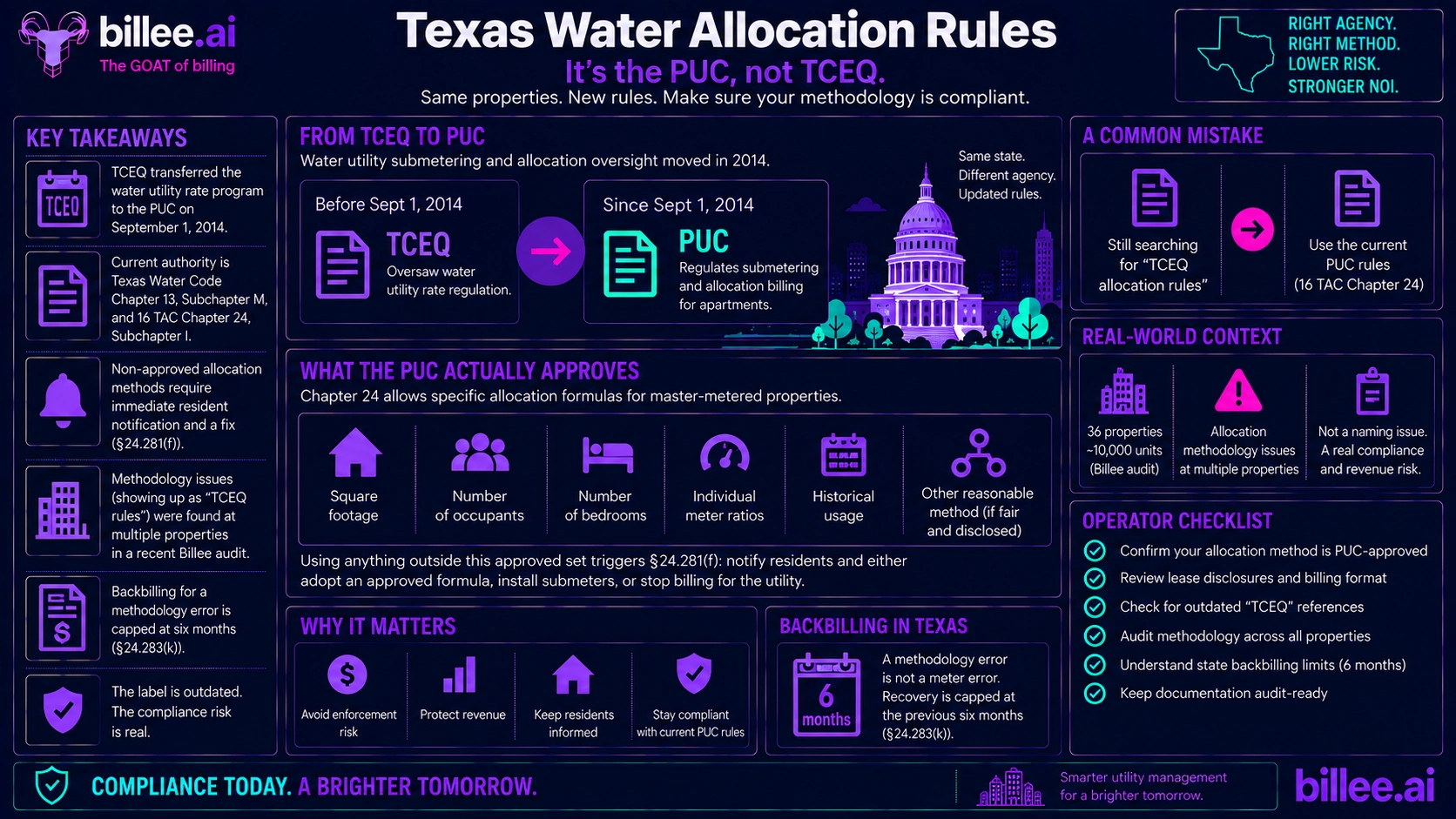
Texas apartment operators still describe their water allocation methodology as a "TCEQ" issue. It hasn't been one since September 1, 2014, the date the Texas Commission on Environmental Quality transferred the water utility rate program, including submetering and allocation oversight, to the Public Utility Commission of Texas. More than a decade later, the terminology has outlived the transfer, and it showed up in a recent Billee portfolio audit too: allocation methodologies flagged as out of step with what the audit called "TCEQ rules" were actually out of step with current PUC rules. The label is outdated. The compliance exposure behind it is not, and it runs deeper than the name on the rulebook.
Quick answer
TCEQ does not currently regulate apartment water and wastewater allocation billing in Texas. That authority sits with the Public Utility Commission of Texas (PUC), under Texas Water Code Chapter 13, Subchapter M, and 16 TAC Chapter 24, Subchapter I. The PUC's rule approves exactly five allocation formulas for master-metered properties, requires the property to register before billing residents and disclose the formula in the lease, and caps how much of an undercharge can be recovered retroactively. Getting the label right doesn't matter operationally. Getting the formula, the registration, and the lease disclosure right does.
Key takeaways
- TCEQ transferred the water utility rate program, including submetering and allocation oversight, to the PUC on September 1, 2014, per TCEQ's own site.
- Current authority is Texas Water Code Chapter 13, Subchapter M, and 16 TAC Chapter 24, Subchapter I, enforced by the PUC, not TCEQ.
- Only five allocation formulas are approved for master-metered, non-submetered billing; using a sixth triggers 16 TAC §24.281(f): immediate resident notice and a required fix.
- Billing under any formula, approved or not, also requires registering with the PUC under §24.277 and disclosing the specific formula in the lease under §24.279, paperwork that gets missed as often as the formula itself.
- A service charge added on top of the allocated utility amount is capped at 9% of that amount under §24.281.
- Correcting a stale or non-compliant methodology is capped at six months of retroactive billing under 16 TAC §24.283(k), since a methodology error is not a meter error.
- Allocation methodology issues, described with the outdated TCEQ label, turned up at multiple properties in a recent Billee portfolio audit of 36 Texas properties.
Why this matters for multifamily operators
Twelve years is a long time for outdated terminology to survive, but it has. Property management contracts, vendor documentation, and internal audit notes still reference "TCEQ rules" for water allocation, even though the agency that enforces those rules today is the PUC. That is exactly what turned up in a recent Billee audit of a 36-property, roughly 10,000-unit Texas portfolio: allocation methodology issues, described using the old TCEQ label, at multiple properties across the portfolio.
The label mismatch is not just a naming quirk. It is usually a signal that nobody has actually checked the underlying methodology against the rule that governs it today, and Chapter 24 is specific in a way that punishes that kind of drift. It doesn't leave room for "close enough": a property is either billing under one of five approved formulas or it isn't, it is either registered with the PUC or it isn't, and the lease either discloses the formula in writing or it doesn't.
The stakes of getting any one of those three wrong are the same: an allocation method the PUC hasn't approved isn't a gray area to clean up at the next lease cycle. It requires immediate resident notice and a fix, and a missing registration or disclosure is its own separate compliance gap, one that can exist even at a property using a perfectly approved formula.
Who actually regulates this now, and what changed in 2014
TCEQ historically oversaw water utility rate regulation in Texas, which is why the terminology took hold. On September 1, 2014, TCEQ transferred that program, along with the sale, transfer, and merger program and the certificate of convenience and necessity program, to the PUC. Water utility submetering and allocation billing for apartments has been a PUC matter since, under Texas Water Code Chapter 13, Subchapter M, and the PUC's own substantive rules at 16 TAC Chapter 24, Subchapter I. None of it runs through TCEQ anymore, and nothing in the current rule references TCEQ at all.
The five formulas the PUC actually approves, and what happens if you use a sixth
Chapter 24 does not leave allocation methodology open-ended. For a master-metered property that isn't submetering water or wastewater, §24.281(e)(2)(A) approves exactly five formulas for splitting a retail utility bill among residents:
| # | Formula | How it works |
|---|---|---|
| 1 | Occupancy ratio | Bill split in proportion to the number of occupants per unit versus total occupants at the property. |
| 2 | Weighted occupancy formula | A tiered weighting by occupant count (roughly 1.0 for one occupant, 1.6 for two, 2.2 for three, and so on), rather than a flat per-occupant split. |
| 3 | Bedroom-based formula | Bill split by the number of bedrooms per unit relative to total bedrooms at the property. |
| 4 | Combined square footage and occupancy | A blend of unit square footage and occupancy, with square footage capped at no more than 50% of the total weighting. |
| 5 | Submetered hot/cold water usage ratio | Allocation based on actual submetered usage ratios, where partial submetering exists. |
A handful of additional formula variants exist for manufactured-home communities and condominium-style ownership, along with specific rules for deducting irrigation or common-area usage before allocating the remainder; those edge cases are outside the scope of what most conventional multifamily properties need, and Billee's Texas PUC Chapter 24 Compliance Guide covers them in full.
What matters for most operators is simpler: if a property's methodology isn't one of these five, §24.281(f) applies. The property must notify residents immediately, in writing, and then do one of three things: adopt an approved formula, install submeters, or stop billing residents for that utility entirely. There is no grandfather clause. A formula that has been in continuous use since before the current rule took effect gets no exemption; the obligation to fix it exists the moment it's identified, not at the next lease renewal or the next rate review.
On top of the formula itself, §24.281 also caps the service charge a property can add on top of the allocated utility amount at 9% of that amount. A service charge above that cap is its own separate violation, independent of whether the underlying allocation formula is compliant.
The paperwork requirements operators often skip
Even a property using a fully compliant formula can still be out of compliance on paperwork, and this is where "TCEQ" thinking tends to cause the most damage, because operators who believe they're dealing with an environmental-agency technicality rarely realize there's a registration and disclosure requirement attached to it at all.
Registration, under §24.277. A property must register with the PUC before it starts billing residents for submetered or allocated utility service, and it must register again any time the billing methodology changes. Registration isn't a one-time formality either: the property has to keep records of its allocation formula, occupancy factors, submeter readings where applicable, the underlying retail utility bills, and monthly revenue collected, for the current calendar year and the prior one (submeter test results get kept even longer, until the meter is retired). If the PUC or a resident requests those records, the property has a production window measured in days, not weeks, generally three to thirty days depending on whether the property has on-site management.
Lease disclosure, under §24.279. The rental agreement itself has to disclose, in writing, the billing method being used, exactly what services are included, the dispute-resolution process available to a resident who thinks their bill is wrong, historical billing data (the average, high, and low month from the prior year), the specific allocation formula if the property isn't submetering, meter-reading and billing and due dates, the timeframe for leak repairs, the resident's right to verify their own bill, and the applicable service-charge percentage. It also has to include, or make available, a copy of the Subchapter I rules themselves.
A property can be using an entirely approved formula, correctly calculated, and still be out of compliance simply because none of this made it into the lease or the PUC registration. That gap is easy to miss precisely because it doesn't show up in a monthly bill review. It only shows up when someone checks the lease language and the PUC filing against the current rule, line by line.
How much you can actually recover, and why timing matters
Finding an outdated or non-approved methodology is one problem. Fixing it forward is straightforward: adopt an approved formula, update the lease disclosures, and re-register with the PUC. Recovering what was undercharged in the past is a separate, narrower question, and it's where the meter-error distinction that governs Texas backbilling actually matters.
Under §24.283(k), an owner can adjust a resident's bill for an undercharge going back six months, but only when the undercharge wasn't caused by submeter or point-of-use submeter error. A stale or non-compliant allocation methodology is exactly that kind of ordinary, non-meter-error undercharge: it's a paperwork and formula problem, not a hardware failure. That means the six-month cap applies in full. A property that has been under-collecting for years because it used a formula the PUC never approved can correct the rate going forward and recover roughly six months of the shortfall, but not the full multi-year gap. The corrected, compliant rate going forward is where the durable recovery actually comes from, not a retroactive lump sum.
This is a meaningfully different outcome than a broken submeter produces. A hardware failure that undercounts usage is explicitly exempt from that six-month cap, because the cause is the meter itself, not the formula. Billee's companion piece on submeter ROI covers that distinction in more detail. The practical takeaway for a methodology fix specifically: budget for a modest one-time catch-up, and plan for the real value to show up in every bill from the correction forward.
What getting this right is worth beyond the monthly bill
The go-forward value of a methodology correction compounds the same way any other recovered NOI does. Consider an illustrative 250-unit property currently billing under a non-compliant, outdated formula that's under-collecting relative to an approved formula by roughly $10 per unit per month, a modest, easily overlooked gap. Corrected, that's $2,500 a month, or $30,000 a year, in additional recovered NOI.
Applying a 6% cap rate, a common though market-dependent benchmark ($30,000 ÷ 0.06), that recovery is worth roughly $500,000 in added asset value at a future sale or refinance, on top of the annual cash flow itself. The exact multiple varies by market and asset class, but the mechanism doesn't: a corrected allocation formula isn't just a bookkeeping fix. It shows up twice, once in monthly cash flow and again in how the property is valued the next time it trades.
Common mistakes
- Still searching for "TCEQ allocation rules" instead of the current PUC rule. The agency changed in 2014; the rule that actually governs the property today is 16 TAC Chapter 24, Subchapter I, enforced by the PUC.
- Assuming an old, non-approved formula is grandfathered in. The rule does not include a grandfather clause; §24.281(f) requires immediate resident notice and a fix regardless of how long the method has been in use.
- Fixing the formula but not the paperwork. A compliant allocation formula doesn't satisfy §24.277 registration or §24.279 lease disclosure on its own; those are separate, independently enforceable requirements.
- Treating a corrected methodology as fully retroactive. Backbilling limits under §24.283(k) mean the corrected go-forward rate, not a multi-year lump sum, is usually the realistic recovery.
- Missing the 9% service-charge cap. A service charge that exceeds 9% of the allocated utility amount is its own violation, separate from whether the underlying formula is approved.
- Mixing formulas inconsistently across similar properties in a portfolio. A method that is compliant at one property but different at a comparable one is a sign nobody has checked the full portfolio against the current rule at once.
How Billee can help
Billee's Regulatory & Compliance service audits allocation methodology, PUC registration, and lease disclosure language against current rules, not outdated TCEQ terminology, property by property. It's part of the same audit process that recovered $220,500 across five properties in a single pass of a 36-property Texas portfolio.
FAQ
Does TCEQ regulate apartment water and wastewater billing in Texas?
No, not since September 1, 2014. That authority now sits with the Public Utility Commission of Texas, under Texas Water Code Chapter 13, Subchapter M, and 16 TAC Chapter 24, Subchapter I.
What happens if my property uses a non-approved allocation formula?
The property has to notify residents immediately, in writing, and then either adopt an approved formula, install submeters, or stop billing residents for that utility, under §24.281(f). There is no grandfather clause for a formula that has been in long-term use.
What are the five allocation formulas the PUC actually approves?
For master-metered, non-submetered properties: occupancy ratio, weighted occupancy, bedroom-based, combined square footage and occupancy (capped at 50% square-footage weight), and a submetered hot/cold usage ratio where partial submetering exists. Manufactured-home and condominium properties have additional approved variants.
Does my property need to register with the PUC before billing residents for allocated utilities?
Yes. §24.277 requires registration before billing starts, and again any time the methodology changes, along with recordkeeping on the formula, occupancy factors, submeter readings, retail bills, and revenue for the current and prior calendar year.
What does the lease need to disclose if we bill residents for allocated utilities?
Under §24.279: the billing method, services included, the dispute-resolution process, historical billing data, the specific formula if not submetering, meter-reading and billing dates, leak-repair timeframes, the resident's right to verify their bill, the service-charge percentage, and access to the Subchapter I rules themselves.
Can I bill residents for the years an outdated or non-approved formula was used?
Usually not in full. A methodology correction is not a meter error, so the standard six-month backbilling cap under §24.283(k) applies, meaning the corrected go-forward rate is typically the realistic recovery.
Is there a cap on the service charge added to a resident's utility bill?
Yes. §24.281 caps the service charge at 9% of the allocated utility amount, separately from whether the underlying allocation formula itself is approved.
How is this different from a broken submeter causing under- or overbilling?
A broken submeter is a hardware failure, which is explicitly exempt from the six-month backbilling cap under §24.283(k). A methodology or paperwork issue is treated as an ordinary undercharge, so the six-month cap applies. Billee's submeter ROI article covers the meter-error case in detail.
How does Billee catch methodology and paperwork issues like this?
Billee's Regulatory & Compliance service checks allocation methodology, PUC registration status, and lease disclosure language against current rules, property by property, the same process used in Billee's RET LP portfolio audit.
Related reading
- Texas PUC Chapter 24 Compliance Guide: the complete rule-by-rule reference for registration, disclosures, every approved formula variant, and meter standards.
- When a Legacy Utility Cap Is Quietly Costing Your Portfolio $100K a Year: another methodology gap from the same portfolio audit.
- The Real Return on Replacing a Broken Submeter: the meter-error side of the backbilling rule covered here.
- The Utility Fee Most Multifamily Operators Forget to Charge: a companion piece on another silent billing gap from the same audit.
If an allocation methodology, registration, or lease disclosure hasn't been checked against current PUC rules in a while, it's worth finding out where it actually stands. Talk to the team.
Sources
- Texas Commission on Environmental Quality, "Water," accessed 2026.
- Public Utility Commission of Texas, "16 TAC §24.277, Registration Requirements and Notice to the Commission," current rule.
- Public Utility Commission of Texas, "16 TAC §24.279, Disclosure in Rental Agreement," current rule.
- Public Utility Commission of Texas, "16 TAC §24.281, Charges and Calculations," current rule.
- Public Utility Commission of Texas, "16 TAC §24.283, Billing," current rule.
Insights and Industry Trends


Explore more insights