

The Real Return on Replacing a Broken Submeter
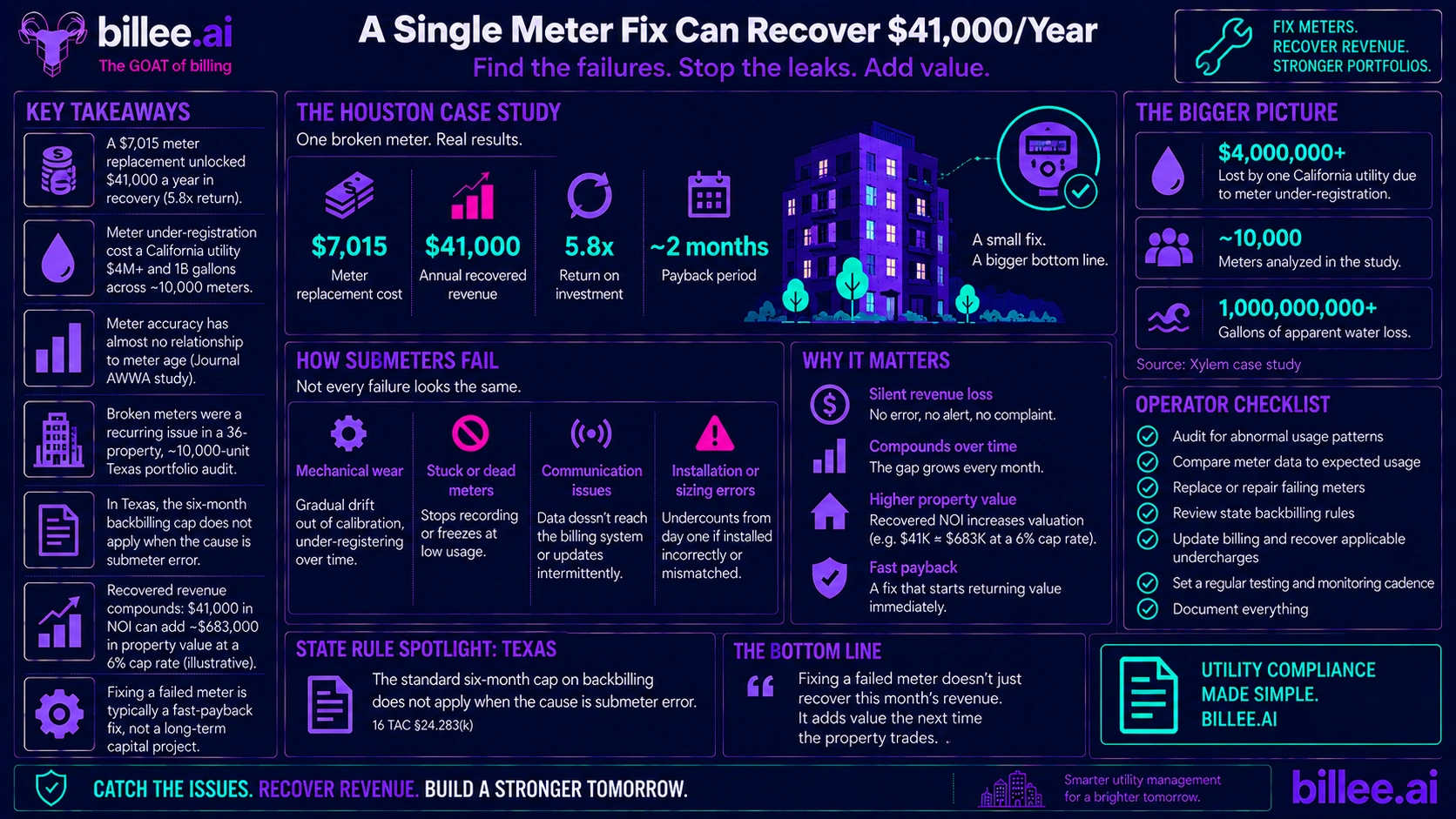
A broken submeter does not throw an error. It just keeps running, quietly under-counting usage every billing cycle, while the resident's bill and the property's recovered revenue both fall further behind actual cost. At one Houston property, replacing a single failed meter for $7,015 unlocked $41,000 a year in previously missed recovery, a return of roughly 5.8 times the repair cost, paid back in about two months, found during a routine Billee portfolio audit. The math is straightforward once a failed meter is caught. The harder part is catching it, and knowing how much of that lost recovery is still collectible once it is.
Quick answer
Replacing a broken submeter is one of the fastest-payback fixes in a utility billing audit, because the lost revenue was already happening before the fix. Correcting it does not create new revenue so much as it stops losing revenue that was already there. In the case above, the repair paid for itself in about two months, and every month after that is recovery the property was not previously collecting. How much of the past undercharge can also be recovered depends on state and local rules, which is a separate question from the fix itself.
Key takeaways
- A $7,015 meter replacement at one Houston property unlocked $41,000 a year in previously missed recovery, about a 5.8x return, per a Billee portfolio audit.
- Meter under-registration alone cost a mid-sized California utility more than $4 million in historical revenue and over 1 billion gallons of apparent water loss across roughly 10,000 meters, per Xylem.
- Meter accuracy has almost no statistical relationship to meter age: a peer-reviewed Journal AWWA study found some meters fail within a few years while others hold accuracy for 20 to 30 years.
- Broken or malfunctioning meters undercounting usage were a recurring issue across a 36-property, roughly 10,000-unit Texas portfolio Billee audited.
- In Texas, the standard six-month cap on backbilling a resident for an undercharge does not apply when the cause is submeter error, unlike most other billing mistakes, per 16 TAC §24.283(k).
- Recovered revenue compounds: at a 6% cap rate, for illustration, $41,000 in recovered annual NOI is worth roughly $683,000 in added property value using the standard NOI-to-value relationship.
- Because the loss is already happening before anyone notices, fixing a failed meter is typically a fast-payback fix, not a long-term capital project.
Why this matters for multifamily operators
A submeter that under-counts usage does not generate a billing error in the usual sense. Nothing looks wrong on the statement, the meter just reports less than what actually flowed. That gap becomes lost recovery every month, and it compounds silently because nothing about the process flags it: no late notice, no resident dispute, no red line on a report.
At scale, that gap gets large. One utility with roughly 10,000 meters lost more than $4 million in historical revenue to meter under-registration, caught only after analyzing consumption patterns for anomalies rather than through routine testing. A multifamily portfolio with broken meters scattered across dozens of properties is exposed to the same dynamic, just distributed across smaller, easier-to-miss losses that add up the same way once someone actually looks.
What a fixed meter is worth beyond the monthly bill
Recovered utility revenue does not just improve next month's cash flow. It also raises the property's valuation, because NOI is the number buyers and lenders use to price the asset. The relationship is simple: value equals NOI divided by the cap rate, so a dollar of recovered NOI is worth more than a dollar the moment the property is appraised or sold.
For illustration, applying a hypothetical 6% cap rate, a common reference point for stabilized multifamily assets, to the $41,000 in annual NOI recovered from the Houston meter fix works out to roughly $683,000 in added property value. That is not a guaranteed appraisal outcome, cap rates vary by market and asset condition, but it shows why a $7,015 repair is worth more than the $41,000 a year it recovers on its own. As the case study behind these numbers puts it, recovered NOI shows up twice: once in monthly cash flow, and again the next time the property trades.
How submeters actually fail
Not every failure looks the same, which is part of why they go unnoticed for so long.
- Mechanical wear. Older mechanical, positive-displacement meters can drift out of calibration gradually as internal components wear, under-registering by a growing margin over months or years without ever fully stopping.
- Stuck or dead meters. A meter can fail outright and report flat or zero usage regardless of what is actually flowing through it, which is often the easiest failure to catch once someone is looking.
- Communication failures on remote-read systems. A meter with a wireless read transmitter can have a dead battery or a failed communication module while the physical meter itself still works. The property keeps receiving a report, it just freezes at whatever the last successful read was, which looks identical to a unit with genuinely low usage.
- Physical damage. Freeze damage, corrosion, and installation issues can all affect accuracy in ways that a routine visual inspection will not catch without an actual usage comparison.
How to tell if a submeter is costing you money
A few signs are worth checking before assuming a meter is fine:
- A unit's usage reads flat or near zero for a period when the unit is occupied.
- Usage does not move with occupancy changes the way comparable units do.
- One unit's reads are consistently far outside the range of similar units in the same building.
- A meter has not been tested or verified since installation or the last known service event.
- A remote-read meter has not reported a changed value in more than one billing cycle.
| Cost | Recovery once fixed | Payback period | |
|---|---|---|---|
| Example (Houston property) | $7,015 meter replacement | $41,000/year previously missed | About 2 months |
How to calculate the real return before you replace one
- Establish a reasonable usage baseline for a comparable occupied unit. As a rough reference point, the average American uses about 82 gallons of water a day at home, per USGS/EPA WaterSense, which a two-person unit would put at roughly 4,900 gallons a month.
- Compare the flagged meter's actual reads against that baseline. A unit reading a small fraction of that, with no vacancy or known behavior change to explain it, is a strong candidate for a failed meter rather than genuinely low usage.
- Convert the gap into a dollar figure at the property's current utility rate to estimate the ongoing monthly and annual loss.
- Compare the annualized recovery against the replacement cost to get a payback period, as in the table above.
- Treat anything under a year's payback as a candidate to act on now, not batch into a future capital cycle, since every month of delay is a month of recovery that stays lost.
How much you can actually recover, and why timing matters
Fixing the meter stops the bleeding going forward. Whether a property can also recover the past undercharge depends on state and local rules, and those rules do not always treat a meter-caused error the same as an ordinary billing mistake.
In Texas, for example, the standard rule caps backbilling a resident for most undercharges at the previous six months of bills. But that specific cap, under 16 TAC §24.283(k), explicitly does not apply when the undercharge was caused by submeter error, which is exactly the scenario a failed meter creates. That distinction matters: a broken meter is not automatically capped at the same six-month window as a data-entry mistake or a rate error, though other legal and lease-specific limits can still apply, and it is worth confirming the current rule and any lease notice requirements before assuming how far back a correction can reach.
This is also why the payback math in the table above focuses on the ongoing annual recovery rather than a lump-sum backbill. The ongoing recovery is certain once the meter is fixed. Recovering the historical undercharge is a separate, rule-dependent question worth pursuing, but not one to count on before confirming what applies.
Common mistakes
- Assuming a meter's age tells you whether it is accurate. Age and performance are barely correlated, so a five-year-old meter can fail while a twenty-year-old one still reads correctly, which means age-based testing schedules alone will miss real failures.
- Treating one failed meter as an isolated incident. A batch of meters installed at the same time, or a specific model with a known weak point, can fail in a cluster, so it is worth checking comparable units and vintages once one failure turns up.
- Replacing the hardware without checking the allocation methodology behind it. A new meter reading correctly still bills incorrectly if the allocation formula behind it is out of date, which leaves part of the recovery on the table even after the physical fix.
- Delaying replacement because the repair looks like a capital expense. The real comparison is not the repair cost in isolation, it is the repair cost against the recovery already being lost every month the meter keeps running broken.
- Relying on a resident complaint to surface a failed meter. A complaint only catches the failures loud enough to notice, typically a meter reading too high, while a meter reading too low in the property's favor rarely generates one at all.
- Assuming the historical undercharge is either fully recoverable or not worth pursuing. Neither assumption is safe without checking the applicable backbilling rule first.
When to handle this in-house vs. bring in a partner
A single flagged meter with an obvious usage anomaly is often manageable in-house: confirm the read against a comparable unit, schedule the replacement, and verify the corrected reads the next cycle. Most property teams can run that process for one or two known issues without outside help.
Finding every failed meter across a multi-property portfolio is the harder problem. It requires comparing usage patterns across hundreds or thousands of units on a rolling basis, not just responding to the ones that happen to generate a complaint, plus confirming the allocation methodology behind each fix and tracking which jurisdiction's backbilling rules apply to each property. That is a systematic, ongoing review most property teams are not staffed to run continuously alongside everything else on their plate.
How Billee can help
Billee's Meter Monitoring & Proactive Alerts service reviews usage patterns across the portfolio on an ongoing basis, flagging meters showing flat, zero, or anomalous reads before they quietly cost a full billing cycle, rather than waiting for a resident complaint or an annual review to catch them. Regulatory & Compliance then checks the allocation methodology and the applicable backbilling rules behind each fix, so a hardware repair does not leave a second issue in place or miss recoverable history the rules actually allow.
That combination is what surfaced the $7,015-to-$41,000 recovery on the Houston property, one fix among $220,500 recovered across five properties in a single audit pass of a 36-property Texas portfolio. Billee's account team then tracks each fix through to the next billing cycle and puts the change on the portfolio dashboard, so it shows up in recovered revenue instead of staying an open item on a list.
FAQ
How do I know if a submeter is broken or just inaccurate?
Compare its reads against occupancy and against similar units. A meter reading flat or near zero for an occupied unit, or one that has not reported a changed value in over a billing cycle, is worth testing.
How much does replacing a failed submeter typically cost?
It varies by meter type and property. In one documented case, a full replacement cost $7,015 and unlocked $41,000 a year in previously missed recovery, a return of roughly 5.8 times the repair cost.
What kind of return can I expect from fixing a broken meter?
Returns vary by how large the undercount was and how long it ran, but because the lost revenue was already happening, payback tends to be fast. The Houston example paid for itself in about two months.
Should meter age determine when I replace a meter?
Not on its own. A Journal AWWA study found little statistical relationship between meter age and accuracy, so age-based replacement schedules alone will miss failures in newer meters and unnecessarily flag older ones that are still performing fine.
Do I need to test every meter at a property, or just the one that looks wrong?
Start with the anomaly, but check comparable units and vintages nearby. A failure pattern at one unit sometimes points to a batch or model-specific issue affecting others installed around the same time.
Does replacing the meter also fix the billing if the allocation methodology is wrong?
Not by itself. A failed meter and an outdated allocation methodology are separate problems that often show up together, and both need correcting to capture the full recovery available.
Can I bill a resident for the usage a broken meter missed in the past?
It depends on the applicable rule. In Texas, for example, the standard six-month backbilling cap does not apply specifically when the cause is submeter error, but confirming the current rule and any lease requirements before assuming a lookback period is worth doing case by case.
Does fixing a meter affect anything beyond the monthly utility bill?
Yes. Recovered utility revenue adds to NOI, and NOI drives the property's valuation, so a fixed meter's benefit shows up in both monthly cash flow and the property's value at a future sale or refinance.
How does Billee catch failed meters like this?
Billee's Meter Monitoring & Proactive Alerts service reviews usage patterns across the portfolio on an ongoing basis to flag anomalies like flat or out-of-range reads, the same process that surfaced the Houston property's meter failure during a routine audit.
Related reading
- The Real Cost of Uncalibrated Meters: how meter accuracy issues extend beyond full failures.
- State Rules on Submeter Accuracy: what regulations require for meter testing and calibration.
- In-House vs. Outsourced Meter Maintenance: weighing who should own ongoing meter upkeep.
- When a Legacy Utility Cap Is Quietly Costing Your Portfolio $100K a Year: a companion piece on another silent billing gap from the same portfolio audit.
Billee's Meter Monitoring & Proactive Alerts service flags failed and anomalous meters before they cost a full billing cycle. Talk to the team if a portfolio-wide check is worth running.
Sources
- Xylem, "Optimizing Water Meter Accuracy: A Data-Driven Approach to Revenue Recovery," accessed 2026.
- D. Stoker et al., "Flow Measurement Accuracies of In-Service Residential Water Meters," Journal AWWA, 2012.
- Public Utility Commission of Texas, "16 TAC §24.283, Billing (Water Utility Submetering and Allocation)," current rule.
- United States Geological Survey / U.S. Environmental Protection Agency WaterSense, "Statistics and Facts," accessed 2026.
Insights and Industry Trends



Explore more insights