

When a Legacy Utility Cap Is Quietly Costing Your Portfolio $100K a Year
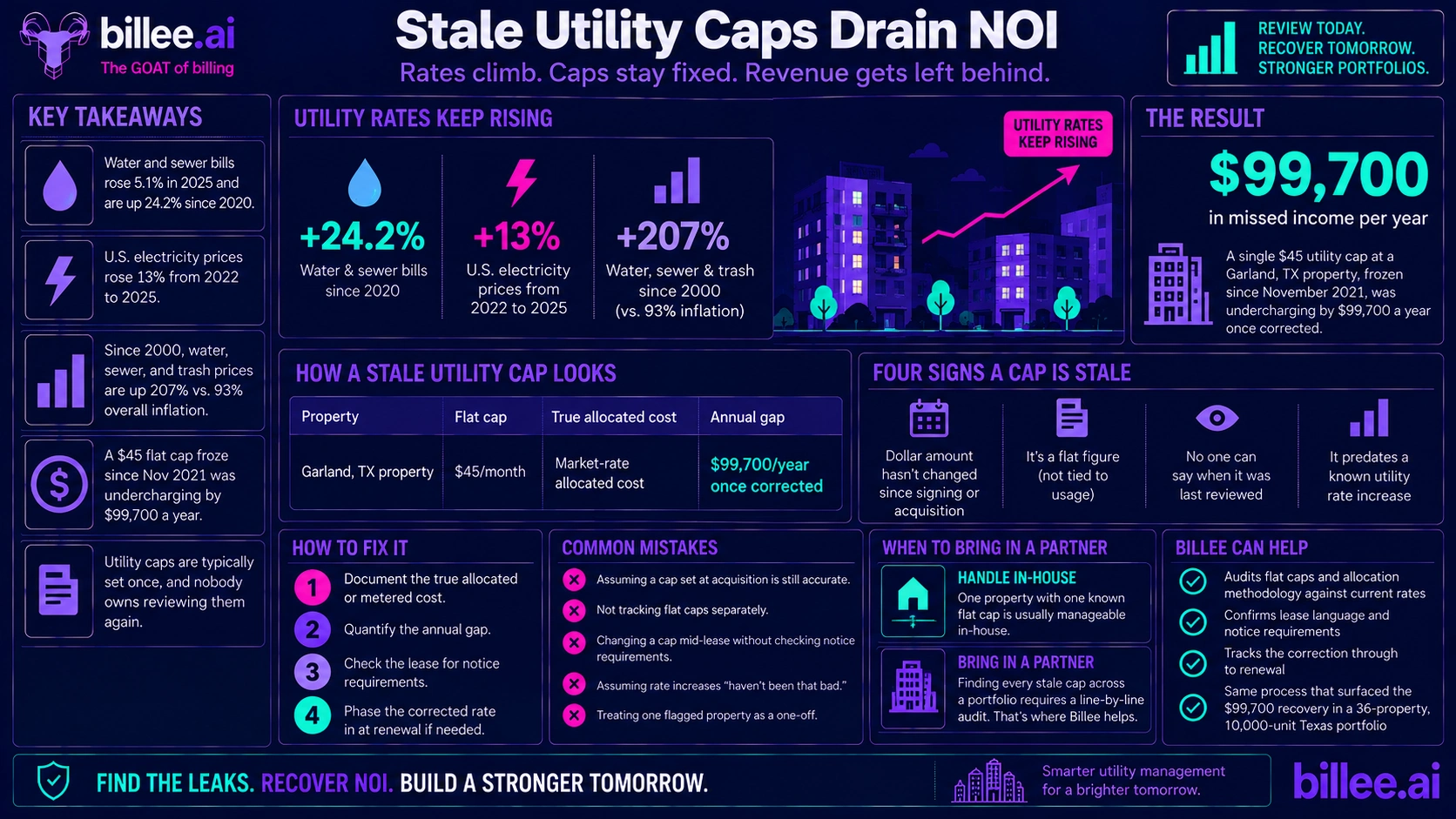
A flat utility cap set years ago, at acquisition or at lease signing, stays fixed in dollar terms while water, sewer, and electricity rates keep climbing. National water and sewer bills are up 24.2% since 2020, and electricity prices are up 13% since 2022. A cap frozen since then is almost certainly undercharging today. In one audited Texas property, a single $45 flat utility cap frozen since November 2021 was recovering $99,700 a year in missed income once corrected, one line item Billee found during a routine portfolio audit. Correcting the rate matters on its own. Recovering what the cap already missed is a separate, more limited question.
Quick answer
A legacy utility cap is a flat dollar amount a lease sets for a resident's utility charge, meant to stand in for metered or allocated usage. The problem is that caps get set once and then almost never get revisited, while the underlying utility rate keeps rising every year. The gap between what the cap charges and what the utility actually costs becomes pure, invisible margin loss. It doesn't show up as a billing error in the usual sense: nothing is wrong with the bill, the number on it is just years out of date. Fixing the rate going forward is straightforward. Recovering the historical gap depends on rules that vary by state and are often more limited than the annual number suggests.
Key takeaways
- Water and sewer bills rose 5.1% nationally in 2025 alone, a five-year high, and are up 24.2% since 2020, per Bluefield Research.
- U.S. electricity prices rose 13% from 2022 to 2025 and continue outpacing inflation, per the EIA.
- Since 2000, water, sewer, and trash prices are up 207% against 93% overall inflation, more than double the general cost of living.
- A flat $45 utility cap frozen since November 2021 was undercharging by $99,700 a year once corrected, found during a Billee portfolio audit.
- Recovered NOI compounds into value: at a 6% cap rate, for illustration, $99,700 in recovered annual NOI is worth roughly $1.66 million in added property value.
- In Texas, backbilling a resident for a non-meter-related undercharge, which a stale flat cap is, is capped at the previous six months of bills, per 16 TAC §24.283(k). The real prize is the corrected go-forward rate, not a large lump-sum backbill.
- Utility caps are typically set once, and nobody on the team owns reviewing them again.
Why this matters for multifamily operators
A flat cap set before the rate increases in the key takeaways above hasn't moved at all since. Every year the rate climbs and the cap stays still, the gap between them gets wider, and none of it shows up as an error on a monthly billing report. It behaves less like a mistake and more like a form of loss to lease, the same underwriting concept operators already track for rent, except almost nobody tracks it for utility caps the same way.
That's exactly what turned up in a recent Billee audit of a 36-property, roughly 10,000-unit Texas portfolio. One building at a Garland, TX property was still running under a $45 flat cap set in November 2021. Correcting it alone recovered $99,700 a year, the largest single fix out of five properties audited in that pass. It wasn't found because a resident complained. It surfaced because someone finally checked.
Because a stale cap never generates a dispute (residents have no reason to flag a charge that is too low), the only way to catch one is to actively compare it against current rates. Left alone, the gap does not stabilize. It widens every year rates rise, which the takeaways above show has been a persistent, multi-year trend rather than a one-time spike.
Where legacy caps typically come from
Flat caps rarely get set carelessly. They usually make sense at the moment they are created, and then outlive the reasoning behind them.
- Inherited at acquisition. A cap baked into leases by a prior owner rarely gets re-underwritten line by line during due diligence, so it carries forward unchanged into the new ownership's rent roll.
- Set as a leasing concession. A capped utility charge offered to close a lease during a soft leasing period can quietly become the standard term for that unit type long after the market conditions that justified it are gone.
- Copied into master lease templates. Once a cap amount is written into a property's standard lease template, it tends to get reused for every renewal and new lease without anyone revisiting the number itself.
- Left alone in markets sensitive to rent-like charges. In markets where operators are cautious about raising resident-facing charges, a utility cap can get treated like rent, left untouched out of an abundance of caution even though it isn't subject to the same constraints.
How to spot a stale utility cap
A quick way to see the exposure is to compare what the cap charges against what the metered or allocated cost would actually be for the same usage, and to see how that gap compounds the longer a cap goes unreviewed.
| Years since last review | Illustrative rate increase | Cap still charges | Growing exposure |
|---|---|---|---|
| 1 year | ~5% | Unchanged | Small, easy to miss |
| 3 years | ~15-20% | Unchanged | Material, still easy to miss |
| 5 years (the Garland, TX example) | ~24%+ | $45/month | $99,700/year once corrected |
Four signs a cap is worth checking:
- The dollar amount hasn't changed since the lease was signed or since acquisition.
- It's a flat figure rather than tied to metered or allocated usage.
- No one on the team can say when it was last reviewed.
- It predates a utility rate increase you know happened in that market.
What to do once you find one
- Document the true allocated or metered cost for the same unit or building.
- Quantify the annual gap between that cost and what the cap currently charges.
- Check the lease for notice requirements before changing anything mid-term.
- Confirm how far back, if at all, the historical undercharge can be recovered under the applicable state and local rules before assuming the full annual gap is collectible retroactively.
- Phase the corrected rate in at renewal if the lease doesn't allow a mid-term change.
How much you can actually recover, and why timing matters
The $99,700 figure is the annual value of correcting the rate, not necessarily the size of a one-time recovery for years already passed. Those are two different numbers, and conflating them oversells what a fix is worth in year one.
In Texas, the standard rule caps backbilling a resident for most undercharges, including a stale flat cap that was never adjusted, at the previous six months of bills, per 16 TAC §24.283(k). That cap applies here because a stale utility cap is not a submeter error, it's an outdated rate, which the rule treats differently from a meter malfunction. In practice, that means a cap frozen since 2021 is not going to yield five years of backdated recovery. It yields, at most, a few months of catch-up plus the full corrected rate from that point forward.
That is still a real number. Recovering $99,700 a year going forward, every year, from a single line item is the actual prize, and it compounds the same way any corrected rate does. It is just a different number than "five years of missed charges," and it's worth being precise about which one a portfolio is actually pursuing before promising a number upstream.
What a corrected cap is worth beyond the monthly bill
Correcting a stale cap does not just improve next month's cash flow. It raises NOI permanently, and NOI is the number buyers and lenders use to price the asset at refinance or sale. The relationship is simple: value equals NOI divided by the cap rate, so a dollar of corrected, recurring NOI is worth a multiple of itself the moment the property is appraised.
For illustration, applying a hypothetical 6% cap rate, a common reference point for stabilized multifamily assets, to the $99,700 in annual NOI recovered from the Garland, TX correction works out to roughly $1.66 million in added property value. Cap rates vary by market and asset condition, so this is illustrative rather than a guaranteed appraisal outcome, but it is why a single stale cap is worth finding. As the case study behind these numbers puts it, recovered NOI shows up twice: once in monthly cash flow, and again the next time the property trades.
Common mistakes
- Assuming a cap set at acquisition is still accurate years later. Nobody re-underwrites a flat charge the way they re-underwrite rent, so it can go a decade without a second look unless someone deliberately checks it.
- Not tracking flat caps separately from RUBS or submeter allocations. When a portfolio system lumps every billing method together, a flat cap never surfaces on its own in a routine review the way an allocation error might.
- Changing a cap mid-lease without confirming notice requirements. Most leases require advance notice or limit mid-term changes entirely, and skipping that step can turn a legitimate correction into a dispute.
- Assuming rate increases "haven't been that bad." The multi-year trend in the key takeaways above shows sustained, compounding increases, not a one-time bump, so the actual numbers for that market are worth pulling before assuming the gap is small.
- Treating one flagged property as a one-off. A cap set by the same prior owner or the same lease template tends to repeat across a portfolio, so one find is a reason to check the rest, not a reason to consider the issue closed.
- Assuming the full annual gap is recoverable retroactively. Backbilling limits mean the corrected go-forward rate, not a multi-year lump sum, is usually the realistic prize.
When to handle this in-house vs. bring in a partner
One property with one known flat cap is usually manageable in-house: pull the lease, check the true cost, confirm notice requirements, and correct it at renewal. A single, well-documented fix does not require much beyond someone actually doing it.
Finding every stale cap across a portfolio nobody has fully re-audited in years is the harder problem. It means a line-by-line review across every lease and every property, cross-checked against current utility rates and against whatever backbilling rules apply in each jurisdiction, something that doesn't happen without someone dedicated to running it on an ongoing basis rather than as a one-time project.
How Billee can help
Billee's Regulatory & Compliance service audits flat caps and allocation methodology against current rates, property by property, and checks the backbilling rules that apply before promising a recovery number that isn't actually collectible. It's how the $99,700 recovery on the Garland, TX property surfaced, one fix among $220,500 recovered across five properties in a single pass of a 36-property Texas portfolio.
Billee's account team then tracks the correction through to renewal and puts it on the portfolio dashboard, so a fix found today doesn't quietly go stale again in another four years, and so the team can see which of the recovered dollars are going-forward rate corrections versus recovered historical undercharges.
FAQ
What is a utility cap in a multifamily lease?
A flat dollar amount a lease sets for a resident's utility charge, used instead of billing the metered or allocated usage directly.
Why would a utility cap become outdated?
Caps are usually set once, at acquisition or lease signing, while utility rates keep rising every year after. Nobody typically owns re-checking it, and nothing about the billing process flags the gap on its own.
How much revenue can a stale utility cap cost a property?
It depends on the size of the gap and how long the cap has gone unreviewed. One audited property was undercharging by $99,700 a year on a single cap frozen since 2021, though how much of that is recoverable retroactively depends on backbilling rules.
Can I change a utility cap mid-lease?
Only if the lease allows it and proper notice is given. Most operators correct a stale cap at renewal instead of mid-term to avoid a dispute over notice requirements.
Is a utility cap the same as a RUBS allocation?
No. RUBS allocates actual utility costs across residents using a formula. A flat cap is a fixed dollar amount that doesn't move with usage or rates at all, which is exactly why it goes stale.
How do I find out if my properties have legacy utility caps?
Check for flat dollar utility charges that haven't changed since signing or acquisition, then compare them against the current metered or allocated cost for the same usage.
Can I recover the full amount a stale cap has undercharged since it was set?
Usually not in full. In Texas, for example, backbilling a resident for this kind of non-meter-related undercharge is capped at the previous six months of bills, so the corrected go-forward rate, not a multi-year lump sum, is typically the realistic recovery.
Does correcting a stale cap affect property value, not just monthly income?
Yes. A corrected cap raises recurring NOI, and NOI drives the property's valuation, so the benefit shows up in both monthly cash flow and the property's value at a future sale or refinance.
How does Billee catch caps like this?
Billee's Regulatory & Compliance audits check billing methodology and rate caps against current allocated costs, property by property, the same process that surfaced the $99,700 recovery in Billee's RET LP portfolio audit.
Related reading
- Top Multifamily Utility Management Mistakes: other recurring errors that quietly cost NOI.
- Catching Billing Errors Before They Post: how routine audits catch issues before they compound.
- Utility Billing Structures for Apartment Operators: how flat caps compare to RUBS and submetering as billing models.
- The Real Return on Replacing a Broken Submeter: a companion piece on another silent billing gap from the same portfolio audit.
If a legacy utility cap hasn't been checked against current rates in years, it's worth finding out what it's actually costing. Talk to the team.
Sources
- Bluefield Research, "National Water and Sewer Bills Rise 5.1%, Outpacing Inflation as Utilities Face Rising Cost Pressures," March 2026.
- U.S. Energy Information Administration, "U.S. electricity prices continue steady increase," May 2025.
- Public Utility Commission of Texas, "16 TAC §24.283, Billing (Water Utility Submetering and Allocation)," current rule.
Insights and Industry Trends


Explore more insights