
Final Utility Bills at Move-Out: Proration, Timing and Deposit Rules
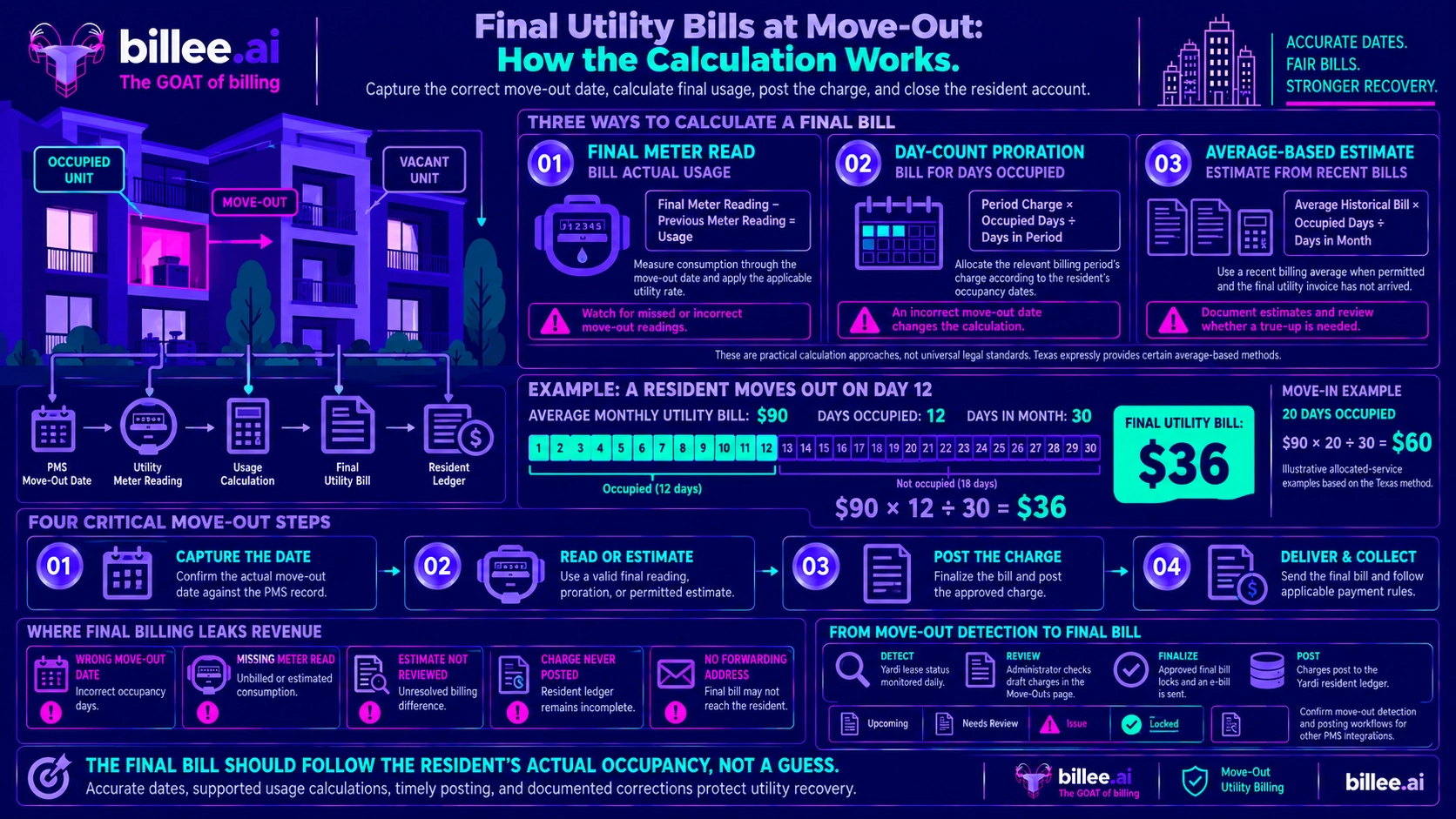
A final utility bill settles a departing resident's account: capture the move-out date, read the meter or prorate the days, post the charge and collect it. Texas lets owners bill before the utility's invoice arrives, using a three-month average. Virginia and Colorado tie utility balances to deposit deadlines. Billee Technologies, Inc. manages final bills through its Move-Outs page.
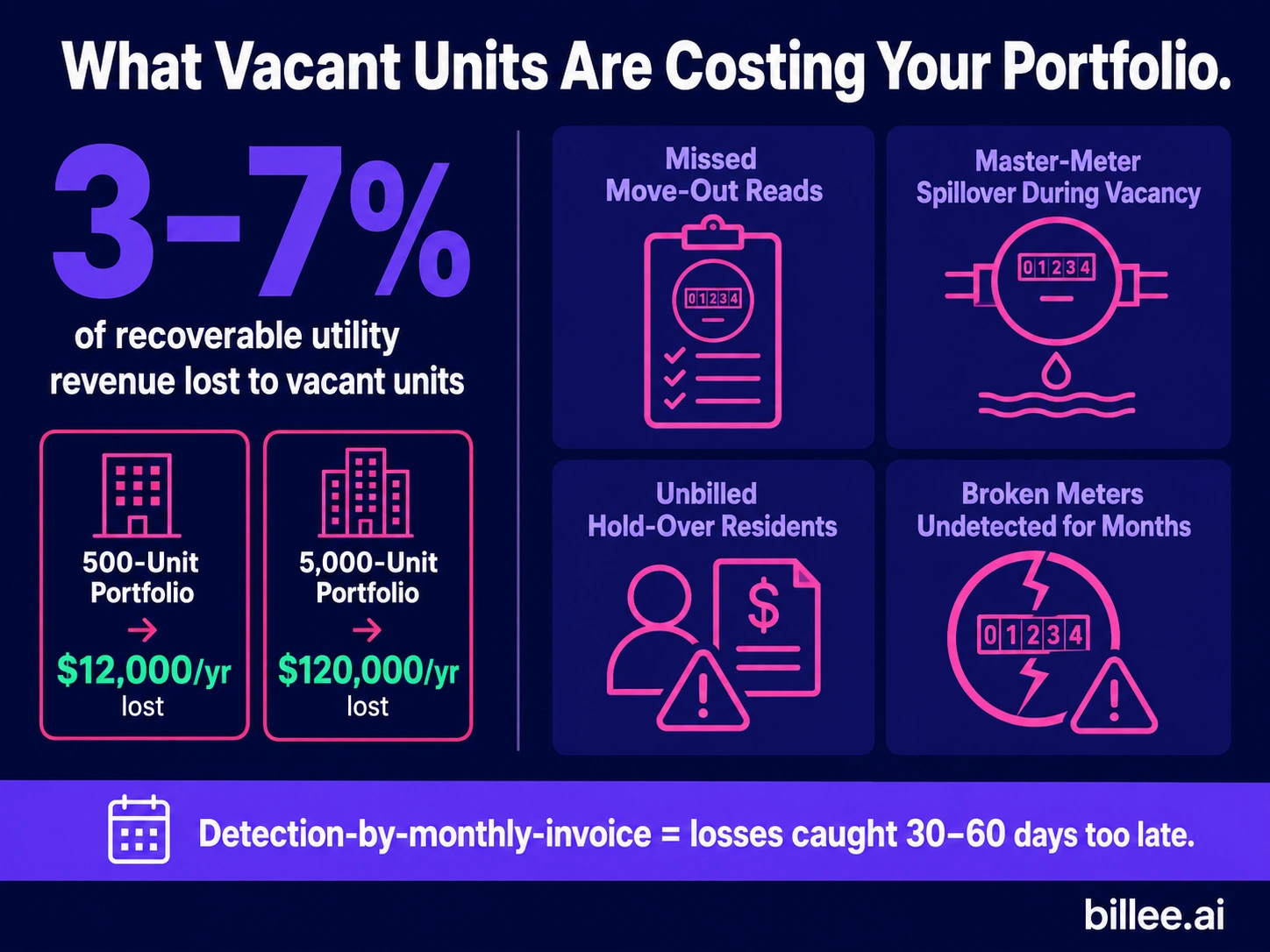
Move-out is one of the places utility recovery leaks. Billee's Vacant Cost Recovery work lists missed or wrong move-out meter reads, hold-over residents who were not billed and move-in and move-out timing errors in the property management system among the sources. This guide covers how final bills are calculated, when they go out and what several states say about deposits and notice. It is not legal advice.
Key takeaways
- A final bill has four jobs: capture the true move-out date, read or estimate usage, post the charge and collect it.
- Texas, under 16 Tex. Admin. Code § 24.281, lets an owner issue a final bill before the utility bill arrives, using the resident's average over the previous three months.
- Texas also bars billing residents for base charges on unoccupied units and bars billing a previous resident's usage to a current one.
- Virginia sets the deposit return and itemized deductions at 45 days and allows a reasonable withholding for an unpaid utility balance after prior written notice.
- Colorado lists nonpayment of utility charges as a permitted deposit deduction, per Colorado General Assembly summaries, and requires a written statement of exact reasons.
- Maryland's new submetering law bars treating an unpaid water bill as unpaid rent in an eviction, and D.C. adds a 45-day notice process for former residents.
- Billee's own best practice is to generate final bills as soon as move-outs appear.
Final bill rules at a glance
| Jurisdiction | Final bill or move-out point | Source |
|---|---|---|
| Texas | Final bill allowed before the utility bill arrives, from a three-month average; no base charges for unoccupied units; due date at least 16 days after delivery | 16 TAC §§ 24.281, 24.283 |
| Virginia | Bill for the utility's billing period unless the lease says otherwise; due date at least 15 days after mailing or delivery; deposit and itemized deductions within 45 days | Va. Code §§ 55.1-1212, 55.1-1226 |
| Colorado | Nonpayment of utility charges is a permitted deposit deduction; deposit due within one month, up to 60 days by lease, with a written statement of exact reasons | C.R.S. 38-12-103, per General Assembly summaries |
| D.C. | Written notice of alleged unpaid amounts to former residents within 45 days after termination | D.C. Law 26-156 |
| Maryland | Unpaid submetered water bills cannot be treated as unpaid rent in an eviction | Chapter 261 (SB 130) |
| Indiana | At least 17 days from the date a sub-bill is sent before a collection action | IURC landlord page |
What a final utility bill involves
A final utility bill closes a departing resident's utility account. It covers usage from the last billing period through the move-out date, and it has to be calculated, delivered, posted to the resident ledger and collected. Four steps carry most of the risk: the move-out date, the read or estimate, the posting and the collection.
Each step fails in a familiar way. A move-out date that is wrong in the property management system shifts the whole proration. A missed read leaves nothing to bill. A bill that never posts never collects. Billee's guides to recovering utility costs from vacant units and common mistakes with vacant-unit utility fees cover the vacancy side of the same problem.
How final bills are calculated
Three practical approaches are available. The table lists them as options, not legal standards. Among the rules read for this guide, only Texas sets out a method.
| Approach | How it works | Watch for |
|---|---|---|
| Final read | Read the submeter on the move-out date and bill actual usage at the rate | A missed or wrong read |
| Day-count proration | Split the period's allocated share by days occupied over days in the period | A wrong move-in or move-out date |
| Average-based estimate | Bill from the resident's recent average when the utility bill has not arrived | A true-up that never happens |
Texas spells out the estimate. 16 Tex. Admin. Code § 24.281 lets an owner issue a final bill to a resident who moves out mid-period without waiting for the utility's bill. For submetered water, an owner using the average-cost method can apply the resident's average volumetric rate over the previous three months to consumption for the billing period.
For allocated service, the owner can bill the resident's average bill over the previous three months, multiplied by days in the unit and divided by days in the month.
An illustrative example. A resident's last three allocated bills average $90. The resident moves out on day 12 of a 30-day month. The final bill is $90 × 12 ÷ 30 = $36. For a move-in on the same terms, the owner calculates a full-month bill, then charges days occupied over days in the month, so 20 days of a $90 month is $60. The figures are illustrative.
Texas adds two guardrails. An owner may not bill residents for dwelling unit base charges applicable to unoccupied units. And under § 24.283, a previous resident's usage may not be back billed to a current resident. The rule's adoption note dates to 2018, so confirm the current text.
When the final bill goes out and how long residents have to pay
The Texas rules read for this guide set no deadline for issuing a final bill, and the Virginia billing statute states none. The pressure comes from elsewhere: deposit deadlines, the utility's invoice lag and the resident's forwarding address.
Payment windows. Texas requires a due date at least 16 days after mailing or hand delivery, and the owner records the date. Virginia's billing statute sets a due date not less than 15 days after mailing or delivery. Indiana requires at least 17 days from the date a sub-bill is sent before a collection action starts, per the IURC's landlord page.
Late charges. Texas allows a one-time late penalty of up to 5% only if the written lease states the percentage. Virginia's billing statute caps a late charge at $5. A final bill that goes out after the resident has left needs the lease terms to be in place before anyone needs them.
The deposit clock. A final bill that arrives after the deposit deadline cannot be netted against the deposit. The next section lists the deadlines.
What states say about deposits and notice
Virginia. Va. Code § 55.1-1226 requires the deposit and itemized deductions within 45 days after the later of termination or vacating. Subsection C lets a landlord withhold a "reasonable portion" for an unpaid water, sewer or other utility balance the resident owes a third-party provider under the rental agreement, after prior written notice. The notice can sit in a termination notice, a notice confirming the vacate date or a separate notice at least 15 days before disposition.
After paying the provider, the landlord confirms in writing within 10 days and pays any balance. If the resident shows written proof that the final bill was paid, the landlord refunds within the 45 days, or within 10 days of receiving proof that arrives later.
Whether a landlord's own sub-bill or RUBS charge counts as a balance owed to a third-party provider is a question for counsel. Separately, § 55.1-1212 lets an owner charge "account move-out fees" only up to actual costs billed by a third-party provider, and only if the lease agrees.
Colorado. Two Colorado General Assembly summaries of C.R.S. 38-12-103 (first, second) list nonpayment of utility charges as a permitted reason to withhold part of a deposit. The deposit is due within one month after the lease ends or the key is surrendered, and the lease can set a longer period of up to 60 days.
A landlord that keeps any part must give a written statement of the exact reasons, and the summaries say omitting it forfeits the right to withhold. The statute text itself was not read for this guide.
D.C. D.C. Law 26-156 adds a notice process for former residents. The provider asks for a forwarding address, then sends written notice of alleged unpaid amounts within 45 days after termination, with supporting documents and the right to dispute. The summary's examples do not mention utility charges. Whether a final utility bill falls inside the process is a question for counsel.
Maryland. Chapter 261 bars treating an unpaid water bill under the new submetering law as unpaid rent in an eviction. That closes one collection route, so ask counsel how a Maryland water balance can be pursued. Billee's state-by-state RUBS guide maps the other states.
Where final bills go wrong
Treat the list below as practical patterns, not legal categories:
- A wrong move-out date. The property management system and the key return disagree, and the proration follows the wrong one.
- A missed or wrong meter read. The final bill rests on a guess.
- An estimate that is never trued up. A resident is charged on a three-month average and nobody checks it against the utility's bill.
- Base charges on a vacant unit. Texas bars them, and D.C. bars separate billing for vacant-unit utilities from Jan. 1, 2027.
- A previous resident's usage on the next resident. Texas bars it.
- A bill that goes to an old address. Without a forwarding address, the resident may never see it.
- A late bill. It arrives after the deposit has been settled.
Corrections matter too. Texas § 24.283(k) addresses adjustments, including refunds for affected bills and a deferred payment plan for an undercharge of $25 or more. Indiana's final rule, per the IURC's order, sets 90 days to correct an error in a resident's favor.
How to get ready
- Set the move-out date of record. Decide which system or document wins when dates disagree.
- Choose a method per property. Final read, day-count proration or average-based estimate, written down.
- Match each state to its deposit clock. Virginia's 45 days and Colorado's one month, up to 60 by lease, drive the bill deadline.
- Review lease terms. Check late-charge wording, move-out fees and what the lease says about final bills. Billee's guide to RUBS lease addendum requirements covers the addendum.
- Collect a forwarding address at move-out. D.C.'s notice process starts with the request, and every state needs a place to send the bill.
- Set a true-up step for estimates.
- Ask your billing vendor in writing. Get the process for detection, timing, correction and collection.
How Billee Technologies helps
Billee Technologies pairs a platform with a named, dedicated account team. Your people review and approve. Billee's team does the work. For move-outs, the job is to catch each one as it happens and get the final bill out quickly.
Detect move-outs as they happen
Billee's Yardi integration monitors lease status daily and detects move-outs. Your team reviews and finalizes each final bill in the portal. After a bill is sent, charges post to Yardi immediately, and the unit goes vacant in both systems. Billee's guide to its Yardi Voyager integration covers the setup. For other property management systems, ask Billee in writing how move-outs are detected.
Work the Move-Outs page
The Move-Outs page is Billee's final bill management screen. Each final bill carries a status: Past Due (past the scheduled date), Upcoming or Pending (due today or in the next 30 days), Needs Review or Draft (created but not finalized or sent), Issue (data problems such as missing meter reads or incorrect unit data, which need Billee team review) and Locked (sent to the resident, with charges posted).
The dashboard's Move-Out Overview shows the status counts, and Billee's training says to check it daily. A Sync PMS button refreshes stale move-out data. The administrator flow has three steps: generate a draft, review the charges, then finalize and send. Finalizing locks the bill immediately, sends the e-bill and posts the charges.
Fix issues and corrections
For an Issue bill, an administrator can request a biller review, which takes 1–2 business days. For a bill that has already been sent, Request Correction also takes 1–2 business days, and the revised bill locks automatically when complete.
The activity log records who did what and when. Billee's guide to handling resident utility bill disputes covers the resident side. How a correction to a locked final bill is handled in detail, including any credit or refund, is a question for Billee in writing.
Close the vacancy leak
Vacant Cost Recovery compares the property management system's occupancy data with actual meter usage. Missed or wrong move-out meter reads, hold-over residents who were not billed and move-in and move-out timing errors in the system are among the leakage sources it looks for. Exceptions above a configurable threshold go, within the same week, to a named account team member.
Billee's account team also handles move-out and final bill exception handling. Read more in Billee's guide to what Vacant Cost Recovery is.
Check the rules behind the bill
Billee's Regulatory & Compliance service covers billing methodology audits, access to legal support and ongoing monitoring for rule changes. Access to legal support is not legal advice. Billee's guide to its regulatory and compliance support explains the scope.
What to ask Billee for in writing
- How final-bill proration is set for RUBS and for submetered properties, and whether an average-based estimate is available where a state allows one.
- How move-outs are detected for property management systems other than Yardi.
- How a final bill is timed against each state's deposit deadline, including Virginia's 45 days and Colorado's one month.
- How a final bill reaches a resident after move-out, including forwarding addresses.
- How a correction to a locked final bill is handled, including credits and refunds, and how it is recorded.
- How final-bill charges feed your deposit accounting in the property management system.
- How move-out fees, if any, are shown and tied to actual cost where a state limits them.
Who Billee is not for
- Portfolios under about 300 units, where Billee's full-service model is usually more than the job needs.
- Anyone looking for a legal opinion on whether a final utility bill can be deducted from a deposit or sent to collections. Billee gives access to legal support, not legal advice, so involve counsel.
- Operators who want to run billing themselves with software alone. Billee's portal exists for review and approval, not self-service operation.
FAQ
What is a final utility bill in multifamily?
A final utility bill is the last utility charge for a departing resident. It covers usage from the last billing period through the move-out date and is posted to the resident ledger. Operators calculate it from a final meter read, a day-count proration or an average-based estimate.
How do you prorate a final utility bill at move-out?
Divide the period's charge by the days in the period and multiply by the days the resident occupied the unit. Texas uses this approach for allocated service: the resident's average bill over the previous three months, times days in the unit, divided by days in the month. For example, $90 × 12 ÷ 30 is $36.
Can a landlord send a final utility bill before the utility's invoice arrives?
In Texas, yes. 16 Tex. Admin. Code § 24.281 lets an owner issue a final bill to a resident who moves out mid-period, using the resident's average over the previous three months. Other states vary, so check the rule for each state where you bill.
How long does a resident have to pay a final utility bill?
The window depends on the state. Texas requires a due date at least 16 days after mailing or hand delivery, Virginia not less than 15 days and Indiana at least 17 days before a collection action. Many states are silent, so the lease should state the due date.
Can unpaid utility charges be deducted from a security deposit?
Some states say so. Virginia lets a landlord withhold a reasonable portion for an unpaid utility balance owed to a third-party provider after prior written notice. Colorado lists nonpayment of utility charges as a permitted deduction. Whether a landlord's own sub-bill qualifies is a question for counsel.
When should final utility bills be generated?
As soon as the move-out is known. Billee's best practice is to generate final bills as soon as move-outs appear. A deposit deadline, such as Virginia's 45 days or Colorado's one month, sets the outer limit.
Who pays for utilities in a vacant unit after move-out?
Texas bars billing residents for base charges on unoccupied units, and D.C. bars separate billing for vacant-unit utilities from Jan. 1, 2027, so those costs stay with the owner there. Elsewhere, check the rule and the lease. Billee's Vacant Cost Recovery compares occupancy with meter usage to flag exceptions.
What should an operator do if a final bill is wrong after it is sent?
Correct it and credit or refund the difference. Texas § 24.283(k) provides for refunds on affected bills, and Indiana's final rule sets 90 days to correct an error in a resident's favor. In Billee's portal, an administrator can request a correction, which takes 1–2 business days.
Billee handles utility billing, vacant cost recovery and vendor management for multifamily operators who want a dedicated team behind the software. If move-outs are where recovery slips, talk to the team about your portfolio.
Sources
- Legal Information Institute, Cornell Law School, "16 Tex. Admin. Code § 24.281, Charges and Calculations," accessed October 2026.
- Legal Information Institute, Cornell Law School, "16 Tex. Admin. Code § 24.283, Billing," accessed October 2026.
- Indiana Utility Regulatory Commission, "Sub-Billing for Landlords (customer assistance page)," accessed October 2026.
- Virginia Legislative Information System, "Code of Virginia § 55.1-1226," accessed October 2026.
- Virginia Legislative Information System, "Code of Virginia § 55.1-1212," accessed October 2026.
- Colorado General Assembly, "Security Deposit Returns to Renters (summary of C.R.S. 38-12-103)," accessed October 2026.
- Colorado General Assembly, "Renters' Rights: Colorado Law Summary," accessed October 2026.
- Council of the District of Columbia, "D.C. Law 26-156. Fair Housing Practices Amendment Act of 2026," accessed October 2026.
- Maryland General Assembly, "Chapter 261 (Senate Bill 130), 2026 Regular Session," accessed October 2026.
- Indiana Utility Regulatory Commission, "Order Approving Final Rule, RM 20-02 (170 Ind. Admin. Code Art. 15)," accessed October 2026.
Insights and Industry Trends