
CDP Disclosure for Multifamily Owners: What It Is and Where Utility Data Fits
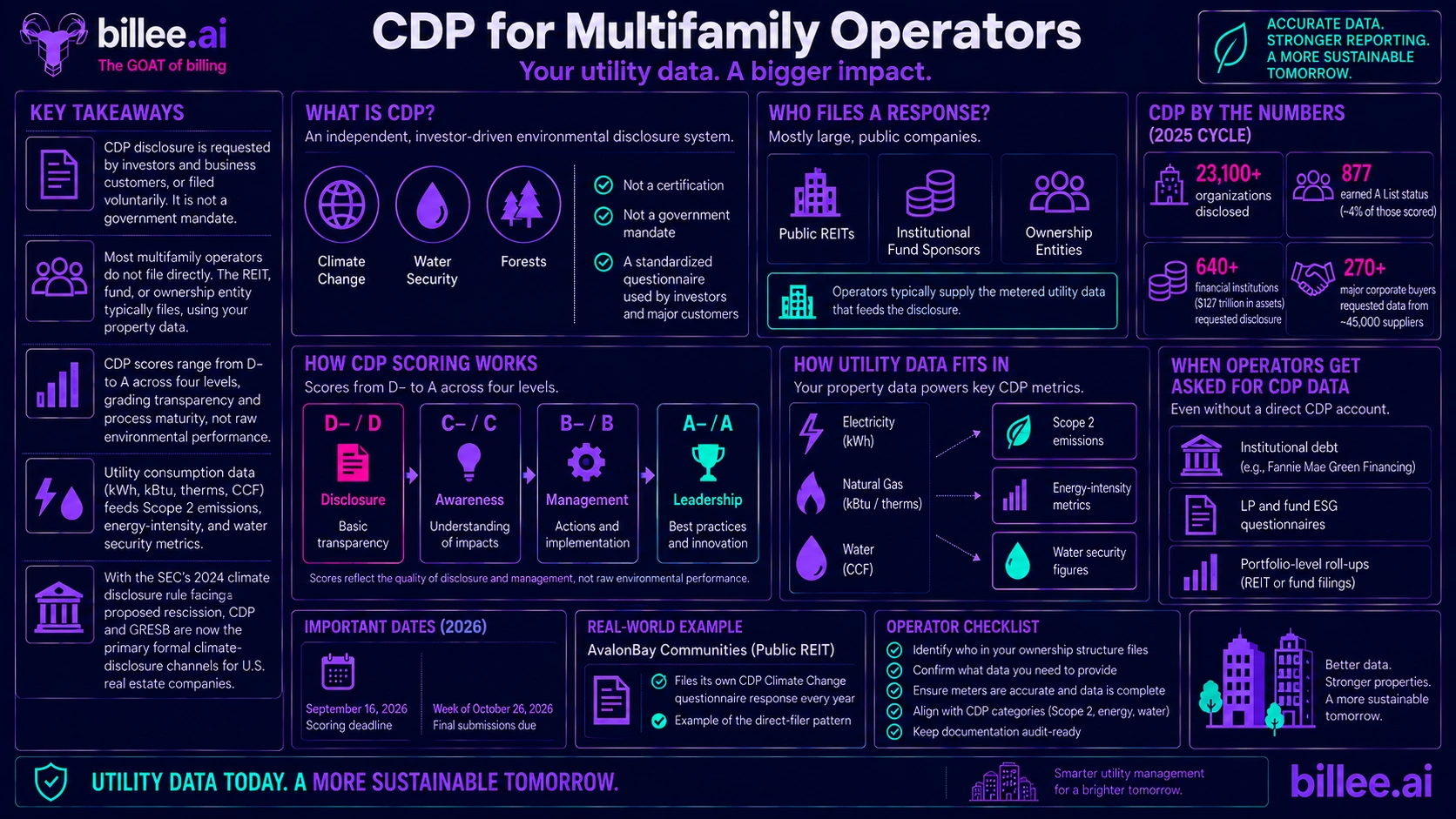
CDP is an independent, investor-driven environmental disclosure system, not a certification and not a legal requirement. Most multifamily operators never file a CDP response themselves; that work typically falls to a public REIT, an institutional fund sponsor, or a portfolio's ownership entity. Where operators actually enter the picture is upstream: the metered electricity, gas, and water data from their properties is the raw material that feeds someone else's CDP disclosure, whether that shows up as a Scope 2 emissions calculation, an energy-intensity metric, or a water security figure. This article breaks down what CDP actually asks for, how its scoring works, and exactly where utility data fits into it.
Key Takeaways
- CDP disclosure is requested by investors and business customers, or filed voluntarily. It is not a government mandate or a building certification.
- Very few multifamily operators file a CDP response directly. Most supply consumption data to a fund sponsor, REIT parent, or lender that files on the portfolio's behalf.
- CDP scores disclosures from D– to A across four levels (Disclosure, Awareness, Management, Leadership), grading transparency and process maturity, not raw environmental performance.
- Utility consumption data (kWh, kBtu, therms, CCF) is the direct input for the Scope 2 emissions, energy-intensity, and water security figures CDP's questionnaires ask for.
- With the SEC's 2024 climate disclosure rule now facing a proposed rescission, CDP and GRESB are effectively the primary formal climate-disclosure channels left for U.S. real estate companies.
What Is CDP, and Who Actually Files a Response?
CDP runs what it describes as the world's only independent environmental disclosure system, covering climate change, water security, and forests. Companies, cities, states, and regions submit standardized questionnaires each year, and CDP scores the responses.
Two things drive most disclosure activity: a direct request, or self-selection. During the 2025 cycle, more than 640 financial institutions controlling $127 trillion in assets asked companies to disclose through CDP, and more than 270 major corporate buyers requested data from roughly 45,000 suppliers in their value chains. Companies that receive no formal request can still disclose voluntarily as self-selected filers.
CDP is not a certification and not a law. Nobody passes or fails CDP the way a building passes an inspection. It functions closer to a standardized survey that investors and large customers use to compare companies' environmental transparency and management practices, one company at a time.
For the 2026 disclosure cycle, the scoring deadline is September 16, 2026, with final submissions due the week of October 26, 2026.
Does CDP Apply to You If You're Not a Public REIT?
Most direct CDP filers are public companies. Of the 23,100-plus organizations that disclosed during the 2025 cycle, CDP scored nearly 20,000, and 877 earned Corporate A List status, about 4 percent of everyone scored. The organizations on that list, and the tens of thousands that disclose without making it, skew heavily toward large public corporations with dedicated sustainability teams.
AvalonBay Communities is a useful example. As a publicly traded apartment REIT, AvalonBay files its own CDP Climate Change questionnaire response every year, including its 2024 submission. That is the direct-filer pattern: a company answers to CDP because its own investors, as CDP signatories, expect it to.
Most Billee readers are not in that position. An operator managing an institutionally owned or institutionally financed portfolio typically is not the entity submitting to CDP. The fund sponsor, the REIT parent, or the institutional owner is. The operator's role is supplying that entity with clean, accurate consumption data for the properties it manages.
When an operator gets asked for CDP-aligned data anyway
Three situations put CDP-style questions on an operator's desk even without a direct CDP account.
Institutional debt is the most common trigger. Lenders offering green financing incentives, including Fannie Mae's Green Financing programs, tie loan terms to building efficiency data, the same kind of information operators already assemble for refinancing and disposition. LP and fund ESG questionnaires are the second trigger: a private equity sponsor or institutional LP often runs its own environmental data request across portfolio companies, using CDP's categories, such as Scope 2 emissions and energy intensity, as the template even without routing through CDP's own platform. Portfolio-level roll-ups are the third: a REIT or fund files one CDP response covering an entire portfolio, and individual property-level operators feed the number rather than filling out the form.
How CDP Scoring Actually Works
CDP grades disclosures on a scale that runs from D– up to A, organized into four levels.
Disclosure, scored D to D–, measures completeness: how much of the requested data a company actually provided. Awareness, scored C to C–, reflects whether a company understands how environmental issues affect its business. Management, scored B to B–, requires evidence of action: policies, targets, and processes actually in place. Leadership, scored A to A–, is reserved for best-practice performance and transparency.
A company has to clear specific "Essential Criteria" at each level before advancing to the next. Miss one, and the score caps at the level below, regardless of how strong the rest of the response is. This is worth stating plainly: a CDP score measures the quality and completeness of a company's disclosure and management process, not how low its emissions actually are. A company with real environmental problems can still score well if it discloses those problems thoroughly and shows it is managing them.
Where Utility Consumption Data Fits in the CDP Questionnaire
This is where an operator's day-to-day utility data connects to what actually gets entered into a CDP form.
Scope 2 emissions need two numbers from the same electricity data
CDP requires both a location-based and a market-based Scope 2 emissions figure. Both start from identical activity data: the metered kWh consumption on the property's electric bill. The difference is which emissions factor gets applied.
Location-based uses the average emissions profile of the regional grid; market-based uses factors tied to any renewable energy certificates or supplier contracts in place. For most multifamily properties without dedicated renewable energy contracts, the two figures land close together, but CDP still wants them reported separately.
Energy intensity metrics reuse the EUI operators already calculate
CDP's energy-intensity figures use the same underlying math as Energy Use Intensity, the metric at the center of ENERGY STAR Portfolio Manager benchmarking covered in how to benchmark utility consumption across a multifamily portfolio: total energy consumed in kBtu, divided by gross square footage, expressed as kBtu per square foot per year. An operator already benchmarking properties in Portfolio Manager is not starting from zero on this part of a CDP response. The consumption data is the same; only the destination changes.
Water consumption lives on a separate track, and the utility bill isn't quite the number CDP wants
CDP's Water Security questionnaire is a distinct disclosure track from Climate Change, scored separately. CDP defines three related figures in its water accounting guidance: withdrawal, all water drawn in; discharge, all water released back out; and consumption, withdrawal minus discharge.
A property's metered water bill, in CCF, maps most directly to withdrawal. Most of that water gets discharged as wastewater, so it is not the same number as CDP's technical consumption figure. An operator asked for CDP water data should not assume the utility bill total drops straight into a consumption field.
CDP's facility-level water accounting guidance also asks whether a property sits in a water-stressed area, typically assessed at the catchment level using tools like the WRI Aqueduct Water Risk Atlas. Properties in the Southwest and parts of the Southeast are more likely to trigger this scrutiny than properties in water-abundant regions.
Portfolio totals, not resident-level bills
The consumption figures CDP wants, like GRESB and Portfolio Manager, are whole-property or portfolio-level totals: the master-meter side of the operation. That is a different aggregation than the unit-level submetered data used to bill residents individually under RUBS or submetering. Both draw from the same underlying utility relationship, but an operator preparing ESG-style disclosure needs the property total, not a roll-up of individual resident invoices, which can diverge from the master meter due to common-area consumption, vacant units, and billing lag.
CDP vs. GRESB vs. ENERGY STAR Portfolio Manager: How They Overlap
Operators already producing GRESB and Portfolio Manager-based ESG reports often assume CDP is a fourth, unrelated hoop to jump through. It mostly is not.
| Framework | Who typically requests it | Core metric | Format | Multifamily-specific note |
|---|---|---|---|---|
| CDP | Investors (as signatories) or major business customers | Scope 1/2/3 emissions, energy intensity, water withdrawal/consumption | Annual questionnaire, scored D– to A | Direct filers are almost always public companies; most multifamily operators are data suppliers, not filers |
| GRESB | Institutional real estate investors and fund LPs | Portfolio-wide ESG performance, including energy, water, and waste | Annual assessment, scored against a real estate peer group | Purpose-built for real estate; GRESB's Real Estate Standard is significantly aligned with CDP's climate modules, which reduces duplicate reporting work |
| ENERGY STAR Portfolio Manager | EPA, plus lenders and certifying bodies | Energy Use Intensity, ENERGY STAR score | Free EPA benchmarking tool, not scored competitively | Feeds directly into both GRESB submissions and CDP's energy-intensity questions |
The SEC Backdrop: Why Voluntary Frameworks Matter More Right Now
For a few years, it looked like public companies would face a mandatory federal climate disclosure requirement alongside CDP and GRESB. The SEC adopted climate-related disclosure rules in March 2024, requiring large filers to report material climate risks and Scope 1 and Scope 2 emissions. Those rules were stayed by litigation almost immediately and never took effect.
As of May 29, 2026, the SEC has formally proposed rescinding the rules entirely, arguing they exceed the agency's statutory authority and impose costs not justified by the benefits. The proposal is in a public comment period, and nothing is final. But the direction is clear enough that operators should not expect a federal mandate to replace or simplify what CDP and GRESB already ask for.
That makes voluntary, investor-driven frameworks more important, not less. With no federal climate disclosure requirement in force, CDP and GRESB remain the primary formal channels institutional investors use to compare real estate companies' environmental data. An operator whose portfolio touches institutional capital should expect these requests to continue, regardless of what happens in Washington.
Best Practices for Feeding CDP-Aligned Reporting Without the Quarterly Fire Drill
- Keep 12 or more trailing months of normalized consumption data on hand. CDP, GRESB, and Portfolio Manager all ask for year-over-year comparisons. Scrambling to reconstruct last year's numbers after a request lands wastes weeks.
- Know which module is actually being requested. Climate Change and Water Security are separate CDP tracks with separate data needs. Confirm which one, or both, the requesting party wants before pulling data.
- Standardize units across the portfolio. kWh for electricity, therms or kBtu for gas, CCF for water. Mixed units across properties create reconciliation work that shows up as delay, not as better data.
- Separate master-meter totals from resident billing data early. The property total an ESG framework wants and the sum of individual resident invoices are not interchangeable. Treat them as two distinct exports.
- Start before the request arrives. Institutional owners and lenders rarely give much lead time once the ask comes in. Portfolios that already track consumption centrally, the kind of visibility a CFO needs from utility reporting, have days of work ahead of them. Portfolios that do not have weeks.
What to Look for in a Utility Data Partner for CDP-Aligned Reporting
- Portfolio-wide, normalized exports. Consumption data in the units CDP, GRESB, and Portfolio Manager actually use, not raw utility bill PDFs.
- Trailing historical data, not just current-month snapshots. Year-over-year comparison is built into every one of these frameworks.
- Clean separation of master-meter and resident-billing data. A partner that only exports resident invoice totals is not solving the ESG reporting problem.
- No added burden on the operations team. If pulling data for a lender or fund sponsor request takes a property manager away from leasing and maintenance for a week, the tooling is not doing its job.
- A track record with ENERGY STAR Portfolio Manager and GRESB-ready formats. These are the two frameworks operators are most likely to already touch, and producing CDP-aligned figures from the same base data should not require starting over.
How Billee Supports ESG and CDP-Aligned Reporting
Billee's ESG & Sustainability Reporting product aggregates the consumption data, kWh, kBtu, therms, and CCF, that Billee already manages for billing, and formats it for the frameworks operators are most often asked to feed: ENERGY STAR Portfolio Manager and GRESB-ready output. Because Billee already manages the underlying utility data for billing purposes, producing a clean, normalized export is a byproduct of the existing workflow rather than a separate reporting project.
Billee does not file a company's CDP response. But the same normalized, portfolio-level consumption data it produces is what feeds a CDP submission, whether that submission is ultimately filed by a REIT parent, a fund sponsor, or a lender working through green financing terms.
FAQ
What is CDP, and how is it different from GRESB? CDP is an independent environmental disclosure platform covering climate change, water security, and forests, used primarily by investors to compare companies' environmental transparency. GRESB is a real estate-specific ESG assessment built for institutional real estate investors and covers a broader set of ESG categories. The two are closely aligned on climate data, which reduces duplicate reporting work for real estate companies that respond to both.
Do individual apartment communities need to report to CDP? No. CDP responses are filed at the company or portfolio level, almost always by public companies, REITs, fund sponsors, or institutional owners. An individual property or its on-site team does not file a CDP response directly.
Is CDP disclosure mandatory? No. CDP disclosure happens because an investor or major customer requests it, or because a company chooses to self-disclose. It is not a government requirement, though the investors requesting it can represent very large pools of capital.
What utility data does CDP ask real estate companies for? Metered electricity consumption for Scope 2 emissions calculations, total energy consumption for energy-intensity metrics, and water withdrawal, discharge, and consumption figures for the separate Water Security questionnaire.
How does CDP differ from the SEC's climate disclosure rule? The SEC's 2024 climate disclosure rule was a proposed federal mandate for public companies. It was stayed by litigation and is now facing a proposed rescission as of 2026. CDP is a voluntary, investor-driven framework that never depended on the SEC rule and continues regardless of its outcome.
What counts as a good CDP score? CDP scores range from D– to A across four levels: Disclosure, Awareness, Management, and Leadership. A and A– scores, reserved for best-practice performance and transparency, went to about 4 percent of scored companies in the 2025 cycle.
Does ENERGY STAR Portfolio Manager data satisfy CDP's requirements? Portfolio Manager's Energy Use Intensity output uses the same underlying calculation as CDP's energy-intensity questions, so it directly supports a CDP response. Portfolio Manager alone does not cover Scope 2 emissions factors or CDP's water security accounting.
How often do companies report to CDP? Annually. Each disclosure cycle has its own scoring and submission deadlines set by CDP, and companies that disclose in consecutive years are compared against their own prior-year data.
Billee already tracks the electricity, gas, and water data a multifamily portfolio runs on, so producing the normalized numbers a CDP-aligned request asks for is a byproduct of the existing billing relationship, not a new project. See what that looks like for your portfolio.
Sources
- CDP, "Disclosure 2026," accessed 2026.
- CDP, "CDP A List 2025: Global Momentum for Environmental Transparency Remains Strong as Markets Demand Actionable Data," 2026.
- AvalonBay Communities, Inc., "2024 CDP Corporate Questionnaire," September 2025.
- Fannie Mae, "Green Financing," accessed 2026.
- CDP Help Center, "Understand your score as a disclosing company," accessed 2026.
- CDP, "Accounting of Scope 2 Emissions," accessed 2026.
- United States Environmental Protection Agency, ENERGY STAR, "What Is Energy Use Intensity (EUI)?," accessed 2026.
- CDP, "Technical Note: Water Accounting Definitions," accessed 2026.
- CDP, "W5 Facility-Level Water Accounting Guidance," accessed 2026.
- GRESB, "How GRESB Aligns With Common ESG Reporting Frameworks," accessed 2026.
- United States Securities and Exchange Commission, "SEC Proposes Rescission of Climate-Related Disclosure Rules," May 29, 2026.
Insights and Industry Trends