
How to Benchmark Utility Consumption Across Multifamily Properties
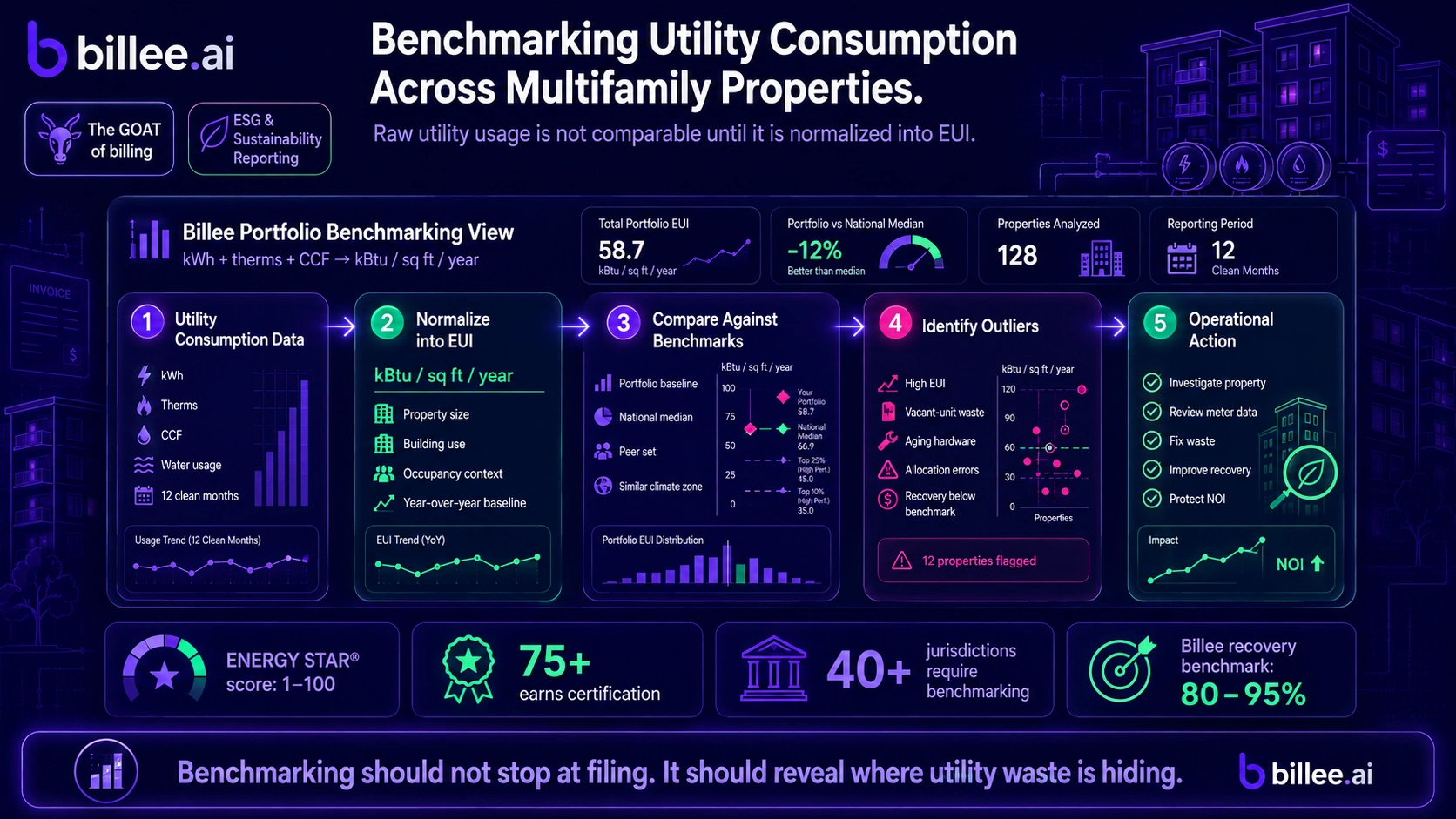
Benchmarking utility consumption across multifamily properties means normalizing usage into Energy Use Intensity, or EUI, and comparing it against a reference point: your portfolio's own baseline, the national median, or a peer set. The EPA's ENERGY STAR Portfolio Manager, the industry-standard tool for this, converts raw kWh, therms, and CCF into a 1 to 100 score automatically. More than 40 U.S. cities and states now require this reporting by law. Billee handles this data aggregation as part of managing a portfolio's utility billing.
Key takeaways
- Energy Use Intensity (EUI) is the standard normalized unit for comparing consumption across properties, measured in kBtu per square foot per year.
- More than 40 U.S. jurisdictions now mandate energy benchmarking through ordinances or Building Performance Standards, each with its own threshold and deadline.
- ENERGY STAR Portfolio Manager's campus, or parent property, feature is the correct structure for benchmarking a multi-building portfolio. Multifamily is one of the property types eligible for campus-level ENERGY STAR certification.
- New York City's Local Law 84 requires filing by May 1 and carries financial penalties for missing the deadline, per NYC's Department of Buildings.
- GRESB, the investor-facing global sustainability benchmark, opens its annual assessment window from April 1 to July 1.
- Billee's portfolio-wide recovery rate benchmark is 80 to 95 percent effective recovery, tracked on the customer dashboard, and properties that benchmark poorly on consumption often fall below that range too.
Quick answer
Raw consumption numbers cannot be compared across properties of different sizes, climates, and occupancy levels. EUI solves that by normalizing usage per square foot per year, typically expressed in kBtu.
ENERGY STAR Portfolio Manager, a free tool from the U.S. Environmental Protection Agency, is the industry-standard way to calculate and compare EUI. It also generates a 1 to 100 score that already adjusts for climate and building operating characteristics; a score of 75 or higher earns ENERGY STAR certification. For a multi-property portfolio, the tool's "campus" structure lets an operator roll every building under one parent property instead of tracking each one in isolation.
Why this matters for multifamily operators
Benchmarking used to be optional. It increasingly is not. More than 40 U.S. cities and states have adopted energy benchmarking ordinances or Building Performance Standards as of 2026, and the thresholds keep expanding. New York City's Local Law 84 applies to buildings over 25,000 square feet and requires an annual filing by May 1. Washington, D.C.'s Building Energy Performance Standards now cover buildings over 10,000 square feet. Chicago, Seattle, and Denver each run their own programs with their own thresholds and deadlines, all detailed further below.
Institutional capital is the second driver. GRESB is the global standard investors and lenders use to score real estate portfolios on ESG performance, and energy consumption data is a heavily weighted input to its Performance Component. Owners with institutional debt or institutional ownership are increasingly asked for this data whether or not their properties sit in a mandated jurisdiction.
Benchmarking also protects net operating income. Properties that benchmark consistently gain the visibility to catch waste before it compounds, and ENERGY STAR-certified buildings save over $0.50 per square foot in operating costs according to EPA program data. A property that benchmarks 20 percent above its peer set on EUI is usually leaking money somewhere: aging hardware, vacant-unit waste, or a stale allocation methodology.
Quick comparison: benchmarking frameworks
- ENERGY STAR Portfolio Manager: voluntary nationally, mandatory in 40+ jurisdictions. Free EPA tool. Produces a 1 to 100 score (75+ is certified) plus EUI.
- Local ordinances and Building Performance Standards: required by city or state law (NYC, DC, Chicago, Seattle, Denver, and others). Free to file, with fines for missed deadlines. Produces a compliance filing and public disclosure.
- GRESB: used by institutional investors and lenders. Paid participation fee. Produces a peer-benchmarked, investor-facing ESG score.
How to benchmark consumption across properties
Most portfolios fail at two specific steps in this process, not at the underlying math. Here is the full sequence, with extra depth on the two steps operators get wrong most often.
Step 1 and 2: Get 12 clean months of data in standardized units
Portfolio Manager requires a full 12 months of whole-building consumption data before it calculates a reliable score or EUI. Partial-year data is the single most common reason a first-time benchmarking attempt gets rejected or produces a meaningless number.
Enter consumption as billed: kWh for electricity, therms or CCF for gas, CCF for water. Portfolio Manager converts everything to source EUI automatically once the data is entered correctly, so there is no need to convert units by hand.
Step 3: Set up a campus, not standalone properties
Setting up a campus instead of standalone properties is the step most multifamily operators get wrong. A "campus" in Portfolio Manager is a group of two or more co-located buildings functioning as a single property with a shared primary use. Multifamily is explicitly one of the property types eligible for campus-level ENERGY STAR certification.
The mechanics are straightforward. Create the parent property first, selecting "more than one" building and specifying the count. Then add each building as a child property with its own unit-level data. Child properties still appear individually in "My Properties," but they roll up to the parent's Summary tab, which is where portfolio-level comparison actually happens.
The mistake operators make is benchmarking each building as a fully separate, unrelated property. That produces a pile of disconnected scores instead of one portfolio view, and it turns benchmarking into a manual reconciliation exercise every quarter instead of a live dashboard. Note also that Portfolio Manager does not support nested campuses; there is only one level of parent and child, which matters for large, multi-phase communities planning their structure.
Step 4: Trust the score for climate normalization
The 1 to 100 ENERGY STAR score already adjusts for climate and operating characteristics. Weather-normalize by hand only when working with raw EUI outside Portfolio Manager, for example in a custom peer comparison the tool cannot generate on its own.
Step 5: Compare against three reference points
Use your own trailing 12-month baseline to track year-over-year change. Use the national median EUI as an external anchor. And use a peer set of similar-vintage, similar-size properties, ideally in the same climate zone, for the most operationally useful comparison.
Step 6: Map your portfolio against a patchwork of local filing deadlines
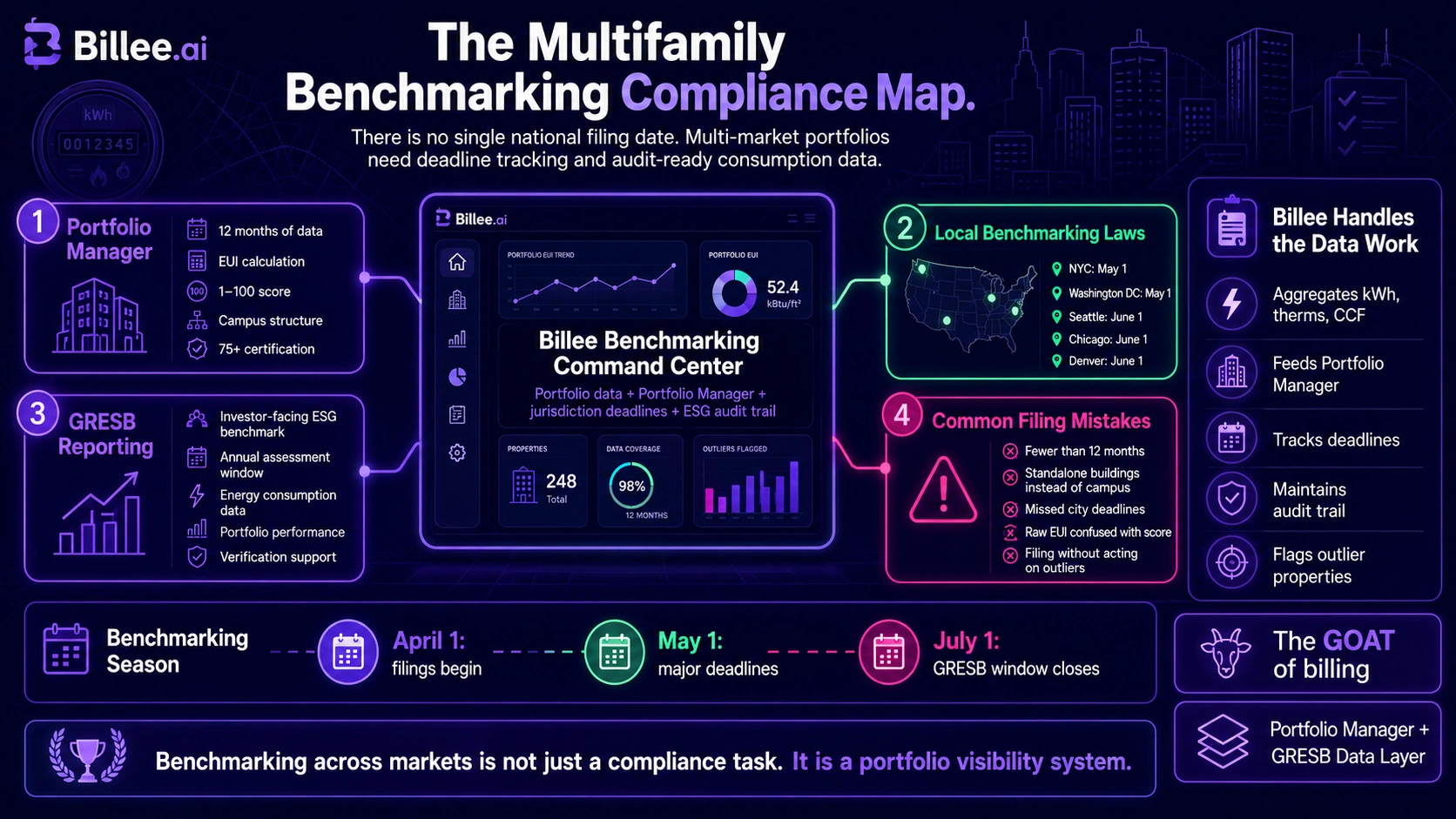
Mapping deadlines across jurisdictions is the second step operators most often get wrong, and it's where a multi-market portfolio creates real operational risk. More than 40 jurisdictions require benchmarking by law, and each sets its own square-footage threshold and filing date. A portfolio spanning three or four major metros can face three or four different deadlines in the same reporting year.
A few concrete examples for 2026, each worth confirming directly with the jurisdiction before filing:
- New York City requires buildings over 25,000 square feet to file Local Law 84 benchmarking data by May 1.
- Washington, D.C. requires buildings over 10,000 square feet to file Building Energy Performance Standards data by May 1.
- Chicago requires buildings over 50,000 square feet to file by June 1, with third-party data verification required every three years.
- Seattle requires buildings over 20,000 square feet to file by April 1, on top of a five-year Building Tune-Up cycle.
- Denver requires buildings over 25,000 square feet to file by June 1 under its Energize Denver program.
The pattern is worth stating plainly: thresholds range from 10,000 to 50,000 square feet, and deadlines cluster between April 1 and June 1. There is no single national date. That is precisely why a spreadsheet-per-property approach breaks down once a portfolio crosses two or three markets.
Step 7: Act on outliers, don't just file them
A benchmarking filing that sits in a compliance folder is a wasted exercise. Properties that benchmark poorly on EUI often correlate with recovery rates below Billee's own 80 to 95 percent portfolio benchmark, tracked on the customer dashboard, driven by vacant-unit waste, aging hardware, or allocation errors. Benchmarking should trigger an operational follow-up, not just a filing.
Common mistakes
- Benchmarking each property as a standalone Portfolio Manager account instead of using the campus, or parent property, structure.
- Submitting fewer than 12 full months of data, which produces an unusable or rejected score.
- Confusing the ENERGY STAR score, which is already climate-normalized on a 1 to 100 scale, with raw EUI, which is not normalized for climate on its own.
- Missing jurisdiction-specific filing deadlines across a multi-city portfolio, where thresholds and dates do not align.
- Treating benchmarking as a once-a-year compliance chore instead of a recurring NOI signal.
- Assuming GRESB and ENERGY STAR Portfolio Manager are the same thing. They serve different audiences: one is a regulatory and EPA-run tool, the other is an investor-facing ESG benchmark.
When to handle this in-house vs. bring in a partner
In-house benchmarking works when a portfolio is small, concentrated in a single jurisdiction with no Building Performance Standard mandate, and has no institutional GRESB requirement. The process is manageable with one person tracking one deadline.
A partner makes more sense once the portfolio spans multiple cities or states with different filing deadlines, ownership requires GRESB or investor ESG disclosure, or the benchmarking data currently comes from a manual, vendor-by-vendor quarterly pull. At that point, the coordination overhead usually costs more staff time than the benchmarking itself.
How Billee can help
Billee already manages utility data for its customers from the meter to the resident bill, so consumption benchmarking is a byproduct of that work rather than a separate quarterly project. The platform aggregates kWh, kBtu, therms, and CCF data across a portfolio and feeds it directly into ENERGY STAR Portfolio Manager, which is part of Billee's ESG & Sustainability Reporting product.
Inside the Billee customer portal, a property picker gives multi-property administrators a single view across the portfolio, and the activity log provides an audit trail useful for compliance review and refinancing due diligence. Billee's account team also tracks jurisdiction-specific deadlines directly, which matters more than software alone once a portfolio spans multiple filing cities. Implementation takes 45 days.
If benchmarking surfaces an outlier property, Billee's Vacant Cost Recovery engine is often the next step, since vacant-unit waste is one of the most common root causes behind a property that scores poorly against its peers.
FAQ
What does "benchmarking utility consumption" mean for multifamily properties?
Benchmarking means normalizing a property's utility consumption into EUI, measured in kBtu per square foot per year, and comparing that figure against a baseline, a national median, or a set of peer properties.
What is a good EUI for a multifamily building?
A good EUI is one at or below the national median and, ideally, at or below the peer set for similar-vintage, similar-size properties in the same climate zone. ENERGY STAR's 1 to 100 score is the more actionable benchmark, since a score of 75 or higher earns certification.
What's the difference between an ENERGY STAR score and EUI?
EUI is the raw normalized consumption number. The ENERGY STAR score is a 1 to 100 rating that further adjusts EUI for climate and building operating characteristics, making it comparable across regions.
Which cities require multifamily energy benchmarking by law?
More than 40 U.S. cities and states require it as of 2026, including New York City, Washington, D.C., Chicago, Seattle, and Denver, each with its own square-footage threshold and filing deadline.
What happens if I miss my building's benchmarking deadline?
Penalties vary by jurisdiction and can include recurring fines for late or missing filings. Operators with properties in multiple cities should confirm each jurisdiction's specific penalty structure directly, since it changes as ordinances are amended.
Is ENERGY STAR Portfolio Manager free to use?
Portfolio Manager is free to use, provided by the U.S. Environmental Protection Agency.
How is GRESB different from ENERGY STAR Portfolio Manager?
GRESB is a paid, investor-facing ESG benchmark used by institutional owners and lenders. Portfolio Manager is a free, EPA-run tool most often used for regulatory compliance and building-level scoring.
Can Billee benchmark consumption across my whole portfolio automatically?
Billee aggregates consumption data across a portfolio as part of managing utility billing, and that data feeds directly into ENERGY STAR Portfolio Manager without a separate manual pull.
If mapping deadlines across a multi-market portfolio and keeping consumption data audit-ready sounds like more coordination than your team wants to own, Billee's ESG & Sustainability Reporting runs that process as part of managing your utility billing. Talk to the team if you want to see how.
Sources
1. United States Environmental Protection Agency, "ENERGY STAR Portfolio Manager Data Explorer," accessed 2026.
2. United States Environmental Protection Agency, "Benchmarking for Multifamily High Rise," accessed 2026.
3. United States Environmental Protection Agency, "How to Benchmark a Campus in Portfolio Manager," March 2024.
4. United States Environmental Protection Agency, "Portfolio Manager," accessed 2026.
5. New York City Department of Buildings, "Local Law 84: Benchmarking," accessed 2026.
6. Facilities Dive, "The 2026 Map of Building Performance Standards Across the US," 2026.
7. City of Chicago, "Chicago Energy Benchmarking," accessed 2026.
8. GRESB, "Real Estate Assessment," accessed 2026.
Insights and Industry Trends