
Average Utility Savings with Submetering
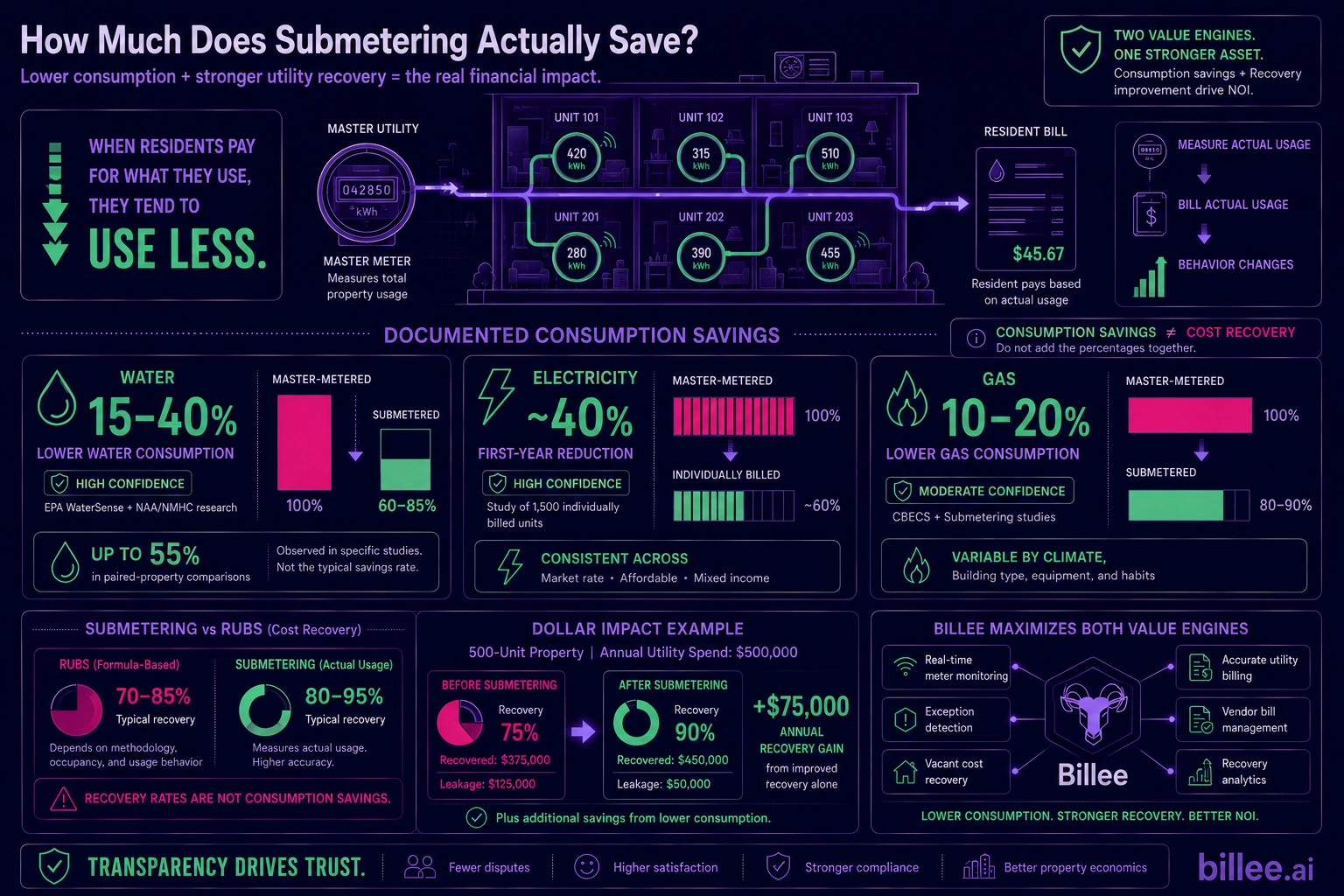
Submetering typically cuts water consumption by 20 to 40 percent and electricity consumption by around 40 percent in the first year, according to EPA, NMHC, and Guidehouse research, once residents are billed for what they actually use. Combined with Billee's 80 to 95 percent effective recovery benchmark, that consumption drop is where most of submetering's real financial return comes from.
Key takeaways
- Water consumption drops 15 to 40 percent after submetering, per EPA WaterSense and NMHC research; paired-property comparisons in the same research show reductions as high as 55 percent against a master-metered baseline.
- Electricity consumption drops roughly 40 percent in the first year after submetering, per a Guidehouse study of 1,500 individually billed units.
- Submetering's water-savings edge over RUBS specifically is real but more moderate: the same underlying study found submetered properties saving 18 to 39 percent versus master-metered, against 6 to 27 percent for RUBS-billed properties over the same baseline.
- Gas submetering almost certainly saves too, but there isn't yet a well-documented consumption-reduction percentage to cite with confidence.
- None of these figures include the separate lift from improved cost recovery: Billee's own portfolio benchmark for submetered properties is 80 to 95 percent effective recovery, versus 70 to 85 percent typical for RUBS.
How much submetering actually saves
"Average" is doing a lot of work in that question, because the honest answer depends on which utility, which baseline a property is measured against, and which study gets cited. Here's what the research actually supports, utility by utility.
Water: the largest and best-documented savings
Water submetering has the deepest research base of any utility type, and the range holds up reasonably well across sources. The EPA's WaterSense program documents a 15 to 40 percent reduction in water consumption in multifamily properties that move from master-metered or flat-fee billing to individual metering.
A water-conservation study conducted for the National Apartment Association and National Multifamily Housing Council found submetered properties using 18 to 39 percent less water than comparable master-metered properties, with paired-property comparisons in the same study showing reductions as high as 26 to 55 percent. The exact number depends on the property and the prior billing method, but every credible source lands somewhere between roughly one-fifth and two-fifths less water, sometimes higher in paired comparisons.
Electricity: a consistent double-digit reduction
Electric submetering's savings are reported more consistently at a single figure than water's. A Guidehouse study of 1,500 individually billed units found an average 40 percent reduction in electricity consumption in the first year after conversion, once residents could see and were billed for their own usage. Savings tend to hold roughly steady after that first year rather than continuing to grow.
Separate NYSERDA-sourced data on New York City public housing, cited in a 2023 HUD report, found the median master-metered apartment using roughly four times the energy of a comparable direct-metered unit, with the most extreme unmetered cases running as high as seven times the electricity use.
Gas: real but not yet well documented
Gas submetering almost certainly produces a consumption reduction for the same behavioral reason water and electricity do: residents billed for actual use tend to use less. But there isn't yet a well-documented, citable consumption-reduction percentage specific to gas the way there is for water and electricity. Gas submetering's savings case currently rests more on accurate cost allocation and faster leak or appliance-issue detection than on a headline conservation number, at least until better data exists.
Why the range is so wide
A property considering submetering reasonably wants one clean number, and the honest answer is that documented "average utility savings" spans roughly 15 to 55 percent across the sources above because four variables move it substantially.
What billing method you're switching from
The baseline matters more than almost anything else. A property moving from a fully master-metered, rent-inclusive model sees the biggest jump. A property already running RUBS sees a smaller one, because RUBS already gives residents some cost exposure before submetering arrives. The section below on submetering versus RUBS breaks out exactly how much smaller that jump tends to be.
Property age and plumbing or wiring configuration
Older buildings with shared plumbing lines or wiring that doesn't cleanly separate by unit can face higher installation costs and, in some cases, incomplete metering coverage on common areas or shared risers that can't be fully isolated, which caps how much of total consumption submetering can actually influence.
Meter accuracy and technology
A meter with poor accuracy generates billing disputes that erode resident trust in the billing itself, which undercuts the same behavior change that drives savings in the first place. Billee's own submetering-system guidance treats AWWA Class B (±2%) as the minimum acceptable standard for water and ANSI C12.1 (±0.5%) for electric; below that, savings estimates get harder to trust because the underlying data is noisier.
Occupancy and how quickly billing goes live
Savings only materialize once residents are actually being billed. A property with a slow rollout, low occupancy, or a long gap between meter installation and the first bill will see savings phase in more slowly than the first-year figures above suggest.
Submetering vs. RUBS: how much more does submetering save
Operators already running RUBS sometimes assume submetering has little left to offer, since RUBS already bills residents for utilities in some form. The data says otherwise, though the gap is real and worth stating honestly. In the NAA/NMHC study, submetered properties used 18 to 39 percent less water than master-metered properties, while RUBS-billed properties used 6 to 27 percent less over the same comparison.
Submetering's advantage over RUBS, in other words, is the difference between those two ranges: a real but more moderate reduction on top of whatever RUBS already achieves, because RUBS allocates a shared bill by formula with no direct feedback on individual usage, while submetering ties the bill straight to each unit's own meter. Billee's comparison of the two billing models covers the full trade-off in installation cost, timeline, and recovery rate; this section is only about the consumption-savings piece of that decision.
What average savings look like in dollars
Percentages translate differently depending on a property's actual utility spend, so a concrete example helps. Take a 200-unit property spending $120,000 a year on water and sewer under a master-metered model. A 25 percent consumption reduction, near the middle of the documented range, works out to roughly $30,000 a year in lower total water and sewer costs before any billing or recovery is factored in.
The $30,000 figure reflects lower consumption alone, not improved recovery: how much of the remaining bill actually gets billed back to residents is a separate factor. Billee's recovery benchmark adds another layer of financial improvement on top of the consumption drop covered here.
At-a-glance: savings by utility type
"Confidence" below reflects how well-corroborated each range is across independent sources, not how large the savings are.
| Utility | Documented savings range | Primary source | Confidence |
|---|---|---|---|
| Water | 15–40% (up to 55% in paired-property comparisons) | EPA WaterSense; NAA/NMHC study | High |
| Electricity | ~40% in the first year | Guidehouse study (1,500 units) | High |
| Gas | Not yet well documented | Not established | Low |
How Billee fits in
Consumption savings are only half of what determines a property's actual financial outcome from submetering; the other half is how much of the remaining bill actually gets recovered from residents. Billee's own portfolio benchmark for submetered properties is 80 to 95 percent effective recovery, against 70 to 85 percent typical for RUBS-billed properties, and Billee's dedicated account team runs that recovery process directly rather than leaving it to property staff.
Where consumption savings depend on accurate metering and a rollout that gets residents billed promptly, Billee's meter monitoring catches broken or drifting hardware before it quietly erodes the savings a property is counting on, and a billing methodology audit at implementation confirms the allocation and meter setup are accurate before the first bill goes out.
FAQ
How much water does submetering actually save?
Research consistently shows a 15 to 40 percent reduction in water consumption after switching to submetering, with some paired-property comparisons showing reductions as high as 55 percent, depending on the prior billing method and property.
How much does submetering save on electricity?
A Guidehouse study of 1,500 individually billed units found an average 40 percent reduction in electricity consumption in the first year after conversion, with savings generally holding steady after that.
Does submetering save money on gas bills too?
Almost certainly, since the same behavior-change effect applies, but there isn't yet a well-documented consumption-reduction percentage specific to gas submetering the way there is for water and electricity.
Do these savings numbers include improved cost recovery, or just lower consumption?
Just lower consumption. Cost recovery, meaning how much of the remaining bill actually gets billed back to residents, is a separate factor. Billee's own benchmark for submetered properties is 80 to 95 percent effective recovery, on top of whatever consumption savings a property sees.
Does submetering save more than RUBS?
Yes, but the gap is moderate rather than dramatic. The same water-conservation study found submetered properties saving 18 to 39 percent versus master-metered properties, compared to 6 to 27 percent for RUBS-billed properties over the same baseline.
Why do different sources report different savings percentages?
Because the baseline billing method, property age and plumbing configuration, meter accuracy, and how quickly a property starts billing after installation all move the number in different directions.
How long does it take to see these savings after installing submeters?
Savings start once residents are actually being billed, not once meters are installed. A property with a fast rollout to billing sees the first-year figures cited above; a slower rollout phases savings in more gradually.
Submetering's average savings come from two separate places: 20 to 40 percent lower consumption once residents are billed for actual use, and a recovery rate that runs well above what RUBS typically achieves. Talk to the team to see what that looks like for a specific portfolio.
Sources
- U.S. EPA, "Water Score for Multifamily Housing," WaterSense program, accessed 2026.
- National Apartment Association and National Multifamily Housing Council, "Water Conservation From User Charges in Multifamily Rental Housing," 1999.
- Guidehouse, study of 1,500 individually billed multifamily units on first-year electricity reduction; cited in Billee's prior published research. The primary Guidehouse report was not independently located during this research pass and should be verified before this citation is relied on further.
- U.S. Department of Housing and Urban Development, "Study of Submetering in HUD-Funded Housing," citing NYSERDA submetering data, 2023.
Insights and Industry Trends