

How Often Should You Actually Audit Your Utility Billing?
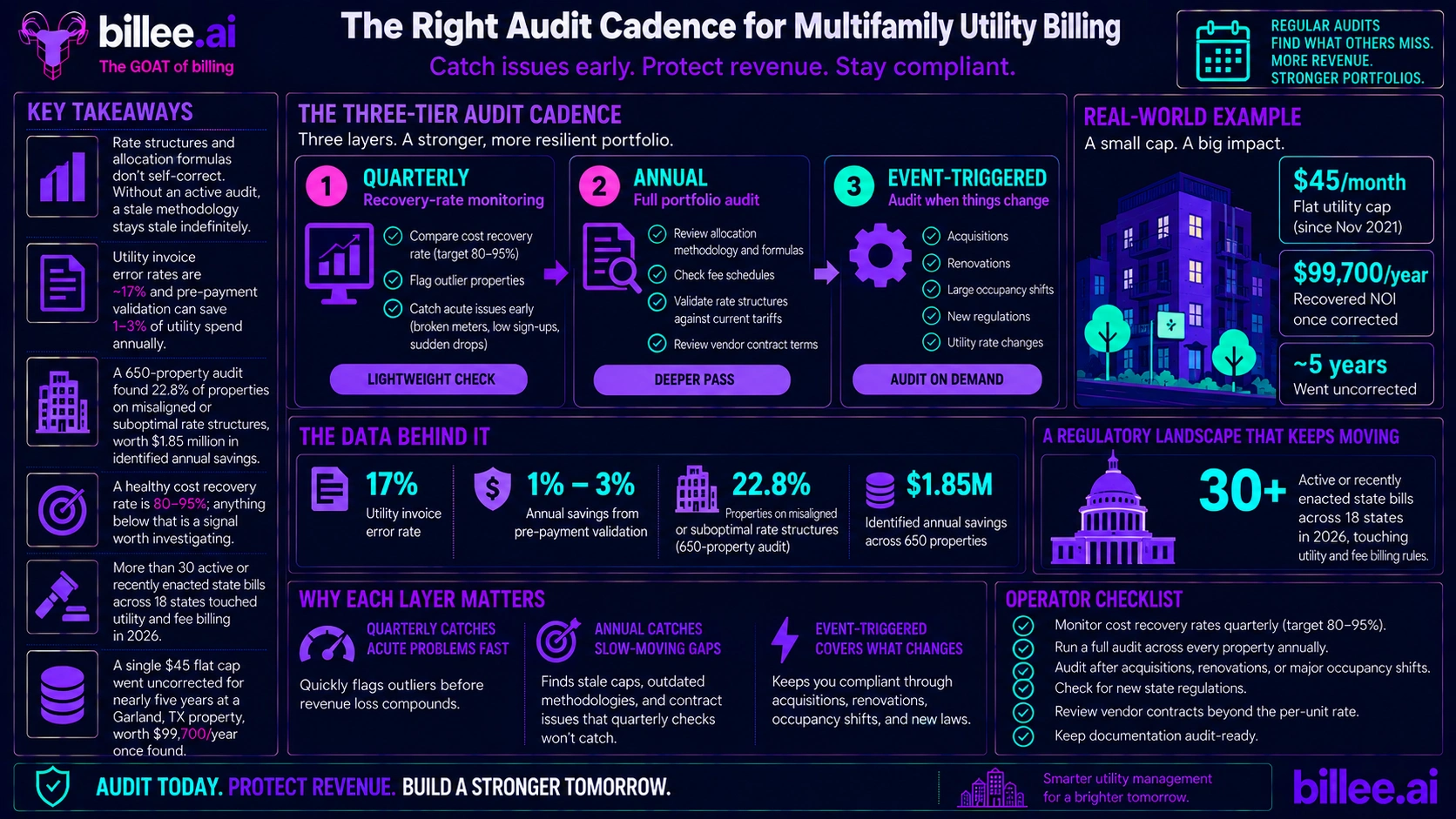
A $45 flat utility cap on one building at a Garland, Texas property sat unchanged from November 2021 until a recent Billee portfolio audit finally caught it, nearly five years after it stopped reflecting the property's actual allocated costs. Once corrected, that single cap was worth $99,700 a year in recovered NOI. Nobody set out to leave $99,700 a year on the table for five years. Nobody was auditing on a cadence that would have caught it sooner, either. Those two facts are the same fact.
Quick answer
A multifamily portfolio needs three layers of review, not one annual event: a lightweight quarterly check of recovery rates to catch outlier properties early, a full annual audit of methodology, formulas, fees, and rate structures at every property, and event-triggered audits outside that schedule whenever something changes, an acquisition, a renovation, a large occupancy shift, a new regulation, or a utility rate change. Skipping any one of the three layers is how a gap like Garland's survives for years instead of months.
Key takeaways
- Rate structures and allocation formulas don't self-correct. Without an active audit, a stale methodology stays stale indefinitely.
- Industry data puts invoice error rates at roughly 17%, and pre-payment validation alone can save 1 to 3% of utility spend annually.
- A 650-property audit found 22.8% of properties operating on misaligned or suboptimal rate structures, worth $1.85 million in identified annual savings across that sample, per Conservice's own published audit data.
- A healthy utility cost recovery rate benchmark sits between 80 and 95%; anything below that range at a given property is a signal worth investigating before the next scheduled audit.
- The regulatory target keeps moving: more than 30 active or recently enacted state bills across 18 states touched utility and fee billing in the 2026 legislative cycle alone.
- The Garland property's flat cap went uncorrected for nearly five years, worth roughly $99,700 a year once found, illustrating what an absent audit cadence actually costs in practice.
- Quarterly monitoring and an annual audit aren't redundant; quarterly catches acute problems fast, while the annual audit catches the slow-moving structural ones quarterly monitoring isn't built to find.
Why this matters
The core problem with utility billing accuracy is that almost nothing about it self-corrects. A rate structure that was right five years ago doesn't automatically stay right as usage patterns, occupancy, and utility company tariffs change; it just sits there, unexamined, until someone specifically checks it. Conservice's own audit of 650 properties found that 22.8% were operating on a misaligned or suboptimal rate structure, not because of a calculation error but because the underlying rate classification, general commercial pricing instead of a multifamily-specific rate, or a legacy tier no longer matched actual usage, had simply never been revisited. That audit alone identified $1.85 million in projected annual savings once corrected.
The invoice-level error rate compounds the same underlying pattern. Roughly 17% of utility invoices contain some error, and while pre-payment validation catches a meaningful share of that, roughly 1 to 3% of total spend annually, it only works if someone is actually doing the validation on a defined schedule rather than sporadically. And the target an audit is checking against isn't static either: 2026 alone saw more than 30 active or recently enacted state bills across 18 states touching utility and fee billing rules, meaning a methodology or fee structure that was compliant a year ago can drift out of compliance without a single thing changing at the property itself.
None of this shows up as an emergency. It shows up as a quiet, compounding gap that looks exactly like the Garland cap: stable, unremarkable, and wrong for years before anyone checks.
The three-tier cadence
Quarterly: recovery-rate monitoring. This is a lightweight check, not a full audit. It compares each property's utility cost recovery rate against a healthy benchmark, generally 80 to 95%, and flags anything falling outside that range for a closer look. This layer exists to catch acute problems fast: a broken meter, a lease-up cohort with poor sign-up rates, a sudden drop tied to a specific building or unit type. It's cheap to run and doesn't require the depth of a full audit, which is exactly why it should happen far more often than once a year.
Annual: the full audit. This is the deeper pass: every property's allocation methodology checked against current rules, every fee schedule checked for staleness or gaps, every rate structure checked against the utility's current tariff, and every vendor contract term reviewed for the categories that don't show up in a headline rate. This is the layer that would have caught the Garland cap, since a $45 flat cap doesn't show up as a recovery-rate anomaly if residents simply pay whatever the cap says without complaint. It only shows up when someone checks whether the cap itself still makes sense.
Event-triggered: outside the regular schedule entirely. Some changes warrant an audit regardless of where a property sits in its quarterly or annual cycle: an acquisition or portfolio onboarding, a major renovation that changes unit mix or square footage, a large occupancy shift, a new state or local regulation taking effect, or a rate or tariff change from the utility itself. Waiting for the next scheduled audit to catch a change that already happened is how a property spends months operating on a formula or rate that's already been overtaken by events.
What going unaudited actually costs over time
The Garland cap makes the cost of no cadence concrete. It was set, or at least last adjusted, in November 2021 and stayed in place until a recent audit corrected it, roughly five years of a property billing residents under a cap that no longer matched its actual allocated utility costs. At the $99,700 a year the correction identified, even a rough, non-compounding estimate using that figure as a proxy for the gap across those years puts the uncorrected shortfall at somewhere in the range of $450,000 to $500,000 over the full period, and that's before accounting for the added property value that recovered NOI represents at sale or refinance. Billee's companion piece on legacy utility caps walks through the full valuation math on this specific case in more detail.
The point isn't the exact dollar figure, which depends on exactly how the gap widened year over year. The point is that a five-year gap is only possible when nothing in the audit cadence was positioned to catch a flat cap that simply never changes on its own. A quarterly recovery-rate check wouldn't have caught it, since residents were paying the capped amount without issue. Only a full audit that specifically asks "does this rate structure still make sense" would have.
How to prioritize which properties to audit first
A portfolio-wide annual audit doesn't have to hit every property with equal depth on the same timeline. Prioritizing a subset for the closest look first makes the annual cycle more effective:
- Properties with the highest total utility spend, where an error of any given percentage translates to the largest absolute dollar impact.
- Properties showing billing volatility, month-to-month swings that don't track with weather or occupancy changes.
- Properties with large common-area loads (pools, fitness centers, clubhouses), where allocation and deduction methodology has more room to drift.
- Properties with frequent estimated reads instead of actual meter reads, since estimated billing is where usage-based recovery quietly diverges from reality.
- Properties that haven't changed hands, been renovated, or triggered an event-based audit in longer than the standard annual window, since those are the properties most likely to be running on a stale methodology by default.
Who should own each layer of the cadence
The three tiers don't need to sit with the same team or the same process, and trying to force them into one workflow is often why the annual layer gets skipped in practice. Quarterly recovery-rate monitoring is lightweight enough to run as a standing report, something a regional manager or an internal analytics team can review on a fixed schedule without specialized regulatory knowledge. It's a dashboard check, not an investigation.
The annual audit is a different kind of work. It requires checking allocation methodology against current state and local rules, reading lease disclosure language against what's actually being billed, and comparing rate structures against current utility tariffs, work that benefits from a dedicated compliance function or an outside partner who tracks rule changes across every jurisdiction a portfolio operates in. A property team stretched across leasing, maintenance, and resident relations is rarely positioned to also stay current on regulatory changes in 18 different states.
Event-triggered audits sit somewhere in between. An acquisition audit is often already part of standard due diligence, so the gap isn't usually whether it happens but whether it specifically checks utility methodology and fee structures rather than just confirming the current numbers reconcile. A renovation or occupancy-shift trigger is easier to miss, since it depends on someone connecting a physical or operational change back to the billing methodology it affects, which is exactly the kind of cross-functional handoff that falls through without a documented process for it.
Common mistakes
- Treating the annual audit and quarterly monitoring as interchangeable. Quarterly recovery-rate checks catch fast-moving problems; only the deeper annual audit catches a structural issue like a flat cap or a stale formula that never trips a recovery-rate alarm.
- Skipping the audit after an acquisition because "it's already been checked." A prior owner's audit history doesn't transfer with the sale, and inherited caps or formulas are one of the most common gaps found at newly acquired properties.
- Auditing every property on the same fixed calendar date regardless of risk. Properties with high spend, volatility, or estimated reads deserve earlier and deeper attention than low-risk properties on the same annual clock.
- Assuming a compliant methodology stays compliant. Regulatory rules change independently of anything happening at the property, so an annual audit needs to check current rules, not just internal consistency with last year's audit.
- Not tracking when the last audit actually happened, property by property. Without a documented cadence, "we audit annually" quietly becomes "we audit whenever someone remembers to," which is how five-year gaps happen.
- Waiting for a resident complaint to trigger a review. A flat cap or stale fee that under-collects doesn't generate complaints; it only generates a quiet, ongoing loss that a complaint-driven process will never surface.
What staying on cadence is worth
The Garland example puts a real number on what a missed cadence costs: roughly $99,700 a year, or an estimated $450,000 to $500,000 across the nearly five years the cap went unchecked. At a 6% cap rate, the $99,700 annual figure alone is worth approximately $1.66 million in added asset value, detailed in the companion legacy-cap article. A disciplined cadence doesn't eliminate every gap immediately, but it caps how long any single gap can run before it's found, turning a potential five-year loss into, at most, a one-year one.
How Billee can help
Billee's Regulatory & Compliance service runs the full three-tier cadence across a portfolio: ongoing recovery-rate monitoring, a full annual audit of methodology, fees, and rate structures at every property, and event-triggered reviews whenever an acquisition, renovation, or regulatory change warrants one. It's the same audit discipline that caught the Garland cap and recovered $220,500 across five properties in a single pass of a 36-property Texas portfolio.
FAQ
How often should a multifamily property run a full utility billing audit?
At least annually, with a lighter quarterly recovery-rate check in between and additional audits triggered by specific events like an acquisition, renovation, or regulatory change.
What's the difference between quarterly monitoring and an annual audit?
Quarterly monitoring is a lightweight check of recovery rates against a healthy benchmark, meant to catch acute problems fast. An annual audit is a deeper review of methodology, formulas, fees, and rate structures, meant to catch slow-moving structural issues quarterly monitoring won't surface.
What events should trigger an audit outside the normal schedule?
An acquisition or portfolio onboarding, a major renovation, a large occupancy shift, a new regulation taking effect, or a rate or tariff change from the utility itself.
How much can go undetected without a regular audit cadence?
The Garland property's flat utility cap went uncorrected for nearly five years, worth an estimated $450,000 to $500,000 over that period once corrected. Gaps like this don't self-correct and don't typically generate resident complaints, so they can run indefinitely without an active audit.
What's considered a healthy utility cost recovery rate?
Generally 80 to 95%. A property falling below that range is worth investigating before the next scheduled audit rather than waiting for the annual cycle.
Should every property in a portfolio be audited with the same depth and timing?
Not necessarily. Properties with the highest utility spend, the most billing volatility, large common-area loads, or frequent estimated reads benefit from earlier and deeper attention than lower-risk properties on the same annual clock.
Why doesn't quarterly recovery-rate monitoring catch something like a stale flat cap?
Recovery-rate monitoring flags properties where actual collections fall short of what's billed. A flat cap that residents pay without complaint doesn't trigger that signal; it only surfaces when an audit specifically asks whether the cap itself still reflects current allocated costs.
Does a compliant methodology stay compliant without further review?
No. Regulatory rules change independently of anything happening at the property, so a methodology that was compliant at last year's audit needs to be checked against current rules, not just compared to its own prior state.
Related reading
- When a Legacy Utility Cap Is Quietly Costing Your Portfolio $100K a Year: the full Garland case and valuation math referenced here.
- Top Multifamily Utility Management Mistakes to Avoid: a broader list of recurring errors, including the regulatory-change risk cited above.
- The Utility Billing Fees That Don't Show Up in the Per-Unit Rate: the vendor-contract terms worth reviewing at the same annual cadence.
If it's been longer than a year since a full audit checked methodology, fees, and rate structures property by property, that's worth fixing before the next renewal cycle, not after. Talk to the team.
Sources
- Conservice, "What 650 Property Audits Revealed About Utility Rate Misalignment," 2026.
- Conservice, "The NOI Drain You Can't See: How Utility Billing Errors Quietly Undermine Portfolio Performance," 2026.
Insights and Industry Trends


Explore more insights