
In-House vs. Outsourced Meter Maintenance: What Multifamily Operators Should Weigh
This is a different question than the one Billee's guide on billing outsourcing answers. That piece compares who processes invoices and posts charges to resident ledgers. This one is about who tests, calibrates, repairs, and replaces the physical meters and the network hardware that reads them, a decision that shapes accuracy, response time, and cost in ways billing software choice never touches. Most operators land somewhere between fully in-house and fully outsourced, and the right mix depends on portfolio size, meter technology, and how much testing volatility a property can absorb.
Key Takeaways
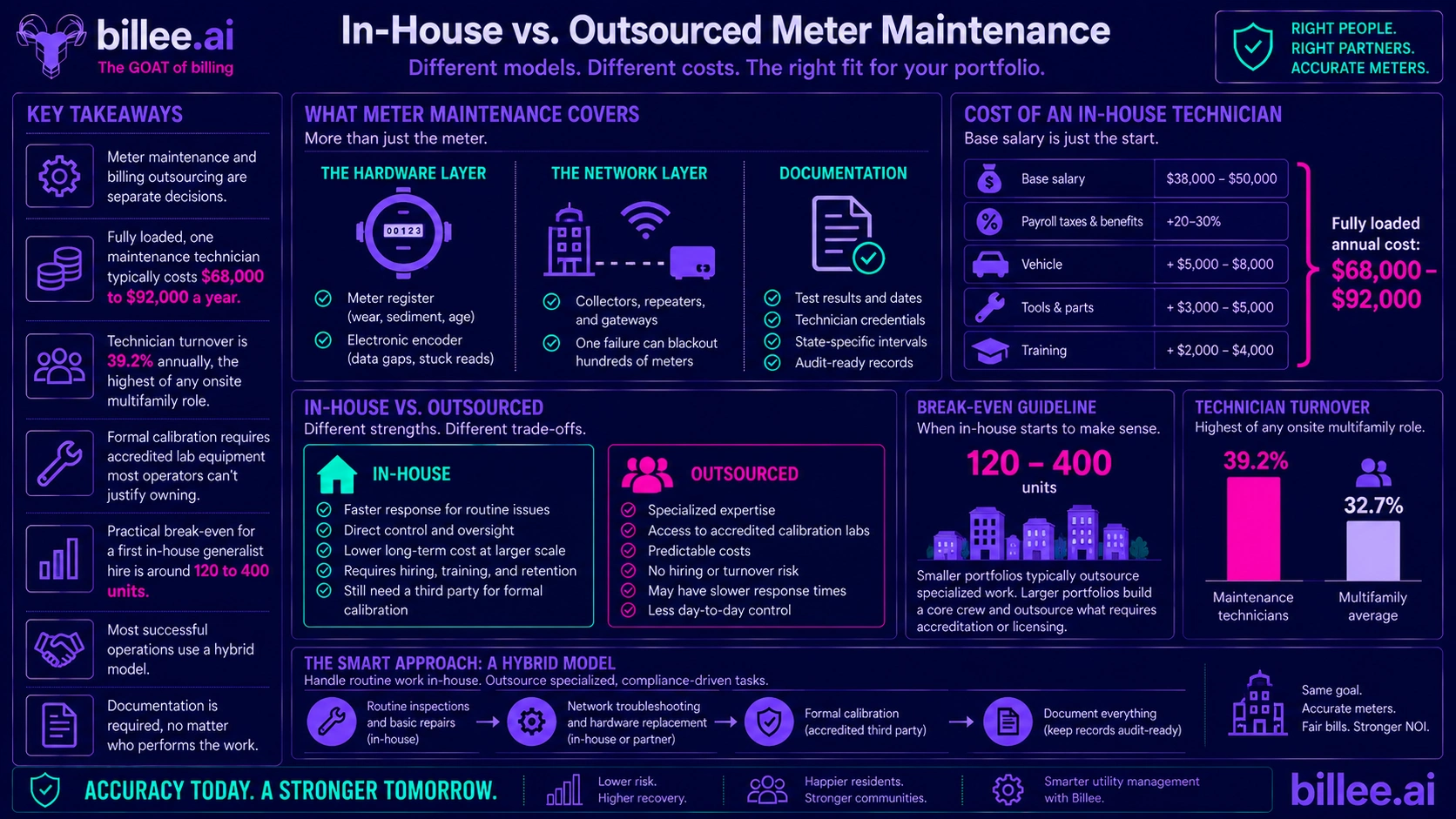
- Meter maintenance and billing outsourcing are separate decisions. Billee's own outsourcing guide covers billing operations exclusively and does not address physical hardware.
- In-house staffing carries a real cost beyond base salary. Fully loaded, one maintenance technician typically runs $68,000 to $92,000 a year once taxes, benefits, a vehicle, tools, and training are counted, well above the roughly $38,000 to $50,000 base salary range alone.
- Maintenance technician turnover is the highest of any onsite multifamily role, with one tracked figure at 39.2% annually against a 32.7% multifamily-wide average, and replacing a technician typically costs $10,000 to $15,000 once recruiting and training are included.
- Formal meter calibration against a NIST-traceable standard requires accredited lab equipment most operators cannot justify owning, which is why even heavily in-house maintenance teams typically route calibration itself to a specialized third party.
- General property maintenance staffing research puts the practical break-even around 120 to 400 units for a first in-house generalist hire, with larger portfolios building a core crew and outsourcing specialized or licensed work.
- Most successful maintenance operations run a hybrid model, handling routine and first-line work in-house while outsourcing specialized, compliance-driven, or accreditation-dependent tasks like formal calibration.
- Neither path removes the need for documentation. Whoever performs the physical maintenance, the testing record has to exist and hold up under audit or dispute.
What Meter Maintenance Actually Covers
The hardware layer
A submeter has more failure points than the register a resident's bill is based on. Advanced metering infrastructure guidance for water utilities breaks the hardware into the meter register itself, which is subject to accuracy drift from wear, sediment fouling, and age, and the electronic encoder that converts a physical reading into digital data. Encoder failures are particularly easy to miss, since they can produce data gaps, stuck reads, or billing discrepancies that go undetected for months rather than failing all at once.
The network layer
Individual meters are only half the system. Submeters that transmit readings by radio or cellular signal depend on a network of collectors, repeaters, and gateways to reach the software that turns readings into bills. Utility AMI maintenance guidance puts this plainly: a single collector or repeater failure can black out hundreds of meters at once, and a meter that cannot communicate is functionally identical to a dead one. It produces no billing data and no early warning that something is wrong.
This is a water-utility framing being applied here to multifamily submetering, since dedicated multifamily-specific network maintenance data is harder to find, but the underlying hardware logic is the same regardless of scale.
Documentation as its own maintenance task
A testing record that cannot be produced on request is, for practical purposes, the same as a test that never happened. Whoever performs the physical work, someone has to own keeping dated calibration records, technician credentials, and state-specific testing intervals in a form that survives a resident dispute or a refinancing due-diligence request.
The In-House Case
What staffing it actually requires
Property maintenance technicians earn a national average of roughly $21 an hour, with typical base salaries between $38,000 and $50,000 a year. General apartment maintenance certifications exist, including the Certificate for Apartment Maintenance Technicians and National Accredited Housing Maintenance credentials, but these cover broad maintenance competency rather than meter-specific calibration work. There is no universal license for meter calibration the way there is for HVAC refrigerant handling under EPA Section 608. In practice, an in-house technician can inspect, clean, and replace obviously failed hardware, but formal calibration against a traceable standard is a different, more specialized task.
The full cost of a technician
Base salary is not the real cost of an in-house hire. Once payroll taxes, benefits, and insurance are applied as a loading factor, plus a vehicle, tools and parts stock, and training time, one fully loaded maintenance technician typically costs $68,000 to $92,000 a year. At a common staffing ratio of one technician per 100 to 150 units, that works out to roughly $45 to $75 per unit per month in maintenance labor cost at scale, before any specialized calibration work is added on top.
Turnover is the real cost driver
Onsite maintenance technicians had a 39.2% annual turnover rate as of 2021, the highest of any multifamily role and well above the multifamily-wide average of 32.7%. A separate industry estimate puts maintenance turnover even higher, above 50% annually, though that figure comes from an unspecified "some studies estimate" attribution and should be read as a rougher, less rigorously sourced range rather than a confirmed benchmark. Either way, replacing a technician costs an estimated $10,000 to $15,000 once recruiting, screening, and training are counted, and a large portfolio staffed at one technician per 100 units can lose well over $100,000 a year to turnover alone before a single meter is tested.
What in-house buys you
The advantage that outsourcing struggles to match is speed. An in-house team can typically respond to an onsite issue in 15 to 30 minutes, and the technician handling it already knows the property's specific meter mix, wiring quirks, and access points. That institutional knowledge has real value for anything time-sensitive, even if it doesn't extend to formal calibration accuracy.
The Outsourced Case
Specialized calibration labs
Formal meter calibration against a NIST-traceable standard is a genuinely different service than general maintenance. Accredited calibration labs compare a meter's readings against primary measurement standards under ISO/IEC 17025 accreditation, producing a certified report of what the meter measured before and after any adjustment. Two calibration providers publicly describe turnaround times of roughly 7 to 10 business days for this kind of testing, though neither discloses per-meter pricing. This is the piece of meter maintenance that most operators, even ones with a strong in-house maintenance crew, end up routing to a third party, simply because owning NIST-traceable calibration equipment is not something a single property or even a mid-size portfolio can typically justify.
General outsourced trade and maintenance rates
Outside of formal calibration, general outsourced maintenance and trade work is typically billed at $75 to $150 an hour depending on the trade, plus a trip fee, with no fixed payroll or benefits cost attached. That variable-cost structure is the main financial argument for outsourcing: a property only pays for work actually performed, rather than carrying a technician's fully loaded cost through slow periods.
What outsourcing buys you, and what it costs
Outsourcing shifts liability for workers' compensation and OSHA compliance to the vendor and gives instant access to licensed specialists a generalist maintenance hire legally cannot cover. The tradeoff is response time, typically 2 to 24 hours depending on the service agreement rather than the 15 to 30 minutes an in-house team can offer, plus quality consistency that varies by vendor and, without a clear scope of work, invoicing that can arrive as what one facilities-management analysis calls a black box: charges without meaningful work-order detail behind them.
The Hybrid Reality Most Operators Land In
Portfolio size sets the natural dividing line
General property maintenance staffing research, not specific to meters but directly applicable to the staffing math behind them, puts the practical threshold for a first in-house generalist hire somewhere between 120 and 400 units, since volume below that range typically cannot keep one technician fully occupied. Portfolios in the 400 to 1,500-unit range tend to build a core in-house crew of three to eight people handling the bulk of routine volume, while outsourcing specialized and licensed work. Above 1,500 units, the pattern shifts to regionalized in-house teams paired with negotiated vendor contracts for calibration and specialized trades. These figures come from general facilities and property maintenance staffing analysis rather than a meter-specific study, and are presented here as the best available proxy for reasoning through meter maintenance staffing specifically.
What a hybrid model actually looks like
The practical version of this split is straightforward: in-house staff handle visual inspection, obvious hardware failures, and minor repairs, while formal calibration and testing against a traceable standard routes to an accredited third party. Across general property maintenance functions, most operators land around 70 to 80% of work handled in-house and 20 to 30% outsourced, though meter calibration specifically tends to skew further toward outsourcing than that average, given the accreditation requirement behind it.
Building the split deliberately rather than by default
A useful starting exercise is auditing a year of maintenance and meter-related work orders to separate routine tasks from specialized ones, then permanently outsourcing anything that requires a license, certification, or accredited equipment an in-house team does not hold. Staffing the in-house crew for baseline volume rather than peak demand, and tracking vendor performance on response time and rework rate rather than price alone, keeps the split from drifting toward whichever option was easiest to arrange rather than the one that actually fits the portfolio.
Decision Factors at a Glance
| Factor | Favors In-House | Favors Outsourced |
|---|---|---|
| Portfolio size | 400+ units with steady work-order volume | Under 400 units, or volume too thin to occupy a full-time hire |
| Response time needs | Urgent, resident-facing hardware failures | Scheduled testing and calibration cycles |
| Accreditation requirement | Not applicable to visual inspection and minor repair | Required for any formal NIST-traceable calibration |
| Geographic spread | Single site or tight cluster | Multi-state portfolios facing varied testing requirements |
| Staff turnover exposure | Low-turnover, stable maintenance team | High-turnover markets where hiring cycles are constant |
| Documentation ownership | In-house CMMS with full visibility | Vendor-supplied certified reports with clear scope |
Best Practices Regardless of Model
Track meter age against known service-life benchmarks
Mechanical water meters have a commonly cited service life of roughly 6 to 8 years before wear affects accuracy, a figure from a single manufacturer source rather than an independent standard, while ultrasonic meters with no moving parts tend to hold accuracy longer. Either way, tracking installation dates against expected service life, covered in more depth in Billee's guide on how often submeters should be calibrated, flags aging hardware before it becomes an accuracy problem, regardless of who performs the physical testing.
Keep the documentation trail intact
Water utility AMI maintenance guidance notes that meter accuracy can decline 1 to 3% annually without structured upkeep, and that programs run through a maintenance-management system see meter read success rates of 97 to 99.5%, compared with 88 to 94% for portfolios without one. That data comes from municipal water utility operations rather than multifamily submetering specifically, but the underlying logic, that untracked hardware drifts and tracked hardware doesn't, applies at any scale. Billee's Regulatory & Compliance product supports the audit trail that protects an operator regardless of whether the physical testing was done in-house or by a vendor.
Watch recovery rate as the leading indicator
Billee's guide on the real cost of uncalibrated meters walks through how a recovery rate drifting out of the healthy 80-95% range shows up as lost NOI well before residents start filing complaints. That signal matters regardless of maintenance model. It tells an operator that something in the hardware or the testing cadence needs attention, whether the next step is a call to the in-house team or a work order to a vendor.
What to Look for in a Partner
- NIST traceability and ISO/IEC 17025 accreditation for any formal calibration work, not just a general claim of accuracy
- A stated testing cadence tied to the actual requirements of the states a portfolio operates in, not a generic interval
- Clear service-level commitments on response time, since outsourced response windows run 2 to 24 hours compared with an in-house team's 15 to 30 minutes
- Itemized reporting rather than invoices without work-order detail behind them
- A documented scope of work that separates routine maintenance from accredited calibration, so both sides know which tasks require which credentials
How Billee Supports This
Billee does not perform physical meter calibration, but the platform is built to make either staffing model easier to manage. Meter Monitoring & Alerts flags the early signs of hardware drift, stuck reads, and communication gaps that either an in-house technician or an outsourced vendor needs to act on. Billee's Billing & Recovery Engine tracks recovery rate as the leading indicator described above, so a hardware problem surfaces as a number worth investigating long before it becomes a resident complaint.
FAQ
Should meter maintenance be handled in-house or outsourced? Most operators land on a hybrid model: in-house staff handle inspection and minor repairs, while formal calibration against a NIST-traceable standard goes to an accredited third party, since owning that equipment rarely makes sense below a large multi-state portfolio.
What does it actually cost to staff meter maintenance in-house? Fully loaded, one maintenance technician typically costs $68,000 to $92,000 a year once benefits, a vehicle, tools, and training are included, well above the $38,000 to $50,000 base salary range alone, and that figure doesn't include specialized calibration equipment.
Is there a certification specifically for meter calibration technicians? Not a universal one. General apartment maintenance certifications exist, but formal meter calibration against a traceable standard is typically performed by accredited labs under ISO/IEC 17025, a different credential than general maintenance certification.
How much does outsourced meter calibration typically cost? Public pricing is not disclosed by the calibration providers reviewed for this article. Operators should expect to request a quote directly, since published rates were not available for either specialized calibration labs or general outsourced trade work beyond a stated hourly range of $75 to $150 for general trades.
At what portfolio size does an in-house maintenance hire make financial sense? General property maintenance staffing research puts the practical threshold around 120 to 400 units for a first generalist hire, since smaller volumes typically cannot keep one technician fully occupied.
Why is maintenance technician turnover relevant to a meter maintenance decision? Maintenance turnover runs higher than any other onsite multifamily role, with replacement costs of $10,000 to $15,000 per technician. That volatility is one of the strongest arguments for outsourcing at least the specialized, accreditation-dependent parts of meter maintenance, where continuity matters most.
Does outsourcing meter maintenance remove the need for in-house documentation? No. Whoever performs the physical work, the property still needs to maintain dated testing and calibration records in a form that holds up under a resident dispute or a due-diligence review.
Whether meter maintenance runs in-house, through a vendor, or somewhere in between, the signal that something has gone wrong should show up in the numbers first. Talk to Billee about tracking recovery rate and hardware alerts so a maintenance decision gets made on data, not guesswork.
Sources
- ZipRecruiter, "Property Maintenance Technician Salary"
- Skillcat, "Apartment Maintenance Industry & Certification Requirements"
- Multifamily Dive, "How to retain maintenance workers in a competitive market"
- AppWork, "Reducing Maintenance Staff Turnover Is the Key to Lower Costs"
- Applied Technical Services, "Water Meter Calibration Services"
- Badger Meter, "Flow Dynamics Calibration Services"
- Oxmaint, "Water Meter Maintenance & AMI System Guide 2026"
- Oxmaint, "In-House vs. Outsourced Maintenance Staffing for Property Managers"
- FacilitiesNet, "Outsourcing Maintenance: When It Makes Sense and When It Doesn't"
Insights and Industry Trends