

Houston vs. DFW: Why Utility Billing Compliance Looks Different by Metro
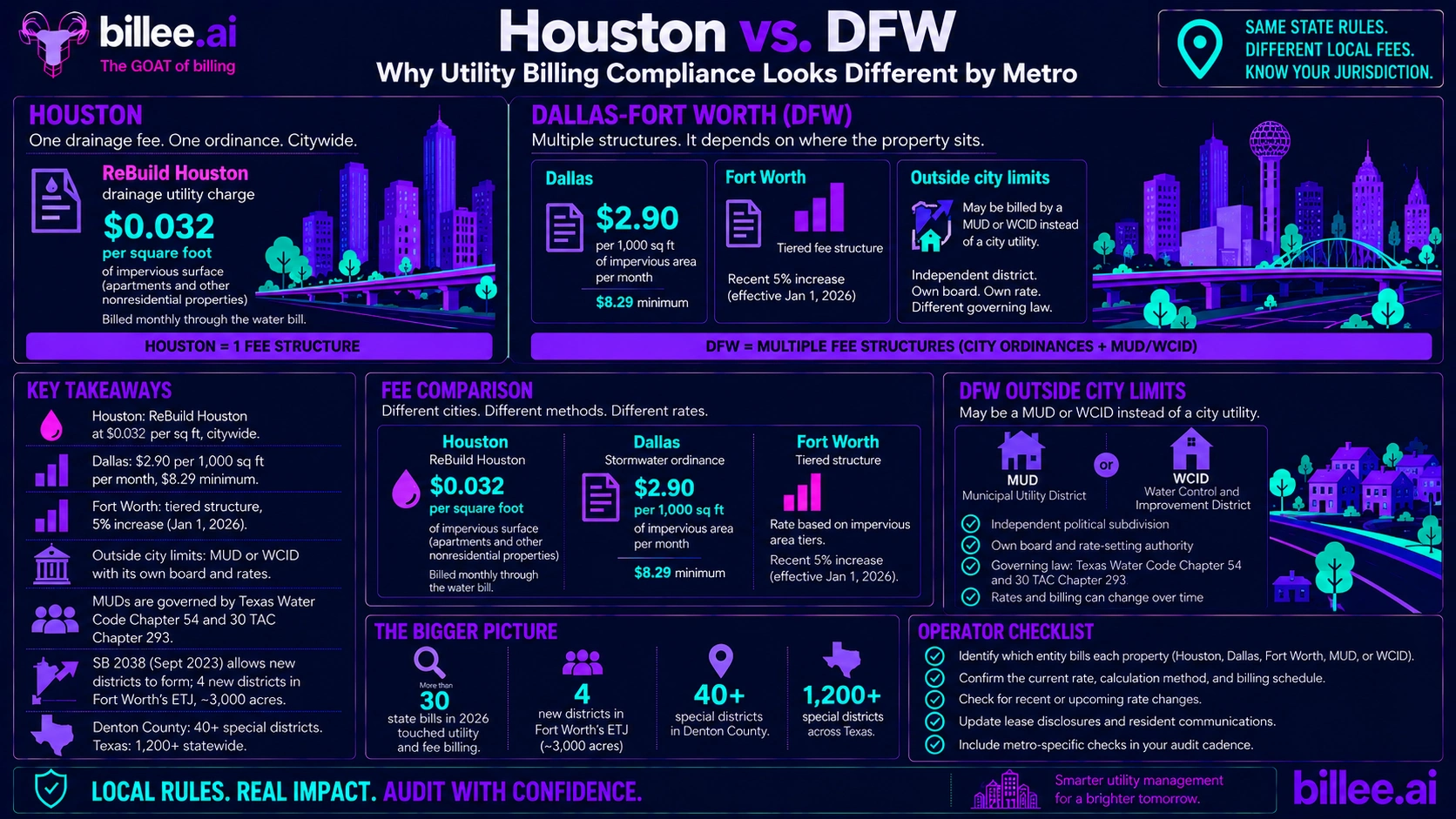
Houston runs one drainage fee, under one ordinance, citywide. Dallas runs its own, calculated a different way. Fort Worth runs a third, different from both. And once a DFW property sits outside city limits, it may not be billed by a city at all, it may be billed by a Municipal Utility District with its own board, its own tax rate, and its own governing law, and new ones are still forming today. The state-level rules covered elsewhere in this series (allocation formulas, backbilling limits, lease disclosures) apply the same way in both metros. What doesn't is everything underneath them: which entity is actually billing a property, on what schedule, using what math. Properties B and C in the RET LP audit, both in Houston, were flagged for a missing or miscalculated stormwater admin fee. Almost certainly, that fee was Houston's own ReBuild Houston drainage charge, a single, specific, citywide program with its own rate and its own rules. A DFW property with the same kind of gap could be missing one of at least three or four entirely different fee structures, depending on exactly where it sits.
Quick answer
Houston bills a single citywide drainage utility charge (ReBuild Houston) based on impervious surface, currently $0.032 per square foot for apartment and other nonresidential properties, through the water bill. Dallas and Fort Worth each run their own, separate stormwater fee ordinances, with different rate structures from Houston's and from each other. Outside city limits, a DFW-area property may instead be governed by a Municipal Utility District (MUD) or Water Control and Improvement District (WCID), an independent political subdivision with its own board and rate-setting authority, not a city ordinance at all. A Houston portfolio tracks one fee schedule. A DFW portfolio may need to track a different provider, rate, and governing entity at every property, and confirm it hasn't changed since the last audit, which is exactly the kind of property-by-property detail Billee's audits are built to catch.
Key takeaways
- Houston's ReBuild Houston drainage utility charge applies citywide at $0.032 per square foot of impervious surface for apartment and other nonresidential properties, billed monthly through the water bill.
- Dallas's separate stormwater ordinance charges $2.90 per 1,000 square feet of impervious area per month, with an $8.29 minimum, an entirely different calculation from Houston's.
- Fort Worth runs its own tiered stormwater fee structure under a separate city code section, recently increased 5% effective January 1, 2026.
- Outside Dallas and Fort Worth's city limits, a property may be served by a Municipal Utility District (MUD) or Water Control and Improvement District (WCID) instead of a city utility, an independent governance structure entirely.
- MUDs are governed by Texas Water Code Chapter 54 and 30 TAC Chapter 293, not by city ordinance, with a board initially appointed by the TCEQ and later elected to four-year, unsalaried terms.
- Senate Bill 2038, effective September 2023, lets landowners petition to leave a city's extraterritorial jurisdiction and form a new district instead; four have already formed in Fort Worth's ETJ alone, releasing roughly 3,000 acres from city oversight.
- Denton County now has more than 40 special districts providing water or emergency services, and Texas has more than 1,200 special districts statewide.
- A DFW property's governing utility entity isn't necessarily fixed at acquisition; new districts are actively forming, so the entity billing a property can change after a portfolio already owns it.
- Properties B and C in the RET LP audit, both Houston properties, were almost certainly missing exactly the ReBuild Houston drainage charge that a citywide audit line item covers in a single pass.
Why this matters
The RET LP portfolio Billee audited concentrates in Houston and Dallas-Fort Worth, and the state-level rules already covered in this series, the PUC's allocation formulas, the six-month backbilling cap, lease disclosure requirements, apply identically in both metros. What sits underneath those rules doesn't. Houston bills utility and drainage charges through one department under one ordinance. DFW is a patchwork of separate city codes and, outside city limits, entirely separate governmental entities with their own boards and their own rate-setting authority. A compliance checklist written for one metro doesn't automatically transfer to the other, and the gap isn't theoretical: it's exactly the kind of thing that shows up as a missing or miscalculated fee line on an audit.
Properties B and C make this concrete. Both are Houston properties, and both were flagged for an incorrect trash admin fee and a missing stormwater admin fee. Houston's stormwater charge isn't a generic concept; it's a specific, citywide program, ReBuild Houston, with a published rate and a published calculation method. A property missing that fee wasn't missing an abstract "stormwater fee." It was out of step with one particular ordinance that every other Houston property in the portfolio is also subject to, in the same way, at the same rate.
DFW doesn't offer that kind of uniformity, and it's getting less uniform, not more. New utility districts are actively forming under a 2023 state law, meaning the governance picture for a DFW-area property isn't necessarily static even after it's already been audited once.
Houston: one city, one drainage fee
Most of Houston's urbanized core is served by City of Houston Public Works, and the drainage-specific charge, ReBuild Houston, is a single citywide program rather than a patchwork of neighborhood-level rules. The charge is based on impervious surface, any area that doesn't readily absorb water: buildings, driveways, parking lots, patios. Apartment properties are classified as nonresidential for this purpose and billed at $0.032 per square foot of impervious surface, compared to $0.032 per square foot for residential properties on curb-and-gutter systems and $0.026 for residential properties on open-ditch systems. The charge is typically billed monthly through the water bill, in either 12 monthly or 4 quarterly installments depending on whether the property already has a city water account. The Houston Apartment Association estimates the impact at roughly $1 to $6 per unit annually for most properties, a modest figure per unit that still adds up across a portfolio, and one Property B and C's combined $29.9k in corrections suggests was being missed or miscalculated entirely rather than merely underpriced.
Passing the charge to residents is allowed, and the Texas Apartment Association's model addendum spells out the protections that go with it: payment due no sooner than 16 days after notification, late charges capped at 5% of the bill, administrative fees capped at $3.00, at least 35 days' notice required before any fee change, and a 60-day window for a resident to dispute the impervious-surface calculation if documentation shows a potential adjustment of at least 2% or $3. All of this sits under one ordinance, administered by one city department, which makes a Houston-only portfolio's compliance picture comparatively simple: one rate, one billing relationship, one dispute process, applied the same way at every property in the city.
Dallas and Fort Worth: same idea, different math, different ordinance
Dallas runs its own, entirely separate stormwater drainage utility program under its own city code section. Nonresidential properties, apartments included, are charged $2.90 per month for each 1,000 square feet, or part thereof, of impervious area, with an $8.29 minimum monthly fee regardless of how small the property's impervious footprint is. Certain properties are exempt, city- and state-owned property, colleges and universities, and cemeteries closed to new interments, and where a property has multiple owners, all co-owners are jointly and severally liable for the charge. The city bills it through the regular water and wastewater account, the same delivery mechanism Houston uses, but the rate, the minimum, and the exemption list are all Dallas's own.
Fort Worth runs a third program, under its own separate city code section, with its own tiered rate categories for residential, commercial, and industrial properties, scaling commercial and industrial rates by impervious surface the same way Houston and Dallas do conceptually, but at Fort Worth's own rates. The city council approved a 5% increase effective January 1, 2026, moving the standard residential tier from $6.94 to $7.29 a month, with commercial and industrial rates adjusting proportionally.
None of these three ordinances match. A portfolio with properties in Houston, Dallas, and Fort Worth is tracking three different rate schedules, three different minimums and exemption structures, and three different dispute processes, for what is conceptually the same charge in each city. Applying one city's rate, notice period, or dispute window to a property in a different city isn't a rounding error; it's checking the wrong ordinance entirely.
The MUD layer: DFW's utility landscape outside city limits
Inside Dallas or Fort Worth's city limits, a property is billed by the city. Outside those limits, which describes a substantial share of the DFW metro's newer multifamily development, a property may instead be served by a Municipal Utility District or a Water Control and Improvement District, an independent political subdivision created by petitioning the Texas Commission on Environmental Quality, not a city department at all.
A MUD's board starts with five members appointed by the TCEQ, who are then replaced over time by residents elected to four-year, unsalaried terms. The district is governed by Texas Water Code Chapter 54 and 30 TAC Chapter 293, with the Public Utility Commission holding appellate jurisdiction over rate disputes, a structure with essentially no overlap with a city's own ordinance-making process. MUDs raise revenue two ways: usage-based utility charges, similar in concept to a city water bill, and ad valorem property taxes used to repay the bonds that financed the district's original infrastructure. The state caps how high that combined tax rate can go, and the cap itself varies by county: up to $1.50 per $100 of valuation in Harris, Galveston, Montgomery, Fort Bend, Waller, and Brazoria counties, $1.20 in Dallas, Denton, Collin, Tarrant, Travis, Hays, Williamson, Comal, and Guadalupe counties, and $1.00 everywhere else. Notably, that means the Houston-area counties actually carry a higher permitted MUD tax cap than the core DFW counties do, the opposite of what the fragmentation story alone might suggest. When a city later annexes a MUD outright, the MUD's tax disappears and the city's own tax rate applies instead, which means a property's governing structure can shift in either direction over its ownership life.
A live example of the fragmentation getting worse, not better
DFW's utility landscape isn't a fixed patchwork; it's actively gaining new pieces. Senate Bill 2038, effective September 1, 2023, lets landowners in a city's extraterritorial jurisdiction petition, with signatures from 50% of the area's registered voters, to be released from that city's oversight and organize a new district instead. In Fort Worth's ETJ alone, near the Alliance development area, four new districts have formed under this process since the law took effect: Tradition MUD 2B, North Fort Worth Water Control and Improvement District, Alpha Ranch Water Control and Improvement District, and Brookfield Water Control and Improvement District, releasing roughly 3,000 acres from Fort Worth's oversight so far. Fort Worth still holds more than 169,000 acres in its ETJ, so the trend has considerable room to continue. Denton County alone now has more than 40 special districts providing water or emergency services, part of a statewide total exceeding 1,200 special districts of all kinds.
This isn't a purely administrative shift. Reporting on the new Fort Worth-area districts documented real operational consequences: a 2021 incident near Prosper in which paramedics took at least 13 minutes to reach a man having a heart attack, attributed in part to jurisdictional gaps around a newly formed district; debt repayment horizons of 20 to 30 years financed through district-level property taxes; multiple developers drilling into the same aquifer without centralized coordination; and district board meetings held in locations, in one case Dallas, that are inconvenient for the Denton County residents the district actually serves. For a portfolio operator, the relevant takeaway isn't the politics of any individual district formation. It's that a property's governing utility entity in DFW isn't a fact that gets established once at acquisition and then stays true indefinitely. It's a fact that needs re-checking, because the map itself is still being redrawn.
What this means operationally for a portfolio spanning both metros
For a Houston property, the audit checklist item is straightforward: confirm the ReBuild Houston drainage charge is calculated correctly against current impervious-surface documentation, and confirm the lease addendum language matches the current TAA-recommended terms.
For a DFW property, the checklist has an extra, more fundamental step that comes first: confirm which entity is actually billing the property today, the city of Dallas, the city of Fort Worth, a smaller municipality, or a specific named MUD or WCID, before assuming any particular rate or ordinance applies. That confirmation isn't a one-time task at acquisition. Given how actively new districts are still forming, it belongs in the annual audit cycle described in Billee's companion piece on audit cadence, not just the initial due-diligence file.
Common mistakes
- Applying a single portfolio-wide "Texas stormwater fee" assumption. Houston, Dallas, and Fort Worth each calculate this charge differently; there is no one statewide rate to apply by default.
- Assuming a DFW property is billed by the city in its mailing address. A property with a Fort Worth or Dallas mailing address can still sit outside that city's limits and be billed by a MUD or WCID instead.
- Not re-verifying the governing entity at each audit cycle in DFW. New districts are actively forming under SB 2038, so a governance fact confirmed two years ago may no longer be current.
- Applying Houston's ReBuild Houston rate or dispute language to a Dallas or Fort Worth property out of habit. The rate, the minimum, and the dispute window are specific to each city's own ordinance.
- Assuming DFW-area counties carry the same or higher MUD tax caps than Houston-area counties. The reverse is true; Harris and its neighboring counties permit a higher combined MUD tax rate than the core DFW counties do.
- Skipping governance and long-horizon debt questions during DFW acquisition due diligence. A property inside a MUD carries a 20-to-30-year tax obligation tied to district bonds, a materially different liability profile than a straightforward city utility relationship.
What getting this right is worth
Properties B and C's corrections, $5.3k and $24.6k in combined annual savings, were only possible because Billee checked the properties against Houston's actual ReBuild Houston rate rather than assuming a generic stormwater figure. Applied at a 6% cap rate, that combined $29.9k in corrected annual recovery is worth roughly $498,000 in added asset value at a future sale or refinance, on top of the monthly cash flow itself. For a DFW portfolio, the equivalent value doesn't come from a single citywide rate check; it comes from correctly identifying which of several possible entities, and which of several possible rate structures, actually governs each property before assuming any one policy applies portfolio-wide.
How Billee can help
Billee's Regulatory & Compliance service tracks utility billing at the level that actually matters: property by property, against the specific ordinance or district that governs each one, whether that's Houston's ReBuild Houston program, Dallas's or Fort Worth's own stormwater code, or a named MUD's current rate. It's the same audit discipline that caught the gaps at Properties B and C and recovered $220,500 across five properties in a single pass of a 36-property Texas portfolio.
FAQ
Does the same stormwater fee ordinance apply in Houston, Dallas, and Fort Worth?
No. Each city runs its own separate ordinance with its own rate structure: Houston charges $0.032 per square foot of impervious surface, Dallas charges $2.90 per 1,000 square feet with an $8.29 minimum, and Fort Worth uses its own tiered rate system.
What is the ReBuild Houston drainage utility charge?
It's Houston's citywide stormwater drainage fee, based on a property's impervious surface area, billed monthly through the water bill and currently set at $0.032 per square foot for apartment and other nonresidential properties.
How is Dallas's stormwater fee calculated differently from Houston's?
Dallas charges by the 1,000 square feet of impervious area ($2.90 per 1,000 square feet, $8.29 minimum) rather than Houston's flat per-square-foot rate, and the two ordinances have different exemptions and billing procedures.
What is a Municipal Utility District, and how is it different from a city utility?
A MUD is an independent political subdivision, created by petitioning the TCEQ, with its own elected board, its own rate-setting authority under Texas Water Code Chapter 54, and its own bond-financed tax structure, entirely separate from a city's utility department.
Why are new MUDs still forming in the DFW area?
Senate Bill 2038, effective September 2023, lets landowners petition to leave a city's extraterritorial jurisdiction and form a new district instead. Four have already formed in Fort Worth's ETJ alone since the law took effect.
How do I know if a DFW property is served by a city or by a MUD?
It depends on whether the property sits within city limits or in unincorporated territory, and mailing address alone doesn't answer that question. Confirming the governing entity requires checking the property against current district and municipal boundary records, not assuming based on the city listed on the address, a check Billee runs as part of onboarding a new property and again at each audit cycle.
Can a property's governing utility entity change after I've acquired it?
Yes. New districts are actively forming in parts of DFW, and a city can also annex an existing MUD, which removes the MUD's tax and applies the city's instead. Either direction of change can happen after a property is already part of a portfolio.
Does Harris County have a higher MUD tax cap than DFW-area counties?
Yes. Harris County and its neighboring counties allow a combined MUD tax rate up to $1.50 per $100 of valuation, compared to $1.20 in Dallas, Denton, Collin, Tarrant, and several other DFW-area counties.
How does this connect to the PUC water allocation and submetering rules already covered elsewhere?
The PUC's allocation formulas, registration requirements, and backbilling limits apply the same way regardless of metro. This piece covers a different layer underneath those rules: which specific entity is billing a property and under what local ordinance or district structure, which varies significantly between Houston and DFW.
Related reading
- RET LP Portfolio Case Study: the full audit behind Properties B and C, and the $220,500 recovered across five Texas properties.
- The Utility Fee Most Multifamily Operators Forget to Charge: the missing-fee problem behind Properties B and C's corrections.
- What Texas Apartment Operators Get Wrong About "TCEQ" Allocation Rules: the statewide PUC rules that apply the same way in both metros.
- How Often Should You Actually Audit Your Utility Billing?: why a DFW property's governing entity belongs in the annual audit cycle, not just acquisition due diligence.
If it isn't clear which entity, city or district, actually governs billing at every property in a DFW portfolio, that's worth confirming before the next audit cycle. Talk to the team.
Sources
- City of Houston, "Explanation of my Drainage Utility Charge," ReBuild Houston, 2026.
- Houston Apartment Association, "City of Houston Drainage Fee," 2026.
- City of Dallas, "Stormwater Drainage Utility Rates," Dallas City Code Sec. 2-168, current.
- Hoodline, "Fort Worth City Council Approves 5% Increase in Stormwater Utility Fees for 2026," 2025.
- Texas Municipal League, "Municipal Utility Districts (MUDs)," 2023.
- Fort Worth Report via KERA News, "New utility districts form as landowners leave Fort Worth oversight, posing new challenges," 2024.
Insights and Industry Trends



Explore more insights