

Florida Utility Billing Rules for Multifamily
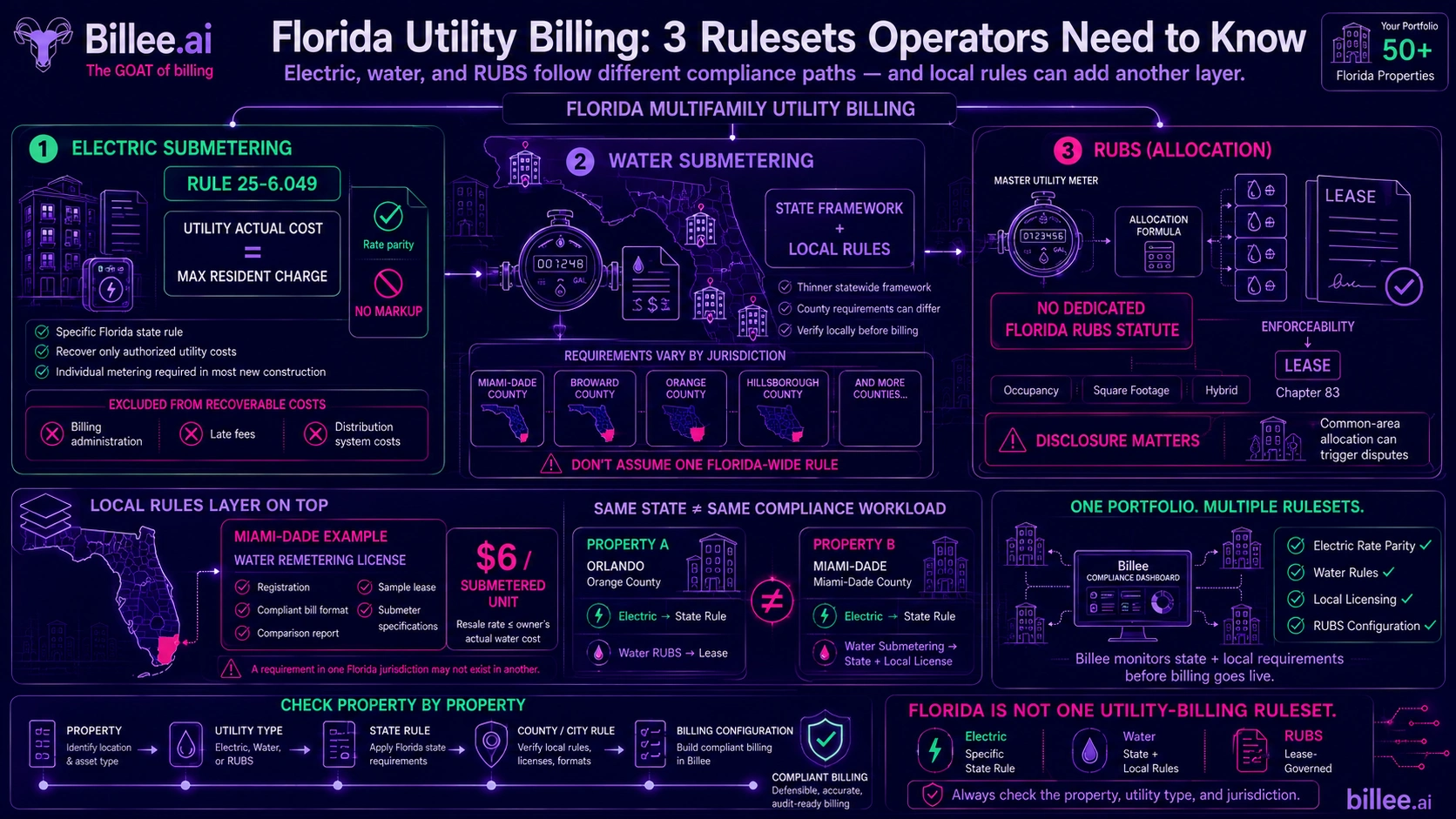
Florida regulates multifamily utility billing through three separate channels, not one. Electric submetering falls under a specific Administrative Code rule that caps what a landlord can recover at the utility's actual cost, no markup. Water submetering runs on a thinner state framework with heavy local variation, and RUBS has no dedicated state statute at all; it runs on the lease. Billee tracks all three, plus the county and city rules layered on top, like Miami-Dade's own water submetering license.
Quick answer
Electric submetering in Florida is governed by Florida Administrative Code Rule 25-6.049, which requires individual metering in most new construction and caps what a landlord can recover from residents at the utility's actual cost, with no markup allowed.
Water submetering operates under a much thinner state framework, and RUBS has no dedicated Florida statute at all. Enforceability for RUBS runs through the lease, under the Florida Residential Landlord and Tenant Act, Chapter 83. County and city rules, like Miami-Dade's water remetering license, can add requirements state law doesn't.
Key takeaways
- Florida regulates utility billing through three separate channels: electric submetering (a specific state administrative rule), water submetering (a thinner state framework plus heavy local variation), and RUBS (no state statute, lease-governed).
- Florida Administrative Code Rule 25-6.049 caps electric submetering recovery at the utility's actual cost, no markup, and requires utilities to file a standard, nondiscriminatory submetering tariff.
- Florida's public utility statute doesn't explicitly define landlords or submetering arrangements, which is exactly why a dedicated administrative rule exists for submetering specifically.
- Florida has no RUBS-specific statute. Chapter 83 governs the relationship between owners and residents generally but doesn't set RUBS disclosure or formula requirements.
- Miami-Dade County requires its own Water Remetering License for landlords reselling water through submeters, separate from and in addition to anything state law requires.
- County and city rules vary significantly across Florida. A requirement that applies in one jurisdiction may not exist in the next one over.
Why this matters for multifamily operators
Florida is one of the largest, fastest-growing multifamily markets in the country, with heavy RUBS usage concentrated in Orlando, Tampa, Miami, and Jacksonville. Operators sometimes read "no RUBS statute" as "no compliance obligations in Florida." That reading is wrong on the submetering side and incomplete on the local side.
Multi-county portfolios feel this gap most directly. A billing configuration that's fully compliant in Orange County can be missing a required license in Miami-Dade, and the difference usually isn't visible until a resident complaint or a county audit surfaces it. Operators scaling a Florida footprint need a process that checks each new property against both the state rules and whatever the specific county or city layers on top, rather than assuming one property's setup transfers cleanly to the next.
Billee configures Florida properties against the electric rate-parity rule, the water framework, and local overlays like Miami-Dade's license, treating "Florida" as three separate compliance channels rather than one uniform ruleset.
The three channels Florida actually regulates
Three separate channels make up Florida's utility billing regulatory picture, and each one works differently. Florida is one of at least 22 states, plus three counties and Washington, D.C., with some form of submetering statute or regulation on the books, per the National Conference of State Legislatures.
| Channel | What it covers | Where it comes from |
|---|---|---|
| Electric submetering | Individual metering mandate, rate-parity cost cap, no markup | Florida Administrative Code Rule 25-6.049 |
| Water submetering | Permitted; utility-facing rules; commonly cited surcharge cap; heavy county variation | Florida Administrative Code Chapter 25-30 and local ordinances |
| RUBS | No dedicated statute; enforceability runs through the lease | Chapter 83, Florida Statutes |
Electric submetering: Florida Administrative Code Rule 25-6.049
Florida Administrative Code Rule 25-6.049 requires individual electric metering in most new commercial and residential construction. Exemptions apply to areas with movable partition walls, central HVAC or backup heating and cooling systems, hospitals, nursing homes, and dormitories, hotels and motels and similar transient lodging, and qualifying timeshare condominiums.
Each exemption tracks a practical reason individual metering doesn't fit. A space with movable partitions changes shape too often to meter reliably. Central HVAC and backup systems serve the whole building at once, not one unit at a time. Hospitals, nursing homes, dormitories, and hotels have occupancy that turns over too fast, or too unpredictably, for a per-unit meter to make sense as a billing tool.
For master-metered properties that submeter electricity to residents, the same rule limits what an owner can recover. Recoverable costs include only the charges the utility itself is authorized to bill under its tariff: customer, energy, demand, fuel, conservation, capacity, and environmental charges, plus applicable taxes. Late fees, returned-check charges, the cost of a customer-owned distribution system, and billing administration are explicitly excluded.
The rate-parity rule sets the ceiling plainly. Charges must reimburse the owner for no more than the resident's actual cost of electricity, with no markup and the same per-unit rate as the master meter.
Utilities, not landlords, carry the filing burden here. Each electric utility must develop and file a standard, nondiscriminatory submetering policy as part of its own tariff.
Rule 25-6.049 exists as a specific carve-out from Florida's general utility law. Florida Statute §366.02 defines a public utility as an entity supplying electricity or gas "to or for the public" and doesn't explicitly address landlords or submetering arrangements one way or the other. The gap in that definition is exactly why a dedicated administrative rule governs submetering instead of leaving it to general utility law.
Water submetering: a thinner framework, heavier local variation
Water submetering is permitted under Florida law, and Florida Administrative Code Chapter 25-30 governs water and wastewater utilities generally. That chapter is written for the utilities themselves rather than for landlords who submeter, a meaningfully thinner framework than the electric side's dedicated submetering rule.
A surcharge of up to 9% on water bills, to cover reading and billing costs, is commonly cited by industry sources, though it's reportedly not permitted in every jurisdiction. Treat that figure as a commonly reported industry data point rather than confirmed statutory text, and verify it against current local rules before relying on it.
The bigger point on the water side isn't a single clean number. County-level variation does most of the real work in Florida's water submetering picture, more than any one statewide rule.
RUBS: no state statute, lease-governed
Florida has no RUBS-specific statute. Chapter 83, the Florida Residential Landlord and Tenant Act, governs the relationship between owners and residents generally, but it doesn't set disclosure or formula requirements for ratio utility billing.
Billee's state-by-state RUBS guide covers Florida's RUBS landscape in full, including the major-metro usage pattern in Orlando, Tampa, Miami, and Jacksonville, and the state's most common dispute pattern: residents challenging RUBS bills that include common-area electricity, like hallway or amenity lighting, without prior disclosure.
A note on gas
Gas doesn't get its own dedicated submetering rule the way electric does. Florida's gas utilities operate under a separate chapter of the Administrative Code (Chapter 25-7), but a search of publicly available sources didn't surface a gas-specific cost-recovery rule as detailed as Rule 25-6.049's electric provisions. Properties submetering gas in Florida are generally better served treating it like the water side: permitted, lightly specified at the state level, and worth confirming against local rules property by property.
How the three channels apply to one property
Take a 250-unit garden-style community in Orlando, in Orange County. Electric is individually metered to each unit, so Rule 25-6.049 applies directly: if the property submeters off a master meter rather than billing residents straight from the utility, recovery is capped at the utility's actual cost, no markup.
Water isn't individually metered at this property, so it runs on RUBS, allocating the master water bill by square footage or occupancy under the lease, governed by Chapter 83. Orange County has no additional water submetering license requirement, so the water side stops at the state and lease level.
Now take a 150-unit high-rise in Miami-Dade County. The electric side works the same way as Orlando: the rate-parity rule applies the moment the property submeters.
The water side looks different. This building submeters water directly to residents instead of using RUBS, which means it needs Miami-Dade's Water Remetering License on top of the general state water framework, an extra registration step, comparison report, and $6-per-unit fee the Orlando property never has to handle. Same state, same general rules on paper, genuinely different compliance workload because of where each property sits.
Local rules layer on top of state law: Miami-Dade's water remetering license as a worked example
Miami-Dade County requires its own Water Remetering License for any owner of a multi-unit building that resells water service to residents through a submeter. The registration goes through the county's Consumer Protection Division, separate from and in addition to anything Florida state law requires.
The application asks for a completed registration form, a bill format that meets county standards, a comparison report showing the owner's water charges against what gets billed to residents, a sample lease, and submeter specifications. The fee is $6 per submetered unit, non-refundable.
Miami-Dade's rate rule mirrors the logic of the state's electric rate-parity requirement: resale rates cannot exceed the owner's actual purchase price from the county. Owners also have 10 days to report business changes and must renew the license at least 30 days before it expires.
Miami-Dade is one county's rule, not a statewide standard. Other Florida counties and cities set their own requirements, some stricter and some looser, and confirming the specific jurisdiction a property sits in is a necessary step before assuming any single Florida-wide standard applies.
Common mistakes
- Assuming "no RUBS statute" means Florida has no utility billing compliance obligations at all, when electric submetering carries a specific, binding rate-parity rule. That gap in attention usually shows up on the electric side first, since it's the channel with an actual enforcement mechanism behind it.
- Marking up electric submetering charges above the utility's actual cost, a direct conflict with Rule 25-6.049's cost-recovery cap. Even a small per-unit markup, applied across a full property over multiple billing cycles, adds up to a rule violation that's straightforward for a resident or regulator to spot.
- Treating Florida as a single ruleset instead of checking county and city requirements, like Miami-Dade's water remetering license, property by property. A billing process built for one Florida county doesn't automatically carry over to the next one, even within the same portfolio.
- Assuming a water submetering surcharge is allowed everywhere in Florida when it varies by jurisdiction and isn't confirmed as a uniform statewide rule. Applying it by default, rather than confirming it locally first, is the kind of assumption that's easy to make once and repeat across an entire portfolio without noticing.
- Reusing a RUBS lease addendum written for another state without accounting for Florida's common-area-cost dispute pattern. An addendum that doesn't clearly disclose how common-area utility costs get allocated is one of the more common sources of resident pushback on Florida RUBS billing.
- Not re-checking local rules when acquiring a new Florida property in an unfamiliar county or city. Acquisition due diligence often covers the physical building and the leases in detail but skips utility billing compliance entirely, which is exactly the gap a county-level license requirement falls into.
When to handle this in-house vs. bring in a partner
A single Florida property in a well-documented jurisdiction, with a clear electric cost-recovery process and a well-drafted RUBS addendum, is manageable in-house.
A partner earns its keep across a Florida portfolio spanning multiple counties, where local licensing and fee rules genuinely differ from one property to the next.
How Billee can help
Billee's regulatory and compliance support checks a Florida property against the electric rate-parity rule, the applicable water framework, and local licensing requirements like Miami-Dade's before billing configuration goes live, not after a dispute surfaces.
Billee also monitors Florida's state and local regulatory activity on an ongoing basis, so a property's configuration updates when a county rule changes instead of waiting for the next audit cycle.
FAQ
What are Florida's utility billing rules for multifamily properties? Florida regulates utility billing through three separate channels: electric submetering under Florida Administrative Code Rule 25-6.049, a thinner state framework for water submetering, and RUBS, which has no dedicated statute and runs entirely on the lease.
Is RUBS legal in Florida? RUBS is legal in Florida. No state statute specifically governs it, so enforceability runs through the lease under Chapter 83, the Florida Residential Landlord and Tenant Act, and some counties and cities restrict it further.
Does Florida regulate submetering? Florida regulates electric submetering directly through Administrative Code Rule 25-6.049, which caps recoverable costs and sets a rate-parity rule. Water submetering operates under a thinner state framework, with more of the real regulation happening at the county and city level.
Can a landlord mark up electric submetering charges in Florida? No. Florida Administrative Code Rule 25-6.049 caps recoverable electric submetering charges at the utility's actual cost, with no markup allowed and the same per-unit rate as the master meter.
Does Miami-Dade require a special license for water submetering? Miami-Dade County requires a Water Remetering License for any owner of a multi-unit building that resells water service through a submeter, registered through the county's Consumer Protection Division.
Does Florida law override county or city utility billing rules? Florida state law sets a baseline, but county and city rules can add requirements on top of it. Miami-Dade's water remetering license is one example of a local requirement that exists in addition to, not instead of, state rules.
Does Billee handle Florida-specific utility billing compliance? Billee checks Florida properties against the electric rate-parity rule, the water framework, and local licensing requirements like Miami-Dade's, and updates that configuration as state and local rules change.
Related reading
For Florida's RUBS landscape in full, see State-by-State RUBS Rules. For the operational side of getting a water submeter installed, see Water Submetering Explained for Apartments. For the operational side of electric submetering, see How Electric Submetering Works, Step by Step.
Billee configures Florida billing against the state's electric and water rules and the local licensing requirements layered on top, not a one-size-fits-all Florida standard. Talk to the team about your portfolio.
Sources
- National Conference of State Legislatures, "Utility Submetering."
- Florida Administrative Code, "Rule 25-6.049: Measuring Customer Service."
- Florida RV Park & Campground Association, "Electricity Sub-Metering Specifics."
- Florida Statutes, "Section 366.02: Definitions."
- Miami-Dade County, "Water Remetering License."
- Dune Labs, "Water Submetering in Florida."
Insights and Industry Trends


Explore more insights