
The Utility Reporting You're on the Hook for After Closing a Green Loan
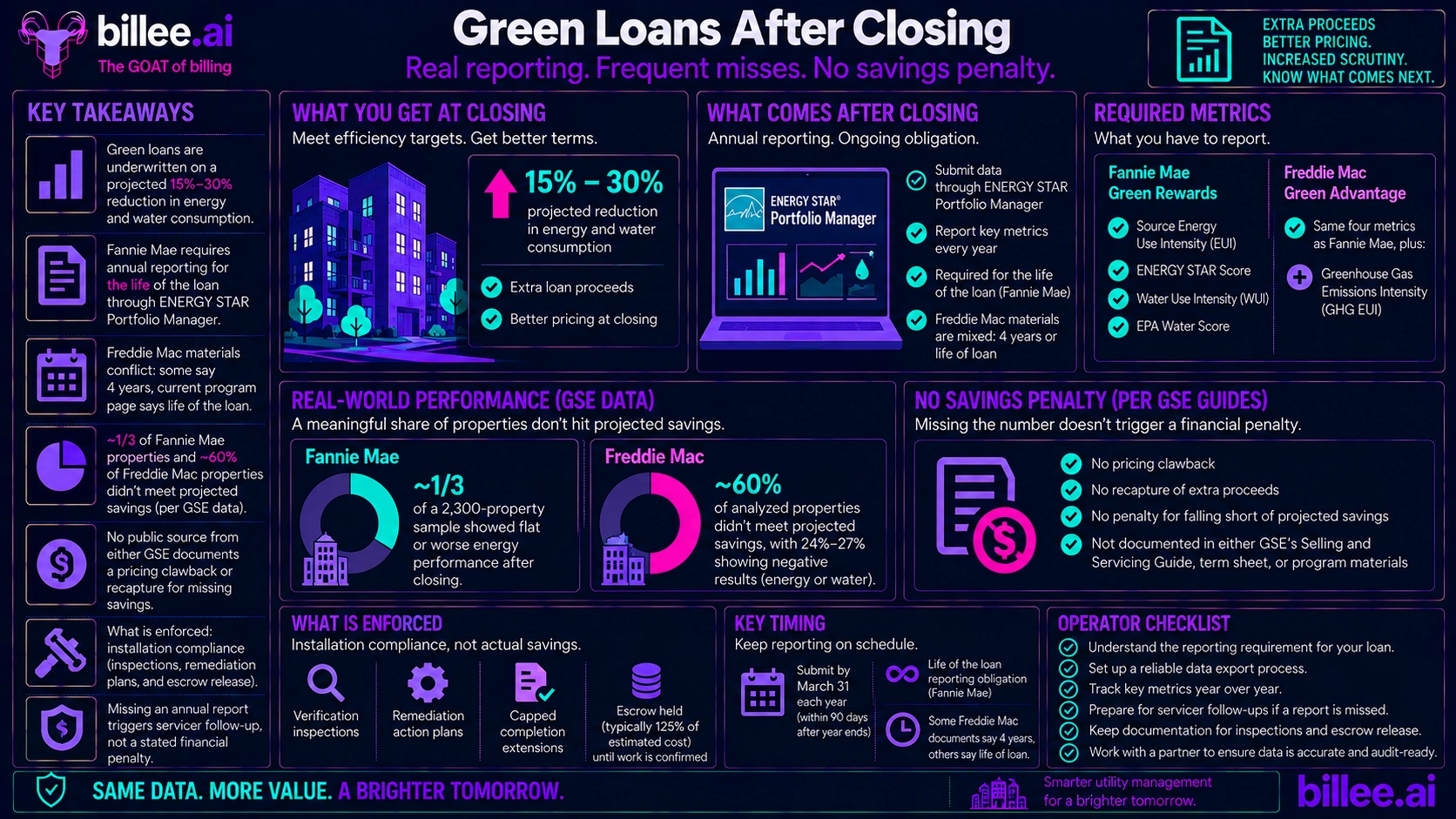
A Green Rewards or Green Advantage loan closes on the strength of a number: a projected 15% to 30% reduction in energy and water consumption. That number gets the borrower extra loan proceeds and better pricing at closing. What doesn't get nearly as much attention is what comes after closing: an annual reporting obligation that, on Fannie Mae's own loans, runs for the life of the mortgage, submitted through the same federal tool the EPA uses for ENERGY STAR benchmarking. And when a property doesn't actually hit the number it was underwritten on, which both GSEs' own published data shows happens often, neither Fannie Mae's nor Freddie Mac's public guide, term sheet, or servicing documentation describes a pricing clawback or a recapture of the extra proceeds. The real enforcement lives somewhere else entirely: whether the equipment got installed, not whether it worked.
Quick answer
Both Fannie Mae's Green Rewards program and Freddie Mac's Green Advantage program (Green Up and Green Up Plus) require borrowers to submit annual energy and water performance data through ENERGY STAR Portfolio Manager after closing, not just at underwriting. Fannie Mae's own materials describe this obligation as running for the life of the loan; Freddie Mac's materials are inconsistent, with one set of documents describing a fixed four-year window and its current program page describing an ongoing, life-of-loan obligation. Both GSEs' own performance data shows that a meaningful share of properties, roughly a third on the Fannie Mae side and roughly 60% on the Freddie Mac side, don't fully meet the savings they were underwritten on. Despite that, no publicly available primary source from either GSE documents a financial penalty, rate adjustment, or recapture of loan proceeds tied specifically to a savings shortfall. What both GSEs do enforce, through verification inspections, remediation plans, and capped completion extensions, is whether the physical improvements were installed correctly and on time.
Key takeaways
- Fannie Mae Green Rewards borrowers must report four metrics annually through ENERGY STAR Portfolio Manager: Source Energy Use Intensity, ENERGY STAR Score, Water Use Intensity, and EPA Water Score.
- Fannie Mae's Green Rewards Term Sheet and borrower-facing Loan Guide both describe this reporting obligation as running for the life of the mortgage loan.
- Freddie Mac Green Advantage borrowers must report five metrics through the same platform, with a submission deadline of March 31 (within 90 days after each calendar year ends).
- Freddie Mac's own published materials disagree on how long that obligation lasts: its Benchmarking FAQ and How-To Guide describe a fixed four-year window, while its current Green Advantage product page describes an obligation for the life of the loan.
- Journalistic analysis of Fannie Mae's own public disclosure data found that roughly a third of a 2,300-property sample showed flat or worse energy performance after closing.
- Freddie Mac's own December 2021 Duty to Serve Green Report found only about 40% of analyzed properties met or exceeded their projected savings, with 24% to 27% of properties (depending on energy or water) showing negative results.
- Neither GSE's Selling and Servicing Guide, term sheet, or benchmarking materials describe a pricing clawback or recapture of additional loan proceeds triggered by a savings shortfall.
- What both GSEs do enforce is installation compliance: verification inspections, remediation action plans, and an escrow (typically 125% of estimated improvement cost) held until efficiency measures are confirmed correctly installed.
- Missing an annual report itself triggers a servicer follow-up process rather than a stated financial penalty, but that doesn't mean it's risk-free to ignore.
Why this matters
The underwriting story around a green loan is well covered elsewhere: the 15% to 30% reduction thresholds, the extra proceeds, the pricing benefit. What happens after the loan closes gets far less attention, and it's not a small commitment. A borrower who takes a Green Rewards or Green Advantage loan is signing up for an annual data-reporting obligation that, on paper, can run for the entire life of the mortgage, tracked through a federal platform, monitored by the GSE, and followed up on by the servicer if it lapses. For a portfolio already pulling consumption data through Billee for billing and recovery, that obligation is a matter of formatting an existing export, not standing up a separate reporting project.
The bigger surprise is what happens on the other side of that obligation. Both GSEs publish their own performance data, and both show that hitting the underwritten savings target is far from guaranteed. Yet searching both GSEs' own guides, term sheets, and program materials for what happens when a property falls short turns up nothing resembling a financial penalty. That gap, real reporting obligations, real and common underperformance, no documented savings-outcome penalty, is the actual story a borrower needs to understand before assuming the annual reporting requirement is a formality.
What Fannie Mae Green Rewards borrowers have to report, year after year
The four metrics, and the platform: ENERGY STAR Portfolio Manager
Fannie Mae's own FAQ on the program is direct about the requirement: borrowers must "enter energy, water, and property data into ENERGY STAR Portfolio Manager." Four specific metrics get tracked: Source Energy Use Intensity, ENERGY STAR Score, Water Use Intensity, and EPA Water Score. This isn't a one-time submission at closing; it's an annual cycle that continues after the loan funds.
The Multifamily Selling and Servicing Guide backs this with contractual teeth. Depending on the loan type, borrowers sign one of three loan agreement modification riders, Form 6241 for a standard Green Rewards loan, Form 6264 if the borrower elects a solar PV system, or Form 6267 for a property with a Green Building Certification, each of which obligates the borrower to report annual energy and water use. Borrowers must also enroll with Fannie Mae's Green Measurement and Verification Consultant within 60 days of the loan's origination date.
Who actually submits it: Bright Power and the Green M&V Service
Fannie Mae contracts Bright Power as its Green Measurement and Verification consultant. In practice, borrowers provide utility account access or data directly to Bright Power, which enters it into Portfolio Manager on Fannie Mae's behalf, rather than the borrower filing directly with the EPA tool themselves. The EPA's own ENERGY STAR partner page for Fannie Mae confirms the scale of this: Fannie Mae describes collecting energy and water performance data "through its Green Measurement and Verification Service to ensure quality data reporting through ENERGY STAR Portfolio Manager for over 3,000 multifamily properties."
How long: "life of the loan," and a reporting-year timing quirk few borrowers know about
Fannie Mae's own materials are consistent and explicit on duration. The Green Rewards Term Sheet states the borrower "must report the Property's annual Energy Performance Metrics, including ENERGY STAR score, for the life of the Mortgage Loan." The borrower-facing Green Rewards Loan Guide repeats the same commitment: "You fulfill the Measurement requirement by providing Fannie Mae the full utility data at the Property annually for the life of the Loan through Bright Power." A separate Fannie Mae factsheet on its Green MBS program describes the same cadence as reporting "annually for life of loan."
There's a lesser-known timing detail that trips up borrowers who assume the reporting calendar simply matches the calendar year. Loans acquired by Fannie Mae in the first half of a given year (January through June) report that same year's utility data the following year. Loans acquired in the second half of the year (July through December) instead collect the following year's data and report it the year after that, a one-year lag built into when the reporting clock actually starts.
What Freddie Mac Green Advantage borrowers have to report, year after year
The five metrics and the March 31 annual deadline
Freddie Mac's structure runs in parallel but isn't identical. Green Up is the loan option available when a borrower commits to Green Improvements identified in a Green Assessment; Green Up Plus is the enhanced version, tied to a more detailed Green Assessment Plus based on an ASHRAE Level 2 study. Both fall under the Green Advantage umbrella, and both carry the same post-closing reporting obligation once the loan closes.
Freddie Mac's Multifamily Seller/Servicer Guide, in the chapter covering benchmarking, requires five data points through Portfolio Manager: ENERGY STAR Score, Energy Use Intensity, EPA 1-100 Water Score, Water Use Intensity, and the property's Portfolio Manager identification. Freddie Mac's own Green Benchmarking FAQ sets a concrete annual deadline: submission "within 90 days after the end of each calendar year or by March 31."
A real discrepancy in Freddie Mac's own materials: four years, or life of the loan?
This is worth stating plainly rather than picking a side: Freddie Mac's own published materials don't agree with each other on how long the reporting obligation lasts. Its Green Benchmarking FAQ and companion Benchmarking How-To Guide both describe a fixed window: monthly data entry beginning the first day of the second full month following the loan agreement date, and continuing "through the last day of the calendar year following the fourth anniversary" of that agreement, a four-year-ish window with a defined end point.
Freddie Mac's current Green Advantage product resource page describes something different: "Data collection is required for the life of the loan." Which of these governs a given loan may come down to the specific loan agreement language rather than the general-purpose materials, and a borrower carrying a Green Advantage loan should confirm the actual duration against their own loan documents rather than assuming either figure applies by default.
What actually happens when a property misses its committed savings
What both GSEs' own performance data shows: underperformance is common, not rare
Both GSEs have published their own results, and the numbers are less reassuring than the underwriting pitch suggests. An investigative analysis of Fannie Mae's own public Green Building disclosure data, covering roughly 2,300 properties, found that about a third showed energy scores flat or lower than at issuance. Of the properties that did improve within two years, roughly 700 out of about 1,600 later stagnated or declined. Loans on the underperforming subset totaled $16.5 billion at issuance.
Freddie Mac's own December 2021 Duty to Serve Green Report tells a similar story from its side. Of 261 properties analyzed for energy performance, 73% achieved positive savings while 27% showed negative results, with about half saving more than 15%. Of 462 properties analyzed for water performance, 76% showed positive savings while 24% showed an increase in consumption despite the installed improvements. Across the program overall, Freddie Mac's own report states that about 40% of properties met or exceeded their savings projections, meaning a majority did not. The report attributes shortfalls to factors including data challenges, occupancy changes, equipment issues, and pandemic-era disruption, but it doesn't discuss any penalty or remedy tied to the shortfall itself.
What the guides actually enforce: installation compliance, not savings outcomes
Searching Fannie Mae's Selling and Servicing Guide, its term sheets, and its borrower-facing materials for a savings-outcome penalty turns up nothing. What the Guide does enforce is a different, narrower thing: whether the efficiency measures were actually installed correctly. Fannie Mae requires a Green Rewards Verification inspection to confirm correct installation and "identify any errors that may hinder the Property achieving the expected savings and benefits." If deficiencies turn up, the servicer must notify the borrower and submit a remediation action plan with a completion target no more than 60 days out. Separately, Fannie Mae typically holds 125% of the estimated improvement cost in an escrow or reserve account until the measures are verified, with a 12-month completion deadline from the loan's origination date.
Freddie Mac's enforcement follows the same pattern. Its Green Improvements Completion Monitoring guidance requires the servicer to confirm work was done "in a professional and workmanlike manner," with the borrower submitting a verification certification within 30 days of completion. Freddie Mac states it "discourages extending the completion date beyond an additional six months" and "in no instance will Freddie Mac extend the completion date beyond an additional 12 months." Like Fannie Mae, none of this documentation addresses what happens if the equipment is installed correctly but simply doesn't produce the projected savings.
The Magnolia Crossing case, and "they've got the carrots, but there's literally no enforcement"
One specific property, cited in that same analysis of Fannie Mae's public data, illustrates how far a result can drift from the original projection. Magnolia Crossing Apartments in Macon, Georgia, saw its energy score rise from the 89th to the 100th percentile within a few years of its Green Rewards loan, then fall to the 27th percentile the following year; its water score similarly declined over the same period. Fannie Mae had estimated the loan would help avoid 22 metric tons of CO2 annually. A York University professor quoted in the same reporting summarized the underlying dynamic bluntly: "They've got the carrots. But there's literally no enforcement."
Fannie Mae vs. Freddie Mac, side by side
| Fannie Mae Green Rewards | Freddie Mac Green Advantage | |
|---|---|---|
| Metrics reported | Source EUI, ENERGY STAR Score, Water Use Intensity, EPA Water Score | ENERGY STAR Score, Site EUI, EPA Water Score, Water Use Intensity, Portfolio Manager ID |
| Platform | ENERGY STAR Portfolio Manager | ENERGY STAR Portfolio Manager |
| Who submits | Bright Power (Fannie Mae's M&V consultant), on the borrower's behalf | Borrower or a Benchmarking Data Consultant retained by the borrower |
| Annual deadline | Tied to loan acquisition timing (see the H1/H2 lag above) | March 31, or 90 days after year-end |
| Stated duration | Life of the loan (consistent across Term Sheet, Loan Guide, Green MBS factsheet) | Inconsistent: four years per the FAQ/How-To Guide, life of loan per the current product page |
| Documented savings-shortfall penalty | None found in public materials | None found in public materials |
| What is actually enforced | Correct installation, verified by inspection; remediation plan if deficient | Correct installation, verified by certification; capped completion extensions |
What this means operationally for a borrower carrying a green loan
Why "no financial penalty for underperformance" doesn't mean "no risk"
The absence of a documented clawback isn't the same as the absence of consequences. A green loan's reporting obligation is written into the loan agreement itself, and loan agreements carry their own general default and covenant provisions independent of the green-specific terms. Reporting is also increasingly visible externally: both GSEs publish portfolio-level performance summaries, and third-party analysis of that public data, like the reporting behind the Magnolia Crossing example, can surface a specific property's shortfall well outside any conversation with the lender.
What actually happens if a required report is just late or missing
Freddie Mac's Guide describes a specific process for a missed submission: Freddie Mac monitors whether benchmarking metrics were received, notifies the servicer if they weren't, and the servicer then contacts the borrower to request the outstanding data. It's a compliance nudge, not a financial penalty as written, but it's also the kind of recurring servicer contact that a borrower juggling reporting across a large portfolio would rather avoid entirely. It's also exactly the kind of gap that shows up when a property manager who set up Portfolio Manager reporting at closing leaves, and nobody downstream inherits the login. Billee's account team owns that continuity as part of the broader vendor and data-management relationship, so a staffing change on the operator side doesn't turn into a missed March 31 deadline on the lender side.
Common mistakes
- Assuming the reporting obligation ends once the improvements are installed. On Fannie Mae's own loans, reporting is described as running for the life of the mortgage, well past the installation and verification stage.
- Assuming Freddie Mac's reporting window is fixed at four years. Freddie Mac's own current program materials describe an ongoing, life-of-loan obligation; the loan agreement itself, not the general FAQ, should settle which applies.
- Treating the underwritten savings percentage as a guarantee rather than a projection. Both GSEs' own performance data shows a majority-to-large-minority of properties don't fully meet their projected savings.
- Assuming a savings shortfall carries a financial penalty. No public Fannie Mae or Freddie Mac document describes a pricing clawback or proceeds recapture tied specifically to underperformance.
- Missing that installation compliance and savings outcomes are enforced completely differently. Verification inspections, remediation plans, and escrow holdbacks are all tied to whether equipment was installed correctly, not whether it delivered the projected result.
- Ignoring a servicer's request for missing benchmarking data. It isn't a stated financial penalty, but a recurring compliance gap is exactly the kind of thing that surfaces at the worst possible time, during a sale, refinance, or portfolio-wide lender review.
What's actually at stake
The dollar figures involved aren't small. Fannie Mae's own analyzed data shows $16.5 billion in loans sitting on properties that underperformed their savings commitment. Freddie Mac's own report shows 27% of a 261-property energy sample and 24% of a 462-property water sample moving in the wrong direction. None of that translates into a documented financial penalty for the individual borrower today, but a green loan's annual reporting requirement is a real, recurring operational commitment, tracked through a platform (ENERGY STAR Portfolio Manager) that already sits at the center of the broader ESG reporting most institutional multifamily owners are managing anyway. Treating it as a box to check once at closing, rather than a data discipline to maintain for years, is the actual risk, not a penalty clause that doesn't currently exist in either program's public documentation.
How Billee can help
Billee's ESG & Sustainability Reporting service already aggregates the same consumption data, kWh, kBtu, therms, CCF, that Fannie Mae and Freddie Mac's benchmarking requirements are built around, and produces ENERGY STAR Portfolio Manager-ready output as a byproduct of managing utility billing end to end. For a portfolio carrying green loans, that means the annual reporting obligation this piece covers doesn't depend on a separate quarterly scramble to pull data from multiple vendors. Because Billee's platform already tracks which properties carry which loan-level reporting commitments as part of its regular utility management work, a green loan's annual metrics come out of the same pipeline as everything else, rather than a spreadsheet somebody has to remember to update once a year.
FAQ
Does the annual reporting requirement on a Fannie Mae Green Rewards loan ever end?
Fannie Mae's own Term Sheet and borrower-facing Loan Guide both describe the requirement as running for the life of the mortgage loan, not for a fixed number of years.
How long does Freddie Mac's Green Advantage reporting requirement last?
Freddie Mac's own materials aren't fully consistent. Its Benchmarking FAQ and How-To Guide describe a four-year window; its current Green Advantage product page describes an obligation for the life of the loan. The governing loan agreement should be checked directly.
What happens if a property doesn't hit its committed energy or water savings?
No public Fannie Mae or Freddie Mac document describes a pricing clawback or recapture of additional loan proceeds tied specifically to a savings shortfall. Both GSEs' own performance data shows shortfalls are common; neither GSE's public materials describe a financial penalty for it.
What does get enforced if a green loan underperforms?
Installation compliance, not savings outcomes. Both GSEs require verification inspections or certifications confirming the efficiency measures were installed correctly, backed by escrow holdbacks and remediation processes, but neither enforces the resulting savings number itself.
Who is Bright Power, and why do they have my utility data?
Bright Power is Fannie Mae's contracted Green Measurement and Verification consultant. Borrowers on Green Rewards loans typically provide utility data or account access to Bright Power, which submits it to ENERGY STAR Portfolio Manager on Fannie Mae's behalf.
What metrics actually get reported each year?
Fannie Mae requires four: Source Energy Use Intensity, ENERGY STAR Score, Water Use Intensity, and EPA Water Score. Freddie Mac requires five: ENERGY STAR Score, Site Energy Use Intensity, EPA Water Score, Water Use Intensity, and the property's Portfolio Manager identification.
Is it common for green-financed properties to miss their savings target?
Yes, based on both GSEs' own published data. Roughly a third of a 2,300-property Fannie Mae sample showed flat or worse energy performance in one analysis, and Freddie Mac's own report found only about 40% of properties analyzed met or exceeded their projected savings.
What happens if I just miss a year's reporting deadline?
Freddie Mac's Guide describes a servicer follow-up process: Freddie Mac notifies the servicer of missing data, and the servicer contacts the borrower to request it. It isn't described as a financial penalty, but it's a recurring compliance flag worth avoiding, especially ahead of a sale or refinance.
Related reading
- How Multifamily Operators Build ESG Reports from Utility Data: the broader reporting pipeline this annual green-loan obligation feeds into.
- The ESG Data Pipeline: How Sustainability Leads Actually Pull Portfolio-Wide Consumption Data for Reporting: how the underlying consumption data actually gets assembled at scale.
- From Audit Finding to Appraisal Line: How Utility Billing Recoveries Actually Move NOI and Valuation: another look at how GSE guide language, not just intuitive math, determines what actually counts in a transaction.
If a green loan's annual reporting is being handled as a once-a-year scramble instead of a standing data discipline, that's worth fixing before the next deadline, not after a servicer follow-up call. Talk to the team.
Sources
- Fannie Mae, "Green Rewards Term Sheet"
- Fannie Mae, "Multifamily Selling and Servicing Guide, Part III, Chapter 4: Green Mortgage Loans"
- Fannie Mae, "Multifamily Selling and Servicing Guide, Part V, Chapter 4, Section 408.03I: Green Rewards Efficiency Measure Verification"
- Fannie Mae, "Green Mortgage Loan Measurement Reporting Requirement"
- Freddie Mac, "Multifamily Seller/Servicer Guide, Chapter 39: Benchmarking"
- Freddie Mac, "Green Benchmarking FAQ"
- Freddie Mac, "Green Advantage: Benchmarking and Utility Resources"
- Freddie Mac, "2021 Freddie Mac Multifamily Duty to Serve Green Report," December 2021.
- Naveena Sadasivam and Clayton Aldern, "Has Fannie Mae's $95 billion in green bonds made anything greener?," Grist, August 11, 2021.
- U.S. EPA ENERGY STAR, "Fannie Mae," partner page.
Insights and Industry Trends