

Utility Billing for Build-to-Rent Communities: What Operators Should Know
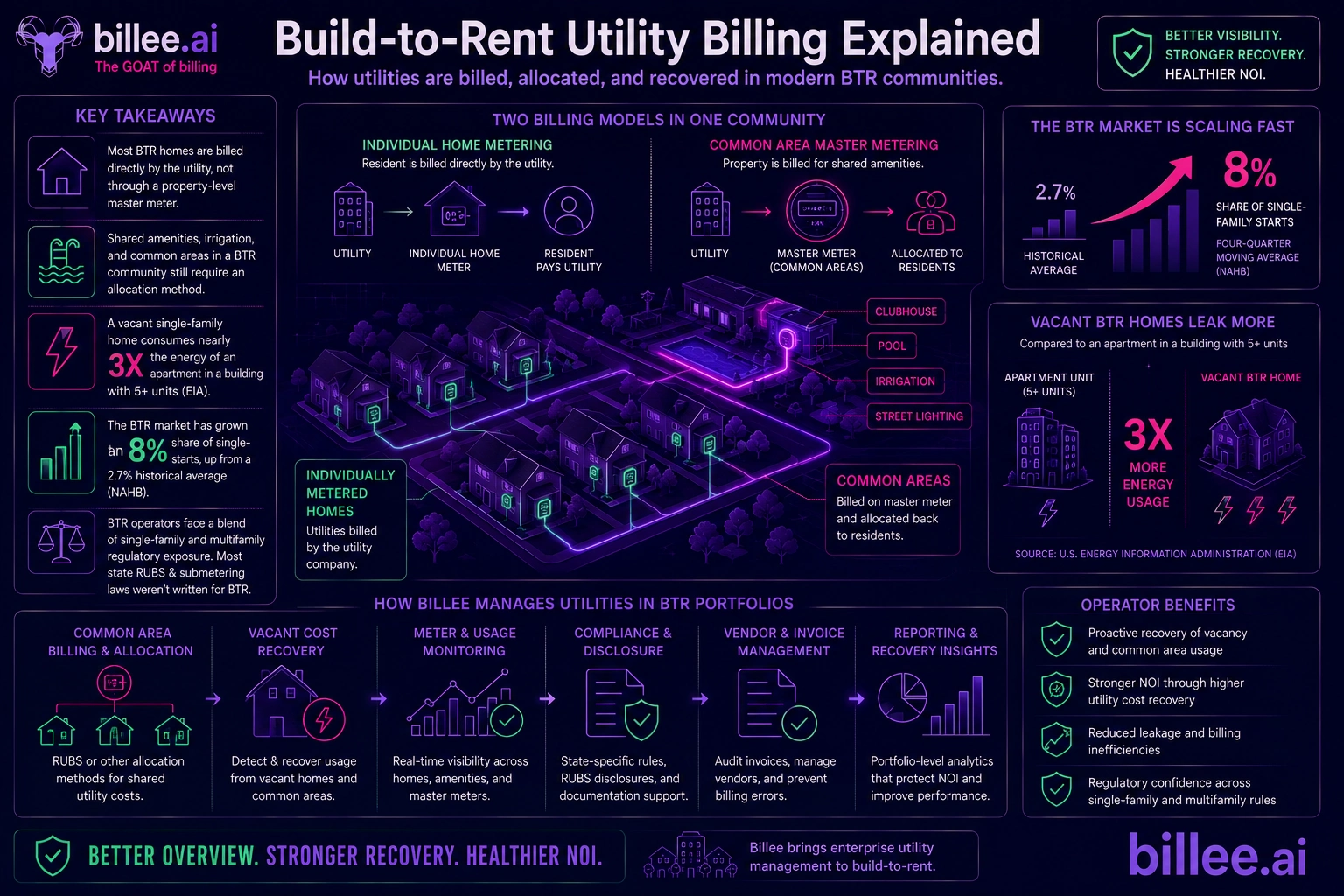
Build-to-rent (BTR) homes are usually billed for utilities differently than apartments. Most sit on individual utility accounts rather than a single master meter, which shifts part of the billing burden onto the utility company itself. That does not remove the operator's exposure. Common areas, vacant homes, and portfolio-wide compliance still need active management, and Billee handles that work for BTR operators the same way it does for traditional multifamily portfolios.
Key takeaways
- Most build-to-rent homes are billed directly by the utility company, not through a property-level master meter.
- Shared amenities, irrigation, and common areas in a BTR community still require an allocation method even when individual homes are separately metered.
- A vacant single-family home consumes nearly three times the energy of an apartment in a building with five or more units, according to the U.S. Energy Information Administration.
- The build-to-rent market has grown to an 8% share of single-family starts, up from a 2.7% historical average, per the National Association of Home Builders.
- BTR operators face a blend of single-family and multifamily regulatory exposure, and most state RUBS and submetering statutes were not written with BTR in mind.
Why Utility Billing Works Differently in Build-to-Rent Communities
Build-to-rent sits between two operating models. Each home looks and functions like a single-family rental, but the community is financed, built, and managed like a multifamily portfolio. Utility billing inherits complexity from both sides.
Most BTR homes are billed directly by the utility, not the property
A typical apartment building runs on a master meter. The utility bills the property, and the operator allocates that cost to residents through a ratio utility billing system (RUBS) or submetering. A build-to-rent home usually skips that step entirely.
Because each home sits on its own lot with its own street address, the utility company frequently sets up a direct account in the resident's name, the same way it would for a standalone single-family rental. The resident pays the utility directly. The operator's day-to-day billing load looks lighter, at least on paper.
Shared amenities and common areas still need an allocation method
Individual metering does not cover everything. Clubhouses, pools, dog parks, community lighting, and irrigation systems for shared landscaping all draw utilities that no single home's meter captures. Someone has to pay for that consumption, and it usually flows through an HOA-style fee or a community charge back to residents.
This is where RUBS still applies inside a BTR community, even one where every home is individually metered. The allocation just covers a smaller, shared slice of the utility bill instead of the whole property.
Vacant BTR homes leak more than vacant apartment units
A vacant unit is a known source of NOI leakage in any multifamily portfolio. In build-to-rent, the exposure per vacant unit is larger. A single-family detached home uses nearly three times the energy of an apartment in a building with five or more units, according to EIA data, since detached homes have more exterior wall area, larger HVAC systems, and no adjacent units buffering temperature swings.
Multiply that gap across a portfolio of dispersed, individually metered homes and the case for structured vacant cost recovery gets stronger, not weaker, than it is for a garden-style apartment community.
BTR blends single-family and multifamily regulatory exposure
State RUBS and submetering statutes are written almost entirely with apartment buildings in mind. Few explicitly address a portfolio of individually addressed, professionally managed single-family homes. A BTR operator applying a RUBS allocation to common-area charges needs to confirm how the state's disclosure and billing rules apply to a structure that is not a conventional apartment building, and document that review the same way a multifamily operator would for any other allocation methodology.
The BTR Market Is Scaling Fast, and So Is the Operational Load
Build-to-rent has moved from a niche investment thesis to a mainstream construction category. The National Association of Home Builders reports that single-family built-for-rent starts reached an 8% four-quarter moving average share of all single-family starts, more than triple the 2.7% historical average measured from 1992 to 2012. Starts over the trailing four quarters totaled 83,000, up more than 20% from the prior four-quarter period.
Roughly 500,000 build-to-rent units are currently tracked nationally by John Burns Research & Consulting, as cited by the National Multifamily Housing Council. Fannie Mae defines a build-to-rent community as 25 or more single-unit structures on a single tax lot, under one centralized, professional management company, functioning operationally like a garden-style apartment community even though the units themselves are detached homes.
That growth curve means more operators are inheriting BTR portfolios without a billing process built for the format. Utility billing that was manageable at one or two communities gets harder to standardize once a portfolio spans dozens of dispersed sites, each with its own mix of metering setups, vendor accounts, and state rules.
Common Operational Pain Points in BTR Utility Billing
- Dispersed addresses make vendor management harder than a single apartment building with one utility account per service.
- Portfolios acquired through multiple developers or builders often have inconsistent metering setups from community to community.
- HOA or community association fees can overlap confusingly with utility charges on the resident's bill.
- Residents accustomed to apartment living expect one bill, not a direct utility account plus a separate community charge.
- Turnover tracking for a detached home does not automatically flag vacant-unit utility exposure the way an apartment PMS workflow does.
- Common-area consumption (irrigation especially) is easy to under-allocate because it is not tied to any single meter.
Apartment vs. Build-to-Rent: Utility Billing at a Glance
| Dimension | Traditional apartment | Build-to-rent |
|---|---|---|
| Default metering | Master meter for the building | Direct utility account per home |
| Resident billing | RUBS or submetering through the operator | Utility bills the resident directly for the home |
| Common-area utilities | Built into the property-wide allocation | Billed separately, often through an HOA-style fee |
| Vacant-unit exposure | Moderate, tied to unit square footage | Higher per unit, per EIA energy-use data |
| Regulatory framework | State RUBS and submetering statutes apply directly | Statutes were written for apartments; application to BTR needs review |
Best Practices for BTR Utility Billing
Confirm metering type home by home before setting a billing policy
Do not assume every home in a portfolio is individually metered just because the community was built as BTR. Older acquisitions, converted single-family rental portfolios, and communities with shared infrastructure sometimes retain master-metered elements. Verify meter type at the home level before applying a blanket policy.
Separate the home utility bill from the community utility bill
Residents should understand clearly which charges come from the utility directly and which come from the operator for shared amenities. Bundling the two into one confusing line item is a common source of resident disputes and unnecessary support tickets.
Build vacant-home monitoring into the turnover process
A detached home does not signal vacancy the way an empty apartment unit does inside a PMS dashboard. Vacant-unit utility monitoring needs to be a deliberate step in the BTR turnover workflow, not an afterthought inherited from apartment operations.
Standardize vendor and billing processes across dispersed addresses
A portfolio spread across multiple communities and municipalities needs one consistent utility vendor management process, not a different ad hoc approach per site. Standardization is what makes a growing BTR portfolio scalable instead of a recurring administrative burden.
Document compliance the same way a multifamily portfolio would
Even where individual homes are utility-metered, any RUBS allocation applied to common-area charges should be documented against the relevant state's disclosure requirements. Treat that documentation with the same rigor as a traditional multifamily billing methodology audit.
What to Look for in a Utility Billing Partner for BTR
- Handles both individually metered homes and community-level RUBS allocation in one system
- Runs vacant-unit monitoring built for single-family energy profiles, not just apartment-scale exposure
- Manages vendor relationships across dispersed, multi-address portfolios without requiring a separate process per community
- Integrates with the PMS platforms BTR operators already use for both the multifamily and single-family sides of the business
- Documents compliance methodology per state, the same way it would for a conventional multifamily portfolio
How Billee Serves Build-to-Rent Operators
Billee's Billing & Recovery Engine supports RUBS, submetered, and hybrid allocation models, which covers the mixed reality of a build-to-rent community: individually metered homes alongside shared amenities that still need an allocation method. The platform does not force a BTR portfolio into an apartment-only billing structure.
Billee's Vacant Cost Recovery engine monitors meter activity against occupancy data and routes exceptions to a dedicated account team, an approach that matters more in BTR given the larger per-unit energy exposure of a vacant detached home. The same dedicated account manager who handles a traditional multifamily portfolio can manage a BTR community's utility vendor relationships and billing exceptions.
Operators running mixed portfolios, some traditional multifamily, some build-to-rent, get one billing partner and one point of contact instead of stitching together a separate process for each property type.
FAQ
Who pays utilities in a build-to-rent home?
The resident typically pays utilities directly to the utility company, since most build-to-rent homes are individually metered under a direct account in the resident's name. The operator is still responsible for shared community utilities, like clubhouse and irrigation costs, usually billed separately through an HOA-style fee.
Can you use RUBS in a build-to-rent community?
Yes, RUBS still applies to shared and common-area utility costs in a build-to-rent community even when individual homes are separately metered. It is used for the community-level portion of the bill rather than the whole property.
Are build-to-rent homes individually metered?
Most build-to-rent homes are metered directly by the utility company because each home has its own address, similar to a standalone single-family rental. Some older or converted BTR portfolios may still have master-metered elements, so operators should verify metering type home by home.
How does vacant cost recovery work for build-to-rent?
Vacant cost recovery in build-to-rent works the same way it does in multifamily: monitoring meter activity against occupancy to catch unexpected usage. The stakes are higher per unit, since a vacant single-family home uses roughly three times the energy of a vacant apartment unit, per EIA data.
Is build-to-rent utility billing regulated differently than apartments?
State RUBS and submetering statutes were largely written for apartment buildings, not build-to-rent communities, so the application to BTR is less settled. Operators applying RUBS to common-area charges in a BTR community should document how their state's disclosure rules apply to that structure.
Does Billee work with build-to-rent portfolios?
Billee supports build-to-rent operators through the same Billing & Recovery Engine and Vacant Cost Recovery products used for traditional multifamily portfolios, adapted for individually metered homes and community-level allocation. Operators running mixed multifamily and BTR portfolios get one billing partner across both.
Build-to-rent utility billing looks lighter on paper because the utility bills the resident directly, but the operator's exposure on common areas, vacant homes, and compliance does not go away. Billee runs that work as a dedicated team for BTR operators the same way it does for traditional multifamily portfolios. See what that looks like for your portfolio.
Sources
- U.S. Energy Information Administration, "Use of Energy Explained: Energy Use in Homes," accessed 2026.
- National Association of Home Builders, "Builders Add Housing Supply Through Single-Family Built-for-Rent Construction," August 2024.
- National Multifamily Housing Council, "Build-to-Rent Homes: What Policymakers Are Getting Wrong," 2026.
- Fannie Mae, "Build-to-Rent Overview," October 2024.
Insights and Industry Trends


Explore more insights