
How Vacant Cost Recovery Protects NOI
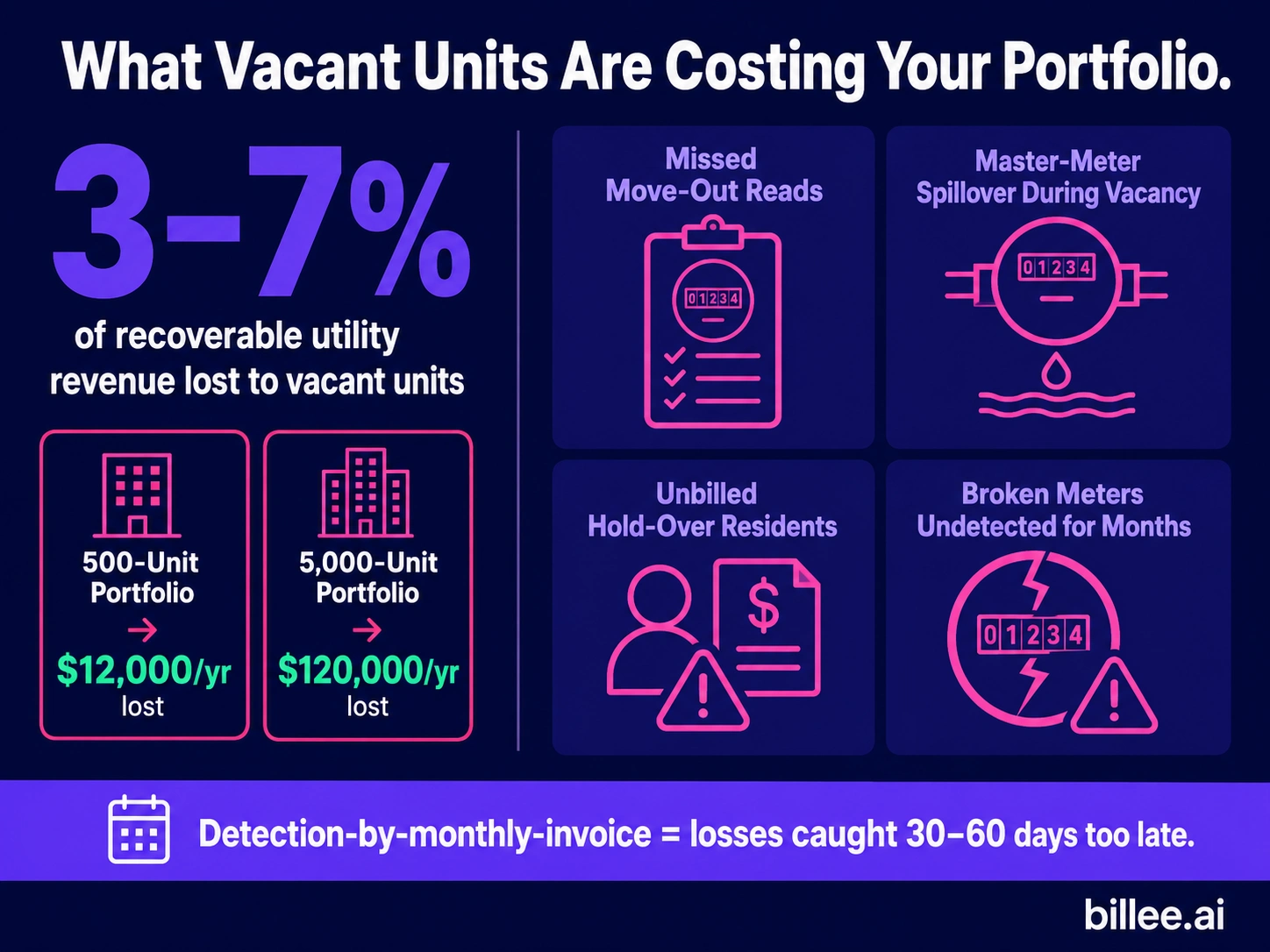
TL;DR: Utility vacant cost recovery is the operational discipline that stops a multifamily property from absorbing utility costs incurred while units sit vacant. The financial case is direct: vacant units typically leak 3 to 7 percent of recoverable utility revenue from a portfolio. For a 5,000-unit portfolio, that gap can move six figures in annual NOI. A working vacant cost recovery (VCR) program closes the gap with continuous occupancy-to-meter monitoring, threshold-based exception generation, and a person who takes corrective action on every exception.
Vacant cost recovery protects NOI by routing the right utility charges to the right party every billing cycle. When a unit goes vacant, the property starts absorbing any utility usage drawn through the master meter for that unit. The cost lands on the operating budget instead of resident allocation, and it compounds month over month until something catches it.
A working VCR program prevents that by monitoring occupancy data against actual meter usage on a daily cadence, generating exceptions when a vacant-flagged unit exceeds a defined baseline, and routing every exception to a named team member who investigates and takes action. The recovered dollars stay in resident allocation or get billed back to a hold-over resident or a prior tenant's deposit reconciliation. Either way, those dollars do not erode NOI.
Why vacant unit costs erode NOI
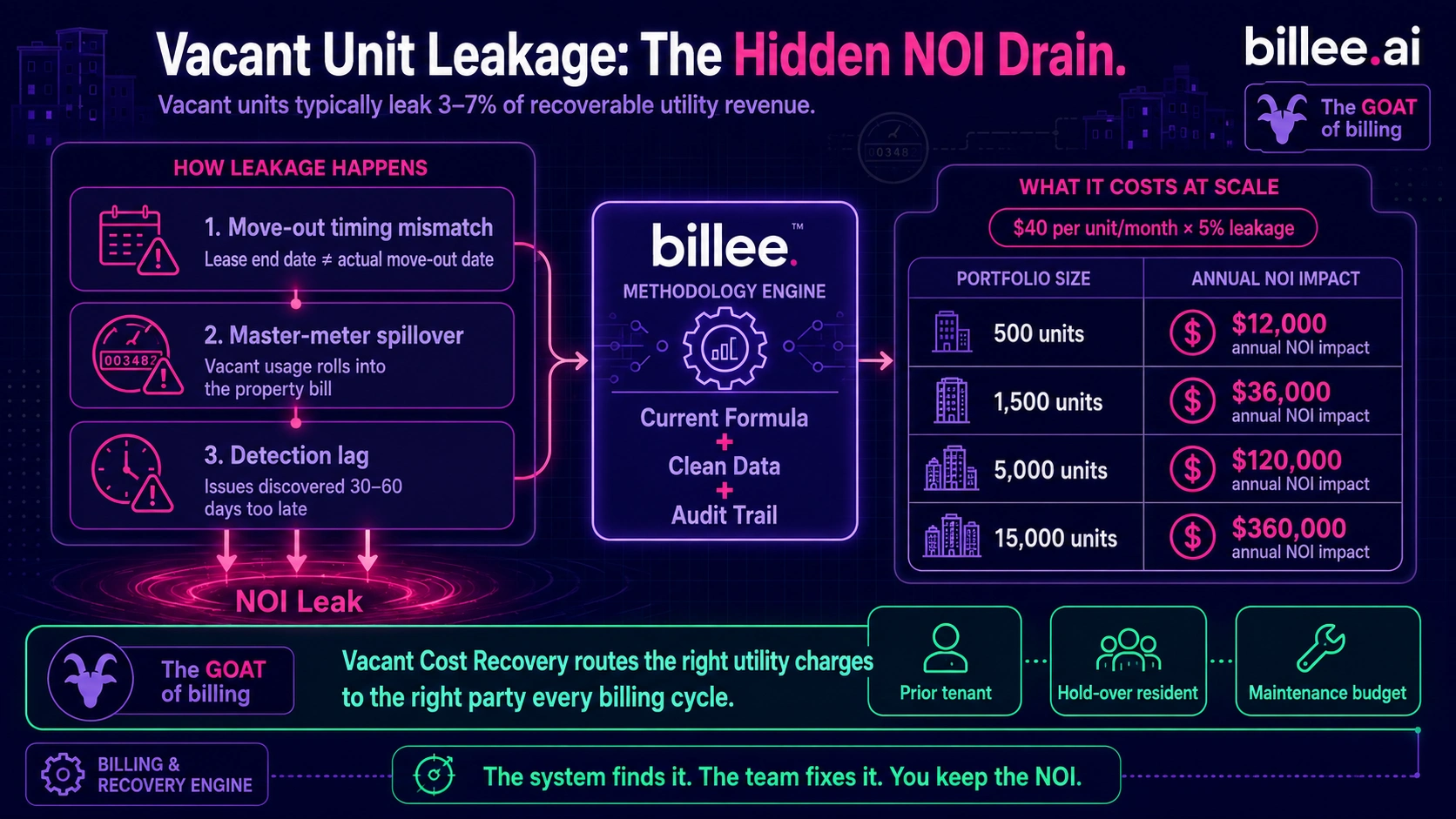
Utility costs in multifamily are recovered from residents through RUBS allocation, submetering, or a hybrid model. When a unit is occupied, the resident's allocated share pays for usage. When a unit is vacant, three things can go wrong, and each one converts a recoverable cost into an operating expense.
Move-out timing mismatches. The PMS records a lease end date. The actual move-out date is often days or weeks later, especially during eviction proceedings or renewal disputes. Utility usage between those dates either gets misallocated to the next resident or absorbed by the property.
Master-meter spillover. In RUBS-billed properties, the master meter captures the property's full usage. If a vacant unit is drawing real consumption (a hold-over resident, a broken meter, an HVAC malfunction), that consumption rolls into the master meter total. The remaining occupied units absorb the cost through allocation, or the property absorbs the difference if the allocation methodology is set up to exclude vacant units.
Detection lag. Operators typically discover vacant unit leakage when the monthly invoice arrives 30 to 60 days after the cost was incurred. By then the recovery window is mostly closed. Hold-over residents have moved out and become unreachable. The prior tenant's deposit reconciliation has finalized. The cost stays on the property's P&L.
The result is a steady downward drift in effective recovery rate that does not show up as a single line item, which is why most operators only discover the leakage when an audit catches it or when refinancing due diligence asks for a defensible recovery rate.
The NOI math
The math on vacant unit leakage is direct, and the dollar impact at portfolio scale is meaningful.
PortfolioAvg utility cost / unit / monthLeakage rateMonthly NOI impactAnnual NOI impact500 units$405%$1,000$12,0001,500 units$405%$3,000$36,0005,000 units$405%$10,000$120,00015,000 units$405%$30,000$360,000
The figures assume an average across water, gas, sewer, and trash. Climate-driven portfolios (Phoenix, Houston, Miami in summer) sit at the high end of the leakage range; temperate portfolios sit lower. Properties with high turnover (student housing, build-to-rent, class C) typically run higher leakage rates than stable luxury portfolios because the move-out volume creates more opportunities for timing mismatches.
For institutional owners, the dollars compound during refinancing and disposition. A documented recovery rate is a refinancing accelerant; an undocumented one gets discounted in due diligence. Buyers do not value "we think we capture most of it" the same way they value a documented 92 percent recovery rate with an audit trail.
What protecting NOI actually requires
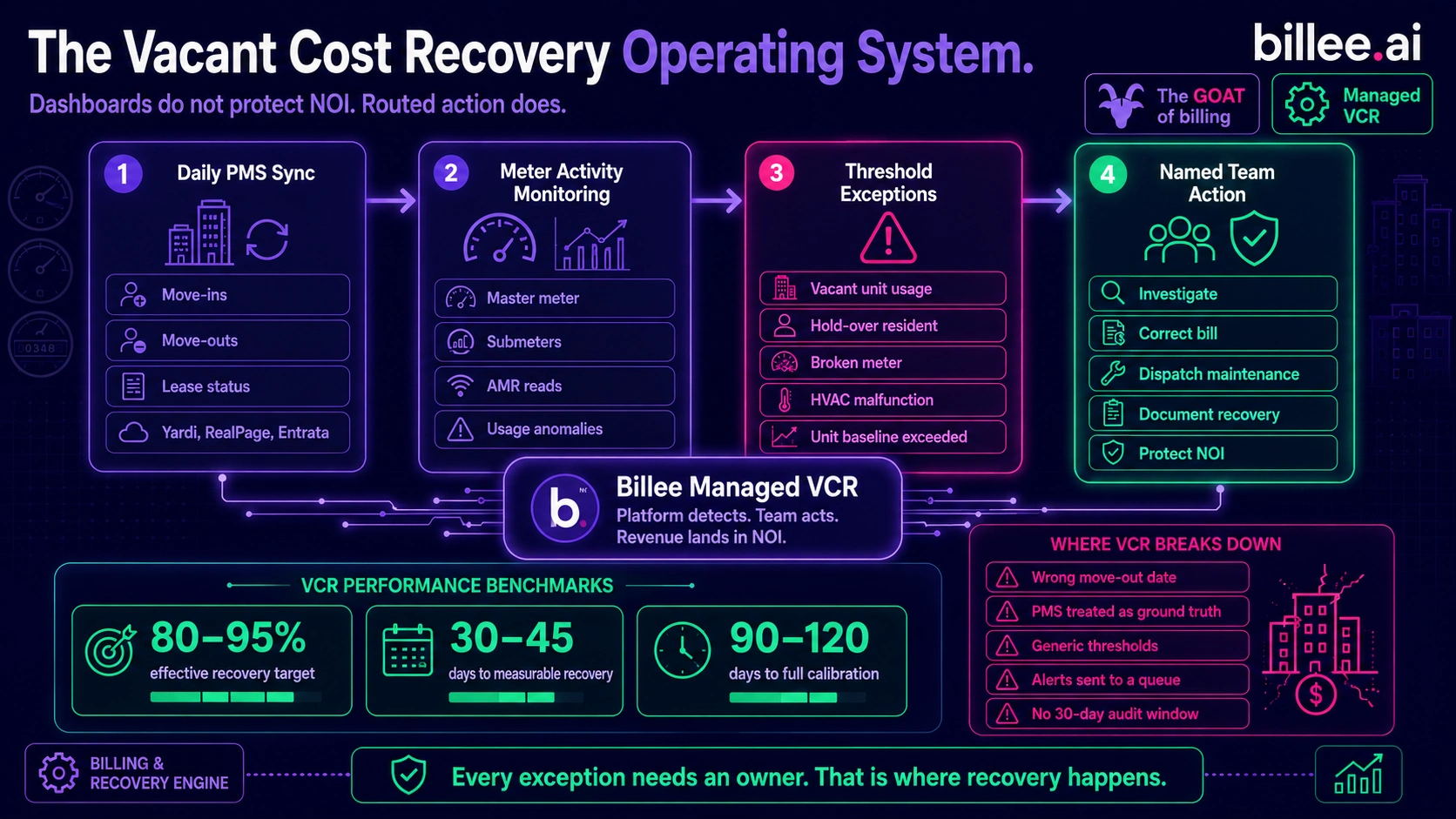
A working VCR program has four operational components running together. Drop any one of them and recovery rate falls.
1. Occupancy sync from the PMS. Resident move-in and move-out events from Yardi Voyager, Yardi Breeze, RealPage, or Entrata flow into the billing system on a daily cadence. Monthly sync is the most common configuration and the most common point of failure. A unit that moves out on day 3 of the month should not be billed as occupied for the remaining 28 days.
2. Meter activity monitoring. Every meter (submetered or master-allocated) reads on a cadence short enough to catch anomalies within days. Automated meter reading (AMR) hardware enables daily or hourly reads. RUBS-based portfolios pull master meter consumption against unit-level occupancy at least weekly. Without near-real-time visibility, the operator is back to discovering issues at monthly-invoice time.
3. Threshold-based exception generation. Every vacant unit has a defined baseline usage threshold, calibrated by unit type and climate zone. When a flagged-vacant unit exceeds the threshold (for example, more than 50 kWh in a billing cycle, or any measurable water usage), the system generates an exception within the same week. Generic thresholds across the portfolio produce false positives on small units and false negatives on large ones, so the calibration step matters.
4. Routed action, not just notification. Every exception is routed to a named person, internal or at a service provider, whose job is to investigate the exception and take the corrective action. Chasing the move-out correction. Generating a revised bill. Dispatching maintenance for a broken meter. Auditing the meter if reads look implausible. The recovery happens at the action step, not the detection step. Dashboards alone do not protect NOI.
For a deeper operational walkthrough of how to implement this in-house, see How to Recover Utility Costs from Vacant Units.
The 80 to 95 percent benchmark and what it signals for NOI
Effective recovery rate is the headline metric for VCR. Billee tracks it as the primary dashboard metric on every customer account. The interpretation, per Billee's portfolio benchmark:
80 to 95 percent effective recovery = great performance. The portfolio is capturing the recoverable utility revenue, the methodology is current, and the exception workflow is being staffed.
Below 80 percent = a problem worth investigating. Most commonly vacant unit leakage, hardware or maintenance issues, or undercharging from a stale allocation method or under-set Common Area Deduction.
The benchmark is what a well-run multifamily portfolio should expect from a real VCR program in 2026. Recovery above 95 percent is rare without submetering, which achieves 85 to 95 percent on its own. Recovery below 80 percent is itself recoverable, usually through methodology review, occupancy sync repair, and exception workflow staffing.
For NOI planning, the benchmark gives operators a clear target. A portfolio running at 72 percent recovery has 8 to 23 percentage points of NOI upside on the utility line, depending on the operational gap. That upside translates directly into the NOI math above.
Common ways NOI protection breaks down
Five recurring failure modes account for most below-benchmark recovery.
Stopping the meter read at the lease end date instead of the actual move-out date. Misallocates usage between the departing resident and the next resident, and absorbs the gap.
Treating PMS occupancy as ground truth without reconciling against meter activity. A unit flagged vacant in the PMS for 90 days can show the meter activity of a two-person household, and no one notices.
Generic thresholds across the portfolio. A 600 sqft studio and a 1,400 sqft three-bedroom have different vacant baselines. A property in Phoenix and a property in Minneapolis have different vacant baselines. One threshold for the whole portfolio produces both false positives and false negatives.
Routing exceptions to a queue instead of a person. Dashboard alerts that no one owns become future write-offs.
No 30-day post-move-out audit window. The single highest-yield VCR action is catching a missed or wrong move-out meter read while the prior resident is still reachable and the deposit reconciliation is still open. Skip the audit and the recoverable amount becomes unrecoverable.
For the full mistakes checklist with the fix for each, see Common Mistakes When Charging Vacant Unit Utility Fees.
When to handle this in-house versus bring in a partner
Running VCR in-house works when three things are true at the same time. The operator has an internal team with both PMS expertise and utility billing expertise. AMR hardware is deployed across the portfolio. The team has weekly bandwidth to investigate exceptions. Most operators below the top-50 by unit count are missing at least one.
A partner is the right answer when the work is continuous, the exceptions are high-volume relative to staff capacity, or the portfolio is geographically distributed across multiple utility jurisdictions. The trade-off is finding a partner who actually staffs the action workflow instead of selling a dashboard with an alert feature.
A reasonable decision test: if the operator cannot produce a documented effective recovery rate for the last 12 months with the methodology that produced it, in-house is not working and the NOI exposure is real.
How Billee protects NOI
Billee operates Vacant Cost Recovery as a managed service. The platform handles occupancy and meter sync, threshold calibration, and exception generation. The dedicated Billee account team takes the corrective action on every flagged exception. The team chases the move-out correction, generates the revised bill, dispatches maintenance for hardware issues, and documents the audit trail for refinancing and disposition.
The benchmark Billee tracks on the customer dashboard is 80 to 95 percent effective recovery, per Billee's standard portfolio benchmark. Implementation completes in 45 days, per Billee's standard implementation timeline, including PMS integration with Yardi Voyager, Yardi Breeze, RealPage, or Entrata. Most operators see measurable recovery within the first full billing cycle (30 to 45 days). Full program optimization, including threshold calibration by unit type and climate zone, typically takes 90 to 120 days.
The structural difference between Billee and dashboard-only VCR tools is that Billee staffs the action workflow as part of the service. Most VCR tools surface exceptions and leave the recovery action to the operator's team. Billee acts on every exception. That is what makes the 80 to 95 percent benchmark achievable in practice rather than only in theory.
FAQ
What is utility vacant cost recovery in multifamily?
Vacant cost recovery (VCR) is the operational discipline of identifying utility costs incurred while a unit is vacant and routing those costs to the right party (a hold-over resident, a prior tenant's deposit reconciliation, an insurance claim, or a maintenance budget) rather than absorbing them as a property operating expense. The methodology applies to both submetered and RUBS-billed portfolios.
How much NOI does a typical multifamily portfolio lose to vacant unit leakage?
Industry estimates put vacant unit leakage at 3 to 7 percent of recoverable utility revenue. For a 500-unit portfolio with $40 per unit per month in utility costs, that is roughly $12,000 in annual NOI. For a 5,000-unit portfolio, $120,000. The dollar impact scales linearly with portfolio size.
What is the difference between vacant cost recovery and the municipal cost recovery rule?
Different concepts. Vacant cost recovery is an operational utility-billing discipline used by multifamily owners to recover utility costs from vacant units. The municipal cost recovery rule (also called the "free public services doctrine") is a tort doctrine that generally prevents municipalities from recovering the costs of emergency response services from individuals whose conduct triggered the response. Operators researching multifamily utility billing want vacant cost recovery, not the municipal cost recovery rule.
What recovery rate should multifamily operators target?
Billee's portfolio benchmark is 80 to 95 percent effective recovery for a well-run program, with anything below 80 percent triggering a methodology review for stale formulas, occupancy data drift, exception workflow gaps, or hardware issues. Submetering pushes the high end of the range; RUBS-based portfolios sit closer to the middle.
Does vacant cost recovery require submetering?
No. VCR works in both submetered and RUBS-billed portfolios. RUBS portfolios use master-meter consumption against occupancy data to detect leakage at the portfolio level. Submetered portfolios can pinpoint individual units. Both produce defensible recovery; submetering is more precise; RUBS is more cost-effective for properties without unit meters in place.
How quickly does a VCR program affect NOI?
Most operators see measurable recovery within the first full billing cycle (30 to 45 days). Full optimization, including threshold calibration by unit type and climate zone, typically takes 90 to 120 days. The 90-day window is when the program transitions from "fixing acute issues" to "documented program with a stable recovery rate that can be referenced in refinancing and disposition."
What does utility recovery mean in multifamily?
Utility recovery is the share of utility costs that the operator successfully bills back to residents (through RUBS allocation or submetering) rather than absorbing as a property operating expense. The recovery rate is calculated as resident-billed utility revenue divided by the property's total utility cost for the billing period, expressed as a percentage. The complement of the recovery rate is the share of utility costs the property absorbs.
Billee runs Vacant Cost Recovery as a managed service for multifamily operators who want the NOI protection without staffing the exception workflow themselves. The platform makes the work visible; the team takes the action; the recovered revenue lands in NOI. Talk to the team.
Sources
1. Simple Sub Water, "RUBS vs. Submetering: Financial Impact on NOI, Costs and Tenant Satisfaction," accessed 2026.
Insights and Industry Trends