
Utility Billing for Senior Living and Assisted Living Communities
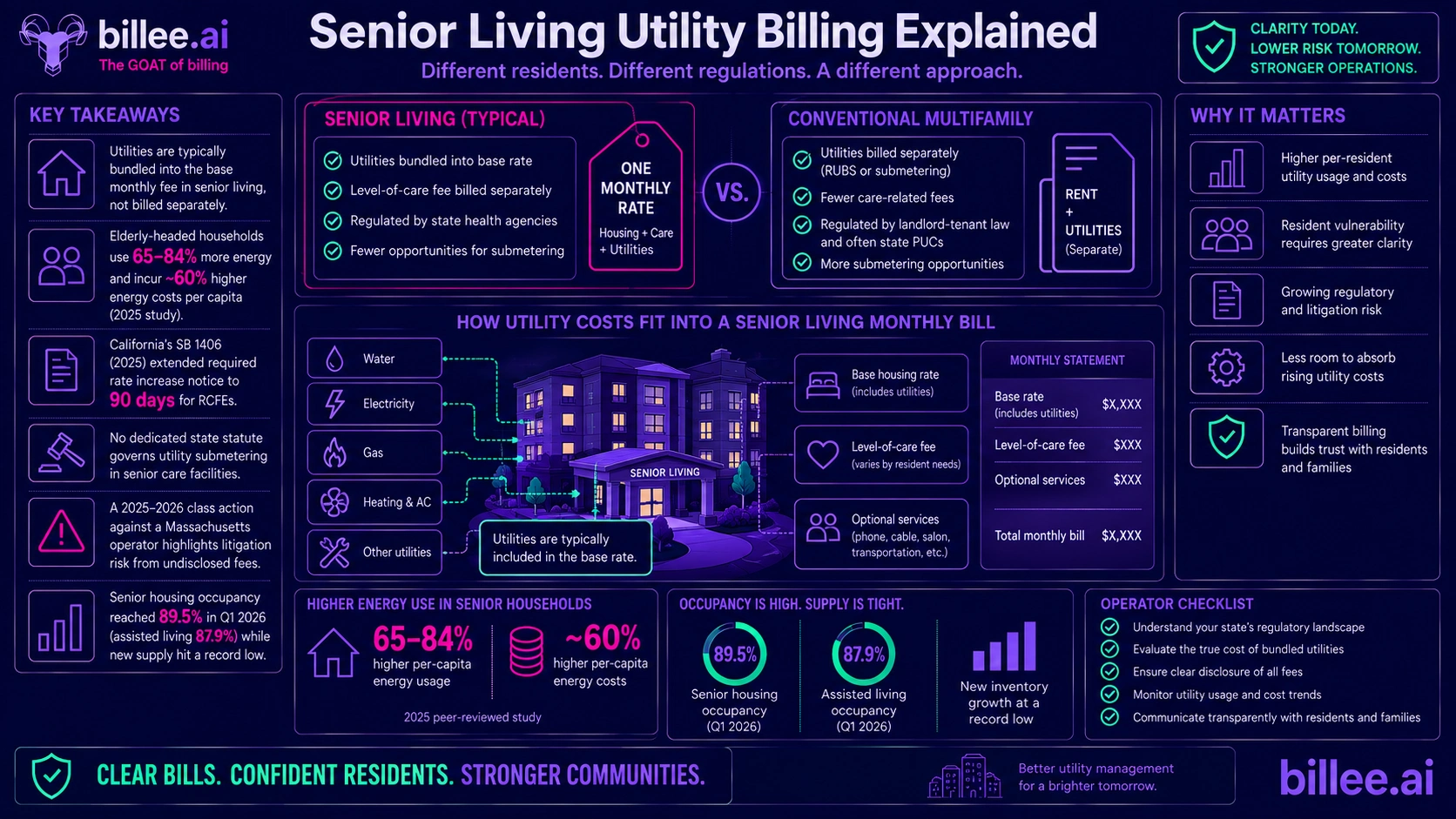
Most senior living and assisted living communities bundle utilities into the base monthly rate instead of billing them separately. That is the opposite of how conventional multifamily handles utility costs, where ratio utility billing systems (RUBS) and submetering split those charges out from rent. This article covers why senior living's default model looks different, what's putting pressure on that model now, and what operators need to understand about cost recovery and disclosure risk before they consider changing how they bill for utilities.
Key Takeaways
- Utilities (electricity, water, gas, heating, and air conditioning) are typically folded into the base monthly fee in senior living, not billed separately. Two independent industry sources confirm this, and it is the reverse of the RUBS/submetering default in conventional multifamily.
- Elderly-headed households show 65-84% higher per-capita energy usage and about 60% higher per-capita energy cost than non-elderly households in identical dwelling types, according to a 2025 peer-reviewed study. Lower occupants-per-square-foot drives most of that gap, not age or health alone.
- California's SB 1406, effective January 1, 2025, raised the required notice period for rate increases at residential care facilities for the elderly (RCFEs) from 60 to 90 days and closed a loophole that let optional or fee-for-service charges skip advance notice entirely.
- No dedicated state statute governing utility submetering or cost allocation in licensed senior care facilities turned up in this research. Utility cost recovery here sits between health-licensing law and the landlord-tenant or public-utility-commission law that governs conventional apartments.
- A 2025-2026 class action against Massachusetts operator HallKeen Management, tied to its Prospect House community in Revere, alleges undisclosed "ancillary fees" that left residents with almost no income left over. It is a real, dated example of what litigation exposure looks like when charges beyond base rent are not clearly disclosed.
- Senior housing occupancy reached 89.5% in the first quarter of 2026, with assisted living specifically at 87.9%, while new inventory growth hit a record low. Operators have less room to absorb rising utility costs quietly inside a flat rate than they did a few years ago.
Why Utility Billing Works Differently in Senior Living
The default model is bundled, not itemized
In conventional multifamily, the norm has shifted toward billing residents directly for utility usage, either through submetering or a ratio-based allocation system. Senior living has not followed that pattern. Industry sources describing typical pricing structures at communities like Morningside House and The Ormsby confirm that electricity, water, gas, heating, and air conditioning are usually bundled into the base monthly fee rather than itemized. What does get billed separately tends to be a different category of cost entirely, such as in-apartment phone and cable, salon services, guest meals, personal laundry, and specialized transportation.
Utilities, in other words, disappear into the rate rather than showing up as a line item a resident or family member can inspect.
A second cost layer conventional multifamily doesn't have
Senior living adds a cost dimension that has no real equivalent in standard apartment billing: the level-of-care fee. This charge scales with how much assistance a resident needs, from medication management to help with daily activities, and it is usually billed separately from the base rate and can change as a resident's needs change. A conventional multifamily operator building a utility billing methodology only has to account for occupancy, unit size, and usage. A senior living operator is layering utility costs, a base housing rate, and a variable care charge into one bill, and residents and families often cannot tell which part of an increase came from which source.
The regulator here is a health agency, not a PUC
Conventional multifamily utility billing answers to landlord-tenant law and, in many states, a public utility commission. Senior living and assisted living communities are licensed and regulated primarily through state health or social-service agencies, which is a different regulatory lineage entirely. That distinction is not just administrative.
Whether standard landlord-tenant protections even apply to assisted living residents is an actively contested legal question in at least one state: elder-law firm Margolis Bloom & D'Agostino has written about the dispute in Massachusetts, where the assisted living industry has argued that Chapter 19D, the state's assisted living statute, preempts landlord-tenant protections, while resident advocates argue it does not. That ambiguity matters directly for utility billing, because landlord-tenant law is exactly where conventional RUBS and submetering rules live.
Resident vulnerability raises the stakes on clarity
The population living in these communities skews toward fixed incomes, and a meaningful share of residents rely on family members or professional case managers to review their bills rather than doing it themselves. That is the throughline connecting the energy-consumption data below, California's new notice requirements, and the litigation described later in this article. A billing error or an undisclosed charge does not just create a support ticket here. It can consume a disproportionate share of a resident's monthly income before anyone catches it.
The Numbers Behind the Pressure
Two data points establish why this is a live issue rather than a theoretical one. The first is occupancy and supply. NIC reported that senior housing occupancy climbed to 89.5% in the first quarter of 2026, up from the prior quarter, with assisted living specifically at 87.9% and independent living above 91%. At the same time, new inventory growth hit a record low of 0.4% year over year, and units under construction fell to their lowest level since 2012.
High occupancy and stalled construction together mean operators have less flexibility to grow their way past rising costs. Utility expenses that used to get absorbed quietly into a rate increase now compete for room against a much tighter margin picture.
The second data point is consumption itself. A 2025 study published in Humanities and Social Sciences Communications found that elderly-headed households show 65-84% higher per-capita energy usage, 61-83% higher per-capita carbon emissions, and about 60% higher per-capita energy cost than non-elderly households living in comparable dwelling types. The researchers attribute most of this gap to lower occupancy density: nearly 80% of elderly households in the study lived in single-family homes with an average of 1,442 square feet of energy-consuming floor area per person, well above other household types.
That is an important nuance. The higher cost is not primarily about elderly residents running the thermostat differently; it is about more square footage being heated and cooled per person. For an operator managing a whole community rather than individual single-family homes, the underlying driver may look different, but the direction of the finding, that this population's utility footprint runs meaningfully higher per resident, is the piece worth carrying into cost planning.
Common Operational Pain Points
- Bundled utility costs make it difficult to isolate true cost-per-resident or cost-per-unit trends as utility rates climb, since the expense is buried inside a single rate line rather than tracked on its own.
- There is no standardized way to compare true underlying costs across communities, because each operator folds utilities into its rate structure differently.
- Level-of-care fees and utility costs both appear inside "the bill," but they follow entirely different logic, and residents or their families often cannot tell them apart.
- Rising utility costs tend to get absorbed into the next base-rate increase rather than tracked and recovered on their own, which leaves operators effectively guessing at their real utility exposure property by property.
- Any future move toward itemizing utility costs carries real disclosure risk in a vertical where fee transparency is already under active regulatory and legal scrutiny.
At a Glance: Conventional Multifamily vs. Senior Living and Assisted Living
| Conventional Multifamily | Senior Living / Assisted Living | |
|---|---|---|
| Default utility billing model | Direct billing via RUBS or submetering | Bundled into base monthly rate |
| Who regulates disclosure | Landlord-tenant law, state PUC | State health/licensing agency |
| Primary regulatory lever | Utility allocation statutes (e.g., PUC submetering rules) | Rate-increase notice and fee-disclosure requirements |
| Non-utility variable costs | Generally none tied to the resident directly | Level-of-care fees, tied to acuity |
| Typical resident financial profile | Varies widely | Skews toward fixed income, often reviewed by a family member or case manager |
| Documented fee-transparency litigation | FTC/Colorado settlement with Greystar over undisclosed fees | Class action against HallKeen Management over undisclosed ancillary fees |
Best Practices for Operators
Know what's actually inside your bundled rate
Before considering any change to how utilities are billed, establish a clean baseline of actual utility cost per property and per unit type, separate from the rate-setting process itself. Most operators can describe their overall rate increase each year. Fewer can isolate how much of that increase, if any, was driven specifically by utility costs. That baseline is the foundation for every decision that follows, whether the decision is to keep bundling utilities or to move toward a more itemized approach.
Treat rate increases and fee disclosure as the same discipline
California's SB 1406 framework, 90 days' advance written notice, no surprise lump-sum assessments, and amortization of new charges over 12 months, is a useful model for the level of advance, itemized disclosure this population and its regulators expect, even in states without an equivalent statute on the books. Building that discipline into rate-setting now is cheaper than retrofitting it after a complaint or a regulatory inquiry.
Document your methodology before you need it
Both the HallKeen litigation and the Massachusetts Chapter 19D dispute turn on the same underlying question: did residents understand what they were being charged for and why. A documented, defensible cost-allocation methodology, kept on file and referenced in resident communications, is the practical difference between a disclosed fee and what a plaintiff's attorney describes as a predatory one.
Don't assume the multifamily RUBS playbook transfers
Senior living has no equivalent statute to the utility allocation rules that govern conventional apartments, and it answers to a different regulator. Any shift toward itemized utility billing in this vertical needs its own compliance review built around health-licensing law and each state's specific rate-disclosure requirements, not a copy of an approach built for standard multifamily.
What to Look for in a Utility Billing Partner
- Direct experience with licensed care-facility billing structures, not only conventional multifamily properties
- A clear audit trail that separates utility costs from level-of-care and ancillary fees rather than blending them
- Documentation practices built for disclosure scrutiny, not only for internal cost recovery
- The ability to model true per-property utility cost trends independent of whatever the annual rate-setting process decides
How Billee Supports Senior Living Operators
Billee's Billing & Recovery Engine tracks utility costs at the property level, which gives operators the kind of clean baseline described above regardless of whether a community currently bundles utilities into its rate or bills them separately. That visibility matters most in a vertical where the utility line item has historically been invisible inside a larger bundled fee.
Billee's regulatory compliance review also applies directly to the disclosure questions this vertical faces. A documented, defensible cost-allocation methodology is useful both for internal cost management and for the kind of scrutiny operators in this space are increasingly seeing, whether from a rate-notice statute like California's or from litigation over undisclosed charges. The same rigor that helps a conventional multifamily operator defend a RUBS methodology in a due-diligence review applies to a senior living operator defending how a bundled rate breaks down.
Fee-transparency scrutiny is not unique to senior living. It has already reshaped how conventional multifamily operators think about resident billing and disclosure, and the same pressure is now visible in this vertical's own rate-notice laws and litigation.
FAQ
Are utilities usually included in senior living rent? Yes. Industry sources describing typical pricing structures confirm that electricity, water, gas, heating, and air conditioning are usually bundled into the base monthly fee at senior living and assisted living communities, rather than billed as a separate line item.
Why don't assisted living communities bill utilities the way apartments do? Conventional multifamily has shifted toward direct utility billing through RUBS or submetering, governed by landlord-tenant and public-utility-commission law. Senior living communities are regulated primarily through state health and licensing agencies, a different regulatory structure that has not developed an equivalent utility-billing framework.
Is there a RUBS law for assisted living facilities? Not that this research identified. A review of licensing frameworks in Montana and Maryland found general requirements to disclose all charges but no provision specific to utility submetering or allocation, unlike the RUBS and submetering statutes that govern conventional apartments in many states.
Do elderly residents really use more energy? A 2025 study in Humanities and Social Sciences Communications found elderly-headed households show 65-84% higher per-capita energy usage and about 60% higher per-capita energy cost than non-elderly households in comparable housing. The study attributes most of that gap to lower occupancy density rather than age alone.
What is California's SB 1406, and does it apply to utility charges? SB 1406 is a California law, effective January 1, 2025, that extended the required advance notice for rate increases at residential care facilities for the elderly from 60 to 90 days and closed a loophole for optional or fee-for-service charges. It governs rate increases and new charges broadly rather than naming utilities specifically, but it sets a disclosure standard that would apply to any utility-related charge folded into a rate increase.
What's the legal risk if a senior living community starts itemizing utility costs? The main risk is disclosure, not the billing model itself. A 2025-2026 class action against HallKeen Management alleges residents were charged undisclosed "ancillary fees" they did not understand or agree to. Any new itemized charge, utility or otherwise, needs the same level of advance, documented disclosure this litigation and California's notice law both point toward.
What's the difference between a level-of-care fee and a utility charge? A level-of-care fee is tied to how much personal care and assistance a resident needs and can change as that need changes. A utility charge, where it is billed at all, reflects the cost of electricity, water, gas, heating, or cooling. The two are billed for entirely different reasons, but because both often appear inside the same monthly statement, residents and families frequently cannot tell them apart without a clear breakdown.
Utility costs in senior living have been invisible for a long time, folded into a rate that residents and families cannot break down. As margins tighten and fee-transparency scrutiny reaches this vertical, that invisibility becomes a liability rather than a convenience. Talk to Billee about building the kind of documented, defensible cost visibility this vertical increasingly needs.
Sources
- NIC, "Senior Living Occupancy Grows Amid Construction Slowdown, Limiting Options for Older Adults."
- Humanities and Social Sciences Communications, "The impacts of population aging on residential energy consumption and carbon emissions in the United States," 2025.
- Hanson Bridgett, "New California Law Requires 90 Days' Notice of RCFE Rate Increases."
- CANHR, "Rate Increases and New Charges: What's Permitted?"
- Margolis Bloom & D'Agostino, "Should Landlord-Tenant Laws Apply to Assisted Living Facilities?"
- Mass.gov, "Boston Globe: Lawsuit Against Revere Assisted Living Home Highlights Residents' Vulnerability to Predatory Fees."
- Morningside House, "Senior Living Costs Beyond Monthly Rent."
- The Ormsby, "Comparing Pricing Models of Senior Living Communities."
Insights and Industry Trends