
Utility Billing for Manufactured Housing Communities
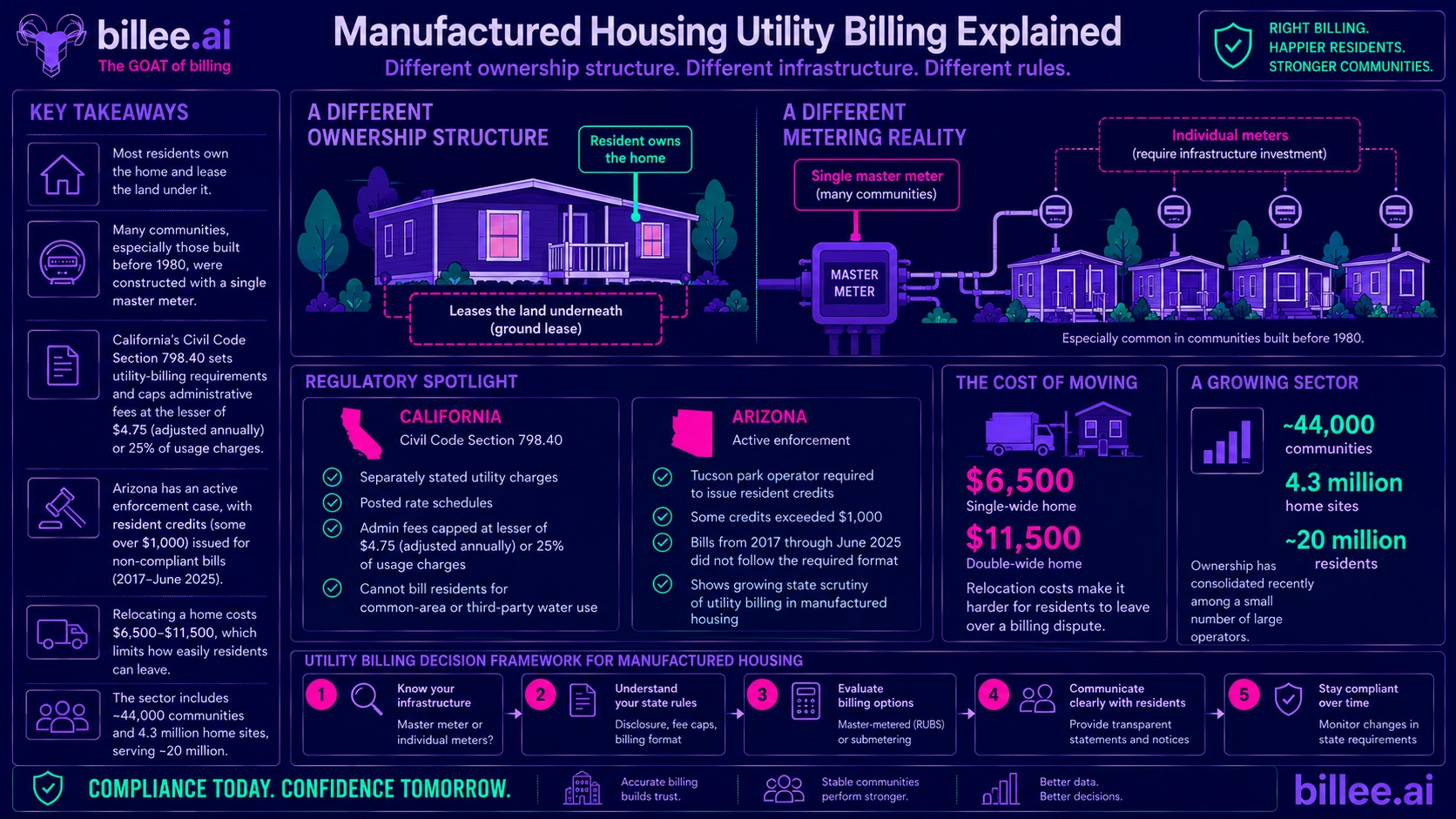
Manufactured housing communities bill for utilities inside a different ownership structure than conventional multifamily. Most residents own their home outright and lease only the land underneath it, and a large share of communities were built with a single master meter rather than individual meters. This article covers what makes utility billing different in this vertical, what a growing number of state-specific statutes require, and what operators need to verify before choosing a billing model.
Key Takeaways
- Most manufactured housing residents own their home and lease the land under it, a split-ownership structure with no real equivalent in conventional apartment billing.
- A large share of manufactured housing communities, especially those built before 1980, were constructed with a single master meter rather than individual meters. Shifting to per-resident billing can require physical infrastructure investment, not just a policy change.
- California's Mobilehome Residency Law contains a dedicated utility-billing statute, Civil Code Section 798.40, that requires separately stated charges, posted rate schedules, and caps administrative fees at the lesser of $4.75 (adjusted annually) or 25% of usage charges. It also bars billing residents for common-area or third-party water use.
- Arizona's mobile home park utility-billing format statute is under active enforcement. The state attorney general's office required a Tucson park operator to issue resident credits, some exceeding $1,000, after billing statements from 2017 through June 2025 did not follow the required format.
- Relocating a manufactured home costs an estimated $6,500-$11,500 for a full-service move, which limits how easily a resident can leave a community over a billing dispute.
- The manufactured housing sector includes an estimated 44,000 communities and 4.3 million home sites nationwide, serving roughly 20 million residents, and ownership has consolidated recently among a small number of large operators.
Why Utility Billing Works Differently in Manufactured Housing Communities
Most residents own the home, not just the space
In a manufactured housing community, a resident typically owns the physical home and leases the lot it sits on, a ground-lease structure that does not exist in conventional apartment billing. Industry data puts roughly 30% of new manufactured homes inside communities under this arrangement, with the remaining 70% titled as real estate on land the owner controls directly. That split matters for utility billing because the resident being billed is often not a tenant in the conventional sense. They are a homeowner paying rent for the ground beneath an asset they own.
A lot of this industry's infrastructure predates individual metering
Many manufactured housing communities, particularly those built before 1980, were constructed with a single master meter serving the entire park rather than individual meters per lot. That is a meaningfully different starting point than build-to-rent or mixed-use properties, which are typically metered individually by design. Converting a master-metered park to per-resident billing usually means installing physical submeters first. It is a capital project with a budget and a timeline, not a policy decision an operator can implement by changing a billing statement.
States have started writing utility-billing rules specifically for this vertical
Two examples show how specific this regulatory language has gotten. California's Mobilehome Residency Law, in Civil Code Section 798.40, requires that submetered water charges be separately stated alongside opening and closing meter readings, that current rate schedules be posted or provided on request, and that administrative fees stay at or below the lesser of $4.75 (adjusted annually) or 25% of usage charges. The statute also prohibits billing a resident for water used by common-area facilities or any other party.
Arizona has its own utility-billing format statute for mobile home parks, and it is under active enforcement. The state attorney general's office found that a Tucson park operator's billing statements, issued from 2017 through June 2025, did not follow the required format, and the office required the operator to issue resident credits, some exceeding $1,000. Both statutes go further into utility-billing mechanics than the general landlord-tenant or rate-notice laws that apply to the other verticals covered in this series.
Residents have limited ability to leave
Relocating a manufactured home is not comparable to moving out of a rented apartment. A full-service move, including transport and setup, runs an estimated $6,500 for a single-wide home and $11,500 for a double-wide, according to industry moving-cost data. That cost is a practical constraint on a resident's ability to exit a community over a billing dispute, and it is part of why state attorneys general and legislatures have gotten specifically involved in this vertical's billing practices rather than leaving it to general consumer-protection law.
The Numbers Behind the Pressure
The manufactured housing sector is large and mostly stable in size. Industry data from 2026 puts the total at roughly 44,000 communities and 4.3 million home sites nationwide, serving an estimated 20 million residents. That scale means utility-billing practices in this vertical affect a meaningful share of the country's rental and ground-lease housing stock, even though the sector gets less attention than conventional multifamily.
The financial exposure from master metering can be significant at the property level. One real-estate consultancy's published estimate puts unrecovered water and sewer costs at a 100-lot Southeastern park at $72,000 to $120,000 a year, with consumption running 20% to 40% higher than in individually metered parks because residents have no direct accountability for usage. That figure comes from one firm's analysis rather than a government data source, and it should be treated as an industry estimate rather than a verified national statistic.
Ownership in this sector has also consolidated. A federal antitrust lawsuit, In re Manufactured Home Lot Rents Antitrust Litigation, alleges that several large community owners used a shared data platform to coordinate lot-rent increases. That litigation concerns rent-setting, not utility billing specifically, but it signals that this vertical's cost practices, ownership concentration, and pricing behavior are under active legal scrutiny more broadly, and utility billing sits inside that same scrutiny.
Common Operational Pain Points
- Master-metered parks have no way to see or recover actual per-resident utility usage without first making a capital investment in submetering.
- A billing methodology built for standard multifamily does not automatically transfer, because the regulatory framework in states like California and Arizona is different and, in some cases, more prescriptive.
- Administrative fees on submetered utility billing can run into statutory caps that do not exist in conventional multifamily.
- Because many residents own their home, a billing dispute carries different stakes than it does in a rented unit. A resident cannot simply move out at lease-end the way a renter can.
- Legacy infrastructure, resident ownership, and a patchwork of state-specific statutes combine to make this one of the more compliance-sensitive verticals to get utility billing wrong in.
At a Glance: Conventional Multifamily vs. Manufactured Housing Communities
| Conventional Multifamily | Manufactured Housing Communities | |
|---|---|---|
| Typical resident ownership status | Renter, owns nothing | Often owns the home, leases the land |
| Default metering infrastructure | Individually metered by design | Frequently master-metered, especially pre-1980 |
| Primary utility-billing statute | General landlord-tenant/PUC law | State-specific mobile home park statutes (e.g., CA MRL, AZ format law) |
| Administrative fee limits | Varies by state, rarely utility-specific | Statutory caps in some states (e.g., CA's $4.75/25% cap) |
| Practical resident mobility | Move out at lease-end | Relocation costs $6,500-$11,500 or more |
| Documented utility-billing enforcement action | FTC/Colorado settlement with Greystar over undisclosed fees | Arizona AG action against a Tucson park operator over billing format violations |
Best Practices for Operators
Know whether you're master-metered or submetered before choosing a billing model
This is the first fact-finding step for any manufactured housing operator considering a change to utility billing. It determines whether the project ahead is a billing-policy decision or a capital project involving meter installation, and it changes the timeline and budget for everything that follows.
Match your billing structure to the statute that actually governs your state
California and Arizona both have dedicated statutes written specifically for this vertical. An operator applying a generic multifamily RUBS approach in a state with a manufactured-home-park-specific law risks noncompliance even with good intentions, since the applicable rules may cap fees, require specific disclosures, or restrict what can be billed in ways a standard multifamily methodology does not anticipate.
Keep administrative fees inside whatever statutory cap applies
California's cap, the lesser of $4.75 (adjusted annually) or 25% of usage charges, shows how specific these limits can get. A fee schedule that was compliant when it was set can drift past a cap over time as usage costs change, so it is worth reviewing on a regular cycle rather than setting it once.
Treat a submeter retrofit as infrastructure, not a billing switch
Budget and plan a metering upgrade the way any capital project gets budgeted, with a timeline for procurement and installation, rather than assuming per-resident billing can start the same month a decision is made. Communities that skip this step and bill as if submeters are already in place risk exactly the kind of format and disclosure violations Arizona's enforcement action addressed.
What to Look for in a Utility Billing Partner
- Experience specifically with manufactured and mobile home park billing statutes, not only conventional multifamily RUBS
- A billing methodology that can be adapted per state rather than applied as one national template
- Clear tracking of administrative fees against any applicable statutory caps
- Support for the metering-infrastructure assessment that has to happen before a master-metered community can bill individually at all
How Billee Supports Manufactured Housing Operators
Billee's regulatory compliance review is built to track billing methodology against the specific rules that apply in each state, which matters more in this vertical than in most. A fee schedule or disclosure format that is compliant in one state can be a violation in another, and the difference is often a specific statutory requirement rather than a general best practice.
Billee's Billing & Recovery Engine also gives operators the property-level cost visibility needed to make an informed decision about a submetering investment in the first place. Before committing capital to a metering retrofit, an operator benefits from knowing exactly what a master-metered property's true utility exposure looks like, the same kind of baseline that matters across every vertical this series has covered.
FAQ
Who pays for utilities in a manufactured home community? It depends on the community. Some bill residents directly for utility usage through submetering, others include utilities in a master-metered lot rent with no individual accountability, and some split the difference by billing certain utilities directly while bundling others into rent.
What does "master-metered" mean in a mobile home park? It means the entire community is served by a single utility meter, and the park owner receives one consolidated bill from the utility provider rather than each resident having an individual meter. Many communities built before 1980 were constructed this way.
Is there a specific law governing utility billing in manufactured housing communities? Yes, in some states. California and Arizona both have statutes written specifically for utility billing in mobile home parks, which is more specific than the general landlord-tenant law that governs utility billing in conventional apartments.
What does California's Mobilehome Residency Law say about utility billing? Civil Code Section 798.40 requires that submetered water charges be separately stated with meter readings, that rate schedules be posted or available on request, and that administrative fees stay at or below the lesser of $4.75 (adjusted annually) or 25% of usage charges. It also bars billing residents for common-area or third-party water use.
Has any state taken enforcement action over utility billing in mobile home parks? Yes. Arizona's attorney general required a Tucson mobile home park operator to issue resident credits, some exceeding $1,000, after finding that billing statements issued from 2017 through June 2025 did not follow the state's required utility-billing format.
Can a manufactured housing community charge an administrative fee on top of utility usage? In some states, yes, but the fee may be capped by statute. California limits administrative fees on submetered water billing to the lesser of $4.75 (adjusted annually) or 25% of usage charges, a specific cap that does not have a direct equivalent in most conventional multifamily utility billing law.
Why can't manufactured housing operators just use the same RUBS approach as conventional apartments? Because the regulatory framework can be different and more specific. States with dedicated mobile home park statutes, like California and Arizona, impose requirements around fee caps, billing format, and disclosure that a generic multifamily RUBS methodology was not built to satisfy.
Why do manufactured housing residents have less ability to switch communities over a billing dispute? Because most residents own their physical home and would have to relocate it, not just move out. A full-service relocation costs an estimated $6,500 to $11,500, which is a real financial barrier to leaving a community even when a resident disputes how they are being billed.
Utility billing in manufactured housing sits inside a different ownership structure, a different metering legacy, and in some states, a genuinely different statute than conventional multifamily. Getting it right takes more than a standard RUBS template. Talk to Billee about building a utility billing methodology that holds up against the specific rules this vertical actually operates under.
Sources
- Justia, "California Civil Code Section 798.40."
- Arizona Attorney General, "AG Mayes Holds Tucson Mobile Home Park Landlord Accountable for Years of Overcharging for Utilities."
- AZ Luminaria, "Arizona attorney general issues consumer alert on utility overbilling in mobile home parks."
- MHInsider, "Manufactured Housing Industry Trends & Statistics."
- Keel Team, "The Master-Metered Trap: Mobile Home Park Utility Billing."
- Oregon Citizens' Utility Board, "Utilities 101: Manufactured and Mobile Housing."
- This Old House, "How Much Does It Cost to Move a Mobile Home? (2026)."
- DiCello Levitt, "In re Manufactured Home Lot Rents Antitrust Litigation" (case filing).
Insights and Industry Trends