
Utility Billing for Affordable Housing Communities
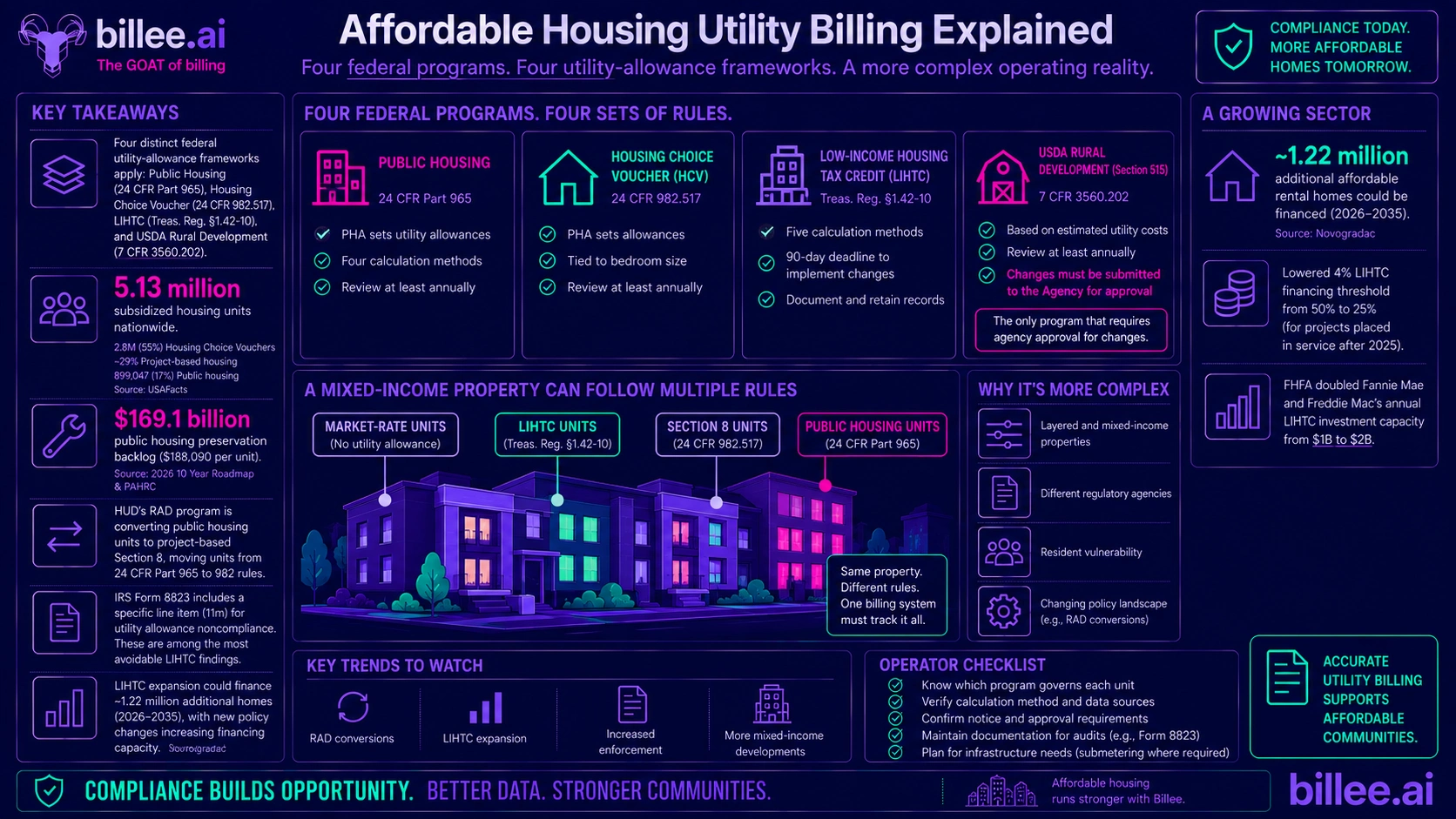
Affordable housing runs on four separate federal utility-allowance frameworks, not one. Public Housing, Housing Choice Voucher, Low-Income Housing Tax Credit, and USDA Rural Development properties each calculate and update utility allowances under their own regulation, and a single property can be subject to more than one at once. This article covers why that makes affordable housing a genuinely different asset class to operate, not just a different compliance checklist, and what's changing in this vertical in 2026.
For the mechanics of how each program's utility allowance is actually calculated, see Billee's step-by-step guide to HUD utility allowance calculations and its guide to LIHTC and Section 8 compliance. This piece looks at the wider operating picture those two guides sit inside.
Key Takeaways
- Four distinct federal utility-allowance frameworks govern this vertical: Public Housing under 24 CFR Part 965, Housing Choice Voucher under 24 CFR 982.517, LIHTC under Treas. Reg. §1.42-10, and USDA Rural Development/Section 515 under 7 CFR 3560.202. USDA's rule has a requirement the other three don't: utility allowance changes must be submitted to the Agency for approval, not just documented internally.
- The national subsidized housing stock is about 5.13 million units: 2.8 million (55%) Housing Choice Vouchers, roughly 29% project-based housing, and 899,047 (17%) public housing units, according to USAFacts.
- Public housing alone carries an estimated $169.1 billion preservation backlog, an average of $188,090 per unit, according to a 2026 report from the 10 Year Roadmap for Public Housing Sustainability and the Public and Affordable Housing Research Corporation (PAHRC). That figure is dramatically higher than HUD's last comprehensive capital-needs estimate of $26 billion in 2010.
- HUD's Rental Assistance Demonstration (RAD) program is actively converting public housing units to project-based Section 8, which means a growing number of units are moving from one utility-allowance framework, 24 CFR Part 965, to another, Section 8 project-based rules, as part of that conversion.
- IRS Form 8823 has a specific line item, 11m, for utility allowance noncompliance findings. Industry guidance describes these as among the most avoidable LIHTC compliance errors, which makes them a real but preventable exposure rather than an unavoidable cost of doing business.
- LIHTC expansion could finance roughly 1.22 million additional affordable rental homes from 2026 through 2035, according to a Novogradac estimate. The One Big Beautiful Bill Act also lowered the private-activity bond financing threshold for 4% LIHTC rehabilitation projects from 50% to 25% for buildings placed in service after 2025, and the Federal Housing Finance Agency doubled Fannie Mae and Freddie Mac's annual LIHTC investment capacity from $1 billion to $2 billion.
Why Affordable Housing Operates as a Different Asset Class
Four federal programs, four utility-allowance frameworks
Public Housing utility allowances are set by the Public Housing Authority under 24 CFR Part 965, using one of four calculation methods and reviewed at least annually. Housing Choice Voucher allowances are also PHA-administered, tied to bedroom size under 24 CFR 982.517. LIHTC properties choose from five methods under Treas. Reg. §1.42-10(b), with a 90-day deadline to implement any change.
USDA Rural Development properties financed under Section 515 sit in a fourth lane entirely, governed by 7 CFR 3560.202. Borrowers must establish utility allowances based on estimated utility costs for each unit size and type, review them annually, and maintain documentation justifying the figures in project files. The distinctive part: any change to the allowance must be submitted to the Agency for approval, not simply applied and documented internally the way LIHTC or Public Housing changes are. An operator managing a portfolio that spans HUD-assisted and USDA-financed properties is running two fundamentally different approval workflows for what looks, on paper, like the same task.
Layered and mixed-income properties multiply the complexity
A single property frequently combines more than one of these programs. LIHTC plus HOME, LIHTC plus Housing Choice Voucher, and increasingly LIHTC plus market-rate units under a mixed-income structure are all common configurations. Mixed-income developments work by combining units affordable to residents across a range of incomes, including market-rate units, within the same project, with market-rate revenue helping subsidize the affordable units.
That structure adds an operational requirement layered programs already share: the physical quality and finishes of subsidized units must be indistinguishable from market-rate units. It also means a single property's utility billing setup has to track which program governs each unit, since a market-rate unit next door to a LIHTC unit follows none of the allowance rules the LIHTC unit does, even though both may be billed through the same system.
RAD conversions are actively moving units between frameworks right now
HUD's Rental Assistance Demonstration program converts public housing properties into project-based Section 8 developments, a shift explicitly designed to bring in the private capital and financing tools public housing's direct-appropriation model doesn't allow. That conversion is not just a change in financing or ownership structure. It moves a unit from the Public Housing utility-allowance framework under 24 CFR Part 965 to the Section 8 project-based rules that govern the program it's converting into.
This is a live, ongoing process, not a one-time historical event. An operator who acquires or manages a formerly-public-housing property needs to know whether and when a RAD conversion has happened, since the utility-allowance methodology, review cadence, and documentation requirements that applied before conversion do not automatically carry forward unchanged.
Extended-use restrictions outlive the operator
LIHTC's extended-use period runs 15 to 30 years depending on the agreement, and it survives a change in ownership. A buyer acquiring a LIHTC property inherits the compliance obligations, including whatever utility-allowance methodology and documentation history came with it, whether or not that history is complete or defensible. For the broader diligence process this creates, see Billee's utility billing due diligence checklist for multifamily acquisitions, which applies with extra weight to a layered-program asset.
The Scale and Stakes of This Vertical in 2026
The affordable housing stock is large and structurally diverse. USAFacts puts the national subsidized housing total at roughly 5.13 million units: 2.8 million Housing Choice Vouchers (55% of the total, the most common form of assistance), about 29% in project-based private developments, and 899,047 units (17%) in public housing directly owned and operated by local housing authorities.
Public housing specifically is under real financial strain. A 2026 report from the 10 Year Roadmap for Public Housing Sustainability and PAHRC puts the nationwide preservation backlog at $169.1 billion, an average of $188,090 per unit, with an additional $3,597 per unit in annual costs as building systems continue to age. That figure represents the first comprehensive nationwide capital-needs assessment since 2010, when HUD's estimate stood at $26 billion, a dramatic increase driven by aging infrastructure and properties over 60 years old costing substantially more to rehabilitate. The report points to RAD conversions, tax credits, and state-level financing models, not traditional appropriations alone, as the path to closing that gap.
At the same time, the LIHTC side of the sector is expanding. A Novogradac estimate cited by Arbor puts the potential impact of 2026's LIHTC expansion at roughly 1.22 million additional affordable rental homes financed from 2026 through 2035, with California projected to add more than 200,000 units, Georgia about 98,000, and Texas roughly 97,000 over the coming decade. Two federal policy changes are driving part of that growth: the One Big Beautiful Bill Act lowered the private-activity bond financing requirement for 4% LIHTC rehabilitation projects from 50% to 25% for buildings placed in service after 2025, freeing up bond capacity for more deals, and the Federal Housing Finance Agency doubled Fannie Mae and Freddie Mac's annual LIHTC investment capacity from $1 billion to $2 billion, with at least 20% of that expanded capacity earmarked for rural markets.
Compliance exposure sits inside this growth story too. IRS Form 8823, the mechanism state housing finance agencies use to report LIHTC noncompliance, has a specific line, 11m, dedicated to utility allowance errors. Industry guidance for LIHTC professionals characterizes these errors as particularly avoidable: the fix is simply applying one of the approved calculation methods correctly and reviewing it on schedule. That combination, a growing pool of properties and a well-documented, preventable error category, is exactly why utility allowance discipline matters more in 2026 than it did five years ago, not less.
Common Operational Pain Points
- Four frameworks with four different review cadences and approval requirements: USDA requires Agency sign-off on any change, LIHTC runs on a 90-day implementation clock, and Public Housing has its own annual review plus a 10% rate-change trigger, each demanding separate tracking.
- Mixed-income and layered properties require tracking multiple rule sets simultaneously on a single property, often unit by unit, rather than applying one methodology portfolio-wide.
- RAD conversions change which framework applies mid-stream, and an operator who doesn't track conversion status risks applying outdated Public Housing rules to a unit now governed by Section 8 project-based requirements.
- Efficiency retrofits change actual consumption without automatically triggering an allowance recalculation. Since allowance calculation methods are themselves consumption-based and reviewed at least annually, a retrofit that meaningfully lowers usage should flow into the next scheduled recalculation, but that step is easy to miss if nobody connects the retrofit project to the compliance calendar.
- Acquiring or disposing of a layered-program asset risks inheriting undocumented compliance gaps, particularly on utility allowance history, that don't surface until an HFA audit or IRS review.
The Four Federal Utility-Allowance Frameworks at a Glance
| Program | Governing Regulation | Who Calculates | Review Cadence | Distinctive Requirement |
|---|---|---|---|---|
| Public Housing | 24 CFR Part 965 | Public Housing Authority | At least annually; off-cycle if utility rates change 10%+ | Four methods available (engineering, actual bills, historical consumption, rate review) |
| Housing Choice Voucher | 24 CFR 982.517 | Public Housing Authority | At least annually | Tied to bedroom size under the payment standard formula |
| LIHTC | Treas. Reg. §1.42-10(b) | Property owner | At least annually; new allowance in use within 90 days of a change | Five approved methods, building-type dependent |
| USDA Rural Development (Section 515) | 7 CFR 3560.202 | Property owner/borrower | Annually, with documentation on file | Changes require Agency approval before taking effect |
Best Practices for Operators
Track program type at the unit level, across all four frameworks
A property spanning Public Housing, HCV, LIHTC, and USDA financing needs unit-level program tracking, not property-level assumptions. The most common failure mode in layered properties is a billing system that inherits a single program's rules and applies them uniformly, missing the units governed by a different framework entirely.
Build a retrofit-to-reallowance workflow
Treat any meaningful efficiency retrofit, whether funded through HUD's Green and Resilient Retrofit Program or another source, as a trigger to schedule an allowance recalculation at the next review point. The retrofit itself doesn't automatically update the allowance; someone still has to connect the two.
Document acquisition-time compliance status before assuming continuity
A buyer inheriting a layered-program property should treat the utility allowance history the same way Billee's due diligence framework treats billing methodology generally: verify it exists, verify it's current, and verify it was calculated under an approved method before assuming it's defensible.
Watch the RAD conversion pipeline
Operators managing formerly-public-housing assets need to know their properties' RAD conversion status specifically, since a completed conversion changes the applicable utility-allowance framework even when day-to-day operations otherwise look unchanged.
What to Look for in a Utility Billing Partner
- Experience configuring billing at the unit level across multiple federal programs on a single property, not just one program type
- A documented process for tracking each program's distinct review cadence and approval requirements, including USDA's Agency-approval step
- Support for the compliance-history review a buyer needs before acquiring a layered-program asset
- A workflow that connects efficiency retrofit projects to the next utility allowance review, rather than treating them as unrelated initiatives
How Billee Supports Affordable Housing Operators
Billee's Regulatory & Compliance product audits billing methodology against the specific program rules that apply to each unit, which matters more in this vertical than almost any other, since a single property can carry two or three different rule sets at once. Billee's Billing & Recovery Engine is configured at the unit level at implementation, distinguishing Public Housing, HCV, LIHTC, HOME, and USDA-financed units within the same property, with the applicable allowance built into the gross rent or Total Tenant Payment calculation rather than applied as a manual adjustment.
For the specific calculation methods behind each program's utility allowance, see the HUD utility allowance calculation guide linked above. For the LIHTC and Section 8 compliance framework in full, including the 90-day implementation rule and refund and recapture exposure, see the affordable housing compliance guide linked above.
FAQ
Is affordable housing utility billing actually more complex to operate, or just more regulated? Both. The regulations themselves add real operational work, primarily unit-level tracking of which framework applies and when each requires review or approval, on top of the standard multifamily billing tasks every operator already handles.
Does USDA Rural Development housing use the same utility allowance rules as HUD? No. USDA Rural Development properties under Section 515 follow 7 CFR 3560.202, a separate regulation from the 24 CFR rules that govern HUD's Public Housing and Housing Choice Voucher programs. USDA's rule requires any utility allowance change to be submitted to the Agency for approval before it takes effect, a step the HUD frameworks don't require in the same way.
What is Form 8823 and how does it relate to utility billing? Form 8823 is the form state housing finance agencies use to report LIHTC noncompliance to the IRS. Line 11m is specifically for utility allowance errors, such as rents not being reduced for a utility allowance when a resident pays utilities directly. Industry guidance treats these as avoidable errors when allowance calculations are reviewed and applied on schedule.
What happens to utility allowance rules when public housing converts through RAD? A RAD conversion moves a property from the Public Housing program to project-based Section 8, which means the applicable utility-allowance framework changes from 24 CFR Part 965 to the Section 8 project-based rules. Operators managing formerly-public-housing assets need to confirm each property's conversion status rather than assuming Public Housing rules still apply.
Do energy efficiency retrofits affect my utility allowance calculation? They can, indirectly. Utility allowance calculation methods are based on estimated or actual consumption, and consumption is exactly what an efficiency retrofit is designed to reduce. A retrofit doesn't automatically trigger a recalculation, but its effect should be reflected the next time the allowance is reviewed under whichever program's cadence applies.
How often must a utility allowance be reviewed across these four programs? At least annually in all four frameworks. Public Housing has an additional trigger for rate changes of 10% or more, LIHTC requires implementation within 90 days of a changed allowance, and USDA requires any change to be submitted for Agency approval before use.
What happens to LIHTC compliance obligations when a property is sold? They transfer with the property. LIHTC's extended-use period runs 15 to 30 years and survives a change in ownership, meaning a buyer inherits the compliance obligations, including whatever utility allowance methodology and documentation history came with the property.
How big is the affordable housing sector in the United States? Roughly 5.13 million subsidized housing units nationally, according to USAFacts: about 2.8 million Housing Choice Vouchers, roughly 29% in project-based private developments, and 899,047 units in public housing directly operated by local housing authorities.
Can a single property be subject to more than one utility-allowance framework at once? Yes. Layered properties combining LIHTC with HOME or Housing Choice Voucher, and mixed-income properties combining subsidized units with market-rate units, are common. Each unit type follows its own applicable framework, which means a single property's billing system may need to apply several different sets of rules simultaneously.
Affordable housing utility billing runs on four different federal frameworks at once, and 2026 is adding real financial pressure, active program conversions, and expanding LIHTC volume on top of that existing complexity. Talk to Billee about building unit-level billing configuration that holds up across every program your portfolio touches.
Sources
- Electronic Code of Federal Regulations, "7 CFR §3560.202: Establishing rents and utility allowances."
- Electronic Code of Federal Regulations, "7 CFR §3560.205: Rent and utility allowance changes."
- USAFacts, "How many subsidized (Section 8) housing units are available in the US?"
- Center for Public Enterprise, "The $169 Billion Challenge: Preserving America's Public Housing"
- NAHB, "What Every LIHTC Professional Needs to Know About IRS Form 8823"
- HUD.gov, "Rental Assistance Demonstration (RAD)"
- Arbor, "LIHTC Increase Set to Support Affordable Housing Expansion in 2026"
- LegalClarity, "What Is Mixed Income Housing and How Does It Work?"
Insights and Industry Trends