

Top Energy Management Software for Multifamily Operators
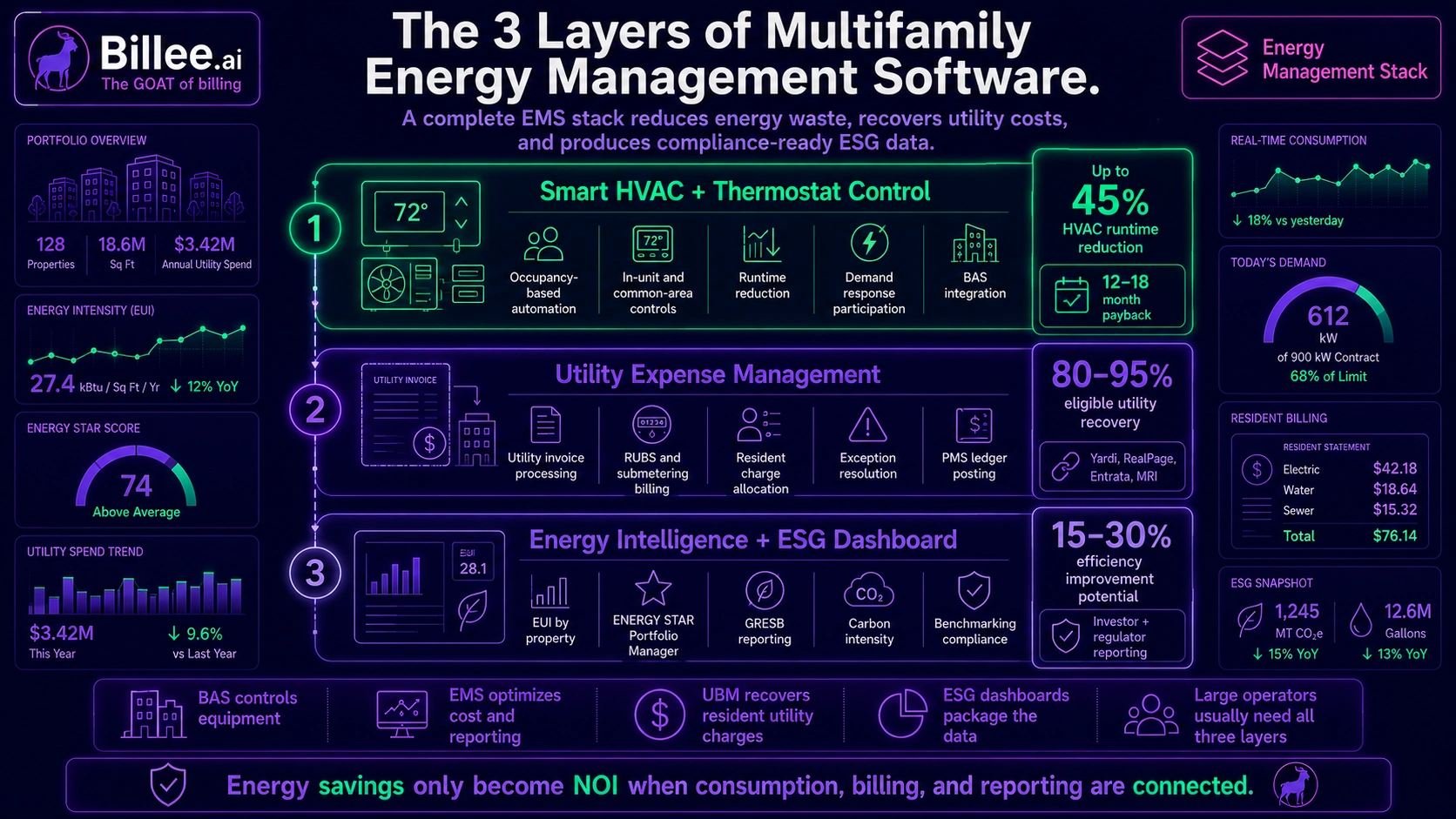
TL;DR: Energy management software (EMS) for multifamily reduces HVAC waste, automates utility billing, and produces the ESG reporting data that institutional investors and regulators increasingly require. Leading platforms fall into three categories: smart thermostat and HVAC control systems, utility expense management (UBM) tools that integrate with property management software, and enterprise-grade energy intelligence suites. A strategic EMS deployment typically reduces energy consumption 15–30%, with HVAC-focused systems cutting runtime by up to 45% and delivering paybacks in 12–18 months. Utility rebates from participating programs can cover up to 100% of upfront hardware costs.
Key Takeaways
- A strategic energy management approach improves multifamily energy efficiency 15–30% on average, according to the U.S. EPA ENERGY STAR program.
- Smart HVAC control systems that use occupancy-based automation cut HVAC runtime by up to 45%, delivering up to 20% in total energy savings.
- 77% of renters say they would pay $30 per month more for a unit equipped with smart technology, making EMS a leasing tool as well as an operational one.
- Payback for EMS hardware is typically 12–18 months; utility rebates can reduce or eliminate net upfront cost entirely in qualifying programs.
- Energy management platforms fall into three distinct layers: HVAC and thermostat control, utility expense management, and energy intelligence and ESG dashboards. Most large operators need all three.
- Utility billing accuracy is the foundation of any EMS investment. Platforms that monitor consumption without capturing cost recovery leave recoverable dollars on the table every billing cycle.
At-a-Glance: Multifamily EMS Platform Categories
| Category | What It Does | Key Integration Points | Best For |
|---|---|---|---|
| Smart HVAC / Thermostat Control | Automates in-unit and common-area conditioning by occupancy | BMS, demand response programs | Reducing per-unit HVAC waste |
| Utility Expense Management (UBM) | Processes invoices, allocates charges, bills residents | Yardi, RealPage, Entrata, MRI | Cost recovery, billing accuracy |
| Energy Intelligence / ESG Suite | EUI dashboards, ENERGY STAR tracking, ESG reporting | ENERGY STAR Portfolio Manager, PMS | Portfolio benchmarking, compliance |
What Is Energy Management Software for Multifamily?
Energy management software helps multifamily operators monitor and reduce energy consumption across their portfolios. It sits at the intersection of building operations and financial management, combining real-time data collection with automation and reporting tools that lower utility costs and support regulatory compliance.
Multifamily EMS is materially different from commercial building software in one important respect: properties have both centralized systems (common-area HVAC, lighting, elevators) and dozens or hundreds of in-unit systems, each with its own occupancy pattern. A commercial office building's energy demand follows a predictable 9-to-5 curve; an apartment building runs around the clock with highly variable per-unit demand.
Space heating alone accounts for roughly 70% of total site energy consumption in large multifamily properties.^1 That concentration in a single system category is what makes HVAC-focused EMS the highest-leverage entry point for most operators. Properties that implement a formal energy management approach achieve efficiency improvements of 15–30% on average.^2
The Three Layers of Multifamily Energy Management Software
Most operators think of "EMS" as a single category, but a complete energy management stack has three distinct layers. Each addresses a different problem. The highest-performing properties deploy all three in coordination.
Layer 1: Smart Thermostat and HVAC Control Systems
HVAC is the highest-leverage target for any energy management investment, accounting for the majority of energy consumption in most multifamily buildings. Smart thermostat and HVAC control systems automate in-unit and common-area conditioning based on real-time occupancy, eliminating the waste that occurs when units are conditioned while unoccupied.
The core differentiator from a standard programmable thermostat is occupancy-based setback. Systems that detect actual occupancy using motion and body heat sensing identify when a unit is genuinely empty and automatically reduce HVAC output, without requiring any behavior change from residents.
Verdant, a Copeland company, is one of the most widely deployed smart thermostat platforms in the multifamily market. Their systems cut HVAC runtime by 45% on average, delivering up to 20% in total energy savings with a 12–18 month payback period.^3 Utility rebates from participating programs can cover up to 100% of upfront hardware costs, and each unit installs in under 10 minutes on a dedicated mesh network that operates independently of building Wi-Fi.^3
Demand response is an additional revenue stream that most operators overlook. When an EMS platform participates in utility-sponsored demand response programs, the utility pays the property to curtail HVAC consumption during peak grid events. Revenue typically ranges from $5 to $15 per kilowatt of curtailed capacity per year, depending on the utility and market.
Layer 2: Utility Expense Management (UBM) Platforms
Utility expense management platforms handle the billing and cost recovery layer of the energy management stack. They ingest master meter invoices from utility vendors, allocate charges across the property using the appropriate methodology (RUBS, submetering, or a hybrid), generate resident bills, and push charges to the property management system for ledger posting.
This is not an optimization layer. UBM platforms do not reduce how much energy the property consumes. Their function is to ensure that utility costs the property incurs are accurately attributed and recovered from residents each billing cycle.
The cost of poor UBM is significant and largely invisible. When residents are undercharged or not billed at all, the discrepancy inflates the property's net utility expense, distorts its energy use intensity (EUI) metrics, and erodes NOI month after month without triggering any obvious alarm. Many operators discover a UBM problem only when they benchmark against peers and find their apparent energy performance is worse than expected.
Leading UBM platforms integrate directly with major property management systems through bidirectional API connections. The data flow runs: utility invoice arrives, the platform allocates charges, charges push to the PMS resident ledger, and an e-bill delivers to each resident. For operators who want a dedicated service model rather than a software-only approach, Billee's Billing and Recovery Engine combines automation with a dedicated account team, handling RUBS and submetering billing, exception resolution, and vendor management end-to-end across the portfolio.
Layer 3: Energy Intelligence and ESG Dashboards
Energy intelligence platforms sit above the operational layer and aggregate consumption data across the entire portfolio. Their outputs are EUI calculations by property, ENERGY STAR Portfolio Manager benchmarking results, carbon intensity reporting by asset, and the ESG data packages that institutional investors and regulators increasingly require.
This is where regulatory compliance reporting happens. NYC Local Law 84 requires annual energy and water benchmarking for buildings over 25,000 square feet, submitted through Portfolio Manager by May 1 each year. NYC Local Law 97 imposes carbon emissions caps beginning in 2024 with penalties of $268 per metric ton of excess emissions. GRESB, the global real estate sustainability benchmark, scores portfolios on the completeness and quality of their energy and emissions data.
Properties that can produce clean, complete ESG outputs from a centralized platform have a measurable competitive advantage in institutional capital markets. Those that cannot face compliance fines and valuation discounts at sale or refinance.
Building Automation Systems vs. Energy Management Software: What's the Difference?
Building automation systems (BAS) and energy management software are frequently conflated but serve different functions. A BAS controls the physical operation of building systems: HVAC, lighting, elevators, and access control. It tells an air handler when to run and at what capacity. It does not manage utility billing or produce ESG financial reports.
EMS sits above the BAS. It consumes data from the BAS (along with utility meters, weather feeds, and occupancy sensors) and uses that data to optimize energy cost, support billing, and produce compliance reports. A BAS without EMS gives operators control but not insight. EMS without BAS integration limits what can actually be automated.
The integration between BAS and EMS is where the most significant value is unlocked. When an EMS platform reads BAS operating data and cross-references it with utility invoice data, it can detect operational waste invisible to either system independently.
Demand Response: The Revenue Stream Most Operators Miss
Demand response programs allow utilities to call on enrolled buildings to reduce consumption during peak grid demand events. In exchange, the utility pays the property for every kilowatt of capacity it can reliably shed on short notice.
EMS platforms with integrated demand response capability handle the curtailment automatically. When the utility sends a DR event signal, the platform reduces HVAC loads in participating units, logs the curtailment, and captures the payment credit. Residents typically experience a minor temperature adjustment for a short window, often without noticing it.
The financial case is underappreciated. A 200-unit building with 50 tons of curtailable HVAC capacity enrolled in a utility DR program at $10 per kilowatt per year generates $10,000 in annual DR revenue on top of its energy savings. That revenue is recurring and requires no additional capital investment beyond the EMS hardware already in place.
PMS Integration Depth: The Most Important Procurement Criterion
UBM and ESG layers of an EMS stack are only as valuable as their integration depth with the property management system. Disconnected systems create double-entry risk, billing delays, and EUI data gaps that undermine compliance filings and investor reporting.
Bidirectionally connected integrations (where the EMS both reads occupancy and lease data from the PMS and pushes billing data back to resident ledgers) are the standard to evaluate against. Read-only integrations that pull from the PMS but do not push charges back require manual intervention on the billing side, reintroducing the error risk the platform is supposed to eliminate.
PMS compatibility also matters for ESG. If the energy intelligence platform cannot pull complete utility invoice data from the PMS general ledger automatically, the EUI calculations it produces will have gaps. Benchmarking submissions with gaps are flagged by Portfolio Manager and disqualify the property from ENERGY STAR certification consideration.
What to Look for When Evaluating Multifamily EMS Platforms
Occupancy detection method is the most important differentiator for HVAC control platforms. Systems that combine passive infrared motion detection with body heat sensing distinguish between an occupied but still unit and a genuinely vacant one. Schedule-based setback, by contrast, assumes fixed occupancy patterns and misses unplanned variations that are routine in residential buildings.
Rebate capture support is underweighted in most procurement processes. Many EMS vendors identify applicable utility rebate programs, pre-fill applications, and track approval status. For properties with 200 or more units, this service can recover $50,000 or more in rebate value on a single installation.
Independent network operation matters in high-density multifamily. Building Wi-Fi is frequently oversubscribed in large properties, and EMS platforms that route through it inherit that instability. Dedicated mesh networks sidestep building Wi-Fi entirely, maintaining connectivity even when the shared network is congested.
The Financial Case for Multifamily Energy Management Software
The direct financial case for EMS investment rests on three pillars: energy cost reduction, NOI uplift from that reduction, and leasing premium from smart technology marketing.
Energy cost reduction is the most straightforward. An 18% reduction in total energy consumption at a 200-unit property paying $250,000 annually in utility costs saves $45,000 per year. At a 5% cap rate, that savings represents $900,000 in asset value.
The leasing premium is often underweighted in ROI calculations. 77% of renters say they would pay $30 per month more for a unit equipped with smart technology.^3 For a 200-unit property, capturing even half of that willingness at $20 per month per unit adds $480,000 per year in revenue.
Utility rebates change the payback math significantly. HVAC control systems that qualify for utility rebate programs can see 50–100% of hardware costs offset, compressing a 12–18 month payback to zero net cost in the best-case scenarios.
ESG Reporting Requirements Making EMS Non-Optional in 2026
Three forces are converging to make EMS infrastructure a baseline operational requirement rather than a discretionary investment for multifamily operators.
NYC Local Law 84 requires annual energy and water benchmarking for all buildings over 25,000 square feet, submitted through ENERGY STAR Portfolio Manager by May 1 each year. Missing or incomplete submissions result in fines. Energy intelligence platforms that produce Portfolio Manager-ready data eliminate the manual extraction and formatting work that compliance otherwise requires.
NYC Local Law 97 imposes carbon emissions caps beginning in 2024, with penalties of $268 per metric ton of excess emissions. Operators without real-time EUI tracking cannot identify which properties are trending toward violations before intervention is still possible.
GRESB is the investor-side driver. Institutional real estate investors increasingly use GRESB scores as an underwriting input, and scores are directly tied to the completeness and quality of a portfolio's energy and emissions data. Properties that cannot produce clean, complete GRESB-formatted data are at a disadvantage in institutional capital transactions.
How Utility Billing Connects to the EMS Stack (Billee)
Energy monitoring without billing recovery creates a hidden problem: if residents are not paying for what they consume, the property's net utility expense does not reflect real operational efficiency. An EMS that reports 20% energy savings may be masking the fact that uncollected resident charges are absorbing that savings and more.
Billee's Billing and Recovery Engine closes that gap. It automates RUBS and submetering billing across the portfolio, recovers 80–95% of eligible utility charges each cycle, and produces clean consumption data that accurately reflects the property's true unrecoverable utility expense. That data is what EUI benchmarks, Portfolio Manager submissions, and green certification applications need to be credible.
Billee's ESG and Sustainability Reporting product generates consumption data formatted for ENERGY STAR Portfolio Manager, supporting both annual compliance submissions and the continuous portfolio monitoring that proactive operators use to identify outlier properties before they trigger regulatory penalties. If your portfolio's recovery rate is below 80%, the issue is billing, not energy efficiency. Fixing the billing foundation before investing in EMS hardware ensures the savings the EMS generates actually reach the bottom line.
Talk to the Billee team to find out where your portfolio stands.
Frequently Asked Questions
What is energy management software for multifamily properties? Energy management software helps multifamily operators monitor, optimize, and report on energy consumption across their portfolios. It typically covers HVAC automation, utility bill management, and ESG reporting, and is deployed either as a single integrated platform or as three coordinated layers.
How much energy can an EMS save in a multifamily building? U.S. EPA ENERGY STAR data shows that a strategic energy management approach can improve multifamily efficiency 15–30%.^2 HVAC-focused systems using occupancy-based control have cut HVAC runtime by up to 45% on average, delivering up to 20% in total energy savings.^3
What is the difference between a BAS and an EMS? A building automation system (BAS) controls the physical operation of HVAC and other building systems. Energy management software (EMS) sits above the BAS and uses operating data to optimize energy cost, support utility billing, and produce compliance reporting. The two are complementary, not interchangeable.
What is demand response and how can multifamily properties participate? Demand response is a utility program that pays properties to reduce consumption during peak grid demand events. EMS platforms with integrated DR capability automatically curtail HVAC loads when a DR event is signaled and log the curtailment for utility payment. Revenue typically ranges from $5 to $15 per kilowatt of curtailed capacity per year.
How do smart thermostats reduce multifamily energy costs? Smart thermostats detect real-time occupancy and automatically reduce HVAC output when a unit is unoccupied, eliminating the energy waste of conditioning empty units. Systems that combine motion and body heat sensing avoid false "vacant" readings during sleep hours or periods of stillness.
What ESG reporting does energy management software produce? Leading EMS platforms produce ENERGY STAR Portfolio Manager submissions, GRESB-formatted reports, carbon intensity calculations, and EUI trend data by property. These outputs support compliance filings under NYC Local Laws 84 and 97 and institutional investor reporting requirements.
How do utility rebates affect EMS payback periods? Many utilities offer rebates for qualifying smart thermostat and HVAC control installations. In some programs, rebates cover 50–100% of hardware costs, reducing the effective payback period to well under 12 months or, in the best cases, to zero net cost.
How does utility billing software fit into the EMS stack? Utility billing recovery ensures that energy savings generated by an EMS flow to the bottom line rather than being absorbed by uncollected resident charges. A property with a recovery rate below 80% will continue to absorb avoidable utility costs even after an EMS installation.
Sources
- Verdant/Copeland. "10 Energy Efficiency Trends for Multifamily Buildings in 2026." Accessed July 2026. https://verdant.copeland.com/blog/10-energy-efficiency-trends-multifamily-buildings-2026
- U.S. EPA ENERGY STAR. "Multifamily Housing." Accessed July 2026. https://www.energystar.gov/buildings/resources-audience/multifamily-housing
- Verdant/Copeland. "Multifamily Energy Management Systems: A 2026 Guide." May 13, 2026. https://verdant.copeland.com/blog/multifamily-energy-management-system-guide
- Verdant/Copeland. "A Complete Guide to Multifamily Energy Efficiency in 2026." Accessed July 2026. https://verdant.copeland.com/blog/a-complete-guide-multifamily-energy-efficiency-2026
- MRI Software. "Energy Efficiency Strategies in Multifamily Property Management." Accessed July 2026. https://www.mrisoftware.com/blog/role-of-energy-management-in-multifamily-property-management/
- Yardi. "Energy Suite." Accessed July 2026. https://www.yardi.com/suite/energy-suite/
- Yardi. "Utility Billing." Accessed July 2026. https://www.yardi.com/product/utility-billing/
- Capterra. "Best Energy Management Software 2026." Accessed July 2026. https://www.capterra.com/energy-management-software/
- Revyse. "Multifamily Utility Management Platforms." Accessed July 2026. https://revyse.com/categories/utility-management
- U.S. EPA. "ENERGY STAR Portfolio Manager." Accessed July 2026. https://www.energystar.gov/buildings/benchmark
- New York City Department of Buildings. "Local Law 84 Benchmarking." Accessed July 2026. https://www.nyc.gov/site/buildings/codes/benchmarking.page
- New York City Department of Buildings. "Local Law 97." Accessed July 2026. https://www.nyc.gov/site/buildings/codes/local-law-97.page
- GRESB. "Real Estate Assessment." Accessed July 2026. https://gresb.com/real-estate/
- PointCentral. "Resident Expectations in 2026: How Smart Multifamily Technology Is Shaping Leasing Decisions." December 22, 2025. https://www.pointcentral.com/2025/12/22/resident-expectations-in-2026-how-smart-multifamily-technology-is-shaping-leasing-decisions/
Insights and Industry Trends


Explore more insights