

Multifamily Solar Energy: ROI and Implementation Guide
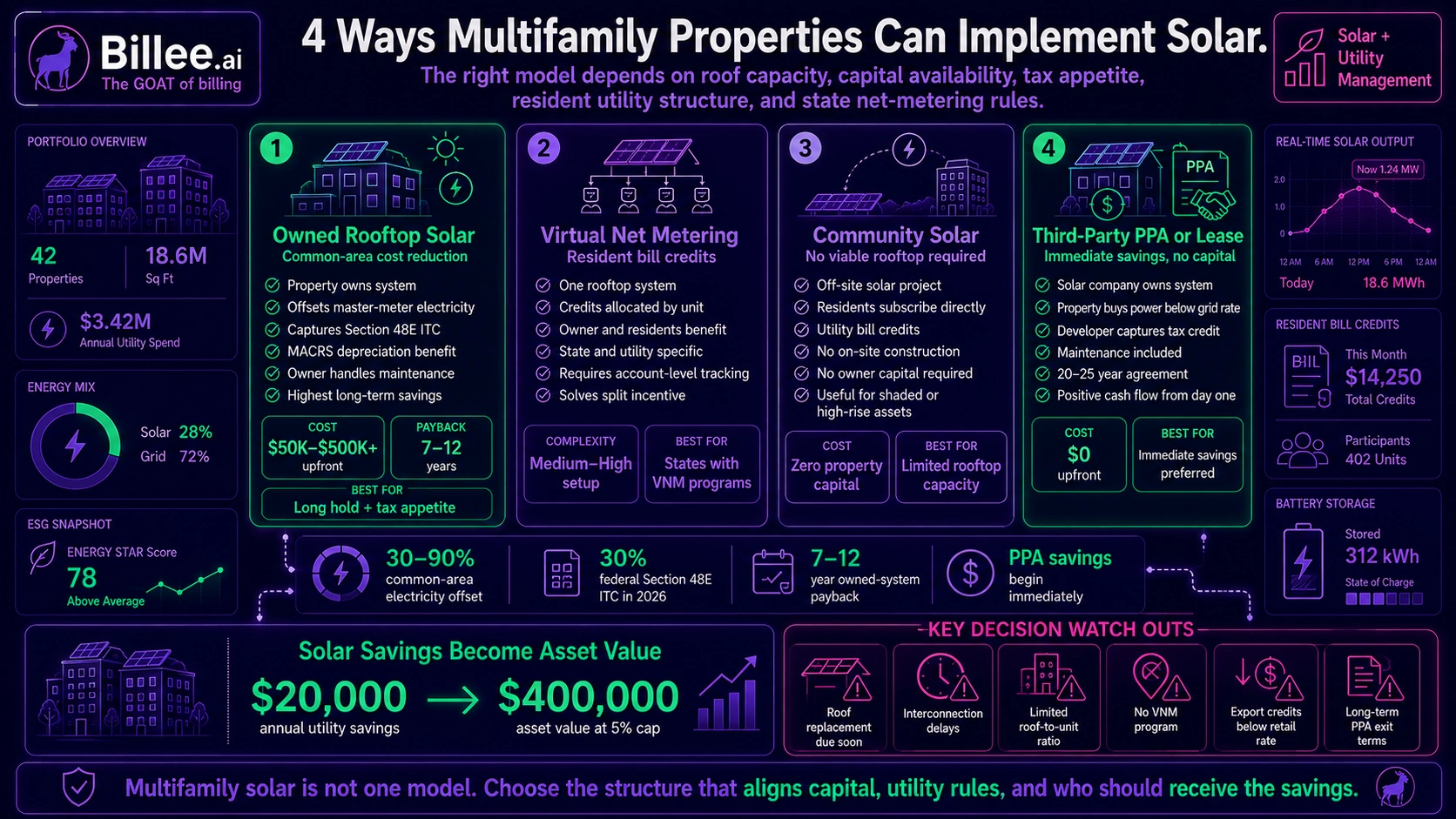
TL;DR: Multifamily solar reduces common-area electricity costs by 30--90% and strengthens ESG credentials, but implementation is more complex than single-family solar because of the split-incentive problem, state-by-state virtual net metering laws, and building structure variability. Four implementation models exist: owner-consumed rooftop solar (common areas), virtual net metering to credit individual resident units, community solar subscriptions, and third-party PPA or lease structures. The federal commercial Investment Tax Credit (Section 48E) is 30% through December 31, 2027 for qualifying projects. Typical payback on an owned system is 7--12 years; PPAs require no capital and deliver savings from day one.
Key Takeaways
- Multifamily solar typically offsets 30--90% of a property's common-area electricity consumption, depending on roof area, orientation, and load profile.
- A 122-kW installation at a Maryland multifamily property reduced approximately 10% of total operating costs, according to the DOE Better Buildings program.
- The federal Section 48E commercial Investment Tax Credit is 30% in 2026. Projects placed in service after December 31, 2027 require construction to begin by a qualifying date. The residential Section 25D credit expired December 31, 2025 and is no longer available.
- The split-incentive barrier -- owners fund installation while residents pay individual utility bills -- is the central challenge of multifamily solar. Virtual net metering and PPA structures are the primary solutions where they are available.
- Third-party PPA or lease ownership eliminates capital and maintenance burden for property owners, transfers the ITC to the solar developer, and delivers immediate savings through below-market electricity rates.
- Solar adds directly to NOI through reduced common-area utility expense; at a 5% cap rate, $20,000 per year in common-area electricity savings generates $400,000 in asset value.
At-a-Glance: Multifamily Solar Implementation Models
| Model | System Owner | Who Benefits | Upfront Cost | ITC Recipient | Best When |
|---|---|---|---|---|---|
| Owned Rooftop (Common Area) | Property owner | Owner (OpEx reduction) | High ($50K--$500K+) | Property owner | Long hold period, tax appetite |
| Virtual Net Metering (VNM) | Owner or third party | Residents (bill credits) + owner | Medium--High | Owner or third party | State VNM program exists |
| Community Solar Subscription | Solar developer | Residents (bill credits) | None | Solar developer | No viable rooftop, state program available |
| Third-Party PPA / Lease | Solar company | Owner (below-market rate) | Zero | Solar company | No capital budget, immediate savings preferred |
Why Multifamily Solar Is Different from Single-Family Solar
Multifamily solar delivers the same underlying technology as single-family installations but introduces three structural complications that make implementation more complex.
The first is scale relative to available roof area. Multifamily buildings house many residents per building but have less roof area per unit than single-family homes. A 200-unit garden-style complex may have abundant flat roof area suitable for solar; a high-rise tower has a small roof footprint relative to its total electricity load and may not be able to generate enough on-site power to meaningfully reduce common-area consumption.
The second is the split incentive: the property owner pays the master meter bill for common areas, but residents pay their own unit electric bills. A rooftop system that reduces the master meter bill only benefits the owner for common-area consumption unless virtual net metering or another credit mechanism is in place to extend savings to individual resident accounts.
The third is legal and regulatory complexity. Some jurisdictions restrict an owner's ability to bill residents for on-site generated electricity. Net metering rules are utility-territory-specific and subject to regulatory change. Interconnection timelines add 3--12 months to project schedules in many markets.
How Multifamily Solar Implementation Works
Step 1: Site Assessment and Load Analysis
The first step is a roof audit: structural capacity, age, available area, orientation relative to sun exposure, and shading from adjacent buildings or mechanical equipment. A roof needing replacement within the next five years should be addressed before any solar installation, since panels typically carry 25-year warranties and roof work after installation substantially increases costs.
Load profile analysis determines how to size the system. For a property owner focused on common-area economics, the analysis separates landlord-paid consumption (master meter: lobbies, hallways, elevators, laundry, parking lights, mechanical rooms) from resident-paid consumption (individual unit meters). Right-sizing the system to common-area load avoids generating excess electricity that earns lower credit rates under net billing rules.
System size estimation requires knowing the local solar resource. Properties in the Southwest average 5.5--6.5 peak sun hours per day; the Northeast averages 3.5--4.5. One kilowatt of solar panels produces 1,100--1,900 kWh per year depending on location and orientation.
Step 2: Choosing the Right Ownership and Financing Model
Owned system (direct purchase) delivers the highest long-term savings. The property owner captures the full Investment Tax Credit, depreciates the system under MACRS (typically 5-year for commercial solar), and keeps 100% of the electricity savings. The tradeoff is significant upfront capital -- $2.50--$3.30 per watt before incentives at 2026 market pricing -- and the need for tax liability to monetize the ITC.
Power Purchase Agreement (PPA): a solar company installs and owns the system at no cost to the property; the property purchases the electricity the system generates at a fixed below-market rate. The ITC flows to the solar company (or its tax equity investors), not the property owner. PPAs eliminate capital requirements and O&M responsibility. The tradeoff is a 20--25 year contract with termination provisions and roof access rights that require careful negotiation.
Lease: similar structure to a PPA but the property pays a fixed monthly fee rather than a per-kilowatt-hour rate. Useful when predictability of cost matters more than per-unit-of-energy pricing.
Third-party ownership (PPA or lease) is the right path when the property owner has limited tax liability to absorb the ITC, wants zero capital outlay, or prefers to avoid ongoing O&M responsibility. Owned systems make sense for portfolios with strong tax appetite and long hold periods where compounding energy savings over 20-plus years represent meaningful value.
Step 3: Federal and State Incentives
The federal Investment Tax Credit under Section 48E is 30% of system cost for commercial solar installations in 2026. This credit applies to direct owners and to third-party owners (solar companies in a PPA or lease structure). Projects placed in service after December 31, 2027 are subject to construction-start requirements under current law; any operator planning a 2027 or later in-service date should verify current begins-construction deadlines with a tax advisor.
The Section 25D residential solar credit, which had applied to owner-purchasers of residential solar, expired December 31, 2025 and is no longer available.
MACRS bonus depreciation allows commercial solar owners to depreciate 80% of system cost in year one under 2026 tax rules, substantially accelerating the after-tax return on owned systems.
State incentives vary considerably. California, New York, Massachusetts, New Jersey, Colorado, and Illinois have significant solar rebate and incentive programs that stack on top of the federal ITC. Net metering rules -- which determine how excess solar production is credited to the utility bill -- are utility-territory-specific and the national trend is toward lower net billing rates rather than full retail credit for exported power. Locking in interconnection and net metering terms before interconnection filing is critical for any project where exported power economics are part of the ROI case.
Step 4: Virtual Net Metering and Resident Solar Access
Virtual net metering (VNM) is the primary mechanism for extending solar benefits from a single rooftop system to individual resident utility accounts. Under VNM, the system's electricity output is credited to the master meter and then allocated by the property owner across individual resident utility accounts, reducing each resident's utility bill.
VNM availability is state and utility specific. California, New York, Massachusetts, Maryland, Colorado, New Jersey, and a growing number of states have VNM programs; within those states, availability varies by utility territory. In California, specialized programs for low-income multifamily properties (such as SOMAH) provide additional incentives and include a guarantee that participating low-income residents see a net reduction in their energy bills.
Community solar is the practical alternative where VNM does not exist or rooftop area is insufficient. Residents subscribe to an off-site solar array, receive credits on their own utility bills, and do not require any on-site installation. From the property owner's perspective, community solar is a resident amenity that reduces utility bills without any capital investment.
Billing complexity is real under VNM. The property must coordinate with the utility on credit allocation formulas, track VNM credits by resident account, and integrate those credits with resident utility billing processes. Properties without reliable utility billing infrastructure find VNM credits difficult to track and pass through accurately.
Step 5: Installation and Grid Interconnection
Installation timeline for mid-size commercial systems (10--500 kW) runs 1--3 months from contract signing to energization. Larger systems (500 kW and above) take 3--9 months for the installation itself.
The interconnection process is the most common source of delay. Utility interconnection approval -- required before the system can export power to the grid -- takes 3--12 months in most markets. Filing the interconnection application as early in the project development process as possible is the single most impactful schedule management step.
Structural engineering review is required for older buildings. Properties built before 1980 often need roof reinforcement or replacement before solar can be installed. High-rise buildings require more extensive structural assessment than low-rise garden apartments. Including structural review in the pre-development phase avoids surprises during installation.
The DOE Better Buildings program documented a case study of a 122-kW rooftop solar installation on a 1960s-era high-rise multifamily building in Montgomery County, Maryland -- installed at full occupancy with no resident disruption -- that reduced approximately 10% of total operating costs.^1
O&M requirements for solar PV systems are low: annual cleaning, inverter monitoring, and periodic inspection. PPA and lease structures include O&M in the contract terms. Owned systems require the property to arrange O&M independently, though most solar contractors offer annual service agreements.
Step 6: ROI Calculation for Multifamily Solar
Owned system ROI example: a 200-kW system at $3.00 per watt installed costs $600,000. After the 30% Section 48E ITC, net cost is $420,000. With 80% MACRS bonus depreciation in year one (at a 25% effective tax rate), the additional year-one tax benefit is approximately $84,000, bringing effective net cost to approximately $336,000. At a local electricity rate of $0.12 per kilowatt-hour and 280,000 kWh per year of generation, annual savings are $33,600. Simple payback on after-incentive cost is approximately 10 years; internal rate of return over a 25-year system life is typically 8--12% depending on utility rate escalation assumptions.
PPA comparison: the same system under a PPA at $0.08 per kilowatt-hour versus a grid rate of $0.12 delivers $0.04 per kilowatt-hour in savings on all generation. On 280,000 kWh per year, that is $11,200 in annual cash savings with zero capital invested. Immediate positive cash flow from day one.
NOI impact: $33,600 per year in common-area utility savings at a 5% cap rate adds $672,000 in asset value for an owned system. The full savings flow to NOI because solar electricity production replaces a direct operating expense with no corresponding operating cost.
Battery storage paired with solar reduces demand charges by shifting grid draws away from peak demand periods. In markets where demand charges represent 30--50% of the electricity bill, battery storage can improve total solar ROI significantly, though at an added cost of $150,000--$400,000 for a system sized to complement a 200-kW array.
Step 7: ESG and Financing Benefits
Solar generation reduces a property's Scope 2 emissions (purchased electricity). For GRESB reporting, documented solar offset represents a verifiable emissions reduction that improves scores on the climate-related risk and performance dimensions. For LEED v5, on-site renewable energy generation contributes points within the newly weighted Decarbonization impact area.
ENERGY STAR Portfolio Manager: solar generation reduces grid electricity consumption, lowering the property's energy use intensity (EUI) score. A lower EUI improves the Portfolio Manager score and can move a property from below to above the 75-point threshold required for ENERGY STAR certification.
Fannie Mae Green Rewards: qualifying properties that reduce energy consumption by 25% or more post-rehabilitation may include solar as part of the qualifying efficiency improvement package for green financing rate reductions.
The Split-Incentive Barrier and How to Solve It
The split incentive is the central economic barrier to multifamily solar adoption. Property owners bear the upfront cost and reap savings only on the master meter (common areas). Residents -- who occupy the majority of the building's floor area and pay the majority of the electricity bills -- benefit from the environmental impact but typically not from direct bill savings, absent VNM.
Three structural solutions address the split incentive in priority order based on availability and simplicity. First, VNM where a state program exists: the owner installs the system, allocates credits to resident accounts, and may recover a portion of the credit value as a solar amenity fee or through reduced vacancy-driven attrition. Second, community solar subscription: no on-site installation required; residents subscribe directly and receive credits on their individual bills. Third, common-area-only system: size the system to cover only landlord-paid consumption, make no attempt to benefit resident accounts, and capture the full savings through reduced master meter bills.
In states without VNM, the economic case for multifamily solar rests almost entirely on common-area load. That is a viable case -- common areas in a 200-unit building consume meaningful electricity -- but it captures a smaller share of the total potential solar savings than VNM would.
How Utility Billing Accuracy Connects to Solar Economics (Billee)
Solar reduces the gross utility cost on the master meter. Utility billing recovery determines how much of the residual cost is recovered from residents versus absorbed by the property each billing cycle. A property with a recovery rate below 80% will continue to absorb avoidable utility costs even after solar installation, masking the true NOI contribution of the solar system.
VNM specifically requires reliable utility billing infrastructure. When VNM credits reduce a resident's monthly utility charge, that reduction must be accurately reflected in the resident's bill. Properties without systematic utility billing processes cannot track VNM credits by unit or ensure that the credits are passed through correctly, creating reconciliation problems and potential resident disputes.
Billee's Billing and Recovery Engine ensures that the net utility cost after solar is accurately allocated and billed to residents each cycle, maintaining the 80--95% recovery rate that distinguishes high-performing portfolios. Billee's ESG and Sustainability Reporting product tracks consumption before and after solar installation, producing the before-and-after benchmarking data that Fannie Mae Green Rewards, LEED v5, and GRESB submissions require.
For operators pursuing solar and VNM, the billing layer is not a back-office detail. It is the mechanism through which solar savings reach resident accounts and through which the property demonstrates verifiable emissions reductions to investors. Talk to the Billee team about ensuring your utility billing foundation is ready before your solar project goes live.
Frequently Asked Questions
Can apartment buildings use solar energy? Yes. Multifamily buildings can install rooftop solar on common-area roofs and use the generated electricity for common-area loads, or extend benefits to individual resident units through virtual net metering where state programs allow. Buildings without viable rooftop area can also participate in community solar programs without any on-site installation.
What is the ROI of solar panels for multifamily properties? Owned systems typically deliver simple payback of 7--12 years after incentives (30% federal ITC plus MACRS depreciation) and internal rates of return of 8--12% over a 25-year system life. PPAs and leases deliver immediate positive cash flow with no capital required. A 200-kW system generating 280,000 kWh per year at $0.12 per kilowatt-hour saves $33,600 annually, representing $672,000 in asset value at a 5% cap rate.
What is the split-incentive problem in multifamily solar? The split incentive refers to the fact that property owners pay for solar installation but residents pay individual electricity bills and capture the majority of potential savings. Virtual net metering and PPA structures are the primary mechanisms for aligning solar benefits with the parties responsible for funding the installation.
What is virtual net metering and which states offer it? Virtual net metering allows a single rooftop solar system to generate credits that are allocated across multiple utility accounts -- including individual resident accounts -- based on a pre-arranged allocation agreement with the utility. As of 2026, California, New York, Massachusetts, Maryland, Colorado, New Jersey, and approximately 24 states and the District of Columbia have policies supporting virtual net metering or community solar with credit allocation.
What is a solar PPA and how does it work for multifamily? A Power Purchase Agreement (PPA) is a contract under which a solar company installs and owns a system on the property at no cost to the property owner. The property agrees to purchase the electricity the system generates at a fixed below-market rate, typically for 20--25 years. The solar company or its tax equity investors claim the federal ITC.
What federal tax credits are available for multifamily solar in 2026? The federal Section 48E commercial ITC is 30% of system cost through December 31, 2027 for qualifying projects. The Section 25D residential credit expired December 31, 2025. Property owners who purchase systems directly can claim the ITC if they have sufficient tax liability; solar companies in PPA or lease structures claim the credit instead.
How does solar connect to LEED v5 for multifamily buildings? Under LEED v5, launched April 28, 2025, on-site renewable energy generation contributes points within the Decarbonization impact category, which now accounts for 50% of all available points. Solar installations can help properties achieve Gold or Platinum certification levels that were not accessible under prior LEED versions, particularly for all-electric or electrification-ready buildings.
What size solar system does a multifamily building need? System size depends on available roof area and target load offset. As a starting estimate, one kilowatt of solar produces 1,100--1,900 kWh per year depending on location. A property consuming 280,000 kWh per year in common areas would need a 150--250 kW system to fully offset that load. Most 2026 commercial systems are priced at $2.50--$3.30 per watt before incentives.
Sources
- U.S. Department of Energy Better Buildings. "Installing Rooftop Solar on a 1960s Multifamily High-Rise Building with Full Occupancy." Accessed July 2026. https://betterbuildingssolutioncenter.energy.gov/implementation-models/installing-rooftop-solar-a-1960s-multifamily-high-rise-building
- Aforenergy. "Solar for Multi-Family Housing: Cut Apartment Energy Costs." March 2026. https://www.aforenergy.com/solar-for-multi-family-housing-cut-apartment-energy-costs/
- Solar Energy Nerds. "Solar for Multi-Family Homes (2026): Cost and How It Works." Accessed July 2026. https://solarenergynerds.com/solar-panels-for-multi-family-homes-2026/
- Multi-Housing News. "The Split-Incentive Barrier to Multifamily Solar." Accessed July 2026. https://www.multihousingnews.com/the-split-incentive-barrier-to-multifamily-solar/
- GreenCalcs. "Federal Solar Tax Credit 2026: Complete Guide to the 30% ITC." Accessed July 2026. https://greencalcs.com/blog/federal-solar-tax-credit-2026/
- SolarProGuide. "Federal Solar Tax Credit 2026: Complete Guide to the 30% ITC." Accessed July 2026. https://solarproguide.com/pages/guides/federal-solar-tax-credit-2026
- Temecula Solar Savings. "Solar Virtual Net Metering California 2026: VNEM for Landlords and Multi-Unit Properties." Accessed July 2026. https://temeculasolarsavings.com/blog/solar-virtual-net-metering-california
- Southern California Edison. "Virtual Net Metering (VNM)." Accessed July 2026. https://www.sce.com/clean-energy-efficiency/solar-generating-your-own-power/billing-incentives/virtual-net-metering
- Ivy Energy. "Virtual Net Metering for Multi-Family Units: A Win-Win for All." Accessed July 2026. https://www.ivy-energy.com/post/virtual-net-metering-for-multi-family-units-a-win-win-for-all
- Qmerit. "The Multifamily Property Guide to Reducing Solar Panel Installation Costs." Accessed July 2026. https://qmerit.com/blog/the-multifamily-property-guide-to-reducing-solar-panel-installation-costs/
- Solar United Neighbors. "Solar for Condos and Multi-Family Buildings." Accessed July 2026. https://solarunitedneighbors.org/resources/solar-for-condos-and-multi-family-buildings/
- Cedar Creek Energy. "Solar Solutions for Multi-Family Properties: Benefits and Considerations." Accessed July 2026. https://cedarcreekenergy.com/solar-solutions-for-multi-family-properties-benefits-and-considerations/
- USGBC. "LEED v5." Accessed July 2026. https://www.usgbc.org/leed/v5
- Energyscape Renewables. "Net Metering by State 2026: Solar Installers Guide." Accessed July 2026. https://energyscaperenewables.com/post/net-metering-by-state-2026/
Insights and Industry Trends


Explore more insights