

Multifamily Energy Audits: How They Work and What They Cost
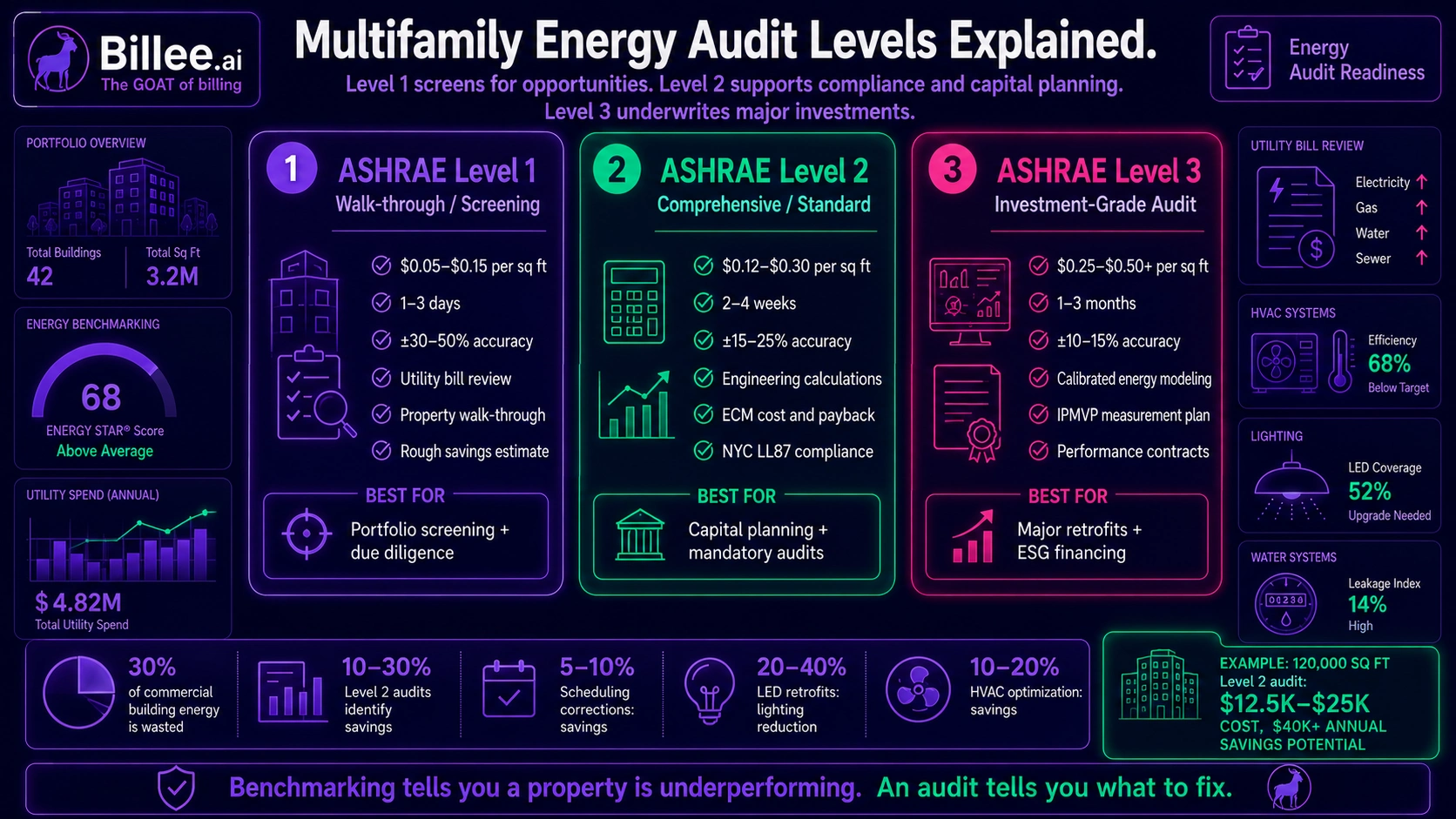
TL;DR: A multifamily energy audit is a systematic inspection of a property's utility consumption, building envelope, HVAC systems, lighting, and water heating to identify energy waste and quantify savings opportunities. ASHRAE Level 1 walk-through audits cost $0.05–$0.15 per square foot and take 1–3 days. Level 2 comprehensive audits cost $0.12–$0.30 per square foot and take 2–4 weeks. Level 3 investment-grade audits cost $0.25–$0.50+ per square foot and take 1–3 months. Level 2 audits, required by NYC Local Law 87 for buildings over 50,000 sq ft, typically identify 10–30% in energy savings, with scheduling and operational corrections paying back in under one year.
Key Takeaways
- The U.S. Department of Energy estimates 30% of commercial building energy is wasted. For a 100-unit community spending $120,000 per year on utilities, that represents roughly $36,000 in recoverable cost.
- A Level 2 audit of a 120,000 sq ft building typically costs $12,500–$25,000 and can identify $40,000 or more in annual savings, paying for itself within 12–14 months.
- ASHRAE Standard 211 defines three audit levels. Level 2 is the standard required by mandatory compliance programs in cities including New York, Boston, Chicago, and Atlanta.
- NYC Local Law 87 requires Level 2 audits plus retro-commissioning every 10 years for buildings over 50,000 sq ft. Buildings with tax block numbers ending in "6" faced a 2026 compliance deadline. Penalties start at $3,000 for the first missed year and $5,000 each year after.
- The fastest-paying measures that audits consistently identify are scheduling corrections (5–10% savings, zero cost), LED retrofits (20–40% reduction in lighting energy, 1–3 year payback), and HVAC optimization (10–20% savings, 1–5 year payback).
- Utility billing accuracy directly affects audit baseline integrity. Properties with unrecovered utility charges produce inflated Energy Use Intensity benchmarks, making savings projections less actionable.
ASHRAE Energy Audit Levels at a Glance
| Level | Common Name | Cost per Sq Ft | Timeline | Accuracy | Best For |
|---|---|---|---|---|---|
| Level 1 | Walk-through / Screening | $0.05–$0.15 | 1–3 days | ±30–50% | Portfolio screening, due diligence, limited budgets |
| Level 2 | Comprehensive / Standard | $0.12–$0.30 | 2–4 weeks | ±15–25% | Capital planning, mandatory compliance (NYC LL87), retrofit scoping |
| Level 3 | Investment-Grade (IGA) | $0.25–$0.50+ | 1–3 months | ±10–15% | Performance contracts, projects over $500K, ESG-financed retrofits |
What Is a Multifamily Energy Audit?
A multifamily energy audit is a formal assessment of a property's energy consumption, conducted according to ANSI/ASHRAE/ACCA Standard 211, which establishes the procedures, scope, and reporting requirements for commercial building energy assessments. The goal is to move beyond knowing a utility bill is high and understand exactly where the waste is occurring, how much it costs, and what it would take to fix.
Benchmarking tells you how your property compares to peers. An audit tells you precisely what to do about the gap. While tools like ENERGY STAR Portfolio Manager produce an Energy Use Intensity score that flags underperforming buildings, only an on-site audit produces the engineering-level findings required to prioritize and fund improvements.
The Building Performance Institute's BPI-1105 Standard Practice for Multifamily Energy Auditing extends ASHRAE methodology to apartment-specific systems, adding requirements for combustion appliance testing and resident unit sampling. Together, these standards give auditors a rigorous framework for multifamily properties, where shared common areas, individual in-unit systems, and domestic hot water loops create complexity not found in single-occupancy commercial buildings.
How a Multifamily Energy Audit Works
A Level 2 multifamily energy audit follows a defined seven-phase process from the first utility bill review to the final report. Understanding each phase helps property teams prepare effectively and set realistic expectations for what the report will contain.
Phase 1: Utility Data Collection and Benchmarking Baseline
The audit begins before anyone sets foot on the property. The auditor collects 12–24 months of utility bills covering electricity, natural gas, and water, then calculates the property's Energy Use Intensity (EUI): total energy consumed per square foot per year, expressed in kBtu per square foot. That EUI is benchmarked against comparable multifamily properties using ENERGY STAR Portfolio Manager, the standard tool required for most mandatory benchmarking filings.
Weather normalization is applied to the data to separate actual operational inefficiency from variation driven by climate. The auditor also identifies anomalies in the billing history, including months with unexplained consumption spikes, unusual baseload patterns, and billing errors that artificially inflate the property's apparent energy cost. These baseline data points drive the entire analysis that follows.
Phase 2: Building Envelope Inspection
The auditor physically inspects the roof, walls, windows, doors, and all penetrations through the building shell, looking for air leakage and insulation gaps that force heating and cooling systems to work harder than necessary. Air sealing and added insulation consistently rank among the highest-return envelope measures in multifamily, with paybacks in the three-to-seven-year range in most climate zones.
Level 2 auditors may use infrared thermography to identify moisture intrusion and thermal bridging not visible to the naked eye. Level 3 audits go further with blower-door testing to quantify whole-building air infiltration rates. Common findings include uninsulated attic bypasses, single-pane windows in pre-1980 buildings, and unsealed penetrations between corridor spaces and residential units.
Phase 3: HVAC and Mechanical Systems Assessment
Every piece of HVAC equipment in the building gets a full inventory: make, model, year of manufacture, rated efficiency (SEER, AFUE, or COP depending on system type), observed condition, and maintenance history. The auditor reviews control sequences, BMS programming, and scheduled operating hours to identify units running when the building is unoccupied or systems failing to reset setpoints between heating and cooling seasons.
HVAC optimization measures identified in audits typically deliver a 10–20% reduction in HVAC energy consumption. Retro-commissioning, required alongside the Level 2 audit under NYC Local Law 87, corrects BMS setpoints, resets schedules, and restores equipment to original design performance, often with zero capital expenditure. Failed economizers, low refrigerant charges, and dirty coils each degrade system efficiency by 10–25% before triggering a service call.
Phase 4: Lighting, Plug Loads, and Common Area Systems
The auditor inventories all common-area lighting by fixture type, wattage, controls, and hours of operation. LED retrofits in multifamily common areas consistently deliver a 20–40% reduction in lighting energy, with payback periods of one to three years. Utility rebates for LED upgrades frequently reduce effective payback to under 12 months.
Laundry room equipment, elevator systems, and pool and amenity loads are evaluated for age, efficiency rating, and hours of operation. For resident units, the BPI-1105 methodology calls for sampling a statistically representative number of units to assess in-unit lighting and plug load patterns without requiring access to every apartment.
Phase 5: Water and Domestic Hot Water Systems
Domestic hot water is often the single largest energy end-use in multifamily buildings, accounting for 25–35% of total energy consumption in all-electric properties. The auditor inspects water heater efficiency ratings, distribution pipe insulation, recirculation loop heat losses, and inlet water temperatures across the building.
Low-flow fixture retrofits on showerheads and faucets reduce hot water demand by 20–30% with payback periods typically under two years. A single dripping faucet wastes more than 3,000 gallons per year and adds meaninglessly to both water and water-heating costs. Auditors flag chronic leaks as quick-wins that carry no capital cost and immediate payback.
Phase 6: Energy Modeling and Savings Analysis
Once the on-site data collection is complete, the auditor performs the engineering calculations that distinguish a Level 2 audit from a walk-through. For each identified Energy Conservation Measure (ECM), the analysis produces a quantified savings estimate in kWh or therms, an estimated implementation cost, and a simple payback period based on current utility rates.
Level 2 calculations carry accuracy of plus or minus 15–25%, which is sufficient for internal capital planning and mandatory compliance filings. Level 3 audits extend this work with calibrated whole-building simulation using software such as EnergyPlus or eQUEST, bringing accuracy to plus or minus 10–15% and enabling performance guarantees. The modeling phase also accounts for interactive effects between measures, which matter when implementing one upgrade changes the savings projection for another.
Phase 7: The Audit Report and ECM Prioritization
The final report ranks all identified ECMs into three tiers. The first tier covers no-cost and low-cost operational changes implementable immediately. The second tier covers low-capital equipment upgrades. The third tier covers major capital projects requiring budget approval and financing.
Under NYC Local Law 87, all retro-commissioning measures with a simple payback under one year must be implemented after the report is filed. Reports also identify applicable utility rebate programs, which often fund 50–75% of LED and HVAC upgrade costs. A Measurement and Verification plan, prepared per the International Performance Measurement and Verification Protocol, specifies how actual post-implementation savings will be confirmed against the audit baseline.
ASHRAE Audit Levels Explained: Costs and Scope for Multifamily
ASHRAE Standard 211 defines three audit levels, each building on the previous with greater depth, time, and cost. Choosing the right level means matching assessment rigor to the decision the report needs to support.
Level 1 (Walk-through / Screening) costs $0.05–$0.15 per square foot and takes one to three days from site visit to report delivery. The auditor reviews 12 months of utility bills, calculates EUI, benchmarks against peer buildings, and walks the property to identify obvious inefficiencies. Deliverables are directional: a list of potential ECMs categorized as no-cost, low-cost, or capital-intensive, with rough-order-of-magnitude savings estimates accurate to within 30–50%. Level 1 is the right starting point for portfolio screening and pre-acquisition due diligence.
Level 2 (Comprehensive / Standard) costs $0.12–$0.30 per square foot, with most projects landing between $0.15 and $0.25. The timeline is two to four weeks depending on building complexity. This level delivers the engineering-grade calculations for each ECM that are required by mandatory audit ordinances, and it satisfies compliance requirements under NYC Local Law 87, Atlanta's Commercial Buildings Energy Efficiency Ordinance, and similar programs in Boston, Chicago, and Seattle. A real-world example illustrates the return: a 120,000 sq ft medical office complex paid $12,500 for a Level 2 audit and identified $47,000 in annual savings from HVAC scheduling corrections, lighting retrofits, and envelope improvements. The audit paid for itself in 14 months.
Level 3 (Investment-Grade) costs $0.25–$0.50 or more per square foot and takes one to three months. This level adds extended monitoring periods, calibrated energy simulation, and an IPMVP-compliant Measurement and Verification plan. The Building Owners and Managers Association recommends that the audit cost not exceed 10% of annual utility spend, which effectively limits Level 3 to situations where major retrofit financing or performance guarantees are in play.
When selecting an auditor, look for credentials that mandatory ordinances specify: Certified Energy Manager (CEM), Professional Engineer (PE) with a mechanical or electrical specialty, or ASHRAE Building Energy Assessment Professional (BEAP). Request a sample report before engaging, and get at least three competitive bids specifying the same ASHRAE level so scope comparisons are meaningful.
What a Multifamily Energy Audit Typically Finds
Scheduling and operational waste is present in nearly every multifamily building that has never been audited. HVAC equipment running outside occupied hours, setpoints not reset seasonally, and outdoor lighting operating on timers that no longer reflect sunrise and sunset times are routine findings that cost nothing to correct. Scheduling corrections alone typically deliver 5–10% savings in total energy spend.
Deferred HVAC maintenance produces compounding inefficiency. A chiller with a dirty condenser coil, low refrigerant charge, or failed economizer can lose 10–25% of its rated efficiency before the decline shows up as a service call. Auditors flag these conditions and quantify the energy cost of continued deferral, which often makes the case for maintenance spending that operations teams have struggled to fund.
The savings breakdown by measure type, based on data from the U.S. Department of Energy's Better Buildings program, is consistent across building types. Scheduling corrections carry immediate payback at zero cost. LED retrofits deliver a 20–40% reduction in lighting energy with paybacks of one to three years. HVAC system optimization delivers 10–20% savings in HVAC energy with paybacks of one to five years depending on the scope. Envelope improvements deliver 5–15% reductions in heating and cooling loads but typically require five to fifteen years to pay back and are most economically packaged with planned renovation work.
Compliance Requirements Driving Energy Audits in 2026
Mandatory energy audit requirements now cover more than 40 U.S. jurisdictions, making compliance a primary driver for Level 2 audits in major multifamily markets.
NYC Local Law 87 requires ASHRAE Level 2 energy audits plus retro-commissioning every 10 years for buildings over 50,000 gross square feet. Compliance deadlines rotate annually based on the last digit of the building's tax block number; buildings with a block digit of "6" had a deadline of March 31, 2026. Penalties for missed compliance are $3,000 for the first year and $5,000 for each subsequent year.
NYC Local Law 84 requires annual energy and water benchmarking for all New York City buildings over 25,000 sq ft. The 2025 calendar year data was due to the city by May 1, 2026, submitted via ENERGY STAR Portfolio Manager. Local Law 97 adds carbon emissions caps beginning in 2024, with fines of $268 per ton of CO2 above the annual limit for buildings over 25,000 sq ft. An energy audit is the essential first step toward identifying which measures reduce carbon at the lowest cost.
New Jersey requires annual energy benchmarking for all buildings of 25,000 sq ft or more. The 2025 data filing deadline was July 1, 2026. Georgia, Massachusetts, Illinois, Washington state, and California all have comparable building performance standards, each with their own size thresholds, audit frequencies, and reporting tools.
From Audit Report to Implementation: Capturing the Savings
Industry data suggests that the typical building implements between 10% and 30% of identified ECMs in the first 12 months following an audit. The gap between savings identified and savings captured is where most properties lose the value they paid to find.
The most effective post-audit workflow moves quickly through the triage process. No-cost operational corrections should be implemented within 30 days. Utility rebate applications for planned equipment upgrades should be submitted before construction begins, because most programs require pre-approval to qualify. Low-capital measures should be sequenced first to generate savings that help fund the capital phase.
Ongoing tracking against the pre-audit baseline is the mechanism that keeps savings real. HVAC equipment that was efficient at the time of the audit can lose refrigerant charge, accumulate coil fouling, or suffer control drift over 12–18 months. Periodic monitoring of Energy Use Intensity against the audit baseline, using the same ENERGY STAR Portfolio Manager tool that established the benchmark, catches efficiency drift before it erases the gains the audit produced.
How Utility Billing Data Connects to the Audit Process
Energy audit accuracy depends on clean utility data. The property's Energy Use Intensity calculation, which drives the entire benchmarking and savings analysis, is built from actual utility costs. A property where resident utility charges are incompletely recovered carries phantom utility expense in the master meter totals: costs that appear as consumption waste but are actually billing process failures.
Billee's Billing and Recovery Engine automates resident utility billing across the portfolio, pulling vendor invoices, allocating charges using the correct methodology (RUBS, submetering, or a hybrid approach), and reconciling charges against actual master meter usage every billing cycle. Billee uses an 80–95% recovery rate as the benchmark for great performance; recovery below 80% signals missed charges, vacant unit leakage, or allocation errors that need immediate correction. When a property's billing recovery is below that threshold, the net utility cost that feeds the audit baseline is inflated by unrecovered charges rather than actual energy waste.
Accurate billing data also simplifies the mandatory filings that most large multifamily properties now face. ENERGY STAR Portfolio Manager benchmarking submissions require clean utility data by meter and property, and discrepancies between master meter invoices and recovered resident charges create reconciliation problems that delay filings. Billee's ESG and Sustainability Reporting product produces consumption tracking compatible with Portfolio Manager, giving properties a single source of data for both internal audit preparation and regulatory compliance submissions. If your property is heading into an energy audit cycle or facing a Local Law 84 benchmarking deadline, a utility billing review is the right place to start. Contact Billee at billee.ai.
Frequently Asked Questions
What is a multifamily energy audit? A multifamily energy audit is a formal assessment of a property's energy consumption, conducted under ANSI/ASHRAE/ACCA Standard 211, that inspects utility data, the building envelope, HVAC systems, lighting, and domestic hot water to identify waste and quantify savings opportunities. The audit produces a prioritized list of Energy Conservation Measures with implementation costs and payback periods.
How much does a multifamily energy audit cost per square foot? Costs vary by audit level. Level 1 walk-through audits cost $0.05–$0.15 per square foot. Level 2 comprehensive audits cost $0.12–$0.30 per square foot, with most in the $0.15–$0.25 range. Level 3 investment-grade audits cost $0.25–$0.50 or more per square foot. For a 100,000 sq ft building, expect approximately $5,000–$15,000 for Level 1, $12,000–$30,000 for Level 2, and $25,000–$50,000 for Level 3.
What is the difference between ASHRAE Level 1, Level 2, and Level 3 audits? Level 1 is a walk-through that identifies rough savings potential with accuracy of ±30–50%. Level 2 is a comprehensive audit with engineering-grade calculations for each measure, accurate to ±15–25%, and is required by most mandatory audit ordinances. Level 3 is an investment-grade audit with calibrated energy simulation accurate to ±10–15%, used when performance contracts or major retrofit financing require guaranteed savings projections.
Is an energy audit required for my apartment building? It depends on location and building size. NYC Local Law 87 requires ASHRAE Level 2 audits every 10 years for buildings over 50,000 sq ft; 2026 compliance applied to buildings with tax block numbers ending in "6." More than 40 U.S. jurisdictions have similar mandatory audit requirements, including Boston, Chicago, Atlanta, San Francisco, and Seattle. Check your city's Building Performance Standards or contact your local Department of Buildings to confirm applicable requirements.
What does an energy auditor look for in a multifamily building? Auditors inspect utility bills, building envelope air leakage and insulation, HVAC equipment age and efficiency, lighting systems, domestic hot water systems, common area plug loads, and equipment scheduling and controls. Diagnostic tools used on-site include infrared cameras, combustion analyzers, power meters, and light meters. The BPI-1105 standard for multifamily also requires combustion appliance testing and sampling of resident units.
How long does a multifamily energy audit take? Level 1 audits take one to three days from site visit to report. Level 2 audits require two to four weeks, including time for detailed system inventory, engineering calculations, and report preparation. Level 3 audits take one to three months due to extended monitoring periods and calibrated energy modeling. Buildings with organized utility data and current equipment documentation complete audits faster.
What savings can a multifamily energy audit identify? Level 1 audits identify directional savings potential of 5–30%. Level 2 audits typically identify 10–30% in energy savings through actionable ECMs. Scheduling corrections and retro-commissioning often deliver 5–10% immediately at zero cost. LED retrofits deliver 20–40% reductions in lighting energy. HVAC optimization delivers 10–20% savings in HVAC consumption. Actual savings depend on current building performance and how many recommendations are implemented.
What happens after an energy audit report is delivered? The report should be triaged into three action categories: immediate no-cost changes, low-capital equipment upgrades with short paybacks, and longer-term capital projects. Utility rebate applications should be submitted before construction begins for eligible measures. Under NYC Local Law 87, all retro-commissioning measures with payback under one year are required to be implemented after filing. Ongoing tracking of Energy Use Intensity against the audit baseline confirms whether implemented measures are delivering projected savings.
Sources
Envigilance. "ASHRAE Energy Audit: Levels 1–3 Explained." Updated February 2, 2026. https://envigilance.com/energy-monitoring/ashrae-energy-audit/
Berntsen, Joel. "What Does a Commercial Energy Audit Cost Per Square Foot?" vUtility, February 27, 2026. https://vutility.com/blog/commercial-energy-audit-cost-per-square-foot
Abraxas Energy Consulting. "ASHRAE Level 2 Energy Audit." https://www.abraxasenergy.com/energy-consulting/commercial-energy-audits/ashrae-level-2/
U.S. Department of Energy. "Building Energy Codes Program." https://www.energy.gov/eere/buildings/building-energy-codes-program
Building Performance Institute. "BPI-1105-S Standard Practice for Multifamily Energy Auditing." https://www.bpi.org
U.S. EPA. "ENERGY STAR Portfolio Manager." https://www.energystar.gov/buildings/benchmark
Envigilance. "NYC Local Law 87 Compliance Guide 2026." https://envigilance.com/energy-monitoring/nyc-building-energy-laws/local-law-87/
KomplyOS. "NYC Local Law 87 Deadlines: NYC Filing Schedule (2026)." https://www.komplyos.com/guides/local-law-87-deadlines
KomplyOS. "NYC Local Law 87 — Energy Audit and Retro-commissioning." https://www.komplyos.com/guides/local-law-87
PulseIQ. "ASHRAE Level 2 Audit." https://pulseiq.com/ashrae-level-2-audit/
Lumiform. "ASHRAE Level 2 Energy Audit Checklist." https://lumiformapp.com/templates/ashrae-level-2-energy-audit-checklist_35438
3D Energy. "Level 2 Energy Audit." https://3denergy.tech/energy-audit-level-2/
EMATPROGRAM. "Energy Audits for Multi-Family Apartment Buildings." https://ematprogram.org/energy-audits-for-multi-family-apartment-buildings/
TTI Environmental. "2026 NJ Energy Benchmarking Requirements." https://www.ttienv.com/
Energo. "Local Law 87 Explained: NYC Energy Audits, Retro-Commissioning, and the 10-Year Compliance Cycle." https://energo.com/blog/local-law-87-explained-nyc-energy-audits-retro-commissioning-and-the-10-year-compliance-cycle/
FS Residential. "Local Law 87: NYC Energy Audits and Retro-commissioning — 2025 Compliance Update." https://www.fsresidential.com/new-york/news-events/articles-and-news/nyc-local-law-87-2025-compliance-update/
Insights and Industry Trends


Explore more insights