

How HUD Utility Allowances Are Calculated: A Step-by-Step Guide for Multifamily Operators
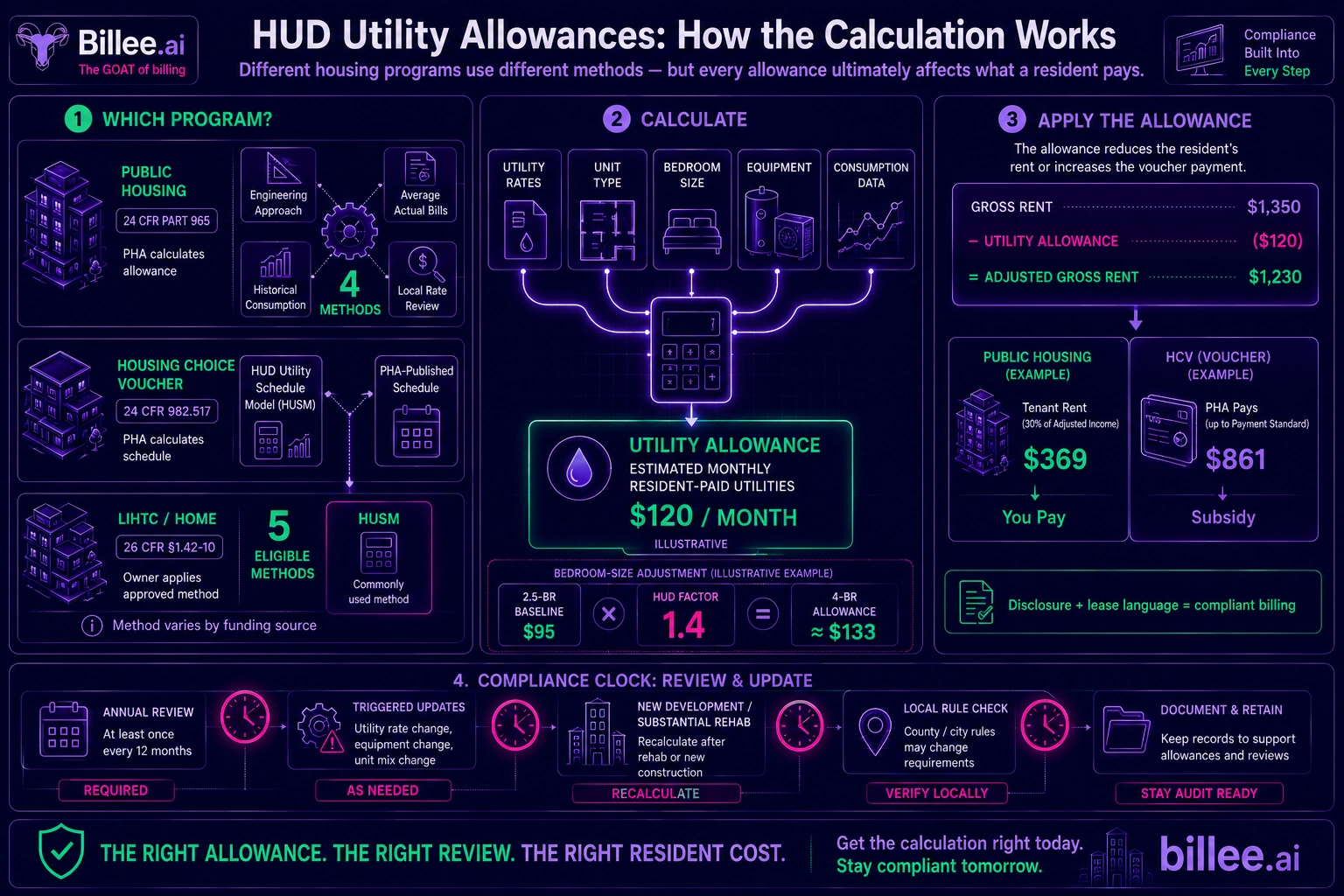
A HUD utility allowance is a dollar figure representing the estimated monthly cost of utilities a resident pays directly, used to keep total housing cost roughly the same regardless of who pays the utility company. Public Housing allowances are calculated using one of four methods under 24 CFR Part 965: the engineering approach, average actual bills, average historical consumption, or a local rate review. Housing Choice Voucher and most LIHTC or HOME properties instead rely on the HUD Utility Schedule Model or a Public Housing Authority's published schedule.
The resulting figure flows directly into the resident's Total Tenant Payment, sometimes generating a reimbursement paid to the resident rather than a deduction from what they owe. Billee tracks which schedule applies to each unit and flags the required review dates automatically.
Key Takeaways
- A utility allowance exists to keep total housing cost neutral whether the owner or the resident pays the utility company directly.
- Public Housing Authorities calculate allowances using one of four methods under 24 CFR Part 965: the engineering approach, average actual utility bills, average historical consumption, or a local utility rate review.
- Housing Choice Voucher properties and most LIHTC or HOME properties instead rely on the HUD Utility Schedule Model (HUSM) or a Public Housing Authority's published schedule.
- Allowances must be reviewed at least annually, with an off-cycle update required when utility rates or fuel costs change by 10 percent or more.
- The allowance can generate a Utility Reimbursement Payment made directly to the resident or the utility company, not just a rent deduction, when the Total Tenant Payment is less than the utility-allowance portion of gross rent.
- For the LIHTC compliance framework, including the 90-day implementation deadline and tax credit recapture exposure, see Billee's guide to utility billing compliance for affordable housing.
- Billee configures utility allowance tracking at the unit level and flags the applicable review clock automatically as part of its affordable housing billing support.
At a Glance: How Each Program Calculates Its Utility Allowance
| Program | Who calculates it | Primary method(s) | Governing regulation | Review cycle |
|---|---|---|---|---|
| Public Housing | The Public Housing Authority | Engineering approach, average actual bills, average historical consumption, or local rate review | 24 CFR Part 965, Subpart E | At least annually; off-cycle if rates change 10%+ |
| Housing Choice Voucher | The Public Housing Authority | HUD Utility Schedule Model or PHA-published schedule | 24 CFR 982.517 | At least annually |
| LIHTC / HOME | The property owner (method varies by funding source) | One of five methods under Treas. Reg. §1.42-10(b), frequently the HUD Utility Schedule Model or HUD-published factors | 26 CFR §1.42-10 | At least annually; new allowance in use within 90 days of an applicable change |
What a HUD Utility Allowance Is and Why the Calculation Matters
The core purpose: cost-neutrality regardless of who pays the utility bill
A utility allowance is HUD's mechanism for making sure a resident's total housing cost doesn't shift based on billing structure alone. If the owner pays the utility company and bundles that cost into rent, the resident's total cost is the contract rent. If the resident pays the utility company directly instead, HUD wants that resident's total cost to land in roughly the same place, so the allowance gets subtracted from what the resident would otherwise owe.
Without that adjustment, a resident paying utilities directly would face a higher effective housing cost than an identical resident next door whose rent includes utilities. The calculation exists specifically to close that gap.
Where utility allowances apply
Three federal program lanes use utility allowances, and each has its own calculation path. Public Housing units, owned and operated directly by a Public Housing Authority, calculate allowances under 24 CFR Part 965. Housing Choice Voucher units, privately owned but subsidized through a PHA, calculate allowances under 24 CFR 982.517.
LIHTC and HOME properties sit in a third lane. They aren't HUD-administered in the same direct sense as Public Housing, but most adopt a HUD-published factor or the HUD Utility Schedule Model as one of several IRS-approved calculation methods. That LIHTC-specific framework, including which method applies to which building type and the 90-day deadline for implementing a change, is covered in full in Billee's guide to utility billing compliance for affordable housing.
What "getting it wrong" actually means
The focus here is how the number itself gets produced, not the audit and recapture consequences of applying it incorrectly. Those consequences are real for LIHTC properties specifically, and Billee's affordable housing compliance guide walks through the 90-day implementation deadline, HFA audit findings, and tax credit recapture exposure in detail.
The calculation itself matters independently of those downstream risks. An operator who understands how a Public Housing Authority actually builds its schedule, or how the Housing Choice Voucher Program math moves from utility allowance to rent, can catch an error before it becomes a finding rather than after.
How Public Housing Utility Allowances Are Calculated (24 CFR Part 965)
Public Housing Authorities have four methods available under 24 CFR Part 965, Subpart E, and HUD's Public Housing Occupancy Guidebook describes all four in its utilities chapter. A PHA can apply different methods to different utility types within the same schedule.
Method 1: The engineering approach
The engineering approach starts with the physical equipment in a representative unit: the heating system, water heater, cooking appliances, lighting, and general plug loads. The PHA calculates expected consumption for each based on typical usage patterns, then applies current utility rates to produce a dollar figure.
The engineering approach works well for newly constructed or renovated units where billing history doesn't exist yet, since it doesn't depend on historical data at all.
Method 2: Average actual utility bills
The average-actual-bills method samples real utility bills paid directly by residents. HUD's guidance calls for a minimum data window, typically 12 months, and a minimum sample per unit type, generally three units where that many are available, to smooth out any single unit's unusual usage pattern.
Average actual bills reflect how residents in that specific community actually use utilities, which can differ meaningfully from an engineering estimate built on generic usage assumptions.
Method 3: Average historical consumption from PHA-owned checkmeters
Where the first two methods rely on estimates or resident-facing bills, this method draws on the PHA's own metering history. A checkmeter is a meter the PHA itself owns and reads, distinct from either a utility company meter or a submeter used for resident billing, and this method counts only consumption recorded during periods when the unit was actually occupied.
Method 4: Local utility rate review
The fourth method pulls current and anticipated rates directly from the utility company's published rate schedules. Every other method still needs current rate data to convert consumption into a dollar figure, so this one functions as both a standalone option and a required input to the other three.
Applying bedroom-size adjustment factors: a worked example
When a PHA has consumption data for only one representative unit size, it applies a bedroom-count adjustment factor rather than collecting separate data for every configuration. HUD's guidance illustrates this with a specific ratio: a four-bedroom unit's allowance is calculated at 1.4 times the consumption figure established for a 2.5-bedroom baseline unit.
Applying that documented 1.4 factor to an illustrative $95-per-month allowance for the 2.5-bedroom baseline produces a four-bedroom figure of about $133, without running a full separate study for every bedroom count in the portfolio. The dollar amounts here are illustrative; the 1.4 multiplier itself is HUD's published convention for scaling a baseline figure across unit sizes.
The HUD Utility Schedule Model (HUSM) and How It's Used Outside Public Housing
What HUSM actually calculates
The HUD Utility Schedule Model is a tool HUD built and makes available for download, using form HUD-52667, that lets a PHA or property enter local utility rate and unit data and receive a calculated schedule by housing type. HUSM can run the calculation using actual utility rates, average consumption measurements, or both, and lets the user compare the results side by side.
HUSM's role in the five LIHTC-eligible methods
HUSM isn't limited to Public Housing. It's also one of five methods available to LIHTC properties that don't receive Rural Housing Service assistance or have HUD-reviewed rents, under Treas. Reg. §1.42-10(b). The full breakdown of all five LIHTC methods, the 90-day deadline for implementing a changed allowance, and the documentation a state housing finance agency will expect to see are covered in Billee's affordable housing compliance guide.
What data to gather before starting a HUSM calculation
Before running a HUSM calculation, an operator needs the unit type and size mix for the property, current local utility rate schedules for every utility type the resident will pay, the heating and cooling equipment type installed in representative units, and prior-year consumption data if any exists.
Missing rate data is the most common reason a HUSM calculation stalls partway through. Utility rate schedules change often enough that a figure pulled even a few months earlier may no longer match what the utility company currently charges.
How the Allowance Flows Into a Housing Choice Voucher Resident's Rent (24 CFR 982.517)
The four numbers: Total Tenant Payment, Payment Standard, Housing Assistance Payment, Family Share
Once a utility allowance is set, it feeds directly into the Housing Choice Voucher Program's rent formula. Total Tenant Payment, defined at 24 CFR 5.628, is the minimum a family contributes toward housing costs: the greater of 30 percent of monthly adjusted income, 10 percent of monthly gross income, welfare rent where applicable, or the PHA's minimum rent.
Gross rent equals the contract rent to the owner plus the utility allowance. The Housing Assistance Payment is the lesser of the payment standard minus Total Tenant Payment, or gross rent minus Total Tenant Payment. Family share, what the resident's payment obligation actually equals, is gross rent minus the Housing Assistance Payment.
A worked example
Consider an illustrative voucher holder with a payment standard of $1,400 and a Total Tenant Payment of $450. The contract rent to the owner is $1,150, and the utility allowance is $120, so gross rent equals $1,270.
Because gross rent doesn't exceed the payment standard, the Housing Assistance Payment is gross rent minus Total Tenant Payment: $1,270 minus $450, or $820. Family share equals Total Tenant Payment in this case, $450, and since that $450 covers more than the $120 utility allowance, the resident pays $330 directly to the owner and covers the utility bill separately.
The Utility Reimbursement Payment: when the PHA pays the resident
The math changes when a resident's Total Tenant Payment is smaller than the utility allowance itself. Using the same $1,400 payment standard and $120 utility allowance, consider a resident whose Total Tenant Payment is only $80 based on a lower adjusted income.
Because $80 doesn't cover the $120 utility allowance, the resident owes nothing to the owner, and the Public Housing Authority reimburses the remaining $40 directly to the resident or the utility company under 24 CFR 5.632. Residents paying a flat rent rather than an income-based rent are not eligible for this reimbursement.
Utility billing consistency matters here beyond the math itself. Billing a voucher-assisted resident under a different formula than market-rate residents at the same property creates fair housing exposure alongside a potential Housing Assistance Payment contract violation, a risk covered in Billee's guide to fair housing and utility charge documentation.
The Review and Update Cycle Every Operator Needs to Track
The annual review requirement and the 10% rate-change trigger
Public Housing Authorities must review their utility allowance schedules at least once a year under 24 CFR 965.507. HUD's utility allowance guidance sets a second, independent trigger: an off-cycle revision is required any time utility rates or fuel costs change by 10 percent or more since the last update, regardless of where that falls in the annual cycle.
A rate increase that crosses the 10 percent threshold in month three of the review cycle still requires an update in month three, not at the next scheduled annual review. Waiting for the calendar date does not satisfy the requirement once the threshold has already been crossed.
Notice timelines: the 60-day PHA notice vs. the LIHTC 90-day clock
Public Housing residents are entitled to 60 days' notice before a utility allowance change takes effect, under 24 CFR 965.502. That's a materially different clock than the one governing LIHTC properties, where a changed allowance must be reflected in the gross rent calculation within 90 days of the change becoming effective, under Treas. Reg. §1.42-10(c).
An operator managing a layered property, Public Housing plus LIHTC for example, needs to track both clocks separately. They don't share a trigger or a duration, and satisfying one does not automatically satisfy the other.
The 5-year individual-metering benefit/cost analysis
Separate from the annual review, Public Housing Authorities must run a benefit/cost analysis at least every five years evaluating whether converting a building to individual metering makes financial sense. This requirement exists because individual metering removes the utility allowance calculation from the equation entirely, since residents billed on their own meter pay their own actual consumption rather than an estimated allowance.
For operators evaluating that same question outside the Public Housing context, Billee's guide to submetering ROI walks through the recovery-rate and payback-period math a comparable analysis would use.
How Billee Tracks Utility Allowance Calculations and Deadlines
Unit-level program configuration
Billee's Regulatory & Compliance product and Billing & Recovery Engine are configured at the unit level at implementation, distinguishing which program, Public Housing, Housing Choice Voucher, LIHTC, or HOME, governs each unit within the same property. The utility allowance in effect for each unit type is built into the gross rent or Total Tenant Payment calculation rather than applied as a manual adjustment.
Tracking the review clock automatically
Billee's account team tracks the applicable review and implementation clock for each unit, whether that's the annual Public Housing review, the 10 percent rate-change trigger, or the LIHTC 90-day implementation deadline, rather than leaving it to a property manager's calendar reminders. Every billing cycle generates per-unit documentation showing the allowance applied, the method used, and the applicable rent limit, ready for HFA, IRS, or PHA review on request.
Implementation takes 45 days. Vendor onboarding, program-specific configuration, and PMS integration with Yardi, RealPage, and Entrata are handled by the Billee team. Talk to the team.
FAQ: HUD Utility Allowance Calculations
What is a HUD utility allowance?
A HUD utility allowance is a dollar amount representing the estimated monthly cost of utilities a resident pays directly to the utility company. It's subtracted from what the resident would otherwise owe in rent so total housing cost stays roughly the same regardless of whether the owner or the resident pays the utility bill.
How is a HUD utility allowance calculated?
The method depends on the program. Public Housing Authorities use one of four methods under 24 CFR Part 965: the engineering approach, average actual utility bills, average historical consumption from PHA-owned checkmeters, or a local utility rate review. Housing Choice Voucher properties and most LIHTC or HOME properties instead use the HUD Utility Schedule Model or a Public Housing Authority's published schedule.
What is the HUD Utility Schedule Model (HUSM)?
HUSM is a calculation tool HUD developed and makes available using form HUD-52667. A Public Housing Authority or property owner enters local utility rate and unit data, and HUSM produces a calculated utility schedule by housing type, comparing results based on actual rates against results based on average consumption.
How often must a utility allowance be reviewed or updated?
At least annually across every program. Public Housing Authorities have an additional trigger: an off-cycle update is required whenever utility rates or fuel costs change by 10 percent or more since the last revision, independent of the annual review date. LIHTC properties must implement a changed allowance within 90 days of the change taking effect.
What is a Utility Reimbursement Payment, and who qualifies for one?
A Utility Reimbursement Payment happens when a resident's Total Tenant Payment is less than the utility-allowance portion of their housing cost. Rather than the resident absorbing that shortfall, the Public Housing Authority pays the difference directly to the resident or the utility company. Residents paying a flat rent are not eligible for this reimbursement.
Do LIHTC properties use the same calculation methods as Public Housing?
Not exactly, though the two can overlap. LIHTC properties choose from five methods under Treas. Reg. §1.42-10(b), one of which is the HUD Utility Schedule Model, the same tool Public Housing Authorities and Housing Choice Voucher administrators use. The full LIHTC-specific framework, including the 90-day implementation deadline, is covered in Billee's guide to utility billing compliance for affordable housing.
Who is responsible for calculating the utility allowance: the PHA or the property owner?
For Public Housing and Housing Choice Voucher units, the Public Housing Authority calculates and publishes the schedule. For LIHTC and HOME properties, the property owner selects and applies one of the approved methods, which often means adopting a figure the PHA or HUD has already published rather than running an independent calculation.
What happens if a utility allowance isn't updated on schedule?
An out-of-date allowance affects the accuracy of every rent calculation that depends on it until it's corrected. For LIHTC properties specifically, a stale allowance is a compliance event that state housing finance agencies routinely cite in audits, with refund and recapture consequences covered in Billee's affordable housing compliance guide.
Billee configures utility allowance tracking at the unit level for Public Housing, Housing Choice Voucher, LIHTC, and HOME properties, with the applicable review clock tracked automatically and audit-ready documentation built into every billing cycle. Talk to the team.
Sources
U.S. Department of Housing and Urban Development, "Public Housing Occupancy Guidebook: Utilities," accessed August 2026.
U.S. Department of Housing and Urban Development, "Housing Choice Voucher Guidebook: Payment Standards," accessed August 2026.
U.S. Department of Housing and Urban Development, "Utility Allowances," policy guidance, May 2020.
eCFR, "24 CFR § 965.502: Establishment of utility allowances by PHAs," accessed August 2026.
eCFR, "24 CFR § 965.505: Standards for allowances for utilities," accessed August 2026.
eCFR, "24 CFR § 965.507: Review and revision of allowances," accessed August 2026.
eCFR, "24 CFR § 982.517: Utility allowance schedule," accessed August 2026.
eCFR, "24 CFR § 5.628: Total tenant payment," accessed August 2026.
eCFR, "24 CFR § 5.632: Utility reimbursements," accessed August 2026.
Insights and Industry Trends


Explore more insights