

How Utility Billing Practices Affect Resident Retention in Multifamily
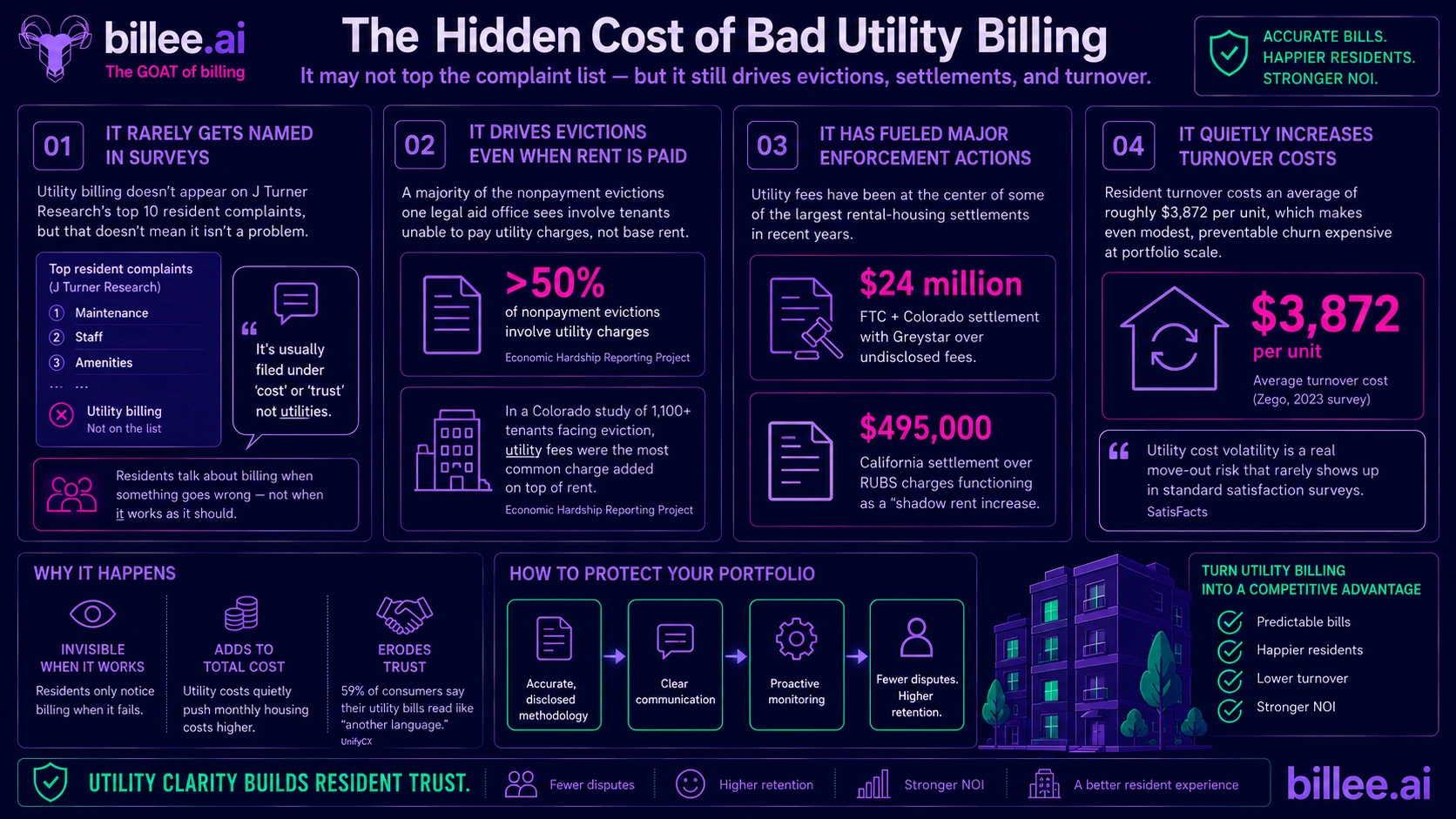
Utility billing rarely shows up when residents are asked why they left. It shows up anyway, in three sharper ways operators tend to underestimate: as a quiet, hard-to-name trust cost that never gets filed under "utilities," as a documented driver of eviction even when rent itself is paid in full, and as the trigger behind some of the largest rental-housing settlements and resident organizing campaigns of the past two years. This article looks at all three, and at what a documented, disclosed billing methodology actually protects against.
Key Takeaways
- Utility billing doesn't appear on J Turner Research's top-10 named apartment resident complaints, but that likely reflects dissatisfaction getting filed under "cost" or "trust," not that billing is harmless.
- A majority of the nonpayment evictions one legal aid office sees involve tenants unable to pay utility charges, not base rent, according to the Economic Hardship Reporting Project.
- In a Colorado study of more than 1,100 tenants facing eviction, utility fees were the most common charge added on top of rent, per the same reporting.
- Utility fees have driven some of the largest rental-housing enforcement actions in recent memory: a $24 million FTC and Colorado settlement with Greystar over undisclosed fees, and a $495,000 California settlement over RUBS charges functioning as a "shadow rent increase."
- Resident turnover costs an average of roughly $3,872 per unit, according to Zego's 2023 survey of 630 multifamily operators, which is what makes even modest, preventable churn expensive at portfolio scale.
Why Utility Billing Rarely Gets Named as the Reason Residents Leave
Billing only becomes visible to residents when something goes wrong
A resident who receives an accurate, predictable utility bill every month has no reason to think about it, let alone mention it in a satisfaction survey or an exit interview. Billing only becomes visible when it fails: a spike with no explanation, a dispute that goes unanswered, a final bill that doesn't match what was expected. That asymmetry is likely why utility billing doesn't appear on J Turner Research's top-10 list of named resident complaints, which is built from national online review data. Reviews get written when something is broken, and broken billing tends to get described as "hidden fees" or "they nickel and dime you," not filed under a category called utilities.
Rent increases are the proven renewal killer, and utility costs quietly ride along
The best-documented driver of non-renewal is a rent increase past a threshold. Most residents accept increases of 3-5% without much resistance, but renewal rates decline noticeably once increases push past 5-7%, since that's the point residents start comparing the property against what else is available. Utility costs rarely get counted in that math, but they function the same way: a resident's real monthly housing cost went up, even if the number labeled "rent" stayed flat. An operator watching only the rent line can miss that a resident's total cost of staying just crossed their personal threshold anyway.
"Financial concern" is a move-out risk most satisfaction surveys never isolate
Standard resident satisfaction surveys are built around categories like maintenance, staff, and amenities, not "can this resident actually afford to stay." Retention research has flagged financial concern as a real move-out risk that typically only surfaces through direct, personal conversation with a resident, not through a survey checkbox. Utility cost volatility is one of the more concrete, addressable things hiding inside that broader "financial concern" bucket, precisely because it's not tracked as its own line item anywhere a property manager would normally look.
A confusing bill erodes trust the same way it does in any other billing relationship
Bill confusion is not unique to multifamily. Fifty-nine percent of consumers say their utility bills read like "another language," according to consumer research cited by UnifyCX, a figure drawn from the broader utility sector rather than multifamily specifically. That same dynamic plausibly intensifies on a RUBS or submetered multifamily bill, which blends several commodities into one allocation formula that residents never see. SatisFacts, a multifamily-specific resident-experience research firm, makes the connection directly: hidden costs "create frustration before the resident relationship has even begun," and that frustration compounds into the trust a renewal decision ultimately runs on.
When Utility Billing Becomes an Eviction Risk, Not Just a Renewal Risk
Utility fees are a documented driver of nonpayment eviction even when rent is current
The sharpest version of "utility billing affects retention" isn't a resident quietly declining to renew. It's a resident losing housing entirely over a charge that was never rent. Reporting from the Economic Hardship Reporting Project found that a majority of the nonpayment evictions handled by Legal Aid of Marin County actually involve tenants who fell behind on add-on utility charges, not base rent. A separate Colorado study cited in the same reporting looked at more than 1,100 tenants facing eviction and found utility fees were the single most common charge added on top of rent among that group.
Leases that allow eviction for unpaid utility charges turn a billing dispute into a housing-loss risk
Many leases classify utility charges as additional rent for enforcement purposes, meaning nonpayment of a utility bill can trigger the same eviction process as nonpayment of rent itself. That structure turns an unresolved billing dispute, a charge a resident believes is wrong, into a housing-loss risk rather than a customer-service annoyance. A resident who is current on rent but disputing a $150 utility charge is not, from a lease-enforcement standpoint, necessarily protected from eviction proceedings while that dispute sits unresolved.
A real example of how an undisclosed monthly charge outgrew the rent it was attached to
The same reporting documented a case where a tenant's actual monthly housing cost reached $2,620, against a lease that advertised $1,725 in rent plus a $35 pet fee, once undisclosed utility and service charges were added in. The gap between the advertised number and the real number is exactly the kind of surprise that turns a manageable lease into an unmanageable one, and it happened on paper that technically disclosed a rent figure, just not the full cost of staying.
Why this risk concentrates around RUBS and add-on fees, not submetered or individually metered billing
This risk is not evenly distributed across billing methods. It concentrates specifically around RUBS-style allocation and bundled add-on fees, where the connection between a resident's actual usage and the number on their bill is least visible. A submetered or individually metered bill ties directly to a meter reading a resident can, at least in principle, verify. A RUBS charge or a bundled "utility administration" fee is a formula result, and a formula a resident can't see is a formula they can't trust when the number moves.
When Utility Billing Becomes a Regulatory and Reputational Risk
Regulators are treating undisclosed utility fees as disguised rent increases
California's Attorney General secured a $495,000 settlement with Mission Rock Residential over a RUBS structure that, combined with near-cap rent increases, pushed residents' total monthly cost past the state's legal rent cap. The state's argument was straightforward: a utility charge that functions as a disguised rent increase is still a rent increase, regardless of what line item it appears under, and is still subject to the same caps.
The FTC's $24 million Greystar settlement named utility administration fees specifically
The FTC and the state of Colorado reached a $24 million settlement with Greystar over advertised rents that concealed mandatory recurring fees, including charges the investigation specifically identified as "utility administration" costs. The settlement requires Greystar to display a total monthly leasing price, including all mandatory fees, before collecting any payment from a prospective resident. It's one of the largest enforcement actions in the sector's history, and utility-related charges were a named part of what triggered it.
Opaque billing can trigger organized resident action, not just individual move-outs
Regulators aren't the only ones responding. Residents at an Equity Residential property in Los Angeles organized a rent strike after requesting, and not receiving, a breakdown of how their RUBS charges were calculated. The organizing escalated from a petition to a formal strike involving dozens of units, and the company ultimately agreed to reduce charges and issue refunds after acknowledging residents had been overcharged. An undocumented billing formula doesn't just risk losing one resident at renewal, it can turn into a collective, public dispute that costs far more in refunds, legal exposure, and reputation than the disputed charges were ever worth.
Common Utility Billing Mistakes That Put Retention at Risk
- An allocation formula that isn't documented anywhere a resident or a regulator can review it. If nobody can explain how a charge was calculated, nobody can defend it either.
- No clear channel for a resident to dispute a charge. A dispute that has nowhere to go gets escalated somewhere else: a bad review, a complaint to a housing agency, a shared post in a resident group chat.
- Vacant-unit or common-area costs quietly absorbed into occupied residents' allocations. This inflates bills for residents who did nothing to cause the increase, and it's exactly the kind of gap vacant cost recovery monitoring is built to catch.
- Fees not disclosed until after a resident has committed to a lease. This is the specific pattern regulators have gone after in the largest recent settlements.
- Utility charges that swing month to month with no explanation. Unpredictability reads as untrustworthy even when the underlying number is technically correct.
Best Practices for Turning Utility Billing Into a Retention Asset
- Document the billing methodology in plain language, and be ready to produce it. A formula that can be explained on request is a formula that survives a dispute, an audit, or a regulator's inquiry.
- Disclose utility charges and their basis before lease signing, not after. This is now a matter of established enforcement precedent, not just good practice.
- Give residents a fast, visible way to ask about or dispute a charge. A question answered in two business days rarely becomes a bad review. A question that disappears into a ticket queue often does.
- Flag unusual charges proactively, before the resident has to ask. A short note explaining an unexpected spike costs a property manager a few minutes and prevents a much longer conversation later.
- Review billing methodology against current state and local rules on a regular cadence. Rules that restrict RUBS or require fee disclosure have moved quickly in the past two years, and a methodology that was compliant last year may not be compliant now.
How Billee Can Help
Billee's Billing & Recovery Engine generates resident bills against a documented, auditable methodology, the kind of paper trail that turns a disputed charge into a quick answer instead of an escalation. Billee's Regulatory Compliance support helps operators confirm their billing methodology against current state frameworks, the same review this article's regulatory section argues is now a real business necessity, not a formality. For operators specifically preparing for a transaction or portfolio review, Billee's utility billing due diligence checklist walks through the same documentation standard from the buyer's side of the table. And through the resident portal, residents can retrieve past bills and get billing questions answered without routing every request through the on-site team, which is exactly the kind of visible, responsive process that keeps a billing question from turning into a move-out decision.
FAQ
Does utility billing affect apartment resident retention? Not usually as a top named reason residents give for leaving, but it affects retention indirectly through eroded trust, and directly in more severe cases through nonpayment eviction risk and the regulatory and reputational fallout from undisclosed fees.
Can a resident be evicted for unpaid utility charges? In many leases, yes. Utility charges are often classified as additional rent for enforcement purposes, meaning nonpayment can trigger the same eviction process as unpaid rent, even when the resident's actual rent is current.
What is a "shadow rent increase"? It's a utility fee or add-on charge that functions as a disguised rent increase, particularly when combined with a rent increase near a legal cap. California's Attorney General has treated this as a violation of rent control law in at least one recent settlement.
What's a good lease renewal rate benchmark in multifamily? Renewal rates in the 50-60% range are typically considered average, 60-70% strong, and above 70% exceptional, though benchmarks vary by property class, with Class A properties often seeing lower renewal due to resident mobility.
How much does resident turnover cost? Roughly $3,872 per unit on average, according to a 2023 survey of 630 multifamily operators, covering costs like marketing, make-ready repairs, concessions, and lost rent during vacancy.
Does RUBS billing create legal risk for operators? It can, specifically when the methodology is undisclosed, undocumented, or functions as a way to exceed a rent cap or evade fee-disclosure requirements. This is a documentation and compliance question, not a reason to avoid RUBS itself, and it isn't a substitute for advice from qualified legal counsel in your jurisdiction.
Does Billee help with utility billing compliance and resident disputes? Yes. Billee's Billing & Recovery Engine documents the methodology behind every resident charge, and its Regulatory Compliance support helps confirm that methodology against current state and local rules.
A resident rarely says "I'm leaving because of my utility bill." They say the property felt expensive, or that they didn't feel like anyone had their back when something went wrong. Often, the utility bill is where that feeling started. Talk to Billee about documenting a billing methodology residents, regulators, and your own team can actually trust.
Sources
- J Turner Research, "J Turner Research Reveals Top 10 Apartment Resident Customer Satisfaction Complaints."
- Economic Hardship Reporting Project, "It Kept Adding Up: How Add-On Utility Fees Can Lead to Eviction for Tenants," August 2026.
- California Department of Justice, "Attorney General Bonta Announces Settlement Over the Use of Utility Fees as Shadow Rent Increases."
- Multifamily Dive, "Greystar to Pay FTC, Colorado $24M to Settle Rental Fee Suit."
- Shelterforce, "LA Tenant Strikes Force Landlord to Refund Opaque Utility Fees," October 2025.
- Multifamily Dive, "Turnover Costs Hold Steady at Nearly $4,000 Per Resident."
- SatisFacts, "Emerging Trends in Resident Feedback."
Insights and Industry Trends


Explore more insights