

How to Set Up Utility Billing for a New Apartment Community
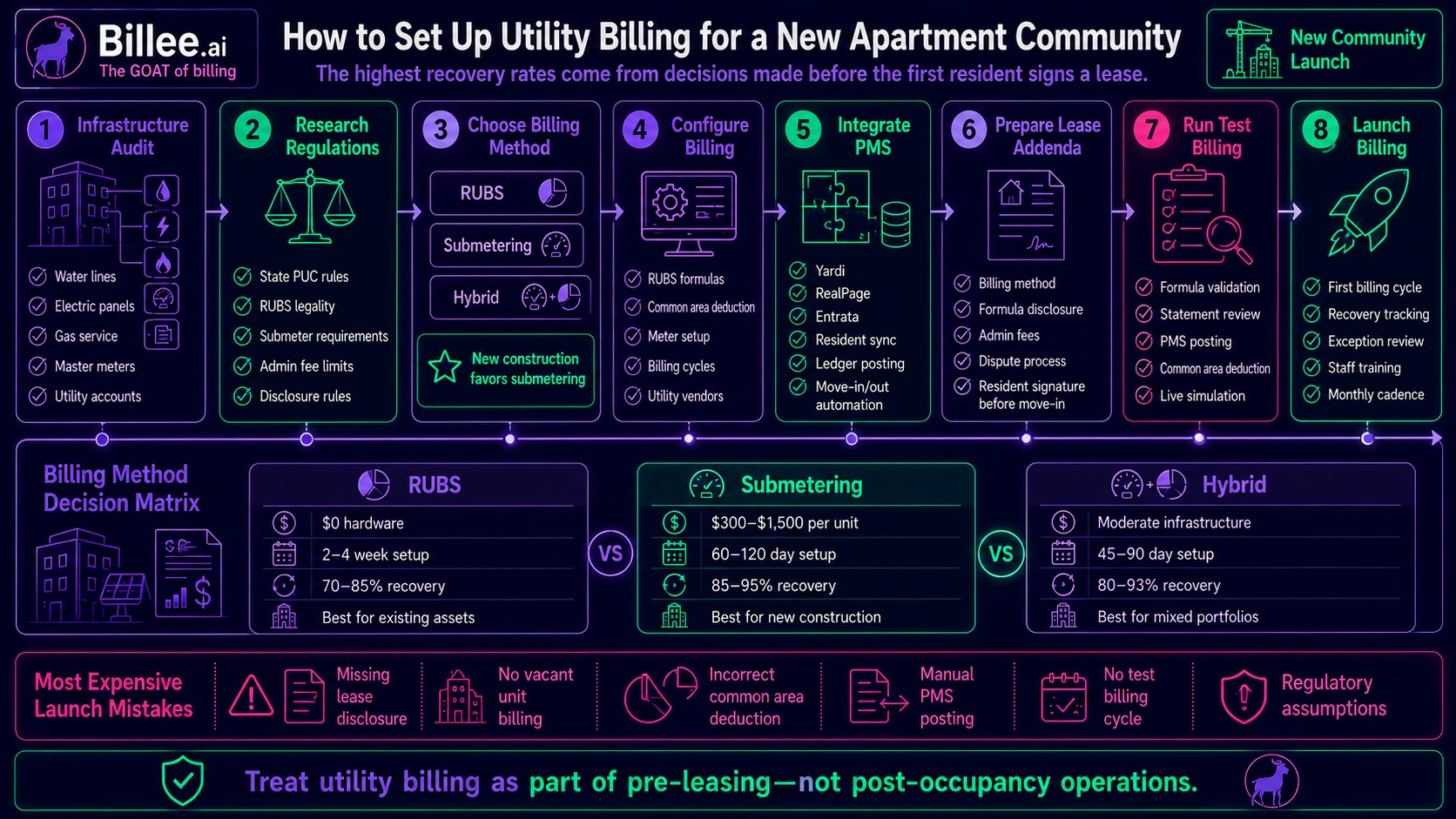
TL;DR: Setting up utility billing for a new apartment community requires four decisions made before the first lease is signed: which billing method to use (RUBS, submetering, or hybrid), which utilities to bill back to residents, which billing platform or provider to use, and how to integrate with your property management system. The full setup process -- from infrastructure audit through first live billing cycle -- typically runs 60--90 days. Recovery rates at a well-configured new community can reach 85--92% within the first three billing cycles. The most expensive mistakes happen when billing setup is treated as an afterthought rather than a pre-leasing requirement.
Key Takeaways
- The single most important setup decision is billing method: RUBS or submetering. New construction is the natural home for submetering because infrastructure can be designed in before walls close -- retrofit costs are substantially higher.
- Every resident must sign a utility billing lease addendum before move-in disclosing the billing method, the allocation formula (for RUBS), any administrative fees, and the dispute resolution process. Undisclosed fees are the most common source of regulatory complaints.
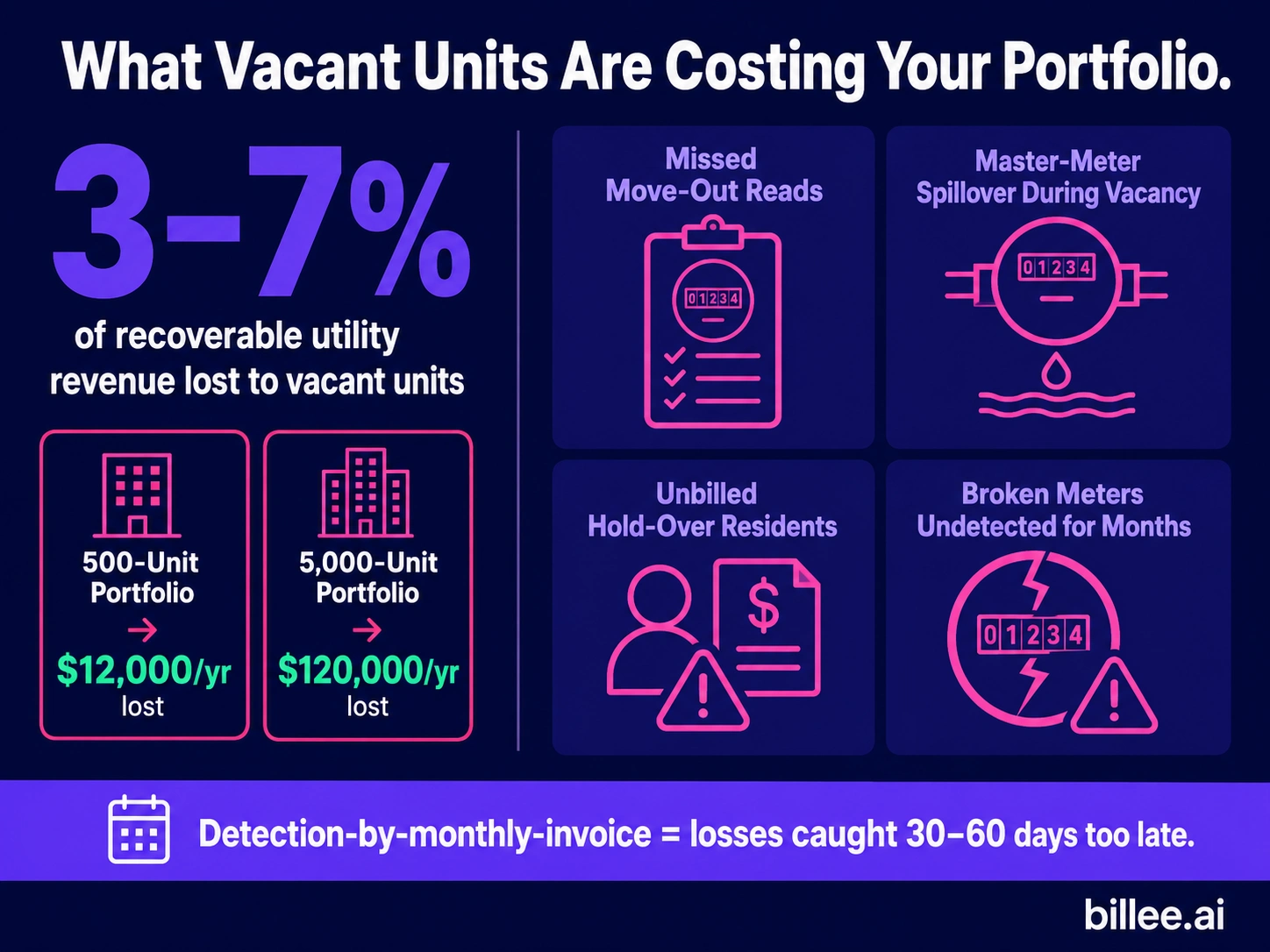
- Vacant unit billing must be configured from day one. Vacant units that show consumption but are not billed leak 3--7% of recoverable utility revenue from a typical portfolio -- a drain that compounds every cycle it goes unaddressed.
- PMS integration is not optional. Billing charges must push automatically to resident ledgers in Yardi, RealPage, or Entrata on the configured date. Manual charge entry is where billing errors and missed charges originate.
- Run a test billing cycle before the first residents move in. Validate that formulas are configured correctly, that PMS integration pushes charges accurately, and that statement formats comply with your state's disclosure requirements.
- California AB 1248 (effective April 1, 2026) substantially restricts RUBS for most utilities. Colorado HB26-1013 (signed March 2026) permits RUBS with four specific conditions. Check current state rules before finalizing your billing methodology.
At-a-Glance: Billing Method Decision Matrix
| Factor | RUBS | Submetering | Hybrid |
|---|---|---|---|
| Infrastructure required | None | Meters per unit | Meters for some utilities |
| Implementation cost | Low ($0 hardware) | $300--$1,500 per unit | Moderate |
| Time to first bill | 2--4 weeks | 60--120 days | 45--90 days |
| Recovery rate potential | 70--85% | 85--95% | 80--93% |
| Dispute defensibility | Formula-based (moderate) | Auditable reads (high) | Varies by utility |
| State restrictions | Increasing | Generally fewer restrictions | Varies |
| Best for | Existing or budget-constrained properties | New construction | Mixed portfolios |
The Four Decisions to Make Before You Set Up a Single Bill
Decision 1 -- Billing Method: RUBS, Submetering, or Hybrid
RUBS (Ratio Utility Billing System) allocates the total master meter cost across resident accounts using a formula: occupancy count, square footage, or a weighted combination of both. It requires no hardware, can be launched in weeks, and works for any property that receives a single utility bill from the utility provider. The tradeoff is a formula-based charge that fluctuates with total property consumption and is more difficult to defend in disputes than a meter read.
Submetering installs individual meters for each unit and bills residents based on measured consumption. It is the most accurate and most defensible billing method, and it consistently achieves higher recovery rates than RUBS. Water submetering for a new multifamily building costs approximately $300--$1,500 per unit installed; electric submetering runs $250--$500 per unit in new construction, where the infrastructure can be designed in before walls close.
Hybrid billing uses submetering for utilities where individual meters are feasible (typically water, sometimes electric) and RUBS for utilities where individual metering is impractical or cost-prohibitive (gas in master-metered buildings, trash, common area electric). Most portfolios that grow over time end up with a hybrid configuration across their property mix.
Decision 2 -- Which Utilities to Bill Back to Residents
Not all utilities need to be billed back, and the decision for each utility affects the billing method selection. Water and sewer are the most commonly billed-back utilities in multifamily -- they have clear per-unit consumption, submetering is widely available, and the cost is significant enough to make billing back worthwhile.
Electric is billed back where units have individual panels or submeters. Gas billing is common in markets where gas is the primary heating fuel and the property has individual gas lines per unit. Trash is often included in RUBS or charged as a flat fee. Common area electric -- lighting, elevators, laundry facilities -- can be billed back separately from unit consumption or excluded from the allocation base entirely, depending on state law and lease structure.
The decision on which utilities to bill back should account for what state law permits (some states restrict or prohibit certain utility allocations), what the local rental market supports (adding utility billing to market rents in a competitive market requires careful positioning), and what the property's infrastructure makes practical to meter.
Decision 3 -- In-House vs. Third-Party Billing Provider
In-house billing means property management staff processes invoices, runs billing cycles, generates resident statements, and manages disputes. It is viable for small portfolios (one to three properties) where the billing volume is manageable and the staff has the time and training to do it accurately.
Third-party billing providers handle the operational billing work -- invoice processing, cycle execution, statement generation, dispute handling -- and pair that service with a software platform that pushes charges into the PMS. For portfolios of meaningful scale, third-party billing consistently delivers better recovery outcomes because exceptions are caught by specialists who process billing every day, rather than by on-site staff managing billing alongside leasing, maintenance, and resident relations.
The right framework for evaluating this decision: what is the cost of staff time spent on billing operations, and how does it compare to the provider's per-unit fee? Add the value of the recovery rate improvement a professional provider typically delivers, and the in-house vs. outsourced decision is usually clear for portfolios above approximately 300--500 units.
Decision 4 -- PMS Integration Requirements
Your billing platform must integrate directly with your property management system. Charges must push to resident ledgers automatically on the configured billing date. Move-in and move-out dates must sync from the PMS to the billing system so new residents are billed from their first day of occupancy and final bills are prorated to the actual move-out date.
Before committing to a billing provider or platform, verify the specific integration capability with your PMS: native integration (data flows directly, in real time) versus batch export (data is periodically exported and manually imported). Native integration is substantially better for billing accuracy. A platform that requires a CSV export and manual import into Yardi or RealPage is not integrated -- it is partially automated, and the manual step is where billing errors enter the system.
RUBS vs. Submetering -- The Right Choice for a New Community
Why New Construction Is the Best Time to Submeter
A new multifamily building is the natural opportunity to install submetering because the infrastructure can be engineered into the design before walls close. Hot and cold water lines can be run individually to each unit from a central distribution point. Individual electrical panels or meters can be specified in the building's electrical design. Gas lines can be sized for unit-by-unit metering where gas service is required.
Retrofit submetering -- adding individual meters to an existing building -- requires opening walls, rerouting plumbing or conduit, and coordinating installation around occupied units. New construction avoids all of that. The per-unit cost of new construction submetering is typically at the low end of the range ($300--$500 per unit for water in a design-optimized building) because no retrofit work is required.
Submetering at new construction also sets the resident expectation correctly from the first lease: residents know they pay for measured consumption, understand the billing model, and have no prior rent-inclusive-utilities baseline to compare against.
How RUBS Allocation Formulas Are Set Up
A RUBS formula is configured by selecting the allocation base and defining any adjustments. The three most common bases: occupancy count (each resident is weighted equally), square footage (each unit is weighted by its leasable area), and hybrid (a formula combining occupancy and square footage with defined weighting factors).
The formula configuration must be documented precisely -- not "approximately proportional to unit size" but "allocated based on unit square footage as a percentage of total leasable square footage, excluding common areas" -- because this exact language goes in the lease addendum and governs how charges are calculated for every billing cycle at this property.
The formula must also specify how the common area deduction works. The billable amount is not the total utility invoice -- it is the total invoice minus the cost of utility consumption in common areas (hallways, lobbies, laundry, parking, mechanical rooms). Most states require this deduction; some specify exactly how it must be calculated. Getting this wrong in the formula setup creates regulatory exposure and, once residents are on RUBS, creates a billing adjustment headache if the formula needs to be corrected after launch.
State and Local Restrictions That Override Your Preference
Billing method selection is not purely an operational decision -- it is also a legal one. Connecticut bans RUBS for residential multifamily entirely. California Assembly Bill 1248, effective April 1, 2026, substantially restricts RUBS in California, prohibiting most RUBS arrangements with narrow exceptions for water and sewer under specific conditions. Colorado HB26-1013 (signed March 2026) permits RUBS for existing properties but under four conditions; new construction in Colorado should verify whether those conditions apply from day one.
The regulatory landscape for RUBS is tightening nationally. Before finalizing the billing method for a new community, verify current state and municipal rules. A billing methodology chosen without a compliance review may need to be changed after leasing has begun -- which creates disclosure obligations, transition costs, and potential resident disputes.
The Legal Foundation -- Lease Language and Disclosures
What the Utility Addendum Must Contain
Every resident must sign a utility billing addendum as part of the lease, completed and disclosed before signing -- not added after move-in. At minimum, the addendum must specify: which utilities are billed separately, the billing method for each utility (RUBS formula or submetering), the exact RUBS formula where applicable, what common area deductions are applied and how they are calculated, any administrative or service fees charged for billing operations, the billing cycle dates, and the dispute resolution process available to residents.
The addendum is not a formality -- it is the legal foundation of every billing cycle at the property. Charges that are not disclosed in the lease addendum cannot be collected without exposing the property to regulatory risk. Administrative fees are the most common undisclosed charge: a $4 per-unit billing service fee is modest, but if it is not in the addendum, it is indefensible against a resident complaint.
Common Area Exclusion Requirements
Utility costs attributable to common areas must be excluded from resident allocation in virtually every state that permits RUBS. "Common areas" is defined by the lease addendum and local regulations -- it typically includes hallways, lobbies, leasing office, laundry facilities, pool mechanical equipment, parking lot lighting, and any other areas not within a leased residential unit.
The percentage of the master bill attributed to common areas varies by property type and season. Properties with large amenity packages (pool, gym, leasing center with HVAC) have larger common area consumption than properties with minimal amenity space. Setting the common area deduction accurately at setup -- verified against actual common area square footage and a reasonable consumption estimate -- prevents either over-billing residents (deduction set too low) or under-recovering from the property (deduction set too high).
Disclosure Timing -- Before Lease Signing, Not After
Utility billing methodology disclosure must occur before the resident signs the lease, not after move-in. Residents who sign a lease without utility billing disclosure, then receive a RUBS or submetered bill in their first month, have a valid legal complaint in most jurisdictions. Depending on state law, they may have the right to void the utility billing arrangement entirely -- in which case the property loses all recovery on those units for the remaining lease term.
The pre-signing disclosure requirement creates an operational sequencing issue for properties that want to get leasing started before billing setup is complete. The solution is to complete billing methodology configuration and lease addendum drafting as part of pre-leasing preparation, before the first prospect tour, so that utility disclosure is part of the standard lease signing process from day one.
Administrative Fees: What You Can and Cannot Charge
States vary on whether landlords can charge administrative or service fees for utility billing. Texas, Florida, and most other states permit a reasonable administrative fee; some cap it at a specific dollar amount per unit per month. New York prohibits administrative fees on submetered utility charges. California's AB 1248 restrictions effectively prohibit administrative fees on RUBS for most utilities.
Where fees are permitted, they must be disclosed in the lease addendum and must not cause total resident charges to exceed the utility provider's actual invoice. Charging a fee that pushes aggregate resident billings above the master meter total is prohibited in every state with RUBS or submetering regulation -- and it is one of the most common violations found in PUC compliance audits.
The Eight-Step Setup Process
Step 1 -- Property Analysis and Utility Infrastructure Audit
Before selecting a billing method, audit the property's utility infrastructure. For water: does each unit have individual hot and cold water lines that can support individual metering, or does the building use a shared distribution system? For electric: does each unit have an individual panel or breaker that can be metered separately? For gas: are there individual gas lines per unit?
The audit also covers the existing utility accounts: how many master meters does the property have, which utilities are on master accounts, and what is the typical monthly spend by utility type? This baseline informs which utilities are worth billing back and helps size the expected recovery if the billing program is implemented.
Step 2 -- Research State and Local Regulations
Before finalizing the billing method, research the applicable state PUC rules and any municipal ordinances governing utility billing in the property's jurisdiction. Specifically: is RUBS permitted? Are there specific RUBS formula requirements? What must the lease addendum include? What administrative fees are permitted? What are the submeter operator licensing requirements, if any?
For multi-state portfolios, this research is property-specific. A national billing provider with a current regulatory database can expedite this step -- but for each new community, verify the current rules rather than relying on prior research from another state or market.
Step 3 -- Configure Allocation Formulas or Meter Infrastructure
For RUBS: configure the allocation formula precisely, calculate the common area deduction percentage, and document the exact formula language for the lease addendum. For submetering: procure and install meters, commission the metering system, and establish the data transmission connection to the billing platform (automated read via smart meters or manual read via field staff protocol).
This step takes 2--4 weeks for RUBS configuration and 30--90 days for submetering installation, depending on property size and meter technology. For new construction, meter installation should be included in the construction schedule and completed before certificate of occupancy.
Step 4 -- Integrate with Your PMS
Configure the billing platform's integration with Yardi, RealPage, Entrata, or your property's PMS. Integration must cover: resident roster sync (new move-ins and move-outs flow automatically from PMS to billing system), charge posting (utility bills push to resident ledgers on the billing date), and AP invoice posting (master meter invoices post to the GL after processing).
Integration configuration typically requires a setup call with both the billing provider and the PMS vendor's integration team. For Yardi Voyager, RealPage, and Entrata integrations, Billee has established data connections that are configured during onboarding. For other PMS platforms, verify integration capability and estimated setup time before selecting the billing provider.
Step 5 -- Prepare Lease Language and Addenda
Draft the utility billing addendum using the exact formula language from Step 3, verified against the regulatory requirements from Step 2. Have the addendum reviewed before the first lease signing -- by legal counsel if the portfolio is large or multi-state, or at minimum by a billing provider with regulatory compliance expertise.
Include the addendum in the standard lease package so it is signed by every resident, not offered as an optional document or added after the initial lease is executed. The addendum should be in plain language, not billing-industry shorthand -- residents need to understand it, and a resident who cannot understand the addendum is a resident who will dispute the bill.
Step 6 -- Load Resident and Unit Data
Before the billing platform can generate its first bill, it needs the property's unit roster: unit numbers, square footage, occupancy count (for occupancy-based RUBS), and move-in dates. This data comes from the PMS. For new construction, it should be loaded before the first residents move in -- not as residents are moving in -- to ensure the first billing cycle captures all occupied units from day one.
Also configure: the common area deduction percentage, billing cycle dates (the date on which the billing cycle opens and closes, and the date charges post to resident accounts), and the utility account numbers and vendor contacts for each master meter account at the property.
Step 7 -- Run a Test Billing Cycle Before Move-Ins
Before the first resident moves in, run a test billing cycle using actual or estimated utility consumption data. Verify that the RUBS formula produces the expected output, that submetered reads are transmitting correctly, that PMS integration posts charges to the correct ledger accounts, and that resident statements display the formula, master bill total, and calculation in the required format.
Testing reveals configuration errors that are far easier to correct before residents receive their first bill than after. A formula error discovered in a test cycle takes an afternoon to fix. The same error discovered after 200 residents have received their first bill requires issuing credit adjustments and a written explanation to every affected account.
Step 8 -- Train On-Site Staff on Dispute Handling
On-site leasing and management staff will be the first contact point for resident billing questions and disputes. Before the first billing cycle, train staff on: how to explain the billing methodology in plain language, what the resident statement shows and how to read it, what the dispute resolution process is and what the response SLA is, and who at the billing provider to contact when a dispute requires investigation access.
Staff who cannot explain the billing methodology confidently will defer to "call the billing company" for every question -- which reduces resident confidence in the property's billing operations and increases dispute escalation. Staff who can explain the formula and walk a resident through the statement resolve most questions before they become formal disputes.
What to Expect in Your First 90 Days
Common Setup Errors and How to Catch Them
The most common setup errors in a new community's first 90 days: RUBS formula applied with an incorrect common area deduction (either too high, reducing the billable base, or too low, over-billing residents relative to what state law permits); PMS integration that misses move-in or move-out dates, resulting in unbilled new residents or residents charged after their move-out; and master meter invoice processing errors in the first two or three cycles before the billing platform has a baseline for anomaly detection.
Run a master-to-resident reconciliation after every cycle in the first 90 days: the sum of all resident bills should equal the master meter total minus the common area deduction. Any variance should be investigated immediately. A 5% variance in cycle one may be a configuration error; let it go unexamined for three cycles and it becomes a systematic loss that is harder to trace.
Recovery Rate Benchmarks in Month 1 vs. Month 6
First-cycle recovery rates at a new community are typically lower than the 90-day stabilized rate because some residents may not have been invoiced from day one of occupancy (due to late data loading), the billing platform may still be calibrating anomaly detection thresholds, and the first invoice from the utility provider may cover a partial billing period. Expect 70--80% in cycle one to two, stabilizing toward 85--92% by cycle four to six as the system calibrates and any configuration errors are corrected.
A recovery rate that does not improve between cycle one and cycle six indicates a persistent configuration problem that requires investigation. The most common culprits: vacant unit consumption not being billed (a 3--7% leak in most portfolios), a RUBS formula not updated when occupancy changed, or a common area deduction set incorrectly.
Building Your Billing Operations Cadence
A sustainable billing operations cadence for a new community includes: a pre-cycle review (the billing platform generates a preliminary report showing all charges before they post; the property manager reviews and approves or requests corrections), a post-cycle reconciliation (verify that charges posted correctly to PMS ledgers and that the master-to-resident variance is within tolerance), and a monthly recovery rate review (track recovery rate by utility type and investigate any cycle-over-cycle decline greater than 3%).
Properties that establish this cadence in the first 90 days build the institutional knowledge to catch problems early. Properties that skip the review process discover problems months later, when correcting them requires retroactive adjustments and resident communication.
Setting Up for Maximum Recovery from Day One (Billee)
Why Setup Quality Determines Long-Term Recovery Rate
The recovery rate a new community achieves at month six is largely determined by decisions made before month one: billing method selection, formula configuration, common area deduction accuracy, PMS integration completeness, and whether vacant unit billing is enabled from the first cycle. Properties set up correctly from the start reach 85--92% recovery within the first three to six billing cycles. Properties set up with configuration errors -- particularly an incorrect common area deduction or missing vacant unit billing -- can stabilize at a permanently lower rate and not know why.
Vacant units are the most consistent source of undetected recovery loss at new communities. During lease-up, a community may have 10--30% vacancy at any given time. Units that show consumption during vacancy (turnover cleaning, maintenance activity, HVAC running to protect the unit) but are not billed represent a direct charge against the property's operating budget. Billee's Vacant Cost Recovery (VCR) product monitors occupancy data against actual meter usage and generates exceptions within the same billing week when a vacant unit shows consumption -- routed to a named Billee account team member who takes action, not just a dashboard alert.
What Billee Configures During a 45-Day Onboarding
Billee's standard implementation timeline is 45 days, covering vendor transitions, PMS integration setup, RUBS formula or submeter configuration, historical data migration, lease addendum review, and staff training. The Billee account team handles the operational setup -- operators stay focused on leasing and property operations rather than billing configuration.
For new communities, Billee's onboarding includes a regulatory compliance review for the property's jurisdiction, ensuring the billing methodology and lease addendum are consistent with current state PUC requirements before the first resident signs. This review is particularly valuable for communities in California, Texas, Colorado, Florida, or Illinois, where state-specific requirements are most detailed and most subject to change.
From First Bill to 90%+ Recovery Rate
The path from setup to strong recovery performance is predictable when the right foundation is in place. Cycle one: run the preliminary billing report, review for configuration errors, approve and post charges, measure the master-to-resident variance. Cycle two: apply any corrections from cycle one, continue monitoring vacant unit billing. Cycle three through six: track recovery rate trend, investigate any property below benchmark. By month six on a well-configured Billee setup, the target is 80--95% recovery rate on every property in the portfolio.
For operators launching a new apartment community and wanting to establish strong billing operations from day one, the Billee team is the starting point.
Frequently Asked Questions
What is the first step in setting up utility billing for an apartment community? Start with a utility infrastructure audit and a regulatory research step in parallel. The audit determines whether your property's infrastructure supports submetering (individual meters per unit) or requires RUBS (formula-based allocation). The regulatory research determines what billing methods are permitted in your state and what the lease addendum must include. Both must be complete before you select a billing method or draft lease language.
How long does it take to set up utility billing for a new property? RUBS billing setup takes 2--6 weeks from contract signing to first billing cycle. Submetering setup takes 60--120 days, depending on whether the infrastructure is already installed (new construction) or needs to be retrofitted. Full PMS integration and first live cycle for a new community typically runs 45--90 days total on a dedicated implementation timeline.
Do I need to submeter a new apartment building? No, but new construction is the best opportunity to do so at the lowest cost. Submetering infrastructure designed into a new building runs $300--$500 per unit for water and $250--$400 per unit for electric. Retrofit submetering on an existing building costs $500--$1,500 per unit for water depending on building type. Submetering delivers higher recovery rates (85--95% vs. 70--85% for RUBS) and is more defensible in disputes.
What goes in a utility billing lease addendum? At minimum: which utilities are billed separately, the billing method (RUBS formula or submetering) for each utility, the exact RUBS formula and common area deduction where applicable, any administrative fees charged, the billing cycle dates, and the dispute resolution process. The addendum must be signed by the resident before move-in, not added later.
Can I charge an admin fee for utility billing? It depends on your state. Texas and Florida permit a reasonable administrative fee; some states cap the amount. California's AB 1248 (effective April 1, 2026) substantially restricts this for most utilities. New York prohibits fees on submetered charges in many jurisdictions. Where fees are permitted, they must be disclosed in the lease addendum and cannot cause total resident charges to exceed the master meter bill.
What is a good recovery rate for a new community? In the first two billing cycles, expect 70--80% as the system calibrates. By cycle four to six, a well-configured community should be at 85--92%. Billee's performance benchmark is 80--95% for strong performance; below 80% flags a configuration problem. Recovery rates that plateau below 80% after month three indicate a persistent billing setup error that requires investigation.
Do I need different billing setup for water vs. electric vs. gas? Yes. Each utility may have a different billing method (some submetered, some RUBS), different state regulatory requirements, and different disclosure language in the lease addendum. Water is most commonly submetered or RUBS-billed. Electric billing depends on whether individual panels exist per unit. Gas is most often billed via RUBS where master-metered. Set up each utility separately within the billing platform with its own formula configuration and compliance documentation.
What happens if I start billing residents without the right disclosures in the lease? The resident may have grounds to void the utility billing arrangement for the remainder of their lease term, meaning the property cannot collect utility charges from that resident regardless of actual consumption. Depending on state law, the property may also face regulatory fines and be required to refund utility charges already collected. The risk is substantially higher for administrative fees than for the core utility charges themselves.
Sources
- AmCoBi. "Multifamily Owners: Including Utilities May Be Killing Your Profits." Accessed July 2026. https://www.amcobi.com/learning/utility-billing-services-blog-resources/129-including-utilities
- Apartment Loans. "The Ratio Utility Billing System Explained." Accessed July 2026. https://apartment.loans/posts/the-ratio-utility-billing-system-explained/
- Baselane. "What Is RUBS Utility Billing? Best RUBS Systems in 2026." Accessed July 2026. https://www.baselane.com/resources/rubs-utility-billing
- Bynry. "Utility Billing Multifamily Software: How It Works." Accessed July 2026. https://www.bynry.com/blog/utility-billing-multifamily-software
- Calcix. "How to Boost Multi-Family NOI with Submetering (2026 ROI Guide)." Accessed July 2026. https://calcix.net/guides/loan-mortgage/increase-multifamily-property-value-utility-submetering-guide
- Entrata. "Decoding Utility Billing: RUBS or Submetering for Your Multifamily Property?" Accessed July 2026. https://www.entrata.com/blog/decoding-utility-billing-rubs-or-submetering-for-your-multifamily-property
- Holland & Knight. "Existing Colorado Multifamily Housing Developments Can Continue Using RUBS Under New Law." April 2026. https://www.hklaw.com/en/insights/publications/2026/04/existing-colorado-multifamily-housing-developments-can-continue
- Livable. "What to Look for in Utility Billing Software: A Checklist for Property Managers." Accessed July 2026. https://blog.livable.com/what-to-look-for-in-utility-billing-software-a-checklist-for-property-managers
- MRI Software. "5 Multifamily Utility Cost Recovery Strategies." Accessed July 2026. https://www.mrisoftware.com/blog/5-multifamily-utility-cost-recovery-strategies/
- Multifamily Refinance. "RUBS Income: Increasing Profits With a Ratio Utility Billing System." Accessed July 2026. https://www.multifamilyrefinance.com/apartment-investing-blog/rubs-income-in-multifamily-real-estate
- Simple Sub Water. "The Complete Apartment Water Submetering Guide." Accessed July 2026. https://www.simplesubwater.com/resources/the-complete-apartment-water-submetering-guide
- Submeter Solutions. "Costs Related to Submeter Installation." Accessed July 2026. https://submetersolutions.com/blog/costs-related-submeter-installation/
- Synergy Utility Billing. "4 RUBS Billing Do's and Don'ts." Accessed July 2026. https://www.synergyutilitybilling.com/rubs-billing-dos-and-donts/
- UBWest. "Utility Billing Best Practices for New Property Managers." Accessed July 2026. https://www.ubwest.com/multifamily-utility-billing/utility-billing-best-practices-for-new-property-managers/
Insights and Industry Trends


Explore more insights