

EV Charging Station Billing for Apartment Communities
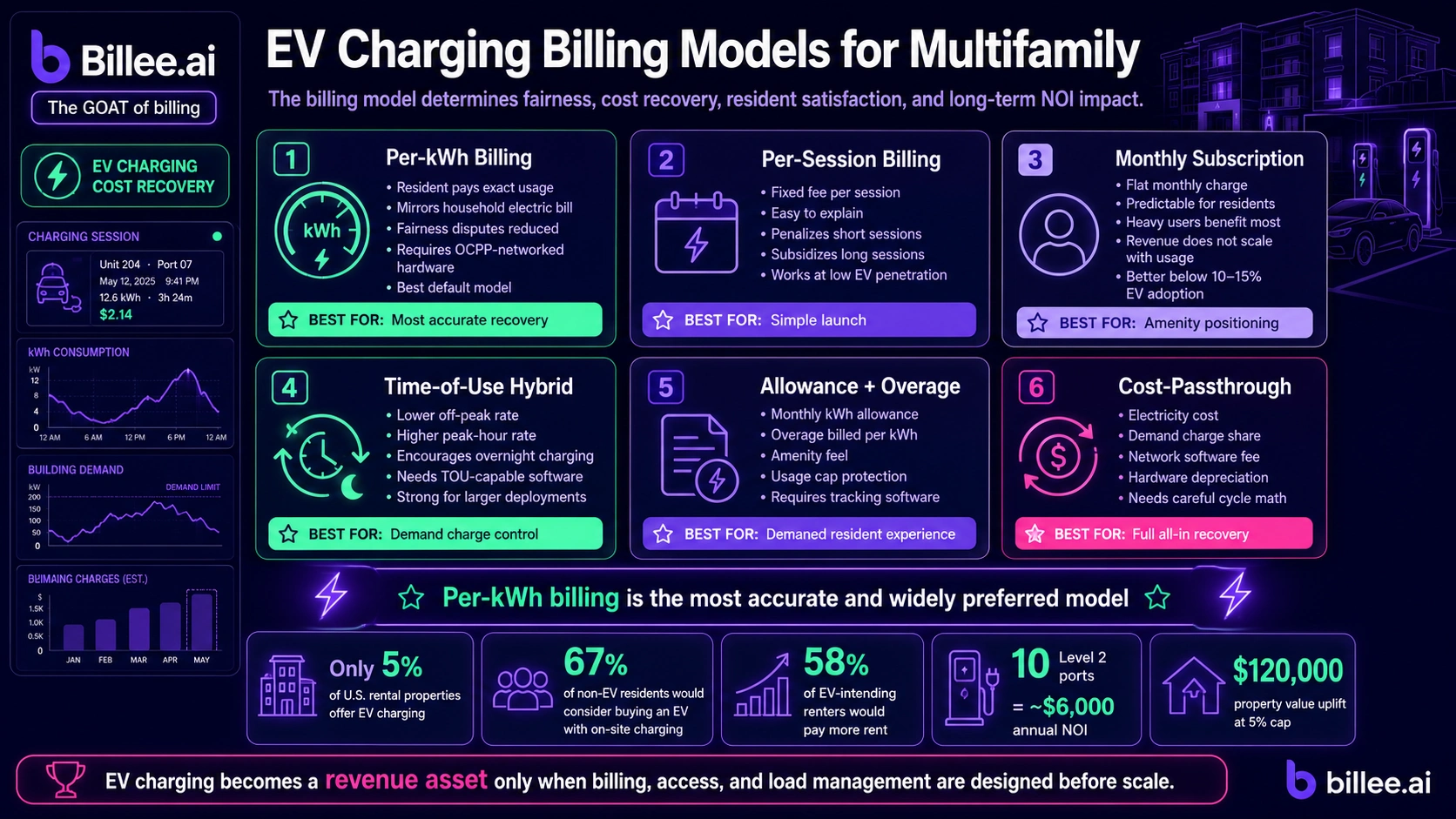
Only 5% of U.S. rental properties currently offer EV charging, yet 67% of non-EV residents say on-site charging would make them consider buying an electric vehicle and 58% of EV-intending renters say they would pay more rent for the amenity. The billing model a property chooses (per-kWh, per-session, flat monthly, time-of-use, or a hybrid) determines resident satisfaction, cost recovery accuracy, and long-term NOI impact. Per-kWh billing is the most accurate and widely preferred model. Level 2 installation runs $4,500 to $12,000 per port all-in at multifamily properties, with substantial state and utility incentives available in 2026, though the federal 30C tax credit expired June 30, 2026. Getting the billing and access infrastructure right before scaling is the decision that separates EV charging as a revenue asset from EV charging as an uncontrolled cost center.
Key Takeaways
- Only 5% of U.S. rental properties currently offer EV charging, despite rising resident demand in every major metropolitan market. (S3DA Design; AmpUp)
- 67% of non-EV residents say building EV charging would make them consider switching to an electric vehicle, making installation a demand-creation tool, not just a convenience. (AmpUp, citing Multifamily Executive)
- Per-kWh billing is the preferred model: residents pay for exactly what they use, mirroring their household electricity bill and eliminating fairness disputes. (AmpUp; DOE Alternative Fuels Data Center)
- A 10-port Level 2 deployment generates approximately $6,000 in additional annual NOI, which at a 5% cap rate translates to $120,000 in property value uplift. (S3DA Design)
- Level 2 installation costs $4,500 to $12,000 per port at multifamily properties all-in, with apartments on the higher end due to panel distance and electrical run length. (Winspark)
- The federal 30C tax credit (30%, up to $100,000 per port) expired June 30, 2026. Multiple state and utility programs remain active and can cover 50 to 100% of make-ready infrastructure costs.
EV Charging Billing Models at a Glance
| Billing Model | How It Works | Best For | Key Tradeoff |
|---|---|---|---|
| Per-kWh | Resident charged for exact electricity consumed | Fairness; transparent cost recovery | Requires OCPP-networked, metered hardware |
| Per-session (flat fee) | Fixed charge per session regardless of kWh | Simplicity; low-complexity setups | Penalizes short sessions; subsidizes long ones |
| Monthly subscription | Flat monthly fee for unlimited or capped charging | Low EV penetration; amenity framing | Heavy users subsidized by light users |
| Time-of-use (TOU) hybrid | kWh rate varies by time of day | Demand charge mitigation; large deployments | More complex for residents to understand initially |
| Included allowance + overage | Monthly kWh allowance; overages billed | Amenity feel with budget control | Requires usage tracking and billing software |
| Cost-passthrough | Blended rate includes demand charge share | Full all-in cost recovery | Requires careful rate calculation per billing cycle |
Sources: AmpUp; DOE Alternative Fuels Data Center; Emergent Metering; EVB
Why EV Charging Is Now a Leasing and NOI Decision
EV charging has crossed from "future amenity" to present competitive pressure in 2026. Global EV sales exceeded 20 million units in 2025, and the International Energy Agency projects sales toward 23 million in 2026, approaching 30% of the global automotive market. In markets like Phoenix and Denver, EV penetration among residents is projected to reach 7% by 2027 and 13.8% by 2029, a trajectory that makes a 10-port charging deployment undersized within five years.
The financial case is direct. A 10-port Level 2 deployment generates approximately $600 per port per year in utilization revenue, adding $6,000 to annual NOI. At a 5% cap rate, that NOI converts to $120,000 in property value uplift; at 6%, $100,000. Neither figure includes rent premiums or retention effects, which compound the return further. Survey data from Multifamily Executive shows 58% of EV-intending residents would pay more in rent for on-site charging access, with reported willingness clustering around $25 to $75 per month.
The opportunity is structural: only 5% of U.S. rental properties currently offer EV charging, creating a meaningful competitive advantage for properties that move first in their submarket. Properties without EV charging are increasingly losing lease prospects at showings to properties that have it, and this gap will widen as EV penetration accelerates.
EV Charging Station Billing Models for Apartment Communities
1. Per-kWh Billing: The Most Accurate Model for Cost Recovery
Per-kWh billing charges residents for the exact electricity they consume, mirroring the structure of their household electricity bill. It is the most common and most defensible model for apartment communities because the fairness story is simple: residents who charge more pay more. National residential electricity rates run $0.15 to $0.20 per kWh, though some high-cost markets exceed $0.30. Properties typically price EV charging per-kWh at a modest markup above their actual rate to recover demand charges, network software fees, and hardware depreciation.
Per-kWh billing requires OCPP-networked chargers that report individual session energy consumption to a central management platform. Each resident's kWh draw is logged, aggregated over the billing period, and pushed to a payment system. The data this model generates is also operationally valuable: session-level consumption records feed ESG reporting, identify charging anomalies (a resident charging 24 hours continuously, or a charger stuck in an open session), and provide the audit trail needed if a resident disputes a charge.
The DOE's Alternative Fuels Data Center identifies billing and cost allocation as among the most significant operational challenges for multifamily EV charging, and per-kWh billing with OCPP-networked hardware is the approach that resolves it most cleanly. Properties choosing this model should confirm their charger hardware supports OCPP 1.6 or 2.0.1 and that their management software can generate resident-facing statements in a format their accounting team can process.
2. Per-Session (Flat Fee) Billing
Per-session billing charges a fixed fee each time a resident initiates a charging session, regardless of how long they charge or how many kilowatt-hours they consume. It is the simplest model to communicate and the lowest-friction option for properties that want to launch quickly without building complex billing infrastructure. A clearly posted "charge per session" fee is easy for residents to understand and easy for property staff to explain.
The structural problem with per-session billing is asymmetric recovery. A resident who plugs in for 15 minutes pays the same as one who charges for 8 hours overnight. Over time, light users subsidize heavy users, and heavy users have no financial incentive to free up chargers. In markets where EV penetration is growing, per-session billing tends to become operationally stressful as utilization climbs and charger access disputes increase.
Per-session billing works best as a starting model at low EV penetration rates, particularly where session lengths are naturally uniform (overnight charging in a dedicated resident-only garage, for example). Most properties accumulate usage data in the first 12 to 18 months and then adjust to per-kWh as they gain confidence in their metering setup and resident communication.
3. Monthly Subscription / Flat Rate
Monthly subscription billing charges residents a fixed fee per month for unlimited or capped access to the property's charging network. It functions like an amenity membership, and for that reason it performs best when EV penetration is low and utilization is modest enough that no single resident is meaningfully overusing the shared resource. Subscription billing maximizes the "amenity feel" at launch and requires the least billing infrastructure overhead.
The risk in subscription billing is concentration of cost. As EV adoption grows and utilization increases, a small number of heavy users can consume a disproportionate share of charging capacity while paying the same flat fee as residents who charge once a week. The property's electricity cost grows with adoption, but revenue does not, creating an expanding gap on the operating line. Most properties that start with subscription billing transition to per-kWh or hybrid as EV penetration in their resident base passes the 10 to 15% threshold.
Subscription models remain viable as one tier within a hybrid pricing structure: a monthly base fee that includes a set kWh allowance, with overages billed per-kWh. This retains the predictability residents appreciate while capping the property's exposure to heavy users.
4. Time-of-Use (TOU) Billing
Time-of-use billing sets a kWh rate that varies by time of day, typically lower overnight during off-peak hours and higher during daytime peak demand. The model directly addresses the largest hidden cost of EV charging infrastructure at multifamily properties: demand charges, the utility fees assessed on the highest 15-minute power draw in a billing period. When residents charge overnight at off-peak rates, the property's peak draw stays lower, and demand charges fall.
TOU billing requires OCPP-enabled chargers with time-of-use rate scheduling in the management software, and it requires residents to adjust their charging habits to capture the benefit of lower overnight rates. Properties with large deployments and sophisticated building management systems increasingly use TOU as part of a smart load management strategy: the price signal shifts resident behavior, and software-based dynamic load balancing handles the rest. The combination of price signals and automated load management is the most effective approach to demand charge mitigation at scale.
TOU billing involves a slightly steeper resident onboarding process than per-session or flat rate, but residents adapt quickly once they understand that charging overnight costs less. The tradeoff is worth it at larger deployments where demand charges could otherwise offset a significant portion of the revenue the EV program generates.
5. Cost Recovery vs. Revenue Generation: Choosing the Right Goal
Before selecting a billing model, a property needs to decide whether EV charging is a cost recovery play or a revenue generation play. The two goals require different pricing strategies, and conflating them produces rates that accomplish neither. Cost recovery means the property breaks even on the electricity it buys, plus a proportionate share of network software fees and hardware depreciation. Revenue generation means the property earns a margin above those costs.
For most multifamily deployments, cost recovery is the baseline and the right starting point. Price per kWh should cover the actual electricity cost plus the demand charge share allocated to EV load plus the network software subscription divided across expected sessions. Charging industry guidance generally suggests a markup of 20 to 40% above the property's actual cost per kWh to cover all-in overhead and generate modest margin without pricing above what residents would pay at public charging stations nearby.
The larger financial event for most multifamily operators is not the per-session margin but the property value uplift from NOI gain, the rent premium on EV-equipped units, and the retention benefit from residents who chose the property partly because of its charging infrastructure. These effects dwarf the per-session economics and argue for pricing that is competitive enough to maximize utilization rather than extracting maximum revenue per session.
6. Billing Software and OCPP Integration
The billing software layer connects charger hardware to resident payment, property management system, and reporting workflows. For any billing model more sophisticated than a basic flat fee, a management platform is required. The key standard that determines interoperability is OCPP (Open Charge Point Protocol), the industry-established protocol that connects chargers from any manufacturer to a central management platform. Properties should require OCPP 1.6 or 2.0.1 support from any hardware they purchase to avoid being locked into a single vendor's software ecosystem.
Essential software capabilities for multifamily EV billing include per-driver charging records and billing, resident onboarding and payment processing, access control rules (resident-only access, garage-specific authentication), real-time session monitoring, automated statement generation, and cost-separation reporting that distinguishes resident utility charges from property operating costs. The platform should also support dynamic load management, since this is the primary tool for managing demand charges as the number of simultaneous charging sessions grows.
Several platforms have developed multifamily-specific modules that integrate with common property management and accounting systems. When evaluating options, key questions are: does the platform support the billing model the property wants to run; does it generate data in a format that feeds ESG and benchmarking reports; and what are the data ownership and contract renewal terms. OCPP compliance protects against lock-in if the software vendor changes pricing or is acquired.
7. Load Management and Demand Charge Mitigation
Demand charges are the largest hidden cost of EV charging infrastructure at multifamily properties. Utilities assess demand charges based on the highest 15-minute power draw in a billing period. A property with 10 Level 2 chargers running simultaneously at full power could generate a demand spike significant enough to add hundreds to thousands of dollars per month to the utility bill, depending on the utility's tariff structure and the property's existing load profile.
Smart load management software prevents this by distributing available power across all active charging sessions rather than running each charger at its rated maximum simultaneously. Dynamic load balancing reduces individual session power during high-demand periods and restores it when demand drops, keeping the property's peak draw under the threshold that would trigger a higher demand charge tier. For properties with battery storage, charging the battery slowly off-peak and discharging it to support EV load during peak hours can cut demand charges by 30 to 70%, per Winspark's analysis of commercial EV deployments.
Load management also affects the capital decision made at installation. A property that relies on static, full-power circuits for each charger needs a panel and service sized for worst-case simultaneous load. A property with smart load management software can install more chargers on the same panel capacity because the software ensures total draw never exceeds the panel's limit. In most multifamily retrofits, this distinction determines whether a service upgrade is required, often the largest single cost driver in an EV charging project.
Installation Costs and Available Incentives in 2026
Level 2 EV chargers are the appropriate technology for multifamily residential charging. They deliver 7 to 19 kilowatts per hour of charge, adding 20 to 40 miles of range per hour, which is more than sufficient for overnight residential sessions. DC fast charging (50 to 350 kW) is sized for highway-stop use cases where vehicles dwell for 20 minutes rather than 8 hours overnight; the infrastructure cost is an order of magnitude higher and the speed is largely wasted in a residential context.
All-in installed cost for Level 2 at multifamily properties runs $4,500 to $12,000 per port, per Winspark's 2026 commercial EV cost guide. Apartments push toward the high end because they frequently lack spare panel capacity and have long electrical runs from the service panel to resident parking stalls. The charger hardware itself is typically only 20 to 35% of the total cost; make-ready infrastructure (panel upgrades, conduit, trenching at $40 to $120 per linear foot, and concrete pads) carries the rest. Properties that pre-install conduit and panel capacity during initial deployment pay significantly less for each subsequent port added, which is why phased buildout with make-ready is the standard recommendation.
The federal 30C Alternative Fuel Vehicle Refueling Property Credit, which covered 30% of EV charging hardware and installation costs up to $100,000 per port at eligible commercial properties, expired June 30, 2026. State and utility programs remain active and, in some markets, more impactful. California utilities have invested more than $240 million in multifamily EV charging infrastructure since 2016, and utility make-ready programs in New York and California cover 50 to 100% of upstream electrical infrastructure costs. Colorado's Charge Ahead Colorado program offers $4,500 per Level 2 port and up to $70,000 per DC fast charging port. Illinois offers rebates covering up to 80% of Level 2 installation costs. New Jersey provides up to $7,500 per Level 2 port and $25,000 per DC fast charging port for public-access multifamily. NYSERDA's Charge Ready NY 2.0 program provides up to $4,000 per port for multi-unit dwellings in New York. The DOE's Alternative Fuels Data Center maintains a state-by-state incentive database that is updated as programs open and close.
Access Control and Parking Management
Access rules for EV charging should be defined before hardware is selected, not after installation. The access model determines which residents can charge, when, and whether guests have any access. It also determines how disputes are resolved as utilization grows and demand for charger time begins to exceed supply. A property that launches without a waitlist policy and idle fee structure will build one reactively under pressure, which is harder than building it proactively.
Authentication options are RFID card tap, mobile app, license plate recognition, or a combination. RFID cards are the most reliable in environments with poor cell signal, such as underground parking garages, and require no smartphone. App-based authentication provides richer resident-facing features (session history, notifications, payment management) but requires a working cellular or Wi-Fi connection at the charger location. Newer integrated solutions combine parking management and EV charging authentication into a single credential, reducing friction for residents who would otherwise manage two separate access systems.
Staged infrastructure buildout is the practical approach to managing access over time. Installing panel capacity and conduit for 40 ports while deploying 10 chargers today costs more on day one but allows expansion as EV penetration in the resident base grows, without returning to trench and repave. A property at 5% EV ownership among its residents needs far fewer chargers than the same property at 20% EV ownership; the staging approach avoids either underbuilding (charger waitlist at launch) or overbuilding (20 chargers sitting idle for three years). Waitlist management, reservation windows, idle fees after session completion, and time limits during peak hours are the operational tools that keep access fair as utilization climbs.
How EV Charging Billing Connects to the Broader Utility Stack
EV charging adds a new and variable load to the master meter. If that load is not submetered and billed individually to the residents consuming it, the property absorbs it as unrecoverable operating expense. The same billing infrastructure that handles RUBS allocation and submeter cost recovery for water, gas, and electricity can often be extended to cover EV charging cost recovery, provided the property's billing platform is set up to handle multiple utility types.
Properties managing EV charging billing in isolation from their broader utility billing operation create unnecessary overhead: separate vendor invoices, separate resident billing workflows, and separate data streams that must be reconciled for ESG and benchmarking reporting. A unified utility management approach consolidates these streams, reduces the operational burden on property staff, and produces cleaner data for the ENERGY STAR Portfolio Manager submissions, GRESB frameworks, and investor-required sustainability reports that multifamily operators increasingly face.
Billee's utility management platform tracks consumption anomalies across the portfolio in real time, including EV charging load spikes that indicate a charger stuck in an active session, a resident charging continuously rather than overnight, or a metering error generating inflated charges. Billee's Meter Monitoring product deploys a team that takes action rather than simply sending an alert, catching these issues in hours rather than the weeks it would take a monthly invoice review to surface them. Billee's ESG and Sustainability Reporting product aggregates consumption data across all utility types, including EV charging, and produces reports formatted for ENERGY STAR Portfolio Manager and GRESB-ready frameworks, turning what would be days of manual reporting work into a single export. Implementation goes live in 45 days. Talk to the team.
Frequently Asked Questions
What is the best billing model for EV charging at apartment communities?
Per-kWh billing is the most accurate and widely preferred model for multifamily EV charging. It charges residents for the exact electricity they consume, mirrors the structure of a household utility bill, and provides the most defensible cost recovery position when residents question their charges. It requires OCPP-networked chargers that track individual session energy consumption, but those same chargers also provide the load management and reporting capabilities multifamily operators need as their EV programs scale.
How do apartment communities recover the cost of EV charging electricity?
Cost recovery requires individually metered or OCPP-networked chargers that log per-session kWh consumption and connect to a billing platform that generates resident charges. Per-kWh billing at a rate that covers the property's electricity cost plus a share of demand charges, network software fees, and hardware depreciation is the standard approach. Properties without individual metering can use per-session or monthly subscription billing as an interim model, though these are less accurate and harder to defend as utilization grows.
How much does it cost to install EV charging stations at a multifamily property?
Level 2 EV charging installation at apartment communities runs $4,500 to $12,000 per port all-in, with multifamily properties on the higher end due to panel capacity limitations and long electrical runs to resident parking stalls. Hardware is typically only 20 to 35% of the total; make-ready infrastructure (panel upgrades, trenching at $40 to $120 per linear foot, conduit, and concrete pads) carries the rest. State incentives and utility make-ready programs remain active in 2026 and can cover a significant share of infrastructure costs.
What EV charging incentives are available for apartment communities in 2026?
The federal 30C tax credit (30%, up to $100,000 per port) expired June 30, 2026. Active state and utility programs include California utility make-ready (50 to 100% of infrastructure costs), Colorado Charge Ahead Colorado ($4,500 per Level 2 port), Illinois (up to 80% of installation costs), New Jersey (up to $7,500 per Level 2 port), NYSERDA Charge Ready NY 2.0 (up to $4,000 per port), and Connecticut Eversource (up to 50% of EVSE costs plus up to 100% of make-ready costs). The DOE Alternative Fuels Data Center's incentive database tracks current program availability by state.
What is OCPP and why does it matter for multifamily EV charging?
OCPP (Open Charge Point Protocol) is the industry-standard communication protocol that connects EV charger hardware to central management software, regardless of who manufactured either. OCPP 1.6 and 2.0.1 are the current versions in deployment. OCPP compliance means a property is not locked into a single vendor's management platform; it can switch software providers or mix hardware from multiple manufacturers without losing session data or billing continuity. It also enables the per-driver billing, dynamic load management, and time-of-use rate scheduling that multifamily EV programs require as they scale.
How do I prevent demand charge spikes from EV charging at my apartment community?
Dynamic load management software distributes available power across all active charging sessions, preventing simultaneous full-power draws that spike the property's peak 15-minute demand. Time-of-use billing that prices overnight charging lower than peak-hour charging shifts resident behavior to off-peak hours, further reducing daytime demand. Battery storage charged during off-peak hours and discharged to support peak EV load can cut demand charges by 30 to 70% at properties where demand charge exposure is high. The most effective approach combines price signals through TOU billing with software-based load management and, where warranted, on-site storage.
Can EV charging stations generate revenue for apartment owners?
Yes. Industry data puts average revenue per Level 2 port at approximately $50 per month, or $600 per year, from utilization fees at standard per-kWh pricing. A 10-port deployment generates roughly $6,000 in additional annual NOI, which at a 5% cap rate translates to $120,000 in property value uplift. Per-session margin is typically the smaller financial event; rent premiums, improved resident retention, and the valuation effect of higher NOI are the larger compounding returns from a well-designed EV charging program.
How do I manage EV charging access fairly as EV penetration grows in my building?
Define access rules before installation: resident-only access versus guest access, assigned parking versus shared first-come charging, and how waitlist management works. Install panel capacity and conduit for significantly more ports than you deploy on day one so expansion is additive rather than a demolition project. As utilization grows, add waitlist queuing, session time limits, idle fees charged after a vehicle finishes charging, and reservation windows so access disputes are resolved by policy rather than conflict. The ratio of chargers to EV-owning residents that worked at 5% EV penetration will need to be revisited at 15% and again at 25%.
Billee's full-service utility management platform handles billing execution, vacant cost recovery, real-time meter monitoring, and ESG reporting across multifamily portfolios, with implementation in 45 days. Talk to the team.
Sources
1. AmpUp, "2026 Multifamily EV Charging Solutions Guide: Condos & Apartments," January 20, 2026.
2. S3DA Design, "Do EV Chargers Increase Property Value? A 2026 Owner's Guide for Multifamily, HOAs, and Landlords," June 25, 2026.
3. Winspark, "Commercial EV Charging Station Cost 2026: Level 2 & DCFC Pricing," updated June 13, 2026.
4. U.S. Department of Energy Alternative Fuels Data Center, "Project Lessons: EV Charging for Multifamily Housing," accessed July 2026.
5. Multifamily Dive, "Demand Soars for EV Charging at Multifamily Properties," accessed 2026.
6. Epic Charging, "EV Charging Solutions for Apartments: Setup, Billing and Management," accessed 2026.
7. EV Connect, "Accelerating EV Adoption: Solutions for Multifamily Properties," accessed 2026.
8. EVB, "EV Charging Management Software Guide 2026: OCPP, Billing & Load Management," accessed 2026.
9. AMPECO, "The OCPP Handbook (2026)," accessed 2026.
10. EV Connect, "Best EV Charging Station Software in 2026," accessed 2026.
11. AmpUp, "Commercial EV Charging Software: Choosing the Right Platform in 2026," accessed 2026.
12. Qmerit, "How Multifamily Property Owners Can Benefit From State and Federal Incentives for EV Charging," accessed 2026.
13. International Energy Agency, "Global EV Outlook 2026: Electric Vehicle Charging," 2026.
14. Uland Power, "Why EV-Friendly Properties Attract More Tenants, Guests, and Employees in 2026," 2026.
15. MRI Software, Voice of the Resident Report, cited in S3DA Design, 2026.
16. SWTCH Energy, "SWTCH Energy and Parking Boss Partner to Deliver Seamless EV Charging and Parking Management for Multifamily Communities," June 2026.
17. National EV Charger Authority, "EV Charging Load Management Systems," accessed 2026.
18. EV IQo, "EV Charger Installation Cost in 2026: Complete Breakdown by State, Setup, and Hidden Fees," accessed 2026.
Insights and Industry Trends


Explore more insights