

Best Utility Billing Software for Property Operators
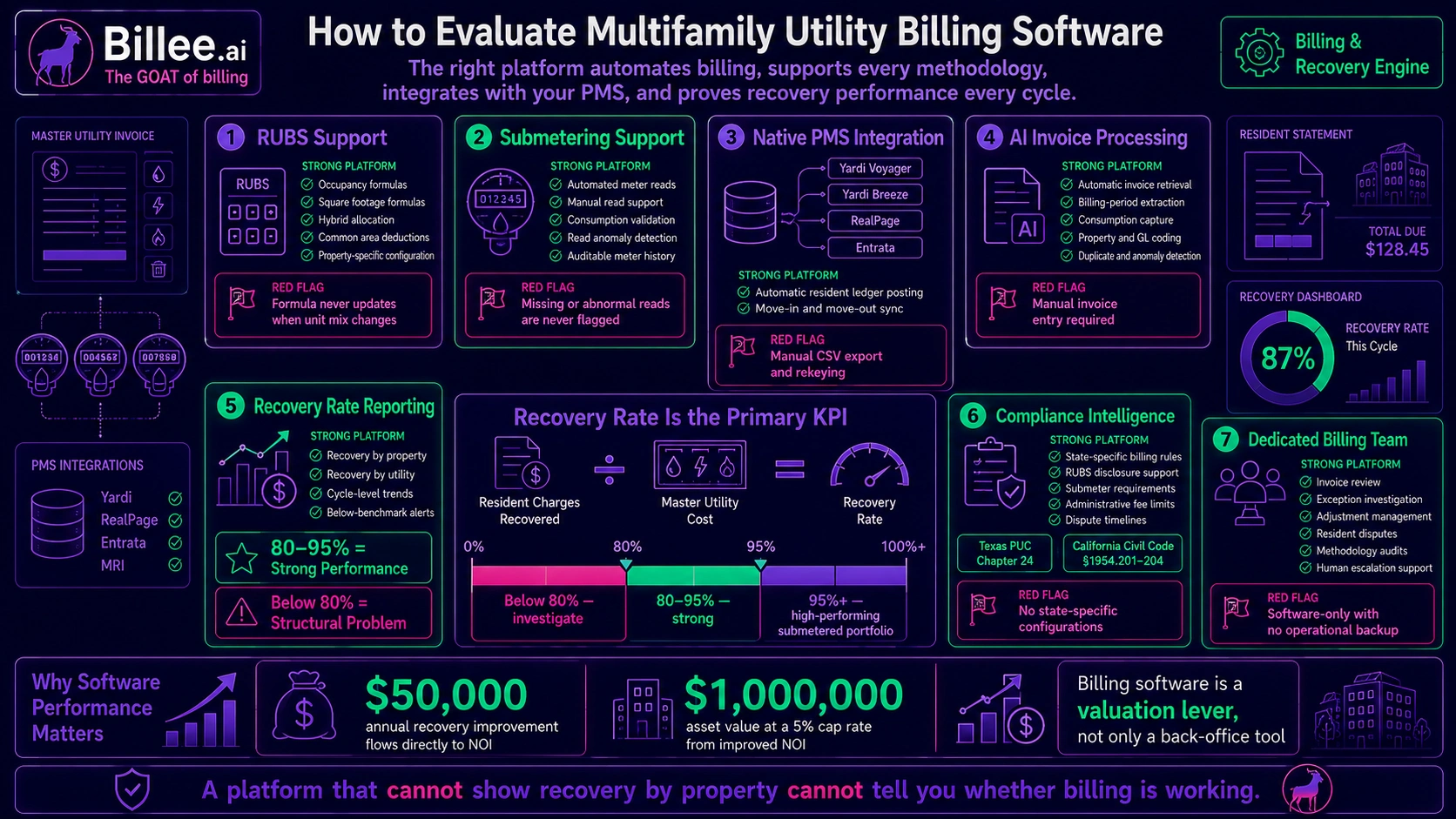
TL;DR: The best utility billing software for multifamily property operators automates resident billing, integrates with your property management system, supports both RUBS and submetered methodologies, and tracks recovery rate by property every cycle. Recovery rates of 80–95% represent strong performance; anything below 80% signals a billing infrastructure problem. Software-only platforms put the operational burden on your team. Full-service platforms pair automation with a dedicated billing team that handles exceptions, audits, and edge cases, and consistently deliver higher recovery outcomes.
Key Takeaways
- Recovery rate, calculated as total charges billed to residents divided by total master meter cost, is the single most important metric for evaluating any utility billing platform. Industry benchmark: 80–95% is strong; below 80% indicates a structural problem.
- Utility billing software must support both RUBS (formula-based allocation) and submetered billing, or you will outgrow it as your portfolio evolves.
- PMS integration with Yardi, RealPage, or Entrata is non-negotiable. Billing data that requires manual rekeying between systems creates errors and delays that show up in your recovery rate.
- AI-powered invoice processing has become a baseline feature in 2026. Leading platforms automatically scan utility invoices, extract data, and post charges to the correct property ledger without manual entry.
- Compliance support is not optional for multi-state portfolios. State PUC regulations, including Texas PUC Chapter 24 and California Civil Code §1954.201–204, govern billing methodology, disclosure requirements, and administrative fee limits.
- At a 5% cap rate, every $50,000 in annualized utility cost recovery improvement translates to $1,000,000 in asset value. Billing software is not a back-office expense; it is a valuation lever.
At-a-Glance: What to Evaluate in Utility Billing Software
| Feature | Why It Matters | Red Flag |
|---|---|---|
| RUBS support | Required for non-submetered properties | Formula not updated for unit-mix changes |
| Submetering support | Required for metered portfolios | Read errors never flagged |
| PMS integration | Eliminates manual rekeying | Manual CSV exports only |
| AI invoice processing | Eliminates data entry errors | Manual invoice entry required |
| Recovery rate reporting | Tells you if billing is working | Platform does not track this metric |
| Compliance database | Required for multi-state operators | No state-specific rule sets |
| Dedicated billing team | Handles exceptions your software cannot | Software-only with no human backup |
What Utility Billing Software Actually Does
Utility billing software for multifamily properties handles the operational process of allocating master meter utility costs across individual resident accounts and generating accurate monthly charges. Most multifamily properties do not have individual meters for each utility; they receive one consolidated bill from the utility provider, then must split that cost across dozens or hundreds of residents using a legally compliant methodology.
Invoice Processing and Master Bill Management
Every billing cycle begins with the utility provider's invoice, often a paper or PDF statement covering the property's entire consumption for water, electric, gas, or trash. The first job of utility billing software is to receive, process, and post that invoice accurately. In 2026, AI-powered invoice ingestion is the standard on modern platforms. The software scans the invoice, extracts total consumption and dollar amounts, identifies the billing period, and codes the charge to the correct property ledger automatically.
Manual invoice entry is where billing errors originate: a transposed digit in the total charge, a wrong billing period, a charge coded to the wrong property. Those errors propagate through every downstream resident bill. Eliminating manual entry at the invoice stage removes the most common source of billing disputes before they start.
Resident Billing and Statement Generation
Once the master bill is ingested, the platform allocates costs across resident accounts using the property's configured methodology: RUBS formula, submeter readings, or a hybrid of both. The output is an itemized resident statement showing the total master bill, the allocation method and formula, the resident's calculated share, and any additional charges such as common area allocations or service fees where permitted.
Resident statements must be clear enough that residents can verify their own charges. A statement that shows only a total dollar amount without the underlying calculation is a dispute waiting to happen. Strong platforms produce statements that show the master bill total, the property's formula or meter reading, and the math used to arrive at each resident's charge, in plain language.
Recovery Tracking and Delinquency Management
Recovery rate is the metric that tells you whether your billing platform is actually working. It is calculated as the total dollar amount billed and collected from residents in a given cycle, divided by the total master meter cost for that same cycle. A platform that does not surface this metric by property, by utility type, and by cycle is not giving you what you need to manage billing performance.
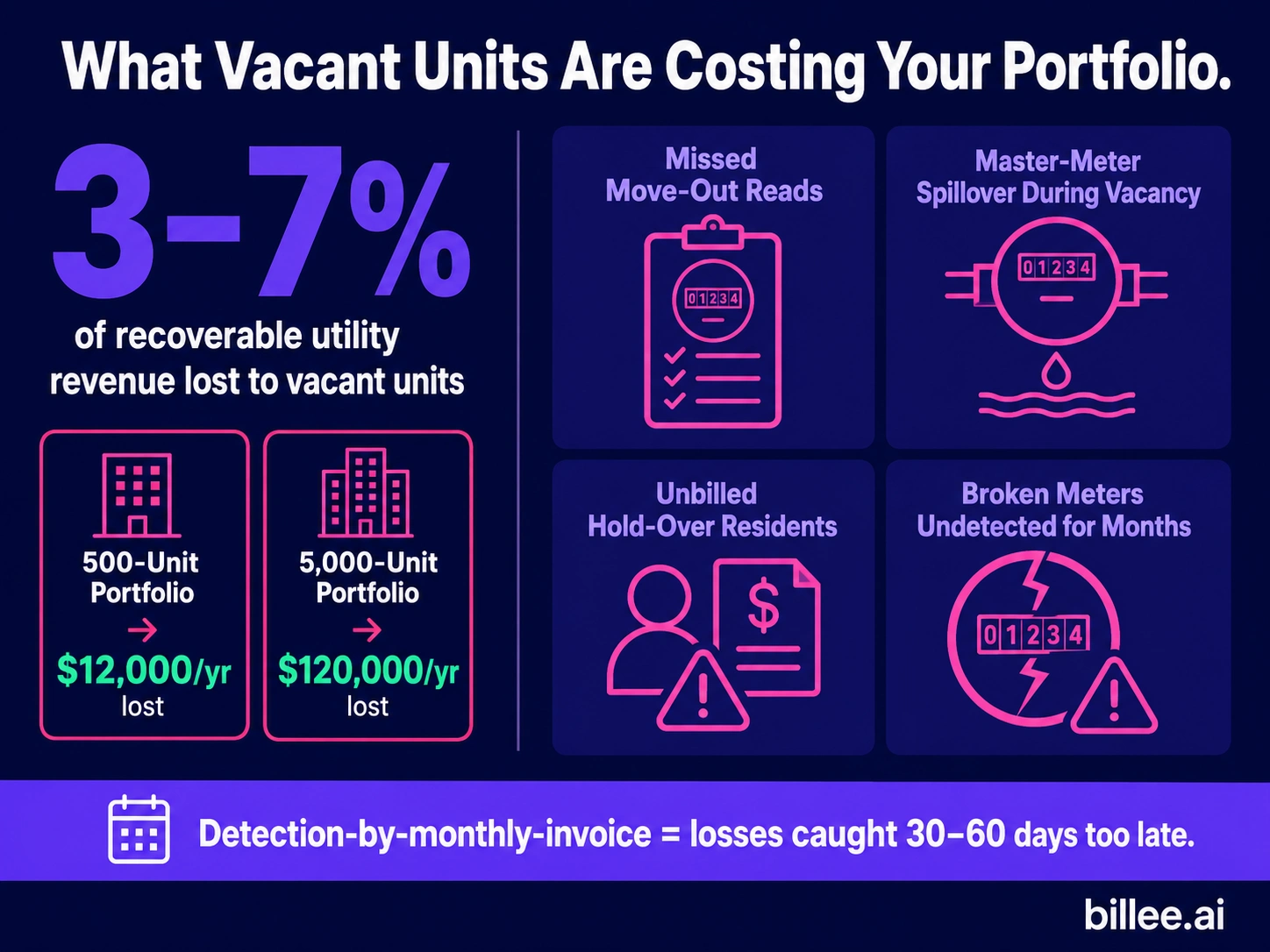
Recovery rate below 80% is a structural signal. The most common causes: vacant units not being billed (a direct dollar leak), RUBS formulas not updated when units were added or renovated, meter read errors that go undetected, and common area deductions improperly applied that reduce the billable base. Good utility billing software flags each of these as exceptions automatically rather than letting them quietly erode the recovery rate cycle after cycle.
ESG and Benchmarking Reporting
Modern utility billing platforms also serve as the consumption data foundation for ESG and sustainability reporting. Properties filing with ENERGY STAR Portfolio Manager, preparing GRESB submissions, or meeting Fannie Mae Green Rewards requirements need reliable, portfolio-wide consumption data aggregated from vendor invoices. A platform that handles billing but cannot produce consumption reports forces operators to maintain a separate data system for ESG, an unnecessary split that introduces reconciliation risk.
The Five Features That Separate Good Platforms from Great Ones
RUBS and Submetering Flexibility
RUBS (Ratio Utility Billing System) allocates utility costs using a formula, typically based on unit square footage, occupancy count, or a combination of both, without individual meters. It is the standard billing method for older multifamily properties that do not have submeter infrastructure and can be implemented in weeks at minimal capital cost.
Submetering measures actual consumption per unit with individual meters, producing the most defensible and accurate bills. Properties with submeter infrastructure consistently achieve higher recovery rates because charges are based on measured usage, not formula estimates.
Most portfolios include a mix: some properties have water submeters but not electric submeters; some use RUBS for water and submeter electric. A platform that forces a single methodology across the portfolio is a constraint. Strong platforms configure the billing method property-by-property, utility-by-utility, and produce the right statement type for each configuration.
RUBS vs. Submetering: How Your Software Must Handle Both
| Factor | RUBS | Submetering |
|---|---|---|
| Meter infrastructure required | No | Yes |
| Time to configure and launch | 2–4 weeks | 8–16 weeks (includes installation) |
| Typical recovery rate | 70–85% | 85–95%+ |
| Bill basis | Formula allocation | Measured consumption |
| Dispute defensibility | Moderate | High (auditable meter reads) |
| Resident consumption incentive | Low | High (usage drives the bill) |
| Best fit | Properties without meter infrastructure | Properties with existing or new submeters |
PMS Integration (Yardi, RealPage, Entrata)
Billing data must flow directly into your property management system. Charges that push automatically to resident ledgers in Yardi, RealPage, or Entrata eliminate manual posting, ensure charges appear on the correct billing cycle, and remove one of the most common sources of billing delay. A platform that requires a manual CSV export or data entry into the PMS is not integrated; it is just partially automated.
True PMS integration means the billing charge posts to the resident ledger on the scheduled date, the payment reconciles against the ledger when collected, and the AP invoice posts to the GL automatically. It also means move-in and move-out dates sync from the PMS to the billing system so new residents are billed from day one and final bills are prorated accurately.
Automated Bill Retrieval and Invoice Coding
The most time-consuming manual task in utility billing is retrieving invoices from utility provider portals, verifying totals against the prior cycle, and coding charges to the correct property and GL account. In 2026, this entire workflow is automatable. Leading platforms maintain connections to utility provider portals, retrieve invoices automatically when they are posted, and use AI-assisted coding to match charges to the correct property, billing period, and GL code, flagging exceptions for human review rather than requiring full manual processing.
Compliance and Regulatory Database
State PUC regulations govern billing methodology, disclosure requirements, administrative fee limits, and submeter operator licensing. Texas PUC Chapter 24 sets detailed rules for submetered and RUBS billing in Texas, including specific disclosure requirements, fee caps, and dispute resolution timelines. California Civil Code §1954.201–204 governs submetering specifically, including requirements for meter accuracy, billing format, and resident dispute rights. Florida, Illinois, New York, and other states have their own frameworks.
A billing platform serving multi-state portfolios must maintain a current compliance database that flags when a property's billing methodology may conflict with local regulations. Operators who discover a compliance gap after a PUC inquiry or resident complaint face potential fines and forced billing adjustments that recover nothing on already-closed cycles.
Recovery Rate Reporting by Property
Recovery rate is the single most important output of any utility billing platform, and it should be reported at the property level, by utility type, and by cycle. Portfolio-level averages can mask significant variation: one property running at 92% can obscure another running at 65%, and the 65% property is leaking meaningful NOI every month.
Strong platforms surface this metric prominently: current cycle recovery rate by property, trend over the prior 6–12 months, and flags for any property that falls below the performance threshold. Billee's Billing and Recovery Engine uses 80% as the investigation floor, per Billee's portfolio benchmark. Below that threshold, the dashboard flags the property for review.
RUBS vs. Submetering: What Your Software Must Support
How RUBS Billing Calculation Works
A RUBS billing cycle begins when the master meter invoice arrives. The billing platform takes the total billable amount, master meter charge minus any required common area deductions, and allocates it across occupied units using the configured formula. Occupancy-based RUBS divides costs by the number of people in each unit relative to the total property occupancy count. Square-footage-based RUBS divides costs by each unit's size relative to total leasable area. Hybrid formulas weight both factors.
Each resident's bill shows their allocated share of the master cost for that cycle. Because RUBS is formula-based rather than metered, the individual charges fluctuate with total property consumption. That requires clear resident communication at move-in to avoid disputes.
How Submetered Billing Works
Submetered billing begins with meter reads, either automated (smart meters transmit readings directly to the billing platform) or manual (reads entered by field staff or a third-party meter reading service). The platform calculates consumption per unit for the billing period, applies the applicable rate (either a pass-through of the utility rate or a rate structure specific to the submetering agreement), and generates individual resident bills based on actual usage.
Submetered bills are more defensible in disputes because consumption is measured, not estimated. A resident who challenges a submetered charge can be shown the opening and closing meter reads for the period. A resident who challenges a RUBS charge can only be shown the formula, which is harder to verify independently and more vulnerable to challenge on fairness grounds.
Mixed Portfolios: Why You Need Both
A platform that handles only RUBS or only submetering constrains your portfolio strategy. Operators who acquire properties without submeter infrastructure need RUBS billing for those assets while maintaining submetered billing at properties that already have meters. As properties are renovated or repositioned, adding submeter infrastructure is a common capital improvement that requires the billing platform to support both methodologies simultaneously during the transition.
The Financial Case for Getting Billing Software Right
Recovery Rate Math on a 200-Unit Property
A 200-unit property spending $40,000 per month on master meter utilities across water, electric, and gas has $480,000 in annual utility costs. At an 80% recovery rate, residents pay $384,000 annually and the property absorbs $96,000 as unrecovered expense. At a 90% recovery rate, residents pay $432,000 and the property absorbs $48,000. The difference between 80% and 90% recovery is $48,000 per year on a single 200-unit property.
NOI Impact at a 5% Cap Rate
$48,000 in annual NOI improvement, capitalized at a 5% cap rate, adds $960,000 in property value. For a portfolio of 10 properties each running below benchmark, the aggregate NOI and valuation improvement from restoring recovery rates to 90% is material at the asset level. Utility billing is not a vendor selection; it is an investment decision.
How Billing Errors Destroy Recovery Rates
The most common recovery rate killers are not dramatic; they are incremental. A vacant unit not billed for three months. A RUBS formula never updated when 12 units were added in a renovation. An invoice processed for the wrong billing period that generated a double-bill the following cycle, then was credited. A property where the common area deduction was set too high and has been reducing the billable base by 15% for two years. No single error collapses recovery rate, but the accumulation of undetected small errors across a portfolio creates the gap between what operators expect and what they collect.
What a Full-Service Platform Adds Over Software-Only
Dedicated Billing Team vs. DIY Software
Software-only utility billing platforms give operators a set of tools and leave the operational work to property management staff. Processing invoices, running the billing cycle, reviewing exceptions, handling adjustments, and managing disputes all fall to whoever on the team has time. For portfolios with one or two properties, that may be manageable. For operators running 20 or 50 properties, it is a persistent operational drain that grows with the portfolio.
Full-service platforms pair the software with a dedicated billing team that owns the operational work. Invoices are processed, cycles are run, exceptions are flagged and resolved, and disputes are handled by the provider's team, not the property management staff. The operator reviews a preliminary report, approves it, and the team handles the rest.
Software-Only vs. Full-Service: How the Two Models Compare
| Capability | Software-Only | Full-Service |
|---|---|---|
| Invoice ingestion | Manual or semi-automated | Fully managed by provider team |
| Exception identification | Operator reviews reports | Platform flags; team investigates |
| Exception resolution | Property staff handles | Dedicated billing specialists handle |
| Dispute management | Property staff handles | Provider manages on your behalf |
| Recovery rate monitoring | Operator pulls reports | Provider flags and investigates drops |
| PMS integration setup | Operator-configured | Provider-configured and maintained |
| Implementation | Operator-driven; timeline varies | Provider-driven; Billee standard is 45 days |
| Ongoing operator time | High | Low (review and approve) |
Audit and Variance Investigation
Billing audits, comparing the sum of resident bills to the master meter charge and investigating any unexplained variance, are the core quality control mechanism in utility billing. A good platform makes this comparison automatically every cycle and flags variances that exceed a threshold for investigation. A full-service platform then has a team that actually investigates: checking meter reads, formula configurations, common area deductions, and invoice totals to find the source of the variance.
Move-Out Prorations and Final Bill Accuracy
Move-out billing is where many platforms break down. The final bill must cover the period from the last full billing cycle through the resident's actual move-out date, a proration that requires knowing the exact move-out date, the daily charge rate, and any deposits or credits to apply. Errors in move-out billing are among the most common sources of resident billing disputes and security deposit disputes. A platform with direct PMS integration pulls the exact move-out date and generates an accurate final bill automatically.
How Billee's Billing and Recovery Engine Works
Billee is a full-service utility management platform, pairing a dedicated account team with modern software built specifically for multifamily owners and operators. The Billing and Recovery Engine handles automated utility billing across the portfolio, with charges allocated using the correct methodology for each property: RUBS, submetering, or a hybrid, depending on infrastructure.
Billee integrates with Yardi (Voyager and Breeze), RealPage, and Entrata for both AP invoice posting and resident ledger billing. Billing charges post automatically to resident ledgers, and AP invoices route to the correct GL without manual entry. The platform surfaces recovery rate by property as the primary performance metric every cycle, with 80% as the investigation floor per Billee's portfolio benchmark.
Billee's standard implementation timeline is 45 days, including vendor transitions, PMS integration, and historical data migration. Billee's Regulatory and Compliance product provides billing methodology audits and access to legal support, with monitoring for regulatory changes that affect Texas, California, Florida, Illinois, and other states with specific submetering and RUBS frameworks.
If your current recovery rate is below benchmark, or if you do not know what your recovery rate is, the Billee team can audit your billing infrastructure and identify the gap.
Frequently Asked Questions
What is utility billing software for multifamily properties? Utility billing software automates the process of allocating master meter utility costs to individual resident accounts and generating monthly charges. It ingests utility invoices, applies the property's billing methodology (RUBS, submetering, or hybrid), generates resident statements, and pushes charges to the property management system. Modern platforms also track recovery rate, surface billing exceptions, and produce ESG consumption reports.
What recovery rate should I expect from utility billing software? Strong performance in 2026 benchmarks at 80–95% recovery, meaning 80–95% of total master meter costs are billed and collected from residents, per Billee's portfolio benchmark. Below 80% indicates a structural problem: vacant units not billed, formula errors, or invoice processing issues that are quietly reducing the billable base every cycle.
Does utility billing software integrate with Yardi or RealPage? The leading full-service platforms integrate with Yardi (Voyager and Breeze), RealPage, and Entrata for both AP invoice posting and resident ledger billing. True integration means charges post automatically to resident ledgers on the scheduled date without manual data export or entry. Confirm the specific integration scope before selecting a platform.
What is the difference between RUBS and submetering software? RUBS software allocates master meter costs across resident accounts using a formula (square footage, occupancy, or hybrid). Submetering software reads individual meter data and generates bills based on measured consumption. The best platforms support both methodologies and mixed configurations, because most portfolios include properties with different infrastructure.
How does AI improve utility billing accuracy? AI-powered invoice processing scans utility provider invoices, extracts billing totals, identifies the billing period, and codes charges to the correct property and GL account automatically. This eliminates the manual entry step where most billing errors originate. Some platforms also use AI to flag anomalies, such as a master bill that is 40% higher than the prior cycle, that warrant investigation before charges are pushed to resident accounts.
What does utility billing software cost? Pricing varies by platform and portfolio size. Software-only platforms typically run in the range of $1–$5 per unit per month, depending on features and scale. Full-service platforms that include a dedicated billing team are priced higher, reflecting the managed service layer, but the recovery rate improvement and staff time savings typically make the ROI straightforward for mid-market to enterprise portfolios. Request quotes from providers for accurate current pricing.
How do I know if my utility billing platform is underperforming? The clearest signal is recovery rate below 80%. Other signals: billing cycles that close late, high volumes of resident billing disputes, manual invoice entry by staff, and ESG reports that do not match utility invoices. If your team spends significant time each month managing the billing cycle rather than reviewing a preliminary report and approving it, the platform is generating work rather than eliminating it.
What is a full-service utility billing provider vs. software-only? A software-only utility billing platform provides tools; your team does the work. A full-service provider pairs those tools with a dedicated team that processes invoices, runs billing cycles, investigates exceptions, handles adjustments, and manages disputes, with your team in a review-and-approve role. Full-service providers consistently achieve higher recovery rates because exception management is handled by specialists, not by property management staff splitting their attention across multiple responsibilities.
Talk to Billee about auditing your current recovery rate and identifying what's leaking.
Sources
- United States Environmental Protection Agency, "WaterSense: Learn About Submetering," accessed 2026.
- Texas Public Utility Commission, "Substantive Rules Applicable to Water and Sewer Service Providers, Chapter 24," accessed 2026.
- California Legislative Information, "Civil Code §1954.201: Submetering of Electrical and Natural Gas Utilities," accessed 2026.
- United States Environmental Protection Agency, "ENERGY STAR Portfolio Manager," accessed 2026.
- Fannie Mae, "Green Rewards," accessed 2026.
- National Multifamily Housing Council, "NMHC Research and Insight," accessed 2026.
Insights and Industry Trends


Explore more insights